Last Edited: 10 days ago
Manuel Batista1
Posted on: 22/10/2026
sorted by publishing date
Last Edited: 2 days ago
Supported by the European Union (EU), EIT Food is the world's largest food innovation community. Its mission is threefold: healthier lives through food, a net zero food system and a fair and resilient food system. Its Consumer Observatory is Europe's central hub for current and future consumer insights on agrifood topics. The general and consumer-specific trends, wild cards and weak signals identified by the Observatory provide the basis for this scenario work.
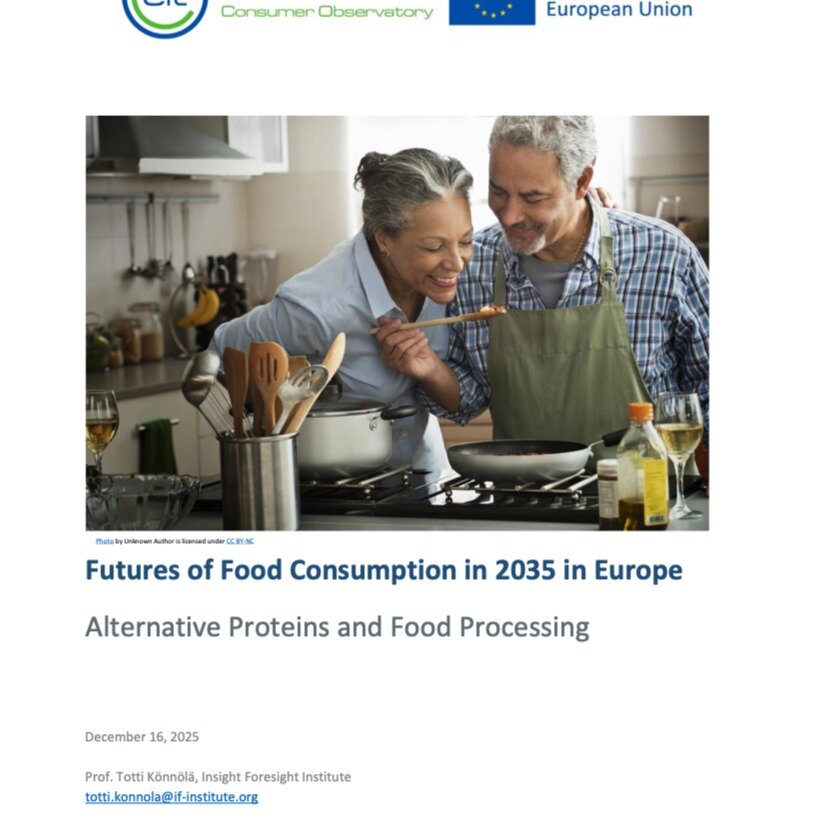
The work continues the 2024 exercise on futures of food consumption and the agrifood ecosystem in 2035 in Europe, this time with emphasis on technological advances, specifically on consumer acceptance of processed and functional food and of alternative proteins. In 2025, Insight Foresight Institute engaged the EIT Food community and a broader set of food and foresight experts in three online workshops. The participants made sense of how societal and consumer trends could interrelate, explored alternative scenarios of food consumption by 2035 and reflected on their implications for today's agrifood ecosystem and policy.
Scenarios are not predictions of the likely future, but they depict possible futures, even less likely ones. The narratives are written in the present tense, as if we were already in 2035. Two dimensions structured the work and ensured that each scenario was truly different:
• Acceptance of alternative proteins, covering both traditional alternative proteins for European markets (e.g. tofu, seitan, tempeh and molluscs) and novel ones (e.g. mycoprotein, cultivated meat, precision fermentation and insects).
• Acceptance of processed and functional food, which may be unhealthy or healthy, even highly functional with health benefits and tailored to individual needs.
Crossing the two dimensions gives four scenarios:
• Scenario 1: NATURAL AND LOCAL – Low in processing, low in alternatives
• Scenario 2: WHOLE-FOOD MOSAIC – Low in processing, high in alternatives
• Scenario 3: HIGH-TECH SAVOUR – High in processing, high in alternatives
• Scenario 4: CONVENIENT AND AFFORDABLE – High in processing, low in alternatives
Posted on: 20/10/2026
Last Edited: 12 days ago
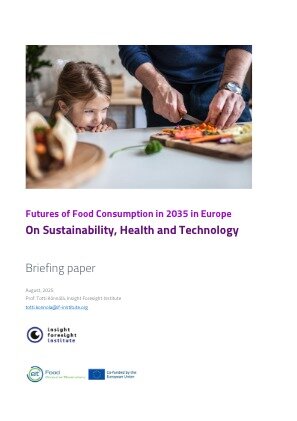
This briefing paper presents four scenarios on the futures of food consumption and the agrifood ecosystem in Europe in 2035, prepared by Insight Foresight Institute for the EIT Food Consumer Observatory. The scenario work started from general and consumer-specific trends identified by the Observatory and was developed in a series of online expert workshops during the summer and autumn of 2024. Two dimensions structured the scenarios: emerging technological opportunities for new products and retail experiences, and (un)sustainable and (un)healthy consumer choices.
Each narrative is written in the present tense and portrays a day in 2035. Green and me describes a high-tech food ecosystem centred on personalised nutrition and sustainable choices, which pays little attention to inequality. Frugal and local describes a localised food sector driven by community values. Cost and control describes a decayed food ecosystem focused on industrial efficiency, and Highs and lows an unequal high-tech food ecosystem. Images generated with AI serve as artistic impressions of each scenario.
The paper closes with implications for today's decision-makers, among them guiding consumers towards One Health choices, mainstreaming precision nutrition, prioritising animal welfare, embracing soilless agriculture, empowering farmers and prosumer communities, managing high-tech risks and balancing global and local dynamics.
https://if-institute.org/futures-of-food-consumption-in-2035-in-europe-on-sustainability-health-and-technology
Posted on: 20/10/2026
Last Edited: 3 months ago
New and emerging plant pests can undermine EU food security and farm/forestry incomes through yield losses, trade disruption and costly control measures, while also causing major environmental impacts through biodiversity loss, landscape change and increased pressure to use pesticides.
Using a comprehensive foresight methodology, this study examines how global trade and tourism, climate change and agricultural systems contribute to the introduction and spread of new and emerging plant pests, assesses current and future pest risks, as well as scientific and technological options for their prevention, detection, and management, and reviews existing EU mechanisms.
The study develops four scenarios up to 2050 to explore how key uncertainties may shape pest risks and system responses. Based on these insights, it identifies policy options to strengthen prevention, preparedness, and response capacities, supporting future EU policymaking.
This foresight study was conducted by Technopolis Group with experts from the Julius Kühn-Institute for the European Parliament's Panel for the Future of Science and Technology and commissioned by Scientific Foresight Unit (STOA) of the European Parliamentary Research Service.
The report is published on the website of the European Parliament: https://www.europarl.europa.eu/thinktank/en/document/EPRS_STU(2026)788146.
Posted on: 31/07/2026
Last Edited: a year ago
EIT Food Consumer Observatory is organising online workshops focusing on the consumer acceptance of functional and processed food and alternative proteins by 2035. The online workshops are organised on September 11 and 18, from 10 to 13 hours CET. This is an open invitation to participate. It is free, just write us to consider your participation and learn more about the process: info@if-institute.org
What to expect in the workshops:
Before the workshops: Read this brief background document to familiarise yourself with the approach and prepare for the workshops.
During the workshops: Discuss and participate by writing your comments via MS Teams chat and the Miro board sticky notes. Note that the workshops will be recorded to enable automated transcription in Teams.
After the workshops: The expert team will develop scenario narratives, which are presented and discussed further in another workshop on November 4th 10-13 CET, which allows the reflection of scenario implications for the current agrifood ecosystem. Finally, a policy brief will be published end of the year.
Last year, we did a similar process focusing on the future of new food products and experiences and One Health. More information here:
https://if-institute.org/futures-of-food-consumption-in-2035-in-europe-on-sustainability-health-and-technology
Posted on: 02/09/2025
Last Edited: 2 days ago
Supported by the European Union (EU), EIT Food is the world’s largest food innovation community – its mission is three-fold aiming at healthier lives through food, a net zero food system and reducing risk for a fair and resilient food system. Its Consumer Observatory is Europe’s central hub for current and future consumer insights on agrifood topics. The observatory has identified general and consumer-specific trends and other driving forces, which were used as a starting point for this scenario work. During the summer and autumn 2024, Insight Foresight Institute organised online workshops to develop four alternative future scenarios and their implications to stakeholders.
Scenarios are not predictions of the likely future, but they depict possible futures. Exploring alternative scenarios helps to expand one’s own span of observation further towards the future, and to possible threats and opportunities that otherwise might not be in the immediate attention span, or just being excluded for being unlikely. While the scenarios often consist of a possible future state and the pathway from the present to that future, in this case, our narratives of the future (written in the present tense, as if we were already in the future) describe each a different day in 2035.
The work focuses on the futures of food consumption and the agrifood ecosystem in 2035 in Europe, specifically with regards to emerging technological opportunities for new products and retail experiences as well as to (un)sustainable and (un)healthy consumer choices. These dimensions provided a structure that ensured that each of the four scenarios was truly different:
• Scenario A: GREEN AND ME - A Day in European High-Tech Food Ecosystem in 2035
• Scenario B: FRUGAL AND LOCAL - A Day in European Localized Food Sector Driven by Community Values in 2035
• Scenario C: COST AND CONTROL - A Day in European Decayed Food Ecosystem Focused on Industrial Efficiency in 2035
• Scenario D: HIGHS AND LOWS - A Day in European Unequal High-Tech Food Ecosystem in 2035.
We conclude the paper by reflecting on the scenarios and their implications to decision-makers today.
Posted on: 08/07/2025
Last Edited: a year ago
Posted on: 28/05/2025
Last Edited: a year ago
How will the city of tomorrow grow? How is food production changing in the future? In their new brochure “100+ Trends Cultivating Urban Agriculture”, Dr. Anna Kirstgen and Dr. Björn Moller from Fraunhofer ISI Foresight Department provide answers within the framework of the FOODCITYBOOST project – and show just how diverse and dynamic urban agriculture is becoming.
📌 Included in the brochure:
• A trend radar featuring over 100 key developments, offering a structured overview and strategic orientation on emerging trends and future perspectives
• 15 deep dives exploring key topics such as social innovations, new technologies, regulations, new business models, and ecological challenges like food waste
A compact overview for anyone involved in urban development, agricultural innovation, or sustainable food systems.
Posted on: 03/05/2025
Last Edited: a year ago
FOODCITYBOOST is a trailblazing project that will help develop the foundations for turning urban jungles into lush, green, food-producing hubs! We imagine cities where rooftops, balconies, and even vertical spaces are bursting with greenery and fresh produce. This is the future that FOODCITYBOOST is planting seeds for, whilst tackling the major contemporary difficulties such as: climate change, biodiversity loss, and the great divide between urban, peri-urban, and rural areas.
Posted on: 03/05/2025
Last Edited: a year ago
Delivering solutions for a more sustainable future
ISINNOVA provides research services and strategic consultancy to public and private actors pursuing sustainable visions, solutions, and policies.
Five Pillars of Our Approach
1. Anticipate – Apply systems thinking and foresight methodologies to identify emerging challenges, reveal interdependencies, and inform proactive, future-resilient strategies.
2. Integrate – Connect disciplines, sectors, and knowledge systems to foster richer analysis and tackle complex challenges holistically.
3. Align – Ensure research, innovation, and governance processes reflect the values, priorities, and needs of society through ethical, participatory, and responsible approaches.
4. Co-create – Engage diverse stakeholders — researchers, policymakers, citizens, and industry — in collaborative processes to design solutions that are inclusive, relevant, and impactful.
5. Transform – Drive systemic change by translating shared knowledge and co-created solutions into sustainable, scalable actions, supported by continuous assessment to ensure applicability, effectiveness, and long-term value.
Track Record
Posted on: 03/04/2025
Last Edited: a year ago
The stages of the implemented process were as follows:
1. Shared understanding of the current situation in the mountain areas
The discussions within the working groups started from a set of summarized information from the extensive analyses previously conducted, structured by strengths and weaknesses, along with additional synthetic data on the tourism, agriculture, forestry, and wood industry sectors.
2. Selection of the drivers of change
The working groups explored and enriched a list of factors/trends that influence the contextual change toward the 2035 horizon, across various dimensions: social, technological, economic, ecological, geopolitical, and values-based factors.
3. Scenario projection for 2035
Based on thematically grouped change drivers, the working groups envisioned and described the state of mountain areas in 2035 under the influence of these drivers, in the absence of strategic corrective interventions.
4. Identification of aspirations – key values, opportunities, best practices
The groups proposed and debated a series of values and aspirations for the future of mountain areas by 2035, including inspiration from best practices in other countries.
5. Consolidation of aspirations into clear directions for transforming mountain areas
This stage involved grouping aspirations by thematic areas, more clearly articulating the transformation vector, and partially exploring concrete actions that would enable these transformations. The sum of these transformation directions forms the **Vision for mountain areas by 2035**.
6. Roadmapping - includes the set of actions that support progress toward the desirable transformation of the mountain areas, across multiple levels.
7. Priority directions
Participants in the workshops identified the actions perceived as the most impactful and/or urgent in transforming mountain areas.
Posted on: 01/04/2025
Last Edited: a year ago
We help people and organisations imagine, work with, and shape their future.
CIFS is one of the worlds oldest think tanks exclusively focusing on foresight. CIFS teach very popular courses in foresight, gives key notes and launch various initiatives and do research projects. CIFS is a self-owned think tank, completely independent of special interests.
Posted on: 31/03/2025
Last Edited: a year ago
Supports the economic growth in South-East Europe by promoting innovative solutions and facilitating the transfer of technologies and know-how.
The first organization in the South- East region to implement foresight methods to shape public policy.
Posted on: 19/03/2025
Last Edited: a year ago
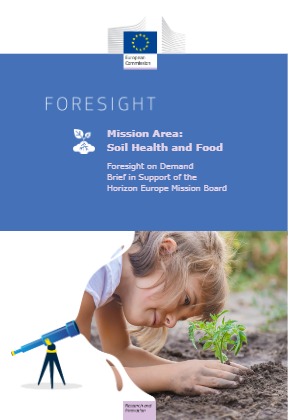
The EU introduced missions as a new instrument in Horizon Europe. Mission Boards were appointed to elaborate visions for the future in five Areas: Adaptation to Climate Change, Including Societal Transformation; Cancer; Healthy Oceans, Seas, and Coastal and Inland Waters; Climate-Neutral and Smart Cities; Soil Health and Food. Starting in autumn 2019, five Foresight on Demand projects supported them with foresight expertise and methodology.
This report provides the work in support of the Mission Board on Soil Health and Food. Adopting a long-term perspective, the project first contributed to better understand the drivers, trends and weak signals with the most significant potential to influence the future of soil health and food. With the Mission Board, three scenarios for 2040 were sketched. In the final step, system-thinking knowledge was applied to identify concepts, solutions, and practices able to promote systematic change in the sector.
Posted on: 28/01/2025
Last Edited: a year ago
The EU introduced missions as a new instrument in Horizon Europe. Mission Boards were appointed to elaborate visions for the future in five Areas: Adaptation to Climate Change, Including Societal Transformation; Cancer; Healthy Oceans, Seas, and Coastal and Inland Waters; Climate-Neutral and Smart Cities; Soil Health and Food. Starting in autumn 2019, five Foresight on Demand projects supported them with foresight expertise and methodology. This report provides the work in support of the Mission Board on Soil Health and Food. Adopting a long-term perspective, the project first contributed to better understand the drivers, trends and weak signals with the most significant potential to influence the future of soil health and food. With the Mission Board, three scenarios for 2040 were sketched. In the final step, system-thinking knowledge was applied to identify concepts, solutions, and practices able to promote systematic change in the sector.
Posted on: 28/01/2025
Last Edited: a year ago
4CF The Futures Literacy Company is a consultancy entirely focused on strategic foresight and long-term strategies. For nearly two decades, 4CF has been on the mission to help its clients prepare for an uncertain tomorrow. The Company has executed hundreds of projects for private companies, public institutions and international entities, including the European Commission and its agencies (EUDA, ENISA), FAO, UNFCCC, UNESCO, UNEP and UNDP. 4CF is at the forefront of global innovation, and actively contributes to the development of cutting-edge foresight tools, including 4CF HalnyX (Delphi platform), 4CF Sprawlr, 4CF FLEx.
Posted on: 17/12/2024
Last Edited: a year ago
The vision of FOSTER is to build a foundation from which a new Knowledge and Innovation System (KIS) for Europe’s food system can emerge. The current structure is insufficient to address the emerging challenges of nourishing people in a healthy and sustainable way. Key objective is to gain insights into how it can be built to be more inclusive and better governed.
FOSTER shall help to transform Europe’s food system outcomes and will achieve this by:
To inspire adoption of FOSTER learnings, over 20 workshops and a final conference will be conducted; scientific position papers and policy briefs will be widely communicated.
Posted on: 09/12/2024
Last Edited: a year ago
Arctik is a Brussels-based communications agency recognised for its strategic and creative communication capacity in the field of sustainability. Arctik develops tailored public relations and communication strategies that take both objectives and resulting impact into account. We facilitate the creation of communities and networks that contribute towards circulating content, whilst cultivating meaningful dialogues and synergies between influencers and decision-makers.
Arctik has substantial experience in designing and implementing communication campaigns and projects which mix creative communication and sustainability. We believe in communication campaigns which provide a setting where opportunities are created, and knowledge is shared between actors. It is an occasion to convey a message and collect insights and intelligence.
Our team has a strong commitment to sustainability. We incorporate sustainable values into operations Arctik has substantial experience in designing and implementing communication campaigns and projects which mix creative communication and sustainability. We believe in communication campaigns which provide a setting where opportunities are created, and knowledge is shared between actors. It is an occasion to convey a message and collect insights and intelligence. and consider environmental and social factors in every business decision, while encouraging our partners and clients to think circular! Arctik is also registered to obtain the Brussels ‘Enterprise ecodynamique’ label.
Arctik, as part of Technopolis Group is present in more than 10 countries with 300 consultants originating from +45 countries and speaking +30 languages. This diversity offers a unique perspective on what local-level stakeholders are receptive to.
Our offices are located in : • Austria • Belgium • Colombia • France • Germany • Ivory Coast • Netherlands • Greece • Portugal • Sweden • Ivory Cost • Colombia • United Kingdom.
Our solutions: Strategy • Messaging and copywriting • Online and offline engagement • Thought-provoking design • Web services • Project Management • Video and animation • Data-driven communication • Events • Social media campaigns & monitoring • Knowledge management and Capitalisation • Media and visibility.
Our expertise: Regional Policy, Circular Economy, Climate Services, Education, Entrepreneurship, Science & Innovation.
Arctik is part of Technopolis |group|
Website www.arctik.eu
LinkedIn linkedin.com/company/arctik/
Bluesky bsky.app/profile/arctik.eu
Posted on: 27/11/2024
Last Edited: a year ago
Insight Foresight Institute (IF-Institute) is an independent research and consultancy firm founded in Madrid (Spain) in 2015. We orchestrate expertise in entrepreneurial innovation ecosystems to spark and drive structural changes, enhance resilience and direct society towards social, economic and environmental sustainability.
Our main sectors
Education|Energy And Environment | Health And Social Care | ICT | Manufacturing | Research And Innovation | Services | Transport And Infrastructure
Our solutions
* Activation & Alignment – scaling up ecosystem activities
* Insight & Foresight – assessing the past performance and exploring future developments
* Strategy & Governance – providing direction and structures
* Training & Mentoring – building capacities and capabilities
* Programming & Implementation – turning visions into action
Our partners
We offer a platform for experts and organisations to come up with creative and viable solutions to complex problems. We work with business, policy, academia and other stakeholders.
* We help established companies to position themselves in the wider ecosystem and work with stakeholders to empower their innovation activities.
* We help startups to define their growth plans and work with other organisations to scale up their transformative business.
* We help policymakers and their stakeholders to improve ecosystem performance and work together for transformative change. Our sectors
Posted on: 25/11/2024
Last Edited: 2 years ago
Considering prevalent trends, such as population growth, increasing demand for animal protein, land use change, and resource scarcity, a blueprint for future crops may help prioritise sustainable and efficient agriculture practices, as well as improved food systems. CropBooster-P, funded under the Horizon 2020 Programme, is a project that aimed to find a solution to this question by looking into innovative crop-breeding technologies for improving climate adaptability, resource use efficiency, yield, and quality.
Posted on: 25/11/2024
Last Edited: a year ago
Results for the working group Food are available at: http://foresight.cnr.it/working-groups/wg-food.html
Posted on: 25/11/2024
Last Edited: a year ago
SF4S is a collaborative action with partners from Higher Education institutions (HEIs), Vocational Education and Training (VET) providers, innovation networks and business entities from the Agri-food, Health and the Mobility sectors.
Carried out between July 2022 - June 2025, SF4S supports our transition to a more sustainable European economy by helping to address the lack of green, digital and future (i.e. sustainability foresight) skills among students and professionals and by connecting knowledge flows between HEI, VET and industry actors that are necessary for Europe to develop cooperative solutions on a large-scale and support the recommendations for action in the major reports and initiatives: Green Deal, NextGenerationEU, European Skills Agenda and OECD Future of Education and Skills 2030.
Posted on: 30/10/2024
Last Edited: a year ago
Institutul de Prospectiva is a research organisation (NGO) with the mission to stimulate future-awareness aimed at addressing the challenges of contemporary societies. To this end, we implement tailored foresight exercises supporting strategic orientation in the public sector, with a focus on foresight for R&I policy at European and national level.
Prospectiva is part of the Foresight-on-Demand (FOD) consortium, tasked with advising the European Commission and fourteen other EU organisations on science and technology policy programming for a period of four years (April 2024 – March 2028).
This is an extension of the previous successful cooperation within the Foresight on Demand framework contract (2019-2023); during this period Prospectiva has contributed to numerous projects, on components related to horizon scanning, large scale Delphi consultations, scenario building, co-creation workshops, speculative design, and the elaboration of various briefs, in-depth case studies and reports. These projects addressed a range of themes, among which the future of food, of retail, of ecosystems’ flourishing, and even of the human condition.
Posted on: 14/10/2024