In 28 April 2025, the UK Government Office for Science published the AI 2030 Scenarios report as part of a broader series on Frontier AI: Capabilities and Risks -- see original source :
📌 Background and scope
- GO-Science havs developed five scenarios, exploring developments in AI up to 2030. Events at a global level are described, but the focus is on implications for the UK.
- The scenarios focus on Frontier AI – the most capable and general models available in 2030. Frontier AI models have created a new, uncertain dynamic due to the pace of their improvement, their adaptability across multiple tasks, and their availability to anyone to interact with in natural language. These scenarios explore how this could play out to 2030.
- The scenarios are designed to help policy makers, industry, and civil society test actions that might mitigate risks and navigate to a more favourable future
- The scenarios are informed by the latest evidence and expert judgements. In drafting this Foresight report, and the Future Risks of Frontier AI paper, GO-Science consulted over 70 experts from industry, academia and policy making to ensure the scenarios and key findings were as robust and evidence based as possible.
- These scenarios have some important limitations. Given the pace and unpredictable nature of AI development, some aspects of the scenarios may also soon become dated. Whilst they have been designed for use in different policy contexts, they may not be suitable in the form presented here for all AI policy questions.
🔔The AI 2030 scenarios
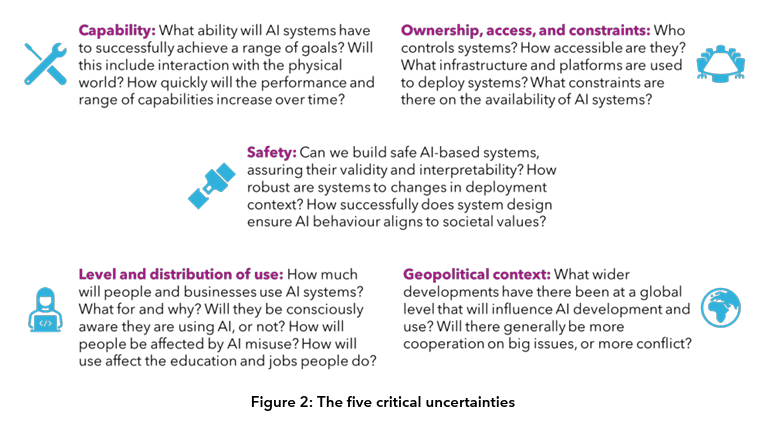
The AI 2030 scenarios are built using five critical uncertainties, factors that are both important to the future of AI development, but also highly uncertain:
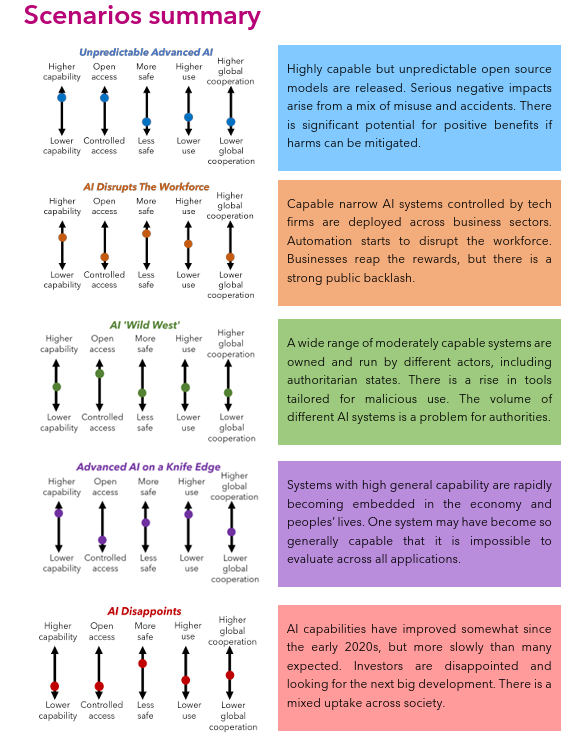
The scenarios are described by a set of narratives. These cover outcomes across the critical uncertainties, and a range of implications across the economy, society and for peoples’ daily lives. Below are brief summaries of the scenarios alongside a ‘slider’ chart to illustrate the critical uncertainty outcomes in each case.