The path to Suzanne's current work has been a winding one. Over a decade of communicating climate and sustainability, a career as a performance storyteller, and research into the smells of ancient Pompeii using urban walking methods during a degree in Classics, all fed into what eventually became her senstoryscapes methodology.
What emerged is an approach that brings climate futures to life through embodied, sensory walkshops in the cities where participants live. We spoke with her about her Walk the Futures research project, about what it means to smell and taste the future, what ordinary people discover when they step into it, and what she hopes a city like Innsbruck, where she is based, might still become.
Can you introduce yourself and tell us more about the Walk the Futures project?
The project grew out of an awareness of a growing body of research suggesting that climate communication has a distance problem. Even people who care deeply about the future can struggle to feel its urgency when the consequences seem remote geographically, temporally, socially, and experientially. Walk the Futures was designed as a tool to close that distance, to make abstract futures local and immediate and, above all, sensory and emotional.
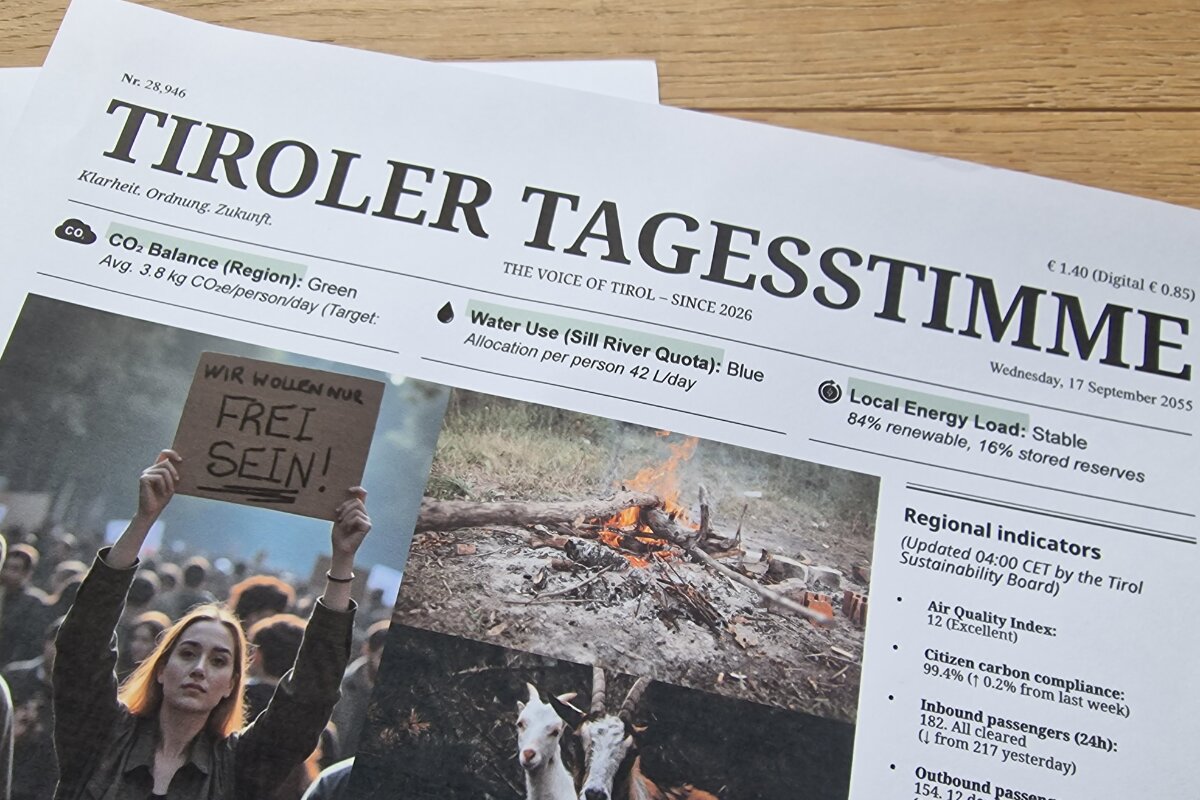
Walk the Futures draws on Jim Dator's four futures archetypes: growth, collapse, discipline, and transformation. It anchors these stories of possible futures to a physically meaningful place in a real city. Participants don't sit in a room and hear about possible futures; they walk into them and through them. Each scenario, or future story, comes to life through a layered set of sensory artifacts: media and marketing material from that imagined world, job descriptions for roles that don’t exist in the present, carefully chosen scents that give each future its own atmosphere. The stories themselves are plausible rather than predictive, drawing on signals and drivers, and deliberately mixing what's concerning with what's hopeful, because no future worth imagining is entirely one or the other.
Talk us through one of your walkshops. How do participants approach futures exploration through this immersive method?
A full walkshop runs for about six hours, which surprises people. A Walk the Futures walkshop isn’t a lecture with a walk attached. It’s a structured experience with time for processing and reflection built in. I take participants on a walk, stopping at four places or stations, and at each, they experience one of four different future scenarios set 30 years ahead. Each scenario is coupled with artifacts that I tell them I have “brought back” from the future. I give them an opportunity to taste, for example, an award-winning white wine grown locally, in a region that isn’t known for wine in the present. Of course, the wine is from a different region and produced in the present, but that’s not the point; participants are invited to suspend their disbelief. I offer them media stories and protest flyers from different futures: none of the stories are supposed to be true, but they are all based on signals and drivers, and they all could be true, given a specific set of circumstances.
Each of the four scenario cycles follows the same rhythm: a ten-minute story presentation with sensory pauses: smell, taste, touch, sight, and sound. These are followed by individual reflection in a workbook, and then a ten-to-fifteen-minute walk to the next location. Informal conversation on the move tends to unlock things that a facilitated discussion in a room wouldn't reach. People say things walking that they wouldn't say sitting down. We share emerging ideas before moving onto the next story, which allows people to see that their thinking is echoed by others in the group, and also introduces different perspectives and provocations.
There's a midpoint break and then a final gathering where the day shifts from imagination to intention. Participants create a collaborative collage of their desired futures, identify what's missing from the pictures they've built, and work backwards from 2056 to ask: if that's where we want to be, what needs to happen now? Each person leaves with three specific commitments: one individual, one community-level, one systemic. All this, from visions to actions, is shared with the group, which is both inspiring and useful for creating accountability. There is a certain vulnerability in doing this sharing that is made possible by all the previous activities. And the conversation doesn't end there. For the following six to eight weeks, participants receive personalised follow-up emails referencing exactly what they committed to, for example: "How are the monthly vegetarian dinners with your neighbours going?"
Which cities have you worked in so far, and how does the experience vary from place to place?
The initial pilots for Walk the Futures have been developed and run in Innsbruck. It's a city defined by mountains and glaciers, a deep connection with nature, and an economy built almost entirely on tourism. That specificity shapes everything. Research published in the European Geosciences Union journal in 2019 suggested that 50% of glacier volume will disappear by 2050. That's not an abstraction in Innsbruck; it's an existential fact that affects everyone in the region, whether they are aware of it or not. The growth scenario places participants at the entrance to a funicular railway that transports people higher into the mountains, and asks them to imagine what innovation might look like if it outpaced loss. The discipline scenario plays out at the train station, where CO₂ budget restrictions have transformed how people move across Europe and have changed the gateway to Innsbruck into something quite different.
The city of Linz is next, planned for this summer. It's a very different kind of city: industrial, grappling with questions about work, automation, and what it means to live in an area where companies like Google are building their first company-owned data centre in Austria. The stories I’m working on now are taking shape around those questions. Then Cologne and hopefully, Warsaw, with local facilitators who have approached me about bringing the format to their cities. These are people who know their cities in ways an outsider like me can't. One of the questions that I hope to answer in this research project is what difference it makes to hear these stories in your mother tongue, from someone who grew up breathing the same air as you, instead of from someone like me: a South African, living in Innsbruck, speaking German that can in no way be mistaken for native.
What are some of the surprising or unexpected takeaways from your walks?
One of the most consistent surprises is how hard participants find it to identify the bright spots, even in scenarios that have elements of hope. People are so conditioned to read the future as threat that they struggle with the idea that a future could be, simultaneously, better in some ways and worse in others, including for groups not represented in the room.
The emotional texture of the walks also surprises people. In Innsbruck, a dystopian story about neighbourhood isolation and social withdrawal consistently opens up conversations about National Socialism and the second world war. This wasn’t explicitly planned, but futures thinking, as many will be aware, is never just about the future.
And then there are the less-dramatic revelations. Many participants arrive never having considered that they could simply write a letter to a government representative or a company as a form of climate action. The idea that ordinary people have the standing to make demands on institutions, that this is a tool available to them, genuinely catches some people off guard. One young woman who came in carrying real climate distress left with a plan: hosting monthly vegetarian dinners for and with neighbours in her building, framed not as climate activism but as a way to be more social, with the harder conversations following naturally. A small thing, maybe, but a concrete one.
If you look towards your own city's future in 2056, what do you imagine?
It's a question the walkshops ask participants to consider, and although I do my best to be neutral, I have my own preferred future that I try to keep out of the scenarios. The futures that I present and invite people to explore through Walk the Futures are not predictions. They're possibilities constructed from underlying drivers and emerging signals, trends that are already visible, tensions that are already being felt. What 2056 looks like will depend on choices being made right now by people, many of whom don't think of themselves as making choices at all.
What I imagine, what I hope for, is not a utopian vision of a perfect city, but something more modest and more durable. I hope that Innsbruck will be a city where people feel genuinely connected to local places and people and public spaces. I hope that this feeling of connection makes people kinder, more willing to act thoughtfully on behalf of futures they may not live to inhabit, and where foresight is not the preserve of experts but a practice available to anyone willing to take a walk and imagine.
To learn more about Suzanne's work, visit www.walkthefutures.org and www.suzannewhitby.org