Loading...

    Mentions of

    sorted by publishing date

    Post Image

    Last Edited: a month ago

    Reimagining climate futures through scent, story, and city streets

    There's a growing recognition in futures thinking that the greatest barrier to climate action isn't a lack of information; it's a lack of imagination. People struggle to ...

    The path to Suzanne's current work has been a winding one. Over a decade of communicating climate and sustainability, a career as a performance storyteller, and research into the smells of ancient Pompeii using urban walking methods during a degree in Classics, all fed into what eventually became her senstoryscapes methodology.


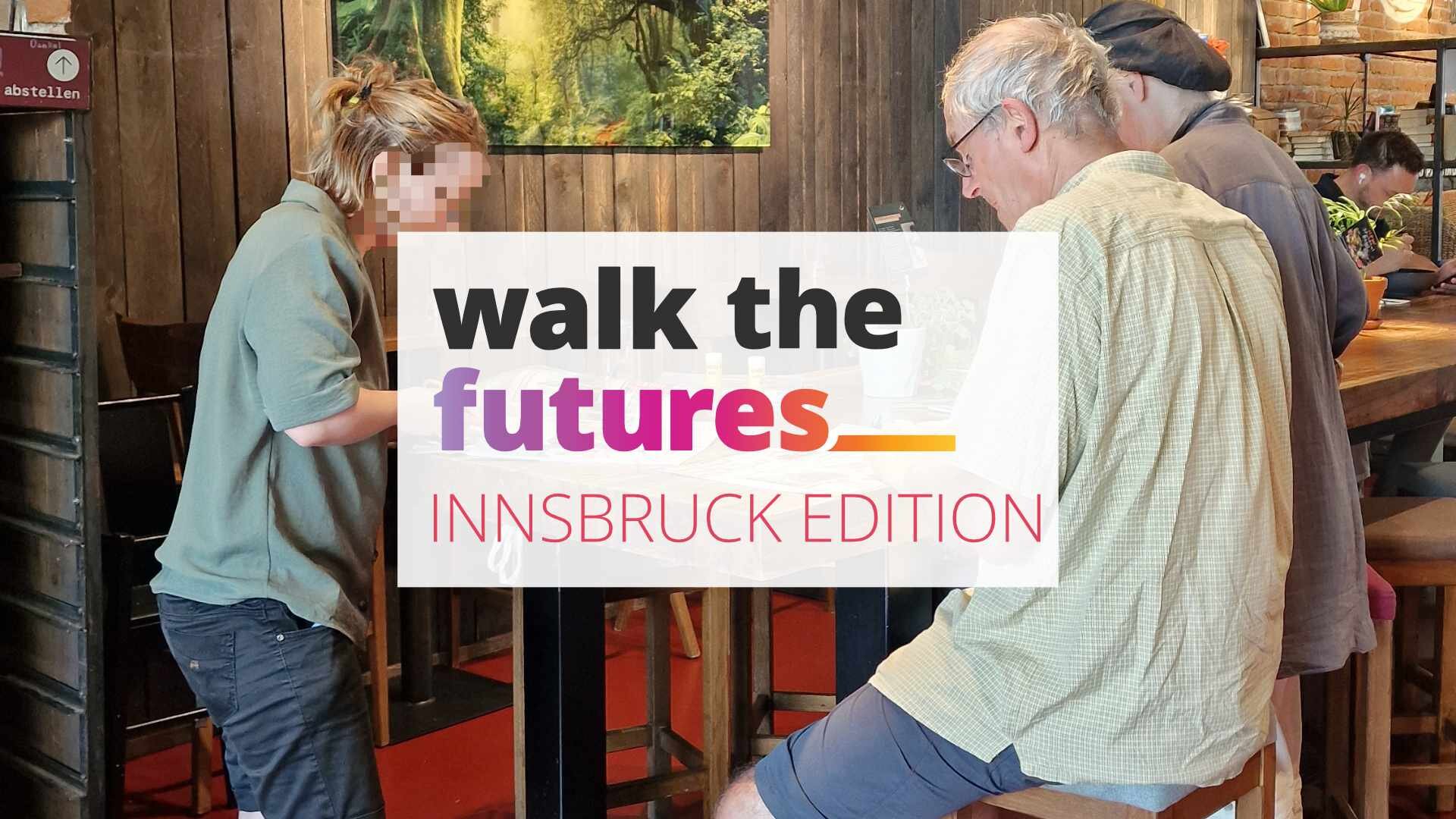
    What emerged is an approach that brings climate futures to life through embodied, sensory walkshops in the cities where participants live. We spoke with her about her Walk the Futures research project, about what it means to smell and taste the future, what ordinary people discover when they step into it, and what she hopes a city like Innsbruck, where she is based, might still become.

    Posted on: 05/05/2026

    Last Edited: a year ago

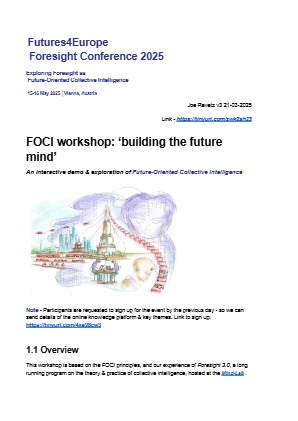
    Co-futuring: the art of interactive Future-Oriented Collective Intelligence building15 May - 15 May 2025

    Workshop at the Futures4Europe Foresight Conference 2025

    This workshop will explore and ‘demonstrate by doing’ the methods and tools now emerging for the Future-Oriented Collective Intelligence (FOCI) approach to foresight and strategic thinking.
    We draw on the experience of Foresight 3.0, and the ongoing experiments at the Manchester Mind-Lab on the theory and practice of collective intelligence. Foresight 3.0 aims to enable and mobilize the FOCI, by working with a wider community of interest, deeper layers of meaning, and further horizons of change / transformation:

    • within the foresight team – starting here with workshop participants 
    • across the wider community of foresight sponsors / stakeholders / users etc.

    Working through case studies on the conference theme of ‘emerging practices and cultures in FOCI’, we aim to explore by demonstration:

    • What kinds of collective knowledge / FOCI can be mapped 
    • Which methods and tools are most useful 
    • How the wider FOCI can be enabled and supported

    Workshop outcomes: shared examples and experience in FOCI methods and tools, collective knowledge mapping, ‘emerging practices and cultures’.

    Posted on: 30/04/2025

    Last Edited: a year ago

    RE-ENGINEERING HUMAN NATURE26 April - 26 April 2025

    Future Dialogue on Brain Interaction


    How does direct interaction with the brain work? The brain consists of a multitude of small nerve cells, so-called neurons. These neurons trigger a firework of electrical impulses with every subtle perception or thought. Even if these impulses are very weak, they can be measured with the help of sensitive sensors or even imitated by electrodes. These devices can be summarized under the term neurotechnologies. Will this make humans part of the machine?

    Neurotechnologies are devices that can directly access, observe, analyze, modify or stimulate the human nervous system. These technologies promise significant improvements for people with diseases such as Parkinson's and Alzheimer's as well as mental illnesses or in stroke rehabilitation. However, in addition to medical applications, there are also visions of enhancing human abilities, expanding consciousness and even merging mind and machine. 


    The prospect of enhancing human capabilities beyond natural limits raises critical questions. The long-term effects are unknown and the dangers arising from potentially discriminatory or abusive use of these technologies are great. Questions arise about the ownership of neural data, the potential for surveillance, commercial manipulation or political influence, as well as equality, inclusion and access, and even the very definition of what it means to be human. The topic underlines the need for a broad-based social discourse.

    In the future dialog Re-Engineering Human Nature, these and other critical points will be discussed with an interested audience and invited experts on two panels. The first panel will deal with human rights, ethics and the safety of neurotechnologies. Afterwards, film screenings will provide impulses for the second panel on the topic of myths and visions of neurotechnologies. With experts from various disciplines, we offer a comprehensive insight into this ambivalent technology and discuss new opportunities, potential challenges and the role of art in this socially relevant field of technology. The event is a collaboration between the Austrian Institute of Technology (AIT), the Ars Electronica NeuroExperience Lab, the Federal Ministry for European and International Affairs (BMEIA) and the University of Art and Design Linz.

    Posted on: 17/03/2025

    Last Edited: 2 years ago

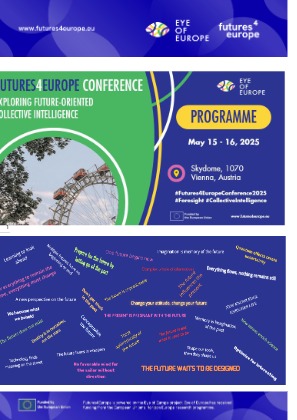
    Futures4Europe Conference 202515 May - 16 May 2025

    Exploring Future-Oriented Collective Intelligence

    The concept of Future-Oriented Collective Intelligence (FOCI) offers a transformative approach to making sense of and addressing future challenges that are complex and interconnected. 

    The topic was at the centre of the Futures4Europe Conference that took place on 15-16 May 2025 in Vienna, Austria, at the Skydome in Vienna’s thrilling 7th district.   

    We are deeply grateful to all 140 participants from 32 countries who joined us for these two days of exploration, dialogue, and inspiration. To gain an overview of the diverse themes, methods, and perspectives presented, you may consult the book of abstracts.

    We also invite you to revisit the highlights of the conference through our photo gallery and short wrap-up video

    Feel free to share them with your networks! We look forward to meeting again in 2026.

    The Conference is organised by AIT Austrian Institute of Technology, as part of the Eye of Europe project, which envisions a more cohesive and influential R&I foresight community that contributes significantly, as collective intelligence, to shaping and guiding policy decisions. The project has received funding from the EU’s Horizon Europe Research Programme under Grant Agreement n°101131738. 

    #Futures4EuropeConference2025 #Foresight #CollectiveIntelligence

    Posted on: 05/11/2024