Loading...

    Mentions of

    sorted by publishing date

    Last Edited: 9 months ago

    Choosing Europe's FutureApril 2024

    The 2024 ESPAS report

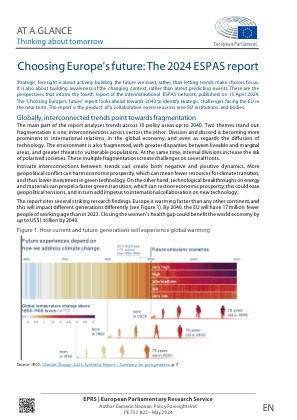
    The latest report of the ESPAS network, Choosing Europe’s Future, analyses global trends in order to identify key strategic challenges for the EU as the next legislative cycle begins. It is the fruit of collaboration between nine EU institutions and bodies. Key takeaways include the importance of being able to act quickly, given that game-changing developments can happen suddenly. It notes the risk of false economies; in areas such as defence and security, for example, efforts to avoid costs now can mean far greater costs in the future. The report points to the importance of threat multipliers and gain multipliers. Action to mitigate social fragmentation can prevent knock-on effects in other domains; the development of effective clean technologies can bring dividends across the board.

    Think Tank European Parliament - Research - Advanced search - Choosing Europe's future: The 2024 ESPAS report

    Posted on: 30/04/2025

    Last Edited: 10 months ago

    Shaping Norway’s Digital FutureMay 2024

    Norway is at the digital frontier in many areas. However, it needs to keep pace with rapid technological developments and competition, while improving performance in areas where it could catch up. Staying at the frontier requires agility, flexibility and well-co-ordinated digital policies. A national digital strategy can play an important role to ensure the policy framework in place makes the most of digital technologies and data for growth and well-being.

    Norway has identified several underlying priorities that will shape the content and structure of its forthcoming national digital strategy: ensuring high-quality information and communications infrastructure; developing the data economy; fostering data protection and information security; increasing the digitalisation of small and medium-sized enterprises; promoting an inclusive digital society in the context of an ageing population; supporting the green transition; and digitalising the public sector. These priorities will help realise Norway’s vision of a sustainable welfare society that safeguards a safe and simple everyday life for citizens and the non-governmental sector, a strengthened business sector and a better and renewed public sector.

    Norway’s digital policy landscape comprises relatively more initiatives related to Innovation than the other dimensions of the OECD Going Digital Integrated Policy Framework (the Framework), followed by Society, Access and Use. In terms of performance, Norway outperforms all OECD countries in indicators related to the effective use of digital technologies. It also outperforms the OECD and Nordic averages in societal indicators of digital transformation. Norway is above the OECD average on indicators of Trust and Access, although below the Nordic average. Norway has opportunities to catch up in indicators related to Market openness, Jobs and Innovation where there is the most potential to improve performance.

    Recommendations
    Key policy recommendations to achieve a more digital, innovative and inclusive Norway are structured around six areas:

    Encourage technology adoption and skills development to ensure a more digital-intensive economy and resilient workforce. This involves promoting adoption of digital technologies among small and medium-sized enterprises and empowering people with the skills to succeed in a digital world of work.

    Prioritise innovation to create a more digital Norway. This requires encouraging a culture of experimentation and risk taking, reducing regulatory burdens on start-ups and young firms, incentivising venture capital investment and support firms in scaling up, promoting investment in research and development, and harnessing the potential of “GovTech”.

    Maximise the potential of data, while maintaining Norway’s strong culture of trust. This includes leveraging Norway’s culture of trust to incentivise data sharing, realising the potential of open government data to drive digital innovation, taking a multifaceted approach to monitoring and addressing cyber risks, and supporting development of data-related skills and infrastructure.

    Harness the potential of digital technologies for society. This involves increasing digital inclusion through policies targeted at the groups most in need, discouraging e-waste production and encouraging e-waste recycling.

    Prepare for next generation networks and a future of unlimited connectivity everywhere. This entails upgrading fixed and mobile networks to 5G and beyond, closing geographic connectivity divides by focusing on the underserved, fostering competition and reducing red tape, and supporting businesses to improve their connectivity.

    Design holistic digital policies within effective governance and monitoring mechanisms. This involves using all dimensions of the Framework to design future digital policies; fostering interministerial and stakeholder co-operation in digital policy design and implementation; monitoring progress using the OECD Going Digital Toolkit as Norway’s national digital dashboard; and strengthening a whole-of-government approach to adoption of digital technologies in the public sector.

    Source: OECD - Publications  

    Posted on: 15/04/2025

    Last Edited: 10 months ago

    OECD Contributions to the 2030 Agenda and BeyondJune 2024

    Shaping a Sustainable Future for All

    The world is at a critical juncture, facing an array of interconnected global challenges. These challenges affect everyone, particularly the poorest and most vulnerable, and range from the triple planetary crises of climate change, biodiversity loss, and pollution, to pandemics, food and energy shortages, large-scale forced migration, rising domestic and global inequality, and escalating armed conflicts. In this context, there has been an alarming stagnation in progress towards achieving the Sustainable Development Goals (SDGs). The rise in public debt levels in many low- and middle-income countries is concerning. The United Nations (UN) Secretary-General's 2023 special edition report on SDG progress underscored that the next five years are critical, as failure to achieve the SDGs could lead to even greater poverty and inequalities, political instability, economic upheaval, and irreversible environmental damage.

    Yet, many countries are facing challenges in ensuring that their governance systems are capable of addressing these complex and interconnected challenges. A need for better governance, effective policy integration, sustainable investment choices as well as effective use of public resources, including Official Development Assistance (ODA), - as well as better international governance of SDGs - to meet sustainable development needs has never been more urgent. Delivering these improvements will require unprecedented action and decisions from public institutions and political leaders, effective and inclusive multilateral cooperation, with the goal of uniting diverse stakeholders to deliver nothing short of a rescue plan for people and the planet, in line with the call to action made by the UN Secretary General.

    As countries approach 2030, there is increasing recognition that the SDG commitments to “leave no one behind” and “reach those furthest behind first” need to extend beyond this timeline. In this context, the UN Summit of the Future presents a unique opportunity to tackle both current and future challenges, with a view to enhancing global collaboration on critical issues. The OECD’s policy work and active global engagement demonstrates its commitment to support all countries to individually and collectively achieve this objective.

    This Report aims to provide OECD support to inform decision making ahead of the UN Summit of the Future and following high-level events. It leverages OECD knowledge, data, tools, instruments and good practices to support national and international actions to respond to future challenges and opportunities. This report addresses two major breakthroughs proposed in the UN Secretary General's Rescue Plan for People and Planet: equipping governance and institutions for sustainable and inclusive transformation, and prioritising policies and investments with multiplier effects for sustainable development. It also aligns with the bold actions outlined in the anticipated Pact for the Future, addressing three of the five key priorities: sustainable development and financing for development; science, technology, innovation, and digital co-operation; and youth and future generations.

    Governance for equitable and sustainable transformation

    Transforming governance systems for sustainable development requires overcoming sectoral silos and policy fragmentation, as well as setting practical, and where feasible, ambitious and coherent economic, social, and environmental objectives that extend beyond short-term political cycles. Establishing robust policy coherence mechanisms is therefore needed to harmonise policy priorities and promote collaboration where most effective, with a view to reducing policy fragmentation, ensuring mutually reinforcing policies across sectors and government levels, and minimising negative transboundary effects of domestic policies.

    Sound governance for sustainable transformation also calls for the strategic use of various government tools - such as strategic foresight, people-centred public policy, mechanisms for stakeholder engagement, regulatory policy, public procurement and budgeting – in order to build resilient, sustainable and inclusive societies. It also calls for ensuring information integrity and providing access to justice for all, which are critical for the sound implementation of individual rights and government commitments.

    Effective governance systems also require the alignment of public investments with the public interest and sustainability priorities, including through the use of existing planning tools, such as National Sustainable Development Strategies, National Development and Decarbonisation Plans, strategic public investment decisions to foster inclusive and sustainable futures, stimulating further investments from private and other sectors, and leveraging transition finance to build resilient infrastructure and other strategic sectors. Integrity and building trust are also core objectives, crucial for fighting corruption and illicit financial flows, essential for effective public service delivery and sustainability. There is also a need to develop and maintain regulatory frameworks that facilitate compliance with SDGs, including the integration of the SDGs across the regulatory cycle and enhancing regulatory co-operation. In addition, developing new measures of progress that focus on both people and the planet will be crucial to a more holistic understanding of global economic prosperity and progress beyond GDP. To this end, the newly established International Forum on Total Official Support for Sustainable Development (TOSSD) could play a pivotal role.

    Finally, adopting a territorial approach to the SDGs is essential as cities and regions play a critical role in promoting a paradigm shift towards sustainability. At least 105 of the 169 SDGs targets will not be achieved without proper engagement and coordination with local and regional governments. The SDGs provide the appropriate framework to define and shape local and regional development visions, strategies, plans, and re-orient existing ones towards sustainable development.

    Policies and investments for sustainable transformation

    Sustainable transformation requires prioritising policies and investments that are mutually reinforcing and can catalyse progress across social, economic, and environmental dimensions, serving as multipliers to accelerate the achievement of the SDGs. This includes closing divides to leave no one behind, through strengthening policies and investments for social inclusion and identifying areas where social inclusion initiatives can be pursued in synergy with environmental protection. A key example of this is pursuing universal social protection, in light of its significant multiplier effects across different SDGs and incomparable potential for promoting just transitions. In addition, leveraging environment-human-well-being synergies is essential for coherent and effective SDG implementation. This requires enhancing transition finance credibility, strengthening domestic enabling conditions, addressing the labour and distributional impacts of climate policies, accelerating access to clean energy, and protecting biodiversity. In addition, there is a need to strengthen measures to protect lives in disaster situations by aligning disaster risk reduction and climate change adaptation responses.

    Additional financing for sustainable transformation

    Delivering an SDG stimulus requires innovative and collaborative solutions to unlock and scale up all sources of financing – public and private, domestic and international – for sustainable development and to address interlinked global crises. These need to harness productive trade and tax revenues, as well as international flows, to support SDG financing, including through innovative financing mechanisms, ensuring that financial flows, trade, development co-operation and other policies align with SDGs and promote inclusive and equitable outcomes, as well as encouraging green budgeting, developing effective tax policies, and improving tax administration, including via digitalisation of tax processes. This may also include innovative forms of financing, such as targeting support to enhance co-operation between public and private financial institutions through blended finance instruments, green, social, and sustainability bonds, and local currency solutions. Once again, integrity, compliance, anti-corruption and the fight against illicit finance are crucial for effective domestic resource mobilisation and attracting additional external financing from both private and public sources.

    Science, technology, and innovation (STI) for sustainable and inclusive transformation

    It is essential to design and implement STI policies in a manner to address societal challenges and achieve sustainable transformation, as set out in the OECD Transformative Agenda for STI Policies. Promoting trustworthy artificial intelligence (AI) is critical for digital transformation. AI is a powerful, versatile technology which has the potential to transform how we work, learn and interact, boosting productivity and economic growth and accelerating progress towards addressing global challenges, such as food security and climate change. However, we also need to address the risks raised by AI technology, including those related to privacy, safety, security, human rights and AI-generated disinformation and manipulated content. Beyond AI, policy efforts needed in the area of digital transformation also include enhancing broadband connectivity; achieving well-performing digital health systems through digital technologies; and, strengthening data governance frameworks while upholding human rights, including women’s and girls’ human rights, which face additional risks in the digital sphere. Strategic foresight should be used for anticipatory and innovative policy exploration about multiple futures, including by assessing emerging critical risks and opportunities in the face of various technological advancements and their implications on our economy and society. Strengthening data governance frameworks will be essential to ensure high standards of data protection, and facilitate data access and sharing across jurisdictions, including in the public sector.

    Empowering youth for a more equitable and sustainable future

    Addressing the needs and rights of youth and future generations is crucial to achieve sustainable development and intergenerational justice. This requires policies that promote formal job creation, high-quality employment services, and support for youth entrepreneurship, as well as social protection systems to meet the specific needs of youth, access to affordable housing, and outreach to vulnerable and disadvantaged young people. Promoting active, meaningful, and inclusive youth participation in decision-making processes at all levels will also help ensure that policies are reflective of their needs and aspirations.

    Source: OECD - Publications  

    Posted on: 15/04/2025

    Last Edited: 10 months ago

    German Call for Papers: Foresight in Theorie und Praxis13 April - 03 May 2025

    As part of the "Foresight in Theory and Practice" track at the INFORMATIK FESTIVAL 2025 in Potsdam

    Die gegenwärtige Zeit ist geprägt von rasanten und oft gleichzeitig stattfindenden Veränderungen und
    Entwicklungen: Technologien wie Künstliche Intelligenz (KI), neue regulative Anforderungen wie die CSRD
    oder der EU AI Act sowie gesellschaftliche und politische Herausforderungen sorgen für dynamische und
    disruptive Zukunftsperspektiven mit spezifischen Anforderungen an die Resilienz und das
    Innovationsmanagement. Die strategische Vorausschau (Foresight) gewinnt aus diesem Grund sowohl in
    Unternehmen als auch in der Forschung zunehmend an Bedeutung.

    Der Workshop „Foresight in Theorie und Praxis“ dient daher als Forum, um Akteure aus Unternehmen und
    wissenschaftlichen Einrichtungen zusammenzubringen und Erfahrungswerte sowie Kooperationspotenziale
    der strategischen Vorausschau zu diskutieren. Insbesondere soll dabei auch die Bedeutung der Informatik
    für den Aufbau und die Weiterentwicklung eines Foresight-Prozesses berücksichtigt werden. 

    Folgende Fragestellungen bieten eine Orientierung über die thematischen Schwerpunkte des Workshops:

    1. Welche Forschungsansätze im Bereich Foresight existieren bereits? Wo gibt es weiteren
      Forschungsbedarf?
    2. Wie werden Forschungsansätze derzeit bereits in der Praxis angewandt? Wodurch zeichnen sich
      diese aus und wo liegen die Grenzen?
    3. Wie gestaltet sich strategische Vorausschau in Unternehmen? Wie unterscheidet sich diese in
      Großunternehmen und KMU?
    4. Wie kann strategische Vorausschau in wissenschaftlichen Einrichtungen umgesetzt werden? Wo
      liegen Unterschiede zur unternehmerischen Herangehensweise, wo gibt es Gemeinsamkeiten?
    5. Wie können digitale Technologien (z. B. IT-Anwendungen, KI) die strategische Vorausschau
      unterstützen und verbessern? Welche Ressourcen und Kompetenzen sind hierfür erforderlich?

    Die Beiträge zum Workshop können verschiedene Aspekte von Foresight bzw. strategischer Vorausschau
    behandeln. Mögliche Themen sind (nicht abschließend):

    • Methoden der strategischen Vorausschau
    • Anwendung von Foresight in Unternehmen
    • Anwendung von Foresight in wissenschaftlichen Einrichtung
    • Digitale Technologien zur Unterstützung von Foresight (z. B. KI, Big Data, Simulationen)
    • KI und Foresight
    • Simulationstechniken
    • Datenanalysen/Datenmangement
    • Szenariotechniken
    • Trendanalysen
    • Horizon Scanning
    • Innovationsmanagement
    • Organisatorische und kulturelle Herausforderungen der strategischen Vorausschau
    • Regulatorische und ethische Aspekte von Foresight
    • Unternehmensstrategie und Foresight
    • Risikomanagement mit Foresight
    • Best Practices und Praxisberichte

    Zielgruppe des Workshops sind Forschende und Anwendende aus dem Bereich strategische Vorausschau
    bzw. Foresight sowie:

    • Fach- und Führungskräfte aus Unternehmen, die strategische Vorausschau in ihre Planung
      integrieren
    • Beratende im Bereich Zukunftsforschung und Trendanalyse
    • Verantwortliche für Innovations- und Technologiemanagement
    • Entscheidungsträger*innen in Politik und Verwaltung, die zukunftsorientierte Strategien entwickeln
    • IT-Experten*innen und Entwickler*innen von digitalen Foresight-Tools
    • Wissenschaftler*innen und Studierende mit Interesse an Foresight-Methoden

    HINWEISE ZUR EINREICHUNG

    Einreichungsfrist für Workshop-Beiträge: 04.05.2025
    Benachrichtigung der Autoren: 02.06.2025
    Einreichungsfrist für LNI-Beiträge: 11.06.2025
    Workshop: 19.09.2025

    Die Einreichung der Beiträge erfolgt als PDF über EasyChair.

    Für die Beiträge sind die LNI-Vorlagen zu verwenden.

    Beiträge können in deutscher oder englischer Sprache verfasst werden und sollten folgenden Umfang nicht überschreiten:

    Full Paper: 10-12 Seiten

    Short Paper: 6 Seiten

    Work-In-Progress-Paper: 3-5 Seiten

    Praxisbeiträge aus der Industrie: 3-5 Seiten

    Posted on: 14/04/2025

    Last Edited: a year ago

    Strategic Foresight for Sustainability (SF4S) - Synthesis ReportOctober 2023

    This is a synthesis report based on 130+ interviews conducted as part of the Strategic Foresight for Sustainability (SF4S). The synthesis report concludes the project’s Work Package 2, led by Finland Futures Research Centre, which had as a central objective to identify “key skills and good practices on the basis of interviews with the key community actors”.

    Nine SF4S consortium partners – DKSD, EDC, EDHEC, FFRC, GEA, HMKW, ISPIM, IZT, and TalTech - carr ied out 91 interviews in situ or via digital communication channels from September 2022 to March 2023. In addition, 47 interviewees or discussants participated via focus group discussions (November 2022) and a public webinar (January 2023). 

    The interviews map out sustainability, digitalisation, and foresight skills and practices in organisations around Europe with an emphasis on the project’s three target clusters: Agri-food, Health, and Mobility. In addition to industry representatives, experts in foresight, policy, consulting, and education have contributed their views to the project. 

    For more information on the report, see the project website.   

    Posted on: 07/01/2025

    Post Image

    Last Edited: a year ago

    Prompting the Future of IP Regulation & Innovation Management

    Anselm Kamperman Sanders and Anke Moerland, Professors of Intellectual Property Law at Maastricht University, share their ‘expert-generated’ responses to prompts concerning the outlook of intellectual property regulation. The two coordinators of the Horizon 2020 European IP Institutes Network Innovation Society project (EIPIN-Innovation Society), completed in 2021, point to global trends and highlight how emerging challenges for IP regulation and innovation management are already on the table.

    Posted on: 25/11/2024

    Post Image

    Last Edited: a year ago

    Copyright Harmony to Unite in Diversity

    ReCreating Europe re-thinks copyri ght codes and the management of creativity in the digital era by looking at the interplay between copyright, access to culture, and fair representation of creators and users.

    Posted on: 25/11/2024

    Post Image

    Last Edited: a year ago

    From Sewing Machines to Fashion NFTs

    Time Traveling through IPR in Creative Industries

    CREATIVE IPR traces the history of intellectual property rights in Europe to investigate how past battles and future challenges in IPR management for creative industries impact creators, businesses and consumers

    Posted on: 25/11/2024

    Last Edited: a year ago

    Unleashing the Potential for CompetitivenessJanuary 2024

    Trends in the Western Balkans

    Commissioned by the RCC, the DLR-PT study "Unleashing the Potential for Competitiveness: Trends in the Western Balkans". It presents trends that are likely to shape the region's competitiveness until 2035. It examines the potential impact on inclusive growth and provides examples that could be useful for the economies of the Western Balkans (WB). Based on desk research, expert interviews and an online trends workshop, the DLR-PT's Foresight team prepared the study in March and April 2023. It provides stakeholders with evidence-based insights to prepare for future developments and help formulate effective policy options and strategies. The study focuses on four key areas defined by the World Economic Forum's Global Competitiveness Report 2020: the enabling environment, human capital, markets and the innovation ecosystem. Through desk research, qualitative interviews and expert workshops, it identifies trends that provide a comprehensive view of the likely evolution of competitiveness over the next 12 years, enabling policymakers to anticipate future challenges. 

    The study provides a methodological overview of Strategic Foresight and delves into the trends within the identified pillars, providing a summary of findings and recommendations for future action. By highlighting the trajectory of competitiveness and its implications, the study provides policymakers with valuable insights to effectively navigate the evolving landscape and foster sustainable growth in the Western Balkans.

    Posted on: 10/11/2024

    Last Edited: a year ago

    Harvesting ChangeDecember 2022

    Harnessing Emerging Technologies and Innovations for Agrifood System Transformation

    FAO’s Office of Innovation is working with partners on an FAO Chief Scientist initiative on Foresight on emerging agrifood technologies and innovations, aligned with the UN 2.0 process and the FOFA 2022: engaging all key actors of agricultural innovation systems in the foresight on emerging technologies and innovations to better prepare for alternative futures, feeding it into anticipatory action, and convening the global community for constructive dialogue and knowledge exchange. The aim is to support policymakers, investors and innovation actors in their approaches and decision-making. The study assesses a selection of technologies and innovations, which potentially could be of paramount importance in addressing agrifood challenges until 2050, as well as the most important trends and drivers that will influence the emergence of agrifood technologies and innovations and their triggers of change, including some regional aspects. The goal is also to build plausible future scenarios for the evolvement of the emerging technologies and innovations in the future with the time horizon of 2050 to inform future-oriented policymaking. The report is built with inputs from a multistakeholder Delphi survey and online workshops with experts.

    Posted on: 10/11/2024

    Last Edited: a year ago

    HORIZON FUTURES WATCH WORKSHOP #7: Futures of Innovation and IP Regulation15 November - 15 November 2023

    The evolving complexity of global challenges is increasingly affecting the steering of European Research and Innovation which aims at addressing important present and future societal concerns. The idea of ‘watching futures’ to anticipate future possibilities and analyse the consequences of current choices to inform and shape a forward-looking EU R&I policy is continuously gaining ground.

    In this light, as part of the ‘European R&I foresight and public engagement for Horizon Europe’ study launched by the European Commission in connection to the Horizon Europe Foresight Network, a second series of online workshops will take place during October – November 2023.

    The workshops, which will run for two hours each, will discuss insights stemming from thematic policy briefs compiled by expert panels, addressing possible future scenarios for critical issues (i.e., Interpretation of Criminal and Lawful Activities, Green Skills and Jobs, Big Tech, etc.). Following the presentation of each policy brief, each workshop will feature two focus groups: one involving the group of experts from the panel who developed the policy brief and one including representatives from topic-relevant EU-funded R&I projects. All events will foster extensive engagement with participants, including policymakers.

    Posted on: 05/11/2024