Last Edited: 2 months ago
Dr Vassilis AGOURIDAS1
Posted on: 09/09/2026
sorted by publishing date
Last Edited: 17 days ago
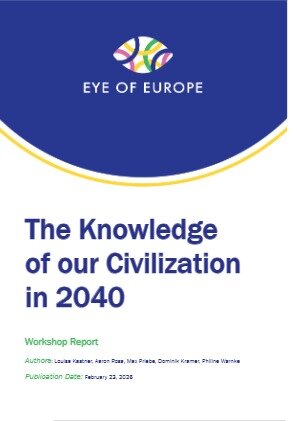
The Knowledge of our Civilizations in 2040 — a foresight workshop hosted by the Foresight Team of the Fraunhofer Institute for Systems and Innovation Research ISI — took place on 20–21 November 2025 at the Berlin-Brandenburg Academy of Sciences and Humanities, as part of the project Eye of Europe.
At the heart of the two-day workshop was the open question of how future civilizations might define, create, harness,
value, share, embed and apply knowledge. The workshop’s aim was to explore both conceivable and desirable alternative
futures for the knowledge of our civilization in Europe by the year 2040 by letting participants explore the theme of the
knowledge of our civilization through a facilitated process consisting of three main stages.
Across four working groups, participants started off by identifying different key domains of trouble in the current state of knowledge, with the notion of trouble being interpreted in a positive way as an area of investigation and exploration where things are in deep flux.
To delve into these areas of trouble, participants then applied the Causal Layered Analysis (CLA) framework twice: first, to critically examine the present by unpacking common narratives, systemic structures, shared worldviews and deep cultural metaphors; and then again, in a creative turn, to imagine desirable alternative futures. This second phase involved reconstructing alternative metaphors, beliefs, and systemic designs, eventually boiling down to a transformed litany.
The workshop set out to explore how future civilizations might define, create, value, and apply knowledge in 2040. Across four “troubles of knowledge,” participants showed that debates about knowledge are never purely technical but deeply political, ethical and cultural. The discussions revealed that today’s knowledge regimes are under pressure, making transformation both necessary and imaginable.
A first major theme concerned power and hierarchy. Many groups described current knowledge systems as exclusionary, dominated by majority viewpoints, elite institutions, economic logics and narrow validation mechanisms. Knowledge was seen as concentrated in authorities, shaped by growth paradigms and entangled with private or geopolitical interests. Declining trust and ideological polarization further destabilize what counts as shared truth. The central question recurring across groups was: Who defines knowledge, and for whom?
A second controversy focused on the purpose of knowledge. Is it primarily a tool for efficiency and competition, or a foundation for collective well‑being and long‑term responsibility? Several groups criticized current reward systems, the reduction of humans to “resources” and the dominance of problem‑solving logic over ethical and relational dimensions. The tension lies between knowledge as power and knowledge as care.
In the reconstruction phase, however, a shared horizon of hope emerged. Knowledge in 2040 was reimagined as relational, processual and co-created. Groups used metaphors such as mycelium networks, symphonies, assemblies, rivers and verbs to describe knowledge as something circulating, regenerative and sustained through relationships. Uncertainty, discomfort and failure were reframed as essential to meaningful knowledge creation.
Participants also envisioned new valuation systems: rewarding intrinsic motivation, collective achievement and planetary well‑being rather than market success. Ideas ranged from re‑commoning knowledge and revising metrics of excellence to fostering transdisciplinarity, citizen participation and relational education.
While the groups differed in where they anchored transformation - epistemic critique, moral renewal, valuation systems or institutional reform - they converged on a broader reorientation: from knowledge as possession to knowledge as relationship; from authority to dialogue; from scarcity to regenerative abundance.
Ultimately, the knowledge of our civilization in 2040 is imagined as being less about mastering complexity than about inhabiting it responsibly. It emphasizes shared meaning over information production and stewardship over competition. Whether such a transformation unfolds will depend not only on institutional reforms, but on the metaphors that guide our imagination. As the workshop demonstrated, changing how we speak about knowledge may be one of the most powerful steps toward changing how we imagine and eventually live it.
Posted on: 18/02/2026
Last Edited: a year ago
Posted on: 09/05/2025
Last Edited: a year ago
Delivering solutions for a more sustainable future
ISINNOVA provides research services and strategic consultancy to public and private actors pursuing sustainable visions, solutions, and policies.
Five Pillars of Our Approach
1. Anticipate – Apply systems thinking and foresight methodologies to identify emerging challenges, reveal interdependencies, and inform proactive, future-resilient strategies.
2. Integrate – Connect disciplines, sectors, and knowledge systems to foster richer analysis and tackle complex challenges holistically.
3. Align – Ensure research, innovation, and governance processes reflect the values, priorities, and needs of society through ethical, participatory, and responsible approaches.
4. Co-create – Engage diverse stakeholders — researchers, policymakers, citizens, and industry — in collaborative processes to design solutions that are inclusive, relevant, and impactful.
5. Transform – Drive systemic change by translating shared knowledge and co-created solutions into sustainable, scalable actions, supported by continuous assessment to ensure applicability, effectiveness, and long-term value.
Track Record
Posted on: 03/04/2025
Last Edited: a year ago
Posted on: 04/12/2024
Last Edited: a year ago
Arctik is a Brussels-based communications agency recognised for its strategic and creative communication capacity in the field of sustainability. Arctik develops tailored public relations and communication strategies that take both objectives and resulting impact into account. We facilitate the creation of communities and networks that contribute towards circulating content, whilst cultivating meaningful dialogues and synergies between influencers and decision-makers.
Arctik has substantial experience in designing and implementing communication campaigns and projects which mix creative communication and sustainability. We believe in communication campaigns which provide a setting where opportunities are created, and knowledge is shared between actors. It is an occasion to convey a message and collect insights and intelligence.
Our team has a strong commitment to sustainability. We incorporate sustainable values into operations Arctik has substantial experience in designing and implementing communication campaigns and projects which mix creative communication and sustainability. We believe in communication campaigns which provide a setting where opportunities are created, and knowledge is shared between actors. It is an occasion to convey a message and collect insights and intelligence. and consider environmental and social factors in every business decision, while encouraging our partners and clients to think circular! Arctik is also registered to obtain the Brussels ‘Enterprise ecodynamique’ label.
Arctik, as part of Technopolis Group is present in more than 10 countries with 300 consultants originating from +45 countries and speaking +30 languages. This diversity offers a unique perspective on what local-level stakeholders are receptive to.
Our offices are located in : • Austria • Belgium • Colombia • France • Germany • Ivory Coast • Netherlands • Greece • Portugal • Sweden • Ivory Cost • Colombia • United Kingdom.
Our solutions: Strategy • Messaging and copywriting • Online and offline engagement • Thought-provoking design • Web services • Project Management • Video and animation • Data-driven communication • Events • Social media campaigns & monitoring • Knowledge management and Capitalisation • Media and visibility.
Our expertise: Regional Policy, Circular Economy, Climate Services, Education, Entrepreneurship, Science & Innovation.
Arctik is part of Technopolis |group|
Website www.arctik.eu
LinkedIn linkedin.com/company/arctik/
Bluesky bsky.app/profile/arctik.eu
Posted on: 27/11/2024
Last Edited: a year ago
Posted on: 19/11/2024
Last Edited: a year ago
Posted on: 18/11/2024
Last Edited: a year ago
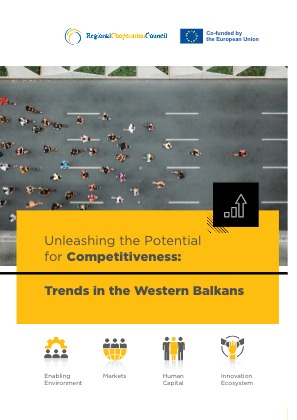
Commissioned by the RCC, the DLR-PT study "Unleashing the Potential for Competitiveness: Trends in the Western Balkans". It presents trends that are likely to shape the region's competitiveness until 2035. It examines the potential impact on inclusive growth and provides examples that could be useful for the economies of the Western Balkans (WB). Based on desk research, expert interviews and an online trends workshop, the DLR-PT's Foresight team prepared the study in March and April 2023. It provides stakeholders with evidence-based insights to prepare for future developments and help formulate effective policy options and strategies. The study focuses on four key areas defined by the World Economic Forum's Global Competitiveness Report 2020: the enabling environment, human capital, markets and the innovation ecosystem. Through desk research, qualitative interviews and expert workshops, it identifies trends that provide a comprehensive view of the likely evolution of competitiveness over the next 12 years, enabling policymakers to anticipate future challenges.
The study provides a methodological overview of Strategic Foresight and delves into the trends within the identified pillars, providing a summary of findings and recommendations for future action. By highlighting the trajectory of competitiveness and its implications, the study provides policymakers with valuable insights to effectively navigate the evolving landscape and foster sustainable growth in the Western Balkans.
Posted on: 10/11/2024
Last Edited: a year ago
The establishment of responsible innovation requires four key institutional changes. First, innovation must be value-driven. Second, an ethics of co-responsibility among stakeholders must be implemented. Third, innovation should be made directional and manageable. Fourth, market failures need to be addressed to facilitate necessary transformative changes, especially with regard to the Sustainable Development Goals (SDGs). This research project will take into account the evolution of Living Labs and various specialized Living Labs (e.g., urban labs, social labs, and responsible Living Labs) to assess to what extent they address these institutional requirements. On this basis, the concept of a new dedicated Living Lab: a Responsible Research and Innovation Lab for Engineering Practices will be introduced. Subsequently this dedicated Living Lab will be operationalised on a theme from the engineering sciences. We will consider innovations stemming from digital tech for Health issues, additive manufacturing or other engineering pratices. We will deploy participatory foresight, to enable a form of anticipatory governance of emerging new innovations.
This dedicated ling lab is contextualised in a broader context of a deliberative democracy: Living Labs can be seen as spaces for Organisational Learning and Collective Experimentation:Living Labs: ‘real-life test and experimentation environments that foster co-creation and open innovation among the main actors of the Quadruple Helix Model, namely: Citizens, Governmental Organisations, Industrial organisations and Academia’ (ENoLL 2024)It operationalises an important feature of Responsible Research and Innovation: Making stakeholders co-responsible and mutually responsive to each other by engaging them in an open co-creation/ co-enquiry process. (among other on the basis of participatory foresight of emerging technologies and innovations)The idea of 'openess' and 'mutual reponsiveness' as values of actors and institutions will also be subject of analysis.Science and innovation can be better fostered in an open, democratic society than in other types of societies. The norm of civic participation in a ‘democracy’ is a lived ideal for citizens, just as the norm of ‘communalism’ is a lived ideal for the scientific community. Both norms presuppose the values of ‘openness’ and 'mutual responsiveness' among scientist and citizens.This highlights ‘openness’ not as a prescriptive norm but as a value of the institution of science. Simultaneously, ‘openness’ is also an institutional value of a democracy. However, science and democracy are dependent on the extent to which scientist and citizens engage on the basis of these norms. How can we best encourage and incentivise those?
Posted on: 28/10/2024
Last Edited: a year ago
The Executive Agency for Higher Education, Research, Development and Innovation Funding (UEFISCDI) is a public institution with legal personality subordinate to the Ministry of National Education in Romania.
Attributions:
Posted on: 28/10/2024
Last Edited: a year ago
Institutul de Prospectiva is a research organisation (NGO) with the mission to stimulate future-awareness aimed at addressing the challenges of contemporary societies. To this end, we implement tailored foresight exercises supporting strategic orientation in the public sector, with a focus on foresight for R&I policy at European and national level.
Prospectiva is part of the Foresight-on-Demand (FOD) consortium, tasked with advising the European Commission and fourteen other EU organisations on science and technology policy programming for a period of four years (April 2024 – March 2028).
This is an extension of the previous successful cooperation within the Foresight on Demand framework contract (2019-2023); during this period Prospectiva has contributed to numerous projects, on components related to horizon scanning, large scale Delphi consultations, scenario building, co-creation workshops, speculative design, and the elaboration of various briefs, in-depth case studies and reports. These projects addressed a range of themes, among which the future of food, of retail, of ecosystems’ flourishing, and even of the human condition.
Posted on: 14/10/2024