Loading...

    Mentions of

    sorted by publishing date

    Last Edited: 4 months ago

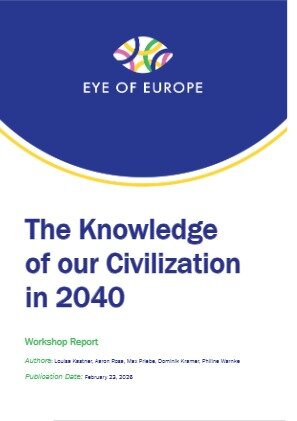
    The Knowledge of our Civilization in 204020 November - 21 November 2025

    A Foresight Workshop on Future Knowledge Systems hosted by the Fraunhofer Institute for Systems and Innovation Research ISI

    The Knowledge of our Civilizations in 2040 — a foresight workshop hosted by the Foresight Team of the Fraunhofer Institute for Systems and Innovation Research ISI — took place on 20–21 November 2025 at the Berlin-Brandenburg Academy of Sciences and Humanities.

    The workshop brought together 28 people from a wide range of academic disciplines as well as artists and futurists from across Europe.

    At the heart of the workshop was the open question of how future civilizations might define, create, harness, value, share, embed and apply knowledge. Our aim was to explore both conceivable and desirable alternative futures for the knowledge of our civilization in Europe by the year 2040.

    Posted on: 07/10/2025

    Last Edited: 5 months ago

    Aging and Assisted Living TechnologiesAugust 2025

    Eye of Europe Foresight Workshop Report

    The Eye of Europe project conducted a pilot workshop focused on Aging and Assisted Living Technologies (AALT) to examine their potential impact on European society and research and innovation (R&I) policy, particularly in the context of demographic changes such as aging populations and increased chronic health issues. The workshop aimed to anticipate the societal and policy implications of integrating smart and digital technologies into assisted living and care for older adults. Using the futures wheel method, participants explored future developments across three main areas: institutional long-term care, home-based care, and the inclusion of individuals with special needs in the workplace. The workshop was structured around three future assumptions for the year 2035, envisioning that AALT will become standard practice in long-term care facilities, widely used in private households, and successfully integrated in workplaces to support employees with special needs. Through this anticipatory approach, the workshop identified overarching effects of AALT on society and highlighted the importance of these technologies in shaping future policy and innovation strategies. This workshop was part of a broader series of foresight pilots designed to engage diverse stakeholders, test foresight methodologies, and contribute lessons to the Eye of Europe community and its online foresight platform. The attached report summarizes the results of the workshop and discusses the findings in the context of Europe R&I policy.

    Posted on: 04/09/2025

    Last Edited: 8 months ago

    Aging and Assisted Living Technologies20 May - 20 May 2025

    Eye of Europe Pilot Workshop

    On May 20, 2025, the international workshop “Eye of Europe: Aging and Assisted Living Technologies (AALT)” took place at the headquarters of VDI/VDE Innovation + Technik GmbH in Berlin. The event was organized within the framework of the EU-funded project Eye of Europe, which aims to strengthen the integration of foresight methods into European research and innovation (R&I) policy-making.
    The workshop’s objective was to analyze the societal impacts and potential of assistive technologies for aging, from both demographic and technological innovation perspectives. It particularly focused on the relevance of AALT for future policy strategies across the European Research Area (ERA).
    23 international experts from academia, policy, civil society, social care, engineering, and business took part in the event. Two keynote contributions from the fields of technology foresight (Dr. Simone Ehrenberg-Silies, VDI/VDE-IT) and smart health (Christian Gräff, Smart Health Living Center Berlin) set the stage. Participants then applied the “Futures Wheel” foresight method to systematically map direct and indirect effects of technological developments in the AALT field.
    The Futures Wheel proved to be a highly effective tool for visualizing complex cause-and-effect relationships under uncertainty and initiating future-oriented planning processes. The workshop offered an interdisciplinary platform for exchange, discussion, and strategic foresight.
    The program was complemented by an informal pre-event on May 19, which included a visit to the Futurium museum and a joint dinner at a traditional Berlin restaurant.

    Posted on: 18/06/2025

    Post Image

    Last Edited: 8 months ago

    From Intuition to Immersion: The Resonant Future Self Framework Makes Foresight Felt

    What if we could test-drive our future selves?

    Most scenario workshops stay in the head. The Resonant Future Self Framework flips that script by letting participants embody possible futures through immersive narrative experiences - while their brains and bodies react in real time. Peaks of coherence in EEG and heart-rate variability become “north-star signals” that guide purpose discovery. The method weaves together generative AI, emotional storytelling, and biometric sensing to open a new path toward deeply felt, personal foresight.

    First public presentation – Vienna, May 2025
    The framework was introduced at the Futures4Europe Conference 2025 – Exploring Future-Oriented Collective Intelligence (Vienna, 15–16 May), organised by the AIT Austrian Institute of Technology as part of the Eye of Europe flagship initiative. The presentation focused on the conceptual foundations of the method, shared results from the first single-participant pilot study, and outlined how emotional resonance - measured through real-time physiological signals - can enrich scenario work with an embodied, intuitive layer of decision-making.

    Next stop – AIMEDIA, Venice, July 2025
    From 6–10 July, the project will be featured in the AI in Immersive Media track at the First International Conference on AI-based Media Innovation (AIMEDIA 2025) in Venice.

    The presentation will cover the generative narrative pipeline that produces the six personalised future-self videos, share expanded pilot-study findings (including EEG and HRV analysis), and preview ongoing efforts to partially automate the scripting, visual generation, and video assembly process using tailored AI workflows.

    While human editing and quality control remain essential, these steps point toward a future in which the method becomes faster, more scalable, and easier to adapt across educational, coaching, and wellbeing contexts.

    Read more
    To explore more about the method, goals, and future plans, visit the dedicated project page (link below).

    Posted on: 08/06/2025

    Last Edited: 10 months ago

    German Call for Papers: Foresight in Theorie und Praxis13 April - 03 May 2025

    As part of the "Foresight in Theory and Practice" track at the INFORMATIK FESTIVAL 2025 in Potsdam

    Die gegenwärtige Zeit ist geprägt von rasanten und oft gleichzeitig stattfindenden Veränderungen und
    Entwicklungen: Technologien wie Künstliche Intelligenz (KI), neue regulative Anforderungen wie die CSRD
    oder der EU AI Act sowie gesellschaftliche und politische Herausforderungen sorgen für dynamische und
    disruptive Zukunftsperspektiven mit spezifischen Anforderungen an die Resilienz und das
    Innovationsmanagement. Die strategische Vorausschau (Foresight) gewinnt aus diesem Grund sowohl in
    Unternehmen als auch in der Forschung zunehmend an Bedeutung.

    Der Workshop „Foresight in Theorie und Praxis“ dient daher als Forum, um Akteure aus Unternehmen und
    wissenschaftlichen Einrichtungen zusammenzubringen und Erfahrungswerte sowie Kooperationspotenziale
    der strategischen Vorausschau zu diskutieren. Insbesondere soll dabei auch die Bedeutung der Informatik
    für den Aufbau und die Weiterentwicklung eines Foresight-Prozesses berücksichtigt werden. 

    Folgende Fragestellungen bieten eine Orientierung über die thematischen Schwerpunkte des Workshops:

    1. Welche Forschungsansätze im Bereich Foresight existieren bereits? Wo gibt es weiteren
      Forschungsbedarf?
    2. Wie werden Forschungsansätze derzeit bereits in der Praxis angewandt? Wodurch zeichnen sich
      diese aus und wo liegen die Grenzen?
    3. Wie gestaltet sich strategische Vorausschau in Unternehmen? Wie unterscheidet sich diese in
      Großunternehmen und KMU?
    4. Wie kann strategische Vorausschau in wissenschaftlichen Einrichtungen umgesetzt werden? Wo
      liegen Unterschiede zur unternehmerischen Herangehensweise, wo gibt es Gemeinsamkeiten?
    5. Wie können digitale Technologien (z. B. IT-Anwendungen, KI) die strategische Vorausschau
      unterstützen und verbessern? Welche Ressourcen und Kompetenzen sind hierfür erforderlich?

    Die Beiträge zum Workshop können verschiedene Aspekte von Foresight bzw. strategischer Vorausschau
    behandeln. Mögliche Themen sind (nicht abschließend):

    • Methoden der strategischen Vorausschau
    • Anwendung von Foresight in Unternehmen
    • Anwendung von Foresight in wissenschaftlichen Einrichtung
    • Digitale Technologien zur Unterstützung von Foresight (z. B. KI, Big Data, Simulationen)
    • KI und Foresight
    • Simulationstechniken
    • Datenanalysen/Datenmangement
    • Szenariotechniken
    • Trendanalysen
    • Horizon Scanning
    • Innovationsmanagement
    • Organisatorische und kulturelle Herausforderungen der strategischen Vorausschau
    • Regulatorische und ethische Aspekte von Foresight
    • Unternehmensstrategie und Foresight
    • Risikomanagement mit Foresight
    • Best Practices und Praxisberichte

    Zielgruppe des Workshops sind Forschende und Anwendende aus dem Bereich strategische Vorausschau
    bzw. Foresight sowie:

    • Fach- und Führungskräfte aus Unternehmen, die strategische Vorausschau in ihre Planung
      integrieren
    • Beratende im Bereich Zukunftsforschung und Trendanalyse
    • Verantwortliche für Innovations- und Technologiemanagement
    • Entscheidungsträger*innen in Politik und Verwaltung, die zukunftsorientierte Strategien entwickeln
    • IT-Experten*innen und Entwickler*innen von digitalen Foresight-Tools
    • Wissenschaftler*innen und Studierende mit Interesse an Foresight-Methoden

    HINWEISE ZUR EINREICHUNG

    Einreichungsfrist für Workshop-Beiträge: 04.05.2025
    Benachrichtigung der Autoren: 02.06.2025
    Einreichungsfrist für LNI-Beiträge: 11.06.2025
    Workshop: 19.09.2025

    Die Einreichung der Beiträge erfolgt als PDF über EasyChair.

    Für die Beiträge sind die LNI-Vorlagen zu verwenden.

    Beiträge können in deutscher oder englischer Sprache verfasst werden und sollten folgenden Umfang nicht überschreiten:

    Full Paper: 10-12 Seiten

    Short Paper: 6 Seiten

    Work-In-Progress-Paper: 3-5 Seiten

    Praxisbeiträge aus der Industrie: 3-5 Seiten

    Posted on: 14/04/2025

    Post Image

    Last Edited: a year ago

    GIZ‘s latest foresight work on geopolitics and sustainable development

    Future-proofing the organization

    For years, the world has been described as being in a state of perma-crisis. As a federal enterprise working in the fields of international cooperation for sustainable development and international education, the Deutsche Gesellschaft für Internationale Zusammenarbeit (GIZ) GmbH is strongly affected by the political and economic environment in which it operates. This is why it is important for GIZ to understand the underlying drivers of change and possible future developments so that it can prepare for the future and the challenges it will face, ultimately making the organization and its staff more resilient.

    With its broad network of staff and international experts in over 120 partner countries, GIZ is well equipped to monitor and differentiate relevant signals and developments. At headquarters, a dedicated foresight team addresses future issues at a corporate level and contributes to the company's strategic decision-making.

    GIZ’ foresight report 2024

    Sustainable development is GIZ’s core business. The 2030 Agenda provides the framework for GIZ’s global activities. As the year 2030 is getting closer, the question is: will the negotiations on a new agenda be successful? But one thing is clear: any negotiation process and subsequent implementation will be increasingly shaped by geopolitical factors. This is why, the 2024 foresight report of GIZ, focuses on geopolitics, sustainable development and the global agenda for the next decade.

    In total, the views of more than 100 GIZ colleagues from GIZ's HQ and the field structure were incorporated into the report through various workshops. In addition, the report is based on extensive analysis of secondary sources, and interviews with more than 30 experts from various (international) institutions to ensure that the report also reflects perspectives from outside GIZ.

    The scenarios (strongly condensed for this post) are based on the four archetypes of the Manoa School of Futures Studies and Jim Dator, which represent four recurring paths of human civilization found in all cultures. Each scenario is supplemented by two to three short wildcards, some of which are listed here as examples.

    Posted on: 18/03/2025

    Last Edited: a year ago

    "The future of quantum computing: what matters now"

    Foresight study on behalf of the German Federal Ministry for Economic Affars and Climate Action

    The DLR-PT conducted a comprehensive foresight study for the BMWK to explore the current progress and challenges in quantum computing. Using DLR-PT's innovative Strategic Impact Navigation Assessment Model (SINAVI), the study employed a range of methods including trend analysis, expert interviews and multi-stage Delphi surveys. Based on these findings, DLR-PT created a forward-looking scenario for 2032 and used the backcasting method to identify key strategies for advancing quantum computing in Germany. The findings were enriched with data from an accompanying performance review of the funding initiative, for which DLR-PT was also responsible. The result was a holistic, actionable roadmap that highlights both the achievements and future potential of the funding programme.

    Posted on: 17/02/2025

    Post Image

    Last Edited: a year ago

    Exploring Futures: Scenario Planning in Collective Consciousness

    Short movie made with AI Tools

    This movie is a way of connecting three domains that bring me joy currently:
    - Strategic Foresight
    - Spirituality
    - AI
    One of the goals is to draw attention to Foresight as one of the Top 5 cutting-edge skills identified in the UN 2.0 agenda, a plan that helps organizations prepare for the future.

    I adapted the Scenario Planning method to explore three possible futures and bring them to life through cinematic storytelling.
    The film also introduces two trained characters, Lina and Arun, within each scenario, making the movie less formal and more engaging.

    I also wanted to show how AI can:
    - Serve as a bridge between ideas and skills from different fields.
    - Help us discover new aspects of human potential.

    This movie isn’t flawless or complete - I’m not a filmmaker, and that’s okay. Its beauty lies in its imperfection, reminding us that sometimes, taking the step to create is more important than getting it perfect. 

    Later Edit: The film EXPLORING FUTURES: SCENARIO PLANNING IN COLLECTIVE CONSCIOUSNESS was included in the non-competition program of the International "Cartoons about the Future Festival," dedicated to films created with the help of AI. It was screened five times during the event, held on March 28-30, 2025, at the Atom Pavilion at VDNkH, Moscow. The festival, organized by the ATOM Foundation for the Promotion of Scientific, Educational, and Communication Initiatives in collaboration with the Big Cartoon Festival team, featured free screenings of short and full-length animated films over three days, offering audiences a diverse selection of forward-thinking works.

    Posted on: 10/02/2025