Last Edited: 3 days ago
Margarida Saragoca1
Posted on: 16/11/2026
sorted by publishing date
Last Edited: 23 days ago
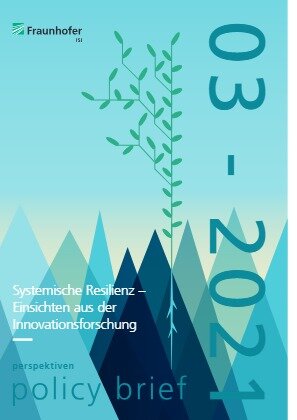
Policy Brief
Resilience must go beyond robustness, redundancy and emergency planning aimed at "bouncing back", and instead encompass systems' capacity to adapt and fundamentally transform ("bounce forward"), since companies, sectors and societies are complex adaptive socio‑technical systems. Because practical guidance for building adaptive and transformative resilience is still scarce, the authors draw on decades of innovation research and policy, which already studies how socio‑technical systems change and how their innovation capacity can be governed. They identify five transferable approaches, illustrated with cases such as the TechnologieRegion Karlsruhe 2030 strategy, the High‑Tech Strategy participation process, the BMVI mobility and fuels strategy, the Commission on the Future of Agriculture foresight exercise, and the mRNA/internet examples of long‑term basic research: developing local resources and regional innovation systems; strengthening diverse networks, participation and trust; providing "strategic intelligence" for governing transformations under uncertainty; fostering anticipation through foresight and futures literacy; and maintaining a broad, publicly funded base of curiosity‑driven research and competences. Conversely, resilience research can enrich innovation policy by challenging overly linear, plannable assumptions, pointing to approaches like anticipatory innovation governance and experimental spaces (real‑world labs) that embed self‑organisation into mission‑oriented policy — showing that innovation and resilience are mutually reinforcing goals requiring long‑term, strategic support.
[AI summary]
Posted on: 27/10/2026
Last Edited: a month ago
Posted on: 21/10/2026
Last Edited: 3 months ago
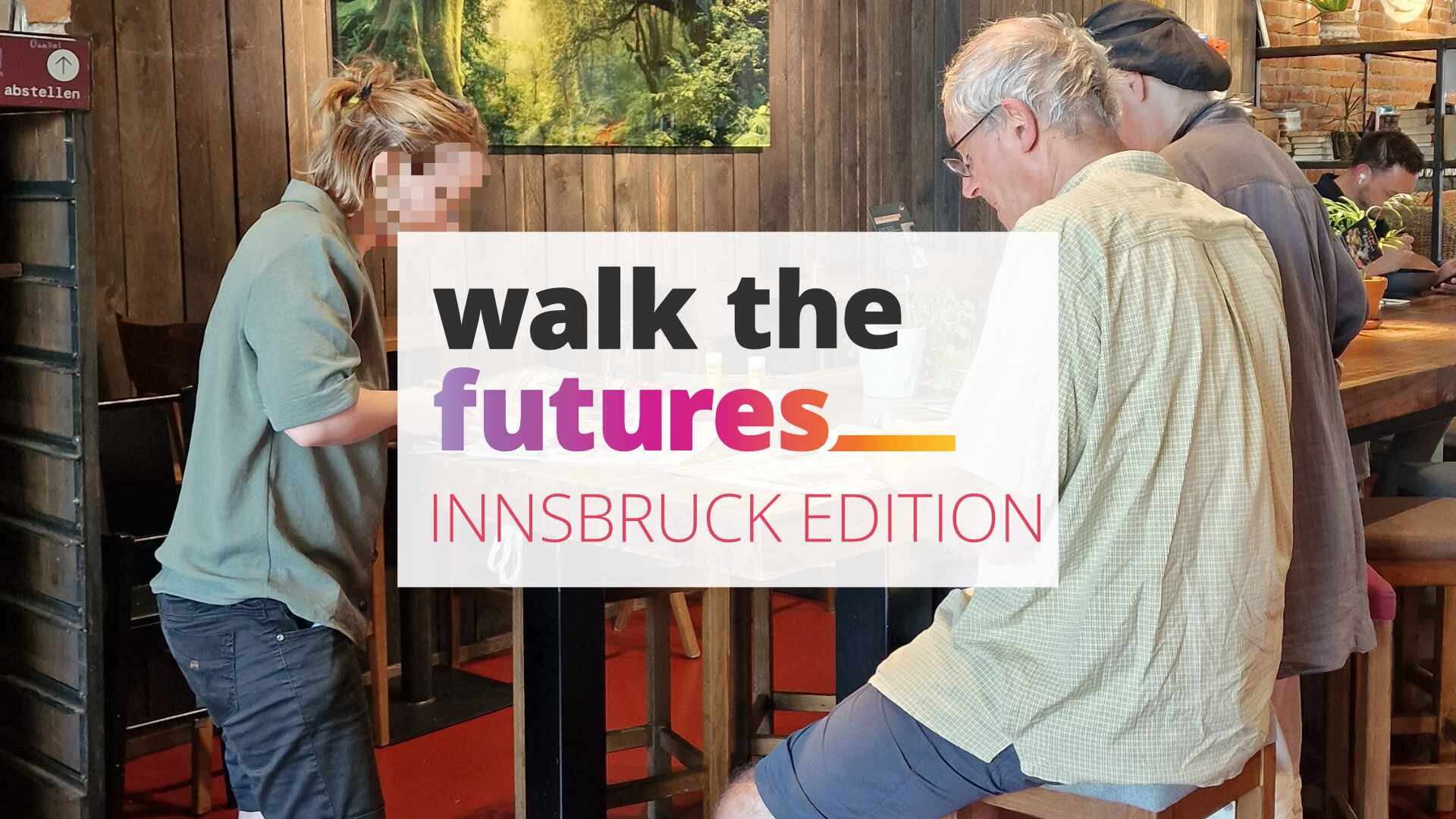
Gemeinsam tauchen wir ins Jahr 2056 ein, probieren Speisen aus der Zukunft, riechen die Düfte der Altstadt und lesen die Schlagzeilen von morgen – mithilfe von Geschichten und multisensorischen Objekten aus möglichen Zukünften.
Freu dich auf einen Spaziergang durch die Stadt, Zeit zum Nachdenken, gute Gespräche, ein gemeinsames Essen (), einen kreativen Workshop – und vielleicht auf einen neuen Blick auf das, was vor uns liegt.
📅 August 21
🕛 8h30-14h30
📍 Rennweg, Innsbruck (in der Nähe des ORF)
🔗 Mehr Infos & kostenlose Anmeldung hier: https://walkthefutures.org/innsbruck/
Du brauchst kein Vorwissen. Bring einfach deine Neugier mit.
Die Veranstaltung steht allen offen, die mindestens 18 Jahre alt sind, in Innsbruck leben oder arbeiten und keine Vollzeitstudierenden sind. Die Teilnahme ist kostenlos und findet im Rahmen einer Pilotstudie statt (endet im Oktober 2026).
Weitere Informationen:
Besuche www.walkthefutures.org oder schreib eine E-Mail an Zukunftsforscherin Suzanne Whitby unter hi@walkthefutures.org.
Posted on: 13/08/2026
Last Edited: 3 months ago
Gemeinsam tauchen wir ins Jahr 2056 ein, probieren Speisen aus der Zukunft, riechen die Düfte der Altstadt und lesen die Schlagzeilen von morgen – mithilfe von Geschichten und multisensorischen Objekten aus möglichen Zukünften.
Freu dich auf einen Spaziergang durch die Stadt, Zeit zum Nachdenken, gute Gespräche, ein gemeinsames Essen (), einen kreativen Workshop – und vielleicht auf einen neuen Blick auf das, was vor uns liegt.
📅 September 8
🕛 8h30-14h30
📍 Rennweg, Innsbruck (in der Nähe des ORF)
🔗 Mehr Infos & kostenlose Anmeldung hier: https://walkthefutures.org/innsbruck/
Du brauchst kein Vorwissen. Bring einfach deine Neugier mit.
Die Veranstaltung steht allen offen, die mindestens 18 Jahre alt sind, in Innsbruck leben oder arbeiten und keine Vollzeitstudierenden sind. Die Teilnahme ist kostenlos und findet im Rahmen einer Pilotstudie statt (endet im Oktober 2026).
Weitere Informationen:
Besuche www.walkthefutures.org oder schreib eine E-Mail an Zukunftsforscherin Suzanne Whitby unter hi@walkthefutures.org .
Posted on: 13/08/2026
Last Edited: 4 months ago
Posted on: 31/07/2026
Last Edited: a year ago
The vision of FOSTER is to build a foundation from which a new Knowledge and Innovation System (KIS) for Europe’s food system can emerge. The current structure is insufficient to address the emerging challenges of nourishing people in a healthy and sustainable way. Key objective is to gain insights into how it can be built to be more inclusive and better governed.
FOSTER shall help to transform Europe’s food system outcomes and will achieve this by:
To inspire adoption of FOSTER learnings, over 20 workshops and a final conference will be conducted; scientific position papers and policy briefs will be widely communicated.
Posted on: 09/12/2024