Loading...

    Mentions of

    sorted by publishing date

    Last Edited: 10 days ago

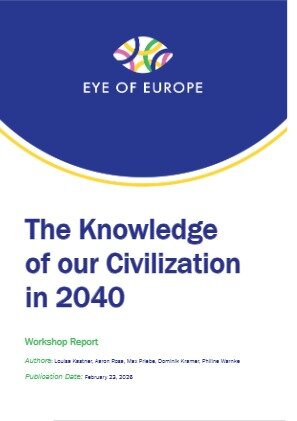
    The Knowledge of our Civilization in 2040January 2026

    Workshop report

    The Knowledge of our Civilizations in 2040 — a foresight workshop hosted by the Foresight Team of the Fraunhofer Institute for Systems and Innovation Research ISI — took place on 20–21 November 2025 at the Berlin-Brandenburg Academy of Sciences and Humanities, as part of the project Eye of Europe.

    At the heart of the two-day workshop was the open question of how future civilizations might define, create, harness,
    value, share, embed and apply knowledge. The workshop’s aim was to explore both conceivable and desirable alternative
    futures for the knowledge of our civilization in Europe by the year 2040 by letting participants explore the theme of the
    knowledge of our civilization through a facilitated process consisting of three main stages.

    Across four working groups, participants started off by identifying different key domains of trouble in the current state of knowledge, with the notion of trouble being interpreted in a positive way as an area of investigation and exploration where things are in deep flux.

    To delve into these areas of trouble, participants then applied the Causal Layered Analysis (CLA) framework twice: first, to critically examine the present by unpacking common narratives, systemic structures, shared worldviews and deep cultural metaphors; and then again, in a creative turn, to imagine desirable alternative futures. This second phase involved reconstructing alternative metaphors, beliefs, and systemic designs, eventually boiling down to a transformed litany.


    The workshop set out to explore how future civilizations might define, create, value, and apply knowledge in 2040. Across four “troubles of knowledge,” participants showed that debates about knowledge are never purely technical but deeply political, ethical and cultural. The discussions revealed that today’s knowledge regimes are under pressure, making transformation both necessary and imaginable.

    A first major theme concerned power and hierarchy. Many groups described current knowledge systems as exclusionary, dominated by majority viewpoints, elite institutions, economic logics and narrow validation mechanisms. Knowledge was seen as concentrated in authorities, shaped by growth paradigms and entangled with private or geopolitical interests. Declining trust and ideological polarization further destabilize what counts as shared truth. The central question recurring across groups was: Who defines knowledge, and for whom?

    A second controversy focused on the purpose of knowledge. Is it primarily a tool for efficiency and competition, or a foundation for collective well‑being and long‑term responsibility? Several groups criticized current reward systems, the reduction of humans to “resources” and the dominance of problem‑solving logic over ethical and relational dimensions. The tension lies between knowledge as power and knowledge as care.

    In the reconstruction phase, however, a shared horizon of hope emerged. Knowledge in 2040 was reimagined as relational, processual and co-created. Groups used metaphors such as mycelium networks, symphonies, assemblies, rivers and verbs to describe knowledge as something circulating, regenerative and sustained through relationships. Uncertainty, discomfort and failure were reframed as essential to meaningful knowledge creation.

    Participants also envisioned new valuation systems: rewarding intrinsic motivation, collective achievement and planetary well‑being rather than market success. Ideas ranged from re‑commoning knowledge and revising metrics of excellence to fostering transdisciplinarity, citizen participation and relational education.

    While the groups differed in where they anchored transformation - epistemic critique, moral renewal, valuation systems or institutional reform - they converged on a broader reorientation: from knowledge as possession to knowledge as relationship; from authority to dialogue; from scarcity to regenerative abundance.

    Ultimately, the knowledge of our civilization in 2040 is imagined as being less about mastering complexity than about inhabiting it responsibly. It emphasizes shared meaning over information production and stewardship over competition. Whether such a transformation unfolds will depend not only on institutional reforms, but on the metaphors that guide our imagination. As the workshop demonstrated, changing how we speak about knowledge may be one of the most powerful steps toward changing how we imagine and eventually live it.

    Posted on: 18/02/2026

    Last Edited: 11 days ago

    Futures4Europe Conversations: Film as Future LensJanuary 2026

    In this episode of Futures4Europe Conversations, Bianca Dragomir speaks with George Cârstocea, who teaches in the Cinema and Media Studies Program at the University of Southern California. His courses range from an Introduction to Cinema—exploring film in dialogue with other arts and technologies—to classes on comedy and animation, Romanian cinema, and science fiction.

    This video interview explores film as a powerful mediator of futures: how speculative stories play with current assumptions about what is possible, desirable, or inevitable; how imaginaries of the future are constructed and circulated; why some narratives lean toward heroic salvation while others turn to comedy or irony; and how dark or hopeful visions affect our emotional and collective orientation toward what lies ahead.

    The interview is structured into eight chapters:

    • Chapter 1. Teaching Cinema: How It All Began
    • Chapter 2. Students in Uncertain Times
    • Chapter 3. What Makes a Movie Worthwhile?
    • Chapter 4. Do SF Movies See Into the Future?
    • Chapter 5. What Happens When Stories Stir Us?
    • Chapter 6. Do Dark Stories Limit Our Imagination?
    • Chapter 7. How Do Films Imagine Hopeful Futures?
    • Chapter 8. “Flexibility Is Life — Hardening Is Death”

    The conversation is also sprinkled with film recommendations—some may be familiar, others perhaps unexpected. Give it a listen. And if you’re planning a movie night, you might want to take George’s recommendations into account.

    Posted on: 17/02/2026

    Last Edited: 5 months ago

    The Knowledge of our Civilization in 204020 November - 21 November 2025

    A Foresight Workshop on Future Knowledge Systems hosted by the Fraunhofer Institute for Systems and Innovation Research ISI

    The Knowledge of our Civilizations in 2040 — a foresight workshop hosted by the Foresight Team of the Fraunhofer Institute for Systems and Innovation Research ISI — took place on 20–21 November 2025 at the Berlin-Brandenburg Academy of Sciences and Humanities.

    The workshop brought together 28 people from a wide range of academic disciplines as well as artists and futurists from across Europe.

    At the heart of the workshop was the open question of how future civilizations might define, create, harness, value, share, embed and apply knowledge. Our aim was to explore both conceivable and desirable alternative futures for the knowledge of our civilization in Europe by the year 2040.

    Posted on: 07/10/2025

    Last Edited: 6 months ago

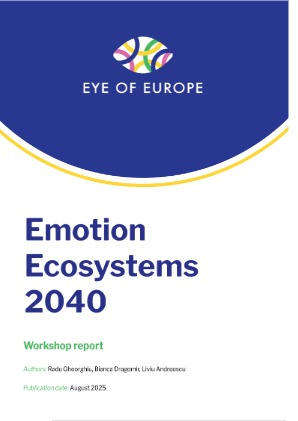
    Emotion ecosystems 2040July 2025

    Workshop report

    The foresight workshop Emotion Ecosystems 2040 was conducted on 📅 24-25th of June 2025, as part of the project Eye of Europe

    Over the course of the two-day workshop, the participants explored the theme of emotion ecosystems by working through a structured process in three facilitated groups, whose composition shifted at key moments. The work began by framing the concept of “emotion ecosystems” in terms of a curated set of societal tensions, each expressing the strain between a shared aspiration and its undesirable consequences: 🌀 Hyperconnection vs Isolation; 🌍Craving for unity vs Tribal polarization; 🩹 Healing collective traumas vs Solitary coping ...and more.

    To delve into these tensions, participants applied the Causal Layered Analysis (CLA) framework twice: first, 🔍to examine the present by unpacking common narratives, systemic structures, shared worldviews, and deep cultural metaphors; and then again, in a creative key, 💡to imagine preferable futures. This second phase involved reconstructing alternative metaphors, beliefs, and systemic designs, supported by a short horizon scanning exercise based on a set of pre-existing and participant-generated key drivers of change. 

    Posted on: 12/09/2025

    Last Edited: 7 months ago

    MUSAE Factory ModelMay 2025

    https://musae.starts.eu/factory-model-pack/

    The MUSAE Factory Model is a cutting-edge approach to help companies stay ahead in a rapidly evolving world by fostering artistic experimentation with advanced technologies. It provides a structured, future-driven innovation model that empowers SMEs and startups in collaboration with creatives and artists in envisioning future scenarios and creating innovative, future-driven solutions. At its core, the Factory Model is based on the Design Futures Art-driven (DFA) method, which blends Design Futures and Art Thinking approaches.

    Factory Model Pack is developed primarily for (European) Digital Innovation Hubs, companies, artists and designers to initiate and support art-tech collaboration. Beyond this, the Design Futures Art-driven (DFA) method has been also widely used and applied in the educational activities in universities. 

    Posted on: 17/07/2025

    Last Edited: 10 months ago

    Emotion ecosystems 204024 June - 25 June 2025

    “The fabric of society is woven with emotional threads, from empathy to outrage, and it is these feelings that shape both harmony and conflict in the world.” — Dalai Lama

    Emotion Ecosystems 2040 — the foresight workshop hosted by Executive Agency for Higher Education, Research, Development and Innovation Funding (UEFISCDI) within the Eye of Europe project — was an inspiring, mind-expanding experience! The co-creation workshop was held on 📅24-25 June 2025 at 📌Conacul Cozieni, near Bucharest, Romania.

    💡The event explored the concept of emotion ecosystems — the dynamic, interwoven emotional currents that shape our collectives, whether in communities, institutions, or digital spaces.
    To capture this complexity, the event brought together voices from across Europe and from various disciplines: social psychology, psychotherapy, anthropology, philosophy, cultural history, spirituality, political science, art and the creative industries, journalism, media studies, science and technology studies, and robotics.

    One portion of the workshop was dedicated to surfacing emotional tensions that mark our time:
    🌀 Hyperconnection vs Isolation; 🌍Craving for unity vs Tribal polarization; 🩹 Healing collective traumas vs Solitary coping ...and many more. Using Causal Layered Analysis, participants unpacked these tensions through multiple layers — from surface narratives and systemic structures to the deeper worldviews and metaphors/myths that sustain them.

    From there, each working group leaned into the future:
    💡 by exploring drivers of change relevant for the tension discussed in their group, and then
    💡 by discussing and proposing new metaphors, worldviews, beliefs, and systems that could soften or transform these tensions. Ultimately, the goal was to imagine what more desirable emotional futures might look like.

    Posted on: 14/04/2025

    Post Image

    Last Edited: a year ago

    INSPIRE 2023

    Art and Futures

    The Inspire project has been running at MOMus since 2012. In a fascinating anarchic creative environment, young artists are invited to create original artworks in one week under the guidance of an established artist. At the same time, curators are invited to set up the exhibition just hours before the official opening.

    Posted on: 25/11/2024

    Post Image

    Last Edited: a year ago

    Design Futures Art-Driven Methodology

    Shaping the Future of Innovation

    Merging Design Futures and Art Thinking approaches for responsible, sustainable and future-proof innovation.

    Posted on: 25/11/2024

    Post Image

    Last Edited: a year ago

    Shaping Futures, Story by Story

    Posted on: 25/11/2024

    Post Image

    Last Edited: a year ago

    Shaping futures, story by story

    Posted on: 31/10/2024