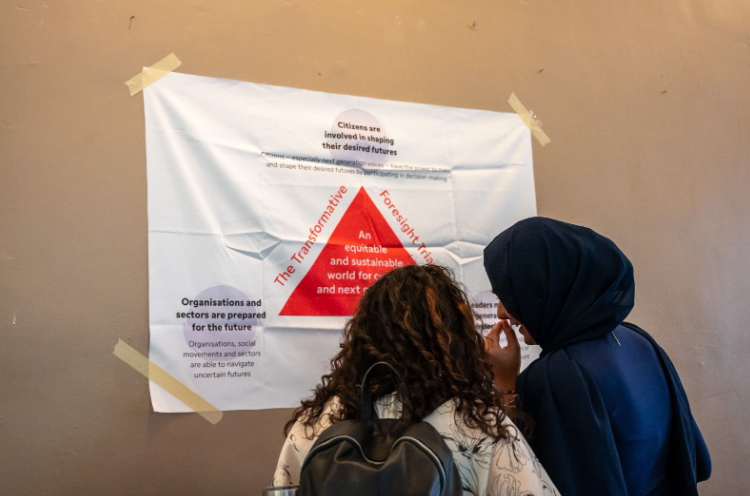
The Knowledge of our Civilizations in 2040 — a foresight workshop hosted by the Foresight Team of the Fraunhofer Institute for Systems and Innovation Research ISI — took place on 20–21 November 2025 at the Berlin-Brandenburg Academy of Sciences and Humanities, as part of the project Eye of Europe.
At the heart of the two-day workshop was the open question of how future civilizations might define, create, harness,
value, share, embed and apply knowledge. The workshop’s aim was to explore both conceivable and desirable alternative
futures for the knowledge of our civilization in Europe by the year 2040 by letting participants explore the theme of the
knowledge of our civilization through a facilitated process consisting of three main stages.
Across four working groups, participants started off by identifying different key domains of trouble in the current state of knowledge, with the notion of trouble being interpreted in a positive way as an area of investigation and exploration where things are in deep flux.
To delve into these areas of trouble, participants then applied the Causal Layered Analysis (CLA) framework twice: first, to critically examine the present by unpacking common narratives, systemic structures, shared worldviews and deep cultural metaphors; and then again, in a creative turn, to imagine desirable alternative futures. This second phase involved reconstructing alternative metaphors, beliefs, and systemic designs, eventually boiling down to a transformed litany.
The workshop set out to explore how future civilizations might define, create, value, and apply knowledge in 2040. Across four “troubles of knowledge,” participants showed that debates about knowledge are never purely technical but deeply political, ethical and cultural. The discussions revealed that today’s knowledge regimes are under pressure, making transformation both necessary and imaginable.
A first major theme concerned power and hierarchy. Many groups described current knowledge systems as exclusionary, dominated by majority viewpoints, elite institutions, economic logics and narrow validation mechanisms. Knowledge was seen as concentrated in authorities, shaped by growth paradigms and entangled with private or geopolitical interests. Declining trust and ideological polarization further destabilize what counts as shared truth. The central question recurring across groups was: Who defines knowledge, and for whom?
A second controversy focused on the purpose of knowledge. Is it primarily a tool for efficiency and competition, or a foundation for collective well‑being and long‑term responsibility? Several groups criticized current reward systems, the reduction of humans to “resources” and the dominance of problem‑solving logic over ethical and relational dimensions. The tension lies between knowledge as power and knowledge as care.
In the reconstruction phase, however, a shared horizon of hope emerged. Knowledge in 2040 was reimagined as relational, processual and co-created. Groups used metaphors such as mycelium networks, symphonies, assemblies, rivers and verbs to describe knowledge as something circulating, regenerative and sustained through relationships. Uncertainty, discomfort and failure were reframed as essential to meaningful knowledge creation.
Participants also envisioned new valuation systems: rewarding intrinsic motivation, collective achievement and planetary well‑being rather than market success. Ideas ranged from re‑commoning knowledge and revising metrics of excellence to fostering transdisciplinarity, citizen participation and relational education.
While the groups differed in where they anchored transformation - epistemic critique, moral renewal, valuation systems or institutional reform - they converged on a broader reorientation: from knowledge as possession to knowledge as relationship; from authority to dialogue; from scarcity to regenerative abundance.
Ultimately, the knowledge of our civilization in 2040 is imagined as being less about mastering complexity than about inhabiting it responsibly. It emphasizes shared meaning over information production and stewardship over competition. Whether such a transformation unfolds will depend not only on institutional reforms, but on the metaphors that guide our imagination. As the workshop demonstrated, changing how we speak about knowledge may be one of the most powerful steps toward changing how we imagine and eventually live it.