Loading...

    sorted by publishing date

    Last Edited: 2 months ago

    THE DEMOGRAPHIC TURN09 December - 09 December 2025

    ACTIONS NEEDED FOR RESEARCH, INNOVATION, AND POLICY IN EUROPE?

    Curious about how Europe’s demographic trends may transform the R&I landscape?


    On 10 December 2025, DG Research & Innovation hosted a hybrid event at the DG RTD Library in Brussels to present the Foresight-on-Demand (FOD) study: “The Demographic Turn: Actions Needed for Research, Innovation and Policy in Europe?”


    FOD team members guided the audience through:

    • Background data showing a shrinking youth population, a declining workforce, and growing fiscal pressures on R&I funding.
    • A six-step Foresight Process combining horizon scanning, scenario-building, and windtunneling to anticipate future challenges.
    • Four Scenarios illustrating different pathways for Europe’s R&I system.
    • Strategic actions to protect fundamental research, foster lifelong learning, strengthen regional innovation, and build societal trust in technology.


    👏 A big thank you to the panelists and speakers:

    • Erik Canton (Deputy Head of Unit – Common R&I Strategy and Foresight Service, DG Research & Innovation)
    • Nicola Francesco Dotti (Chief Economist Unit – Common R&I Strategy and Foresight Service, DG Research & Innovation)
    • Brikena Xhomaqi (The Lifelong Learning Platform)
    • Alex Petropoulos (Centre for Future Generations)
    • Thomas Estermann (European University Association)
    • Maciej Krysztofowicz (EU policy Lab, Joint Research Centres)
    • Viola Peter (FOD team, Technopolis Group)
    • Michal Nadziak (FOD team, 4CF)
    • Katarzyna Figiel (FOD team, 4CF)

    And to all participants for an engaging exchange on how to build a more adaptive and resilient EU R&I system.


    Missed the event? Explore the below documentation !


    Posted on: 27/11/2025

    Last Edited: 4 months ago

    Geopolitical & industrial decarbonisation scenarios to identify R&I opportunities for the EUMay 2025

    How can the EU navigate amidst global uncertainties to foster a more resilient and effective path toward industrial decarbonisation?

    This report presents the outcomes of the Geopolitical Industrial Decarbonisation Scenarios workshop, convened on behalf of the Eye of Europe Horizon Europe project by the Insight Foresight Institute. Bringing together 30 participants from across the European Union—including policymakers at EU, national, and regional levels, industry leaders, energy and climate specialists, and foresight and forecasting experts—the workshop explored how the EU can navigate mounting geopolitical uncertainty while accelerating industrial decarbonization on a 2050 horizon.

    The discussion was structured around two core aims. First, participants examined a suite of forward-looking geopolitical scenarios, assessing how divergent power dynamics, energy trade patterns, and technological trajectories could either hinder or catalyse the transition to a net-zero industrial base in the EU countries. Particular attention was paid to supply-chain resilience, strategic autonomy in critical materials, and the interplay between carbon border adjustments and global climate diplomacy. Second, the workshop sought to surface emergent research and innovation (R&I) needs and opportunities that would equip EU actors to thrive across the scenarios. Priorities highlighted include advanced electrification processes for hard-to-abate sectors, low-carbon hydrogen and synthetic-fuel value chains, circular-economy business models, and data-driven tools for real-time decarbonisation monitoring.
    Outputs from the session feed directly into the Eye of Europe project’s multi-workshop learning cycle. Immediate products comprise this extended report for attendees; aggregated insights captured in the public Pilot Logbook Part I – What we did and Part II – What we learned; and distilled policy recommendations to be released in the Eye of Europe Policy Brief: Foresight Perspectives on Key R&I Topics. Beyond documentation, the Insight Foresight Institute will leverage the findings to stimulate agenda-setting dialogues with EU bodies and industrial stakeholders, ensuring that identified R&I pathways inform Horizon Europe programming and other EU-level funding instruments. Workshop materials and presentations are retrievable via the futures4europe.eu knowledge-sharing portal, reinforcing the project’s commitment to an open foresight community.

    Posted on: 03/10/2025

    Last Edited: 4 months ago

    Future of Sustainable Fashion IIMay 2025

    The Future of Sustainable Fashion event took place on Monday, April 14, 2025, at the MOMus - Museum of Modern Art in Thessaloniki, Greece. The workshop was implemented surrounded by the relative with the subject exhibition Collective Threads: Anna Andreeva at the Red Rose Silk Factory. This initiative was implemented by Helenos Consulting, a partner of the Eye of Europe Project, and aimed at engaging domain professionals, including foresight and fashion experts.

    Posted on: 01/10/2025

    Last Edited: 4 months ago

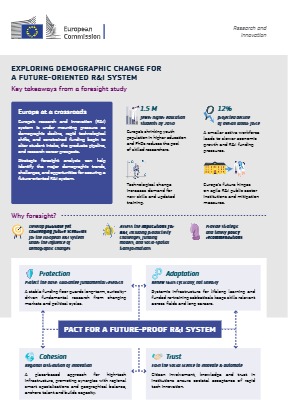
    Exploring Demographic Change for a Future-Oriented EU R&I SystemNovember 2025

    Key takeaways from a foresight study

    Europe’s research and innovation (R&I) system is under mounting pressure as demographic decline, rapid technological
    shifts, and constrained funding begin to alter student intake, the graduate pipeline, and research career prospects. By 2050, Europe could face 1.5 million fewer higher education students and a 12% decline in the labour force. These trends call for bold, future-oriented strategies.

    Comissionned by DG Research & Innovation, the Foresight-on-Demand project team adopted a structured foresight architecture designed to translate broad uncertainties into actionable strategy. A hybrid and multi-stage strategic foresight methodology was used to systematically assess the impact of demographic change on the European R&I system.

    What you'll find in this report:

    • Background data showing a shrinking youth population, a declining workforce, and growing fiscal pressures on R&I funding.
    • A six-step Foresight Process combining horizon scanning, scenario-building, and windtunneling to anticipate future challenges.
    • Four Scenarios illustrating different pathways for Europe’s R&I system.
    • Strategic actions to protect fundamental research, foster lifelong learning, strengthen regional innovation, and build societal trust in technology.

    Posted on: 25/09/2025

    Last Edited: 5 months ago

    Signal CardsJune 2025

    Signal Cards from ESPAS Horizon Scanning

    The Signals Cards present emerging issues identified through the ESPAS Horizon Scanning activity. Apart from using them to inform the regular Horizon Scanning newsletters, they work well as conversation starters in (foresight) workshops to get people into the right headspace to think about and interact with the future. The Signal Cards are a fun and interactive tool ideal for workshops to expand thinking, foster imagination and explore different potential futures. 

    How to use the cards

    Instructions provided with the cards contain four different short exercises that can be used at the beginning of a workshop to broaden the thinking, spark imagination and encourage looking forward.

    You can start your workshop with a quick exercise to

    📌 find relevant signals of change for your topic

    📌 challenge the common perspective

    📌 explore different aspects of novelty or

    📌 think about the culminating effects various signals might have together.

    If you have more time, you can dive deeper into the signals and explore their potential impacts for example in the beginning of a (foresight) project. Participants can envision a world where some of the signals become reality and brainstorm what might be the consequences. This can help to pinpoint areas for further analysis. You can find detailed instructions for all these exercises in the Signal Cards file. Or feel free to create your own activities with the Signals Cards!

    Download the Signal Cards, follow the enclosed detailed instructions and see how they can transform your next workshop.

    Print the chosen cards (ideally on thick paper, 2 pages per A4 sheet to get A5 sized cards) or paste them as pictures to a digital platform for online workshops.

    Read more from the blog.

    Posted on: 23/09/2025

    Last Edited: 5 months ago

    Resilience - The future of Europe as seen by EU citizensAugust 2025

    This report presents an analysis on the topic of resilience of the stories selected from the #OurFutures initiative. These stories — envisioning life in 2040 — provide unique insights into how people across the EU perceive Europe's capacity to remain resilient amid multiple transformative challenges.
    This thematic analysis supports the European Commission’s 2025 Strategic Foresight Report on resilience . It therefore focuses on stories that explicitly reference the role and position of Europe, its institutions, and its collective future.

    The report identifies eight major challenge areas shaping perceptions of Europe's resilience, with climate and democracy emerging as particularly cross-cutting themes. The analysis also explores the optimistic and pessimistic visions citizens express about Europe’s future – on the one hand those describing a Europe that has responded to its challenges through transformation, and on the other, those that foresee institutional collapse, authoritarian drift, climate catastrophe, and social fragmentation. Five key tensions structure the debates within the stories, revealing the difficult trade-offs that Europe must navigate to remain resilient. Potential shocks that citizens anticipate underscore where citizens feel Europe is most vulnerable and where resilience must be strengthened.

    Despite their concerns, storytellers propose a wide range of concrete strategies to enhance European resilience, many of them emphasizing systemic reform and long-term thinking. The report synthesizes citizens’ views on Europe’s role in the world.

    Posted on: 23/09/2025

    Last Edited: 5 months ago

    Scenario workshops on the future of food10 September - 10 September 2025

    the consumer acceptance of functional and processed food and alternative proteins

    EIT Food Consumer Observatory is organising online workshops focusing on the consumer acceptance of functional and processed food and alternative proteins by 2035. The online workshops are organised on September 11 and 18, from 10 to 13 hours CET. This is an open invitation to participate. It is free, just write us to consider your participation and learn more about the process: info@if-institute.org

    What to expect in the workshops:
    Before the workshops: Read this brief background document to familiarise yourself with the approach and prepare for the workshops.
    During the workshops: Discuss and participate by writing your comments via MS Teams chat and the Miro board sticky notes. Note that the workshops will be recorded to enable automated transcription in Teams.
    After the workshops: The expert team will develop scenario narratives, which are presented and discussed further in another workshop on November 4th 10-13 CET, which allows the reflection of scenario implications for the current agrifood ecosystem. Finally, a policy brief will be published end of the year.

    Last year, we did a similar process focusing on the future of new food products and experiences and One Health. More information here:
    https://if-institute.org/futures-of-food-consumption-in-2035-in-europe-on-sustainability-health-and-technology 

    Posted on: 02/09/2025

    Post Image

    Last Edited: 5 months ago

    Supporting the institutionalisation of future-oriented policymaking

    A new initiative to support EU Member States in embedding long-term, anticipatory thinking into decision-making at every level—national, regional, and local. 

    Future-Oriented Policymaking is an ongoing joint project by the European Commission Directorate-General for Structural Reform Support (DG REFORM) and the EU Policy Lab of the Joint Research Centre. The project supports foresight capacity building in EU Member States and integrating future-oriented thinking into decision-making.

    The project supports foresight capacity building in EU Member States and integrating future-oriented thinking into decision-making.

    Get involved!
    The success of the project depends on the active participation of policymakers, practitioners, and citizens. Whether you are an experienced foresight practitioner or entirely new to the concept, we welcome your insights.

    Share ideas, take our survey*: Help us understand your needs and shape the final deliverables. What has worked well in your context? What challenges have you faced? How can we make foresight more relevant to your needs? > Survey

    Join our beta testing group**: Be among the first to try out our new toolkit and training materials. Your feedback will help us refine and improve these resources for everyone (fill in the survey and click join beta testing group at the end).

    * Preferably before 12 September 2025 to make full use of your ideas.

    * *Places for beta testing are limited, and we are committed to working with a diverse range of partners. If you are interested, please fill in the survey by 5/09/2025 . We will confirm participation after that date. Institutionalising future-oriented policymaking is a collective journey, which requires commitment, curiosity, and courage: from leaders, civil servants, and citizens alike. Let’s work together to make foresight a cornerstone of European policymaking. 

    Stay tuned for updates and don’t hesitate to reach out if you’d like to contribute to this exciting initiative.

    > Future-oriented Policymaking 

    Posted on: 29/08/2025

    Last Edited: 6 months ago

    Report on the assessment of the digital competencies needed in the Romanian civil serviceFebruary 2025

    Taking into account relevant policies at the national and European Union levels

    Romania’s public administration faces deep-rooted structural challenges that hinder the development of digital competencies and slow progress in both digital transformation and human resources management (HRM) reforms. While digital competencies are essential to achieving Romania’s public sector modernization goals, they are not a standalone solution. In this context, the government of Romania, assisted by the World Bank through the Technical Support Instrument (TSI), aims to develop a General Digital Competence Framework for Civil Servants.

    This report if one of the outputs of the TSI project; its goal is to identify the digital competencies necessary at the intersection of Romania’s digital transformation and HRM reform agendas, laying the groundwork for a more capable and future-ready public administration. The report employs a comprehensive multi-layered analysis, incorporating: a top-down review of national and EU strategies, policies, and regulations; a bottom-up analysis of job descriptions, focus groups, interviews, and working groups; international best practices in public sector digital competencies; and a foresight perspective to anticipate future digital skill needs.

    Chapter VI | Foresight: fit-for-future digital roles in the public administration describes the foresight exercise carried out by Institutul de Prospectiva and the World Bank, which was aimed at ensuring that the proposed digital competency framework will remain future-ready, enabling civil servants to navigate digital transformation, deliver citizen-centric services, and address complex policy challenges with agility and innovation. The process was meant to inform the definition of specific digital roles that are needed in the future, but also to allow the formulation of recommendations regarding the general digital competencies of public administration employees.

    The foresight methodology utilized horizon scanning and scenarios (both explorative and normative), as essential tools in helping policymakers navigate uncertainty by exploring various probable and/or desirable futures. This foresight exercise focused on the year 2032, a timeframe suited for significant structural transformation in public administration, allowing for the development and maturity of complex digital systems.

    In terms of process, the scenario-building process was based on an iterative consultation process. It built on inputs developed by the foresight team from Institutul de Prospectiva and was progressively refined through three online working sessions with international experts from the World Bank and the Joint Research Centre (JRC) and a final in-person workshop with local experts from the public administration and the private sector in Romania.
    The figure below provides a concise overview of the scenario-building steps.

    📌The Baseline Scenario “Romanian Digital Administration in 2032” provides a ‘current paradigm’ case: It takes the current Romanian strategic documents in the field of digital transformation as a starting point. It assumes that the key goals set in these
    documents are generally met by 2032. The logic is the following: assuming Romania’s current digitalization paradigm (and
    associated digital roles) turn out mostly as planned, what is the gap between this best-case baseline and the digital society scenarios for 2032?

    📌The Context Scenario about the “Digital society in Romania in 2032” is an exploratory scenario, meaning it describes a probable future rather than one driven by a deliberate vision of a desirable future society. The core scenario integrates high-impact, high-probability trends - or drivers of change -identified in the initial horizon scanning phase. While these drivers describe the evolution of the European and global contexts, their advancement has been partially adjusted to reflect specific conditions in Romania. In addition to the core scenario, four other narratives were built around drivers of change previously identified as having high impact as well as a rather high degree of uncertainty. These new dimensions largely complement rather than challenge the core scenario.

    📌The five Aspirational Scenarios 2032 describe visions regarding the digital transformation of the Romanian public administration, going beyond the trajectory set in the baseline scenario. They examine a range of potential paths/options that could contribute, individually or in various combinations, to a more ambitious and impactful digital transformation in the public administration. Each scenario revolves around a key dimension. Primarily, these dimensions emerge from Romania’s current policy discourse and strategic documents, where they are often mentioned but with limited precision or commitment. Additionally, they reflect elements of the context scenario, incorporating anticipated societal developments by 2032, as
    well as digital trends and paradigm shifts observed in public administrations in the EU and worldwide.

    A list of key digital roles follows the baseline and aspirational scenarios, outlining the expertise civil servants need to bring them to life. These roles do not distinguish between in-house and outsourced expertise, as that remains a separate decision.


    Posted on: 11/08/2025

    Last Edited: 10 months ago

    Participatory Foresight on Next Generation Online PlatformsNovember 2024

    Future of Platformisation in Europe – closing event guide

    This study involves the execution of a comprehensive, two-year foresight exercise on next-generation online platforms. Using participatory foresight techniques, the study team will analyse the potential impacts of the rapidly evolving platform ecosystem on the European Union's society and economy. The study aims to enhance the Commission's understanding of the potential challenges and opportunities associated with the ongoing platformisation trends in various policy areas. In addition, the study will contribute to strengthening the European Commission's capabilities in using participatory foresight techniques to inform policymaking in the future. The study comprises 10 policy papers delivered in three sets. The study will harness the participatory foresight methodology to achieve its objectives. Participatory foresight is a technique focused on exploring different future scenarios and their impacts while actively engaging stakeholders in co-creation and co-assessment exercises. For each set of policy papers, the foresight process will include analysis and synthesis of pertinent technological and societal trends, assessment of various wildcards and the definition of the main scenarios and impacts. Some of the methods used in the study include visioning, roadmapping, backcasting and scenario analysis. For each set of policy papers, the study team will organise two participatory foresight meetings with a wide variety of stakeholders.

    Posted on: 15/04/2025

    Last Edited: 10 months ago

    Foresight Study on Fishers of the FutureNovember 2024

    Final Report

    The study represents the Commission’s commitment, outlined in its 2023 Communication on the functioning of the Common Fisheries Policy (CFP), to address emerging challenges in the sector. It aligns with the Commission's definition of foresight as “the discipline of exploring, anticipating, and shaping the future to inform today’s decision-making.” This participatory study places fishers at its core, integrating their perspectives into the development of future scenarios and fisher profiles to inform strategic policymaking for a sustainable, competitive and resilient EU fishing sector, as part of the wider blue economy. It does not present policy proposals, which was never the intention, rather it serves to stimulate further the important debate on securing and giving a perspective on the future of EU fishers.

    European Commission: European Climate, Infrastructure and Environment Executive Agency, F&S, IPSOS, POSEIDON, Tetra Tech, Davies, M., Macfadyen, G., Brugere, C., Chiarelli, N., Dale, F.Caillart, B., Foresight study on fishers of the future – Final report , Publications Office of the European Union, 2024;

    Posted on: 15/04/2025

    Post Image

    Last Edited: 10 months ago

    Co-Creating Futures of Democracy in Europe

    YouthDecide 2040 is looking for participants to join our regional workshops

    📣 YouthDecide 2040 is looking for participants to join our regional workshops and co-create the future of European democracy!

    Be part of a one-and-a-half-day immersive workshop where diverse voices come together to imagine and shape resilient, thriving European democracies.

    🗣️💬 Through creative, participatory foresight activities, we will explore different visions of democracy in 2040—your perspective matters!

    🧭 The wider, the better
    Are you a European resident over 18? This call is for you!
    We're fostering intergenerational discussions on the future of European democracy, centring youth voices (18-34).

    🔓 The call for applications will remain open through May 2025. 

    Posted on: 10/04/2025

    Post Image

    Last Edited: 10 months ago

    Giving Future Generations a Voice - The Welsh Approach to Futures Thinking

    At Futures4Europe, we had the pleasure of chatting with Petranka Malcheva, Policy Lead for Health, Long Term Thinking and Prevention at the Office of the Future Generations Commissioner of Wales. Her mission is to reduce health inequalities in Wales and to shift the focus from treatment to prevention guided by Wales’ pioneering Futures Generations Act. Petranka also leads the work on long-term thinking, supporting Wales’ public sector organisations to increase capabilities, skills and balancing short-term urgent issues without compromising the well-being of people living in the future.

    Petranka will address the role of “Collective Intelligence” in Foresight for Research and Innovation Policy at the upcoming
    Futures4Europe Conference 2025, held in Vienna on the 15-16 May 2025.

    Posted on: 26/03/2025

    Last Edited: a year ago

    Eye of Europe´s third Mutual Learning Event21 January - 21 January 2025

    Integration of Foresight into the R&I Policy Cycle

    The third Mutual Learning Event (MLE) of project Eye of Europe took place online on January 21st, 2025. As a Coordination and Support Action, project Eye of Europe aims to enhance the integration of foresight practices into the Research and Innovation (R&I) policy-making across Europe and to nurture a vibrant, cohesive R&I foresight community that contributes significantly, as a collective intelligence, to shaping and guiding policy decisions.

    Over forty participants from diverse stakeholder groups joined the event: Eye of Europe partner organizations, representatives from the European Commission, R&I funding agencies, representatives of governmental bodies. Expert presentations of two European and one national foresight exercises showcased diverse practices for integrating foresight results into the R&I policy cycle and formed the basis for vivid discussions in three interactive sessions.

    Presentations:

    • Project coordinator Radu Gheorghiu (UEFISCDI, Romania) introduced the Eye of Europe project as a social infrastructure supporting the strenghtening of the European foresight community. To this end, Eye of Europe hosts a series of activities: five mutual learning events, eleven pilot foresight activities and two conferences - highlighting the upcoming Futures4Europe conference to be held in Vienna on May 15-16, 2025. Moreover, the project enabled the upgrade of the platform futures4europe.eu to better serve its role as the online home of a vibrant and inclusive European foresight community. Multiple new improvements of the platform were shared in the closing section of the event.
    • Moderator of the event Lenka Hebáková (TC Prague, Czech Republic) followed up with an introduction on the event´s aims and agenda.
    Nikos Kastrinos (former EC) shared about the Foresight on Demand project "Foresight towards the Second Strategic Plan of Horizon Europe”, providing insights into how foresight was employed and linked with the policy cycle in the period of HE strategies setting.
    • “Megatrends 2050 in a Changing World and their Impact on Portugal” presented by Monica Isfan (PlanAPP, Portugal) showcased Portugal's experience with embedding foresight in the context of strategic planning.
    Klaus Kubeczko (AIT, Austria) and Jürgen Wengel (former EC) shared about the Foresight on Demand project “S&T&I 2050: Science, technology and innovation for ecosystem performance : accelerating sustainability transitions“ on mapping the relationship between emerging trends in science, technology and innovation and ecosystem performance in the context of the European Green Deal. Moreover, the presentation highlighted the project's engagement of a wide range of STI experts in a Dynamic Argumentative Delphi survey.


    This event is the third in a series of five MLEs planned in the project; the following event will be held beginning April 2025 in Budapest. All Eye of Europe MLEs are organized by Technology Centre Prague (TC), Eye of Europe partner and key Czech national think tank and academia based NGO with a rich experience with knowledge-based policy making support and (participatory as well as expert based) foresight activities.

    Posted on: 17/02/2025

    Last Edited: a year ago

    Horizon scanning — tips and tricksJuly 2023

    A practical guide - Eionet Report

    This document provides guidance on how to conduct a structured horizon scanning process to identify emerging developments that could have potential impact in the future, and in particular on the environment. It starts with an overview of the guide (Chapter 1) and an introduction to horizon scanning (Chapter 2) in connection with the concept of futures literacy. It then provides a step-by-step approach for conducting a structured horizon scanning process (Chapter 3), including a variety
    of diverse sources for spotting signals, different frameworks for signal scanning and several options to unpack and analyse the collected signals and patterns of change through creative methods and exercises. It also proposes a few different and complementary ways of communicating the findings to relevant stakeholders, networks and communities. Lastly, it suggests some tools (Chapter 4) that can be used to strengthen the scanning process. The annexes offer a detailed comparison of such tools and a glossary of terms related to futures literacy.

    Posted on: 30/01/2025

    Post Image

    Last Edited: a year ago

    Foresight and Societal Resilience: How FUTURESILIENCE walks the talk

    Foresight and societal resilience are intimately linked. Foresight processes generate insights and relationships that help communities in dealing with uncertainty. Through Foresight – so scholars argue – communities gain a richer understanding of the potential of the present and strengthen the social fabric in its ability to act upon these insights, from coping and adaptation to transformation.
    So far goes the theory …
    The FUTURESILIENCE project has set out on a jour ney exploring foresight’s contribution to societal resilience in practice.
    Ten “FUTURESILIENCE Labs ” located in ten different regions across Europe have embarked on a scenario process to strengthen resilience in the face of very different challenges. In the meantime, the ten Labs are in the middle of their journey - here is a sneak preview into two of the Labs:
    The IMMER Lab aims at strengthening the local resilience of mobility and energy-related activities in the cross-border Strasbourg-Kehl region. To this end, the Lab is using a science fiction-based Futures Café approach where actors from municipalities co-develop and discuss a range of science-fiction based crisis scenarios such as e.g. a Tsunami in the Rhine River Valley. In its recent Futures Café workshop , after exploring a range of different scenarios, the group discovered seven actions that were useful across scenarios and therefore highly likely to underpin crisis resilience.
    The COSIGHT Lab is located in the German city of Hamburg. It aims to mitigate societal polarization and enhance societal resilience by increasing conflict resolution and problem-solving skills. This involves developing resilience-promoting citizen processes. To this end it is complementing an existing participatory process, the “CoSaturday”, with the FUTURESILIENCE scenario approach. The first COSIGHT workshop focused on the integration of migrant populations – a much-contested issue in Hamburg. The first workshop gathered more than 35 integration stakeholders from a wide range of backgrounds. Participants identified key influencing factors of integration, barriers for successful integration and tools to address these barriers. COSIGHT is now looking to transfer these findings to local policy makers.
    Experience from these Labs seems to confirm the theoretical argument. A particular strength lies in the rich diversity of approaches. Even though the FUTURESILIENCE project provided an overarching guideline for a scenario process, each Lab interpreted this process according to the local specific requirements and capacities as IMMER and COSIGHT illustrate. As FUTURESILIENCE evolves, we will highlight further glimpses into the manifold discoveries made during the Labs’ foresight journey.

    Posted on: 13/12/2024