Loading...

    Mentions of

    sorted by publishing date

    Post Image

    Last Edited: 2 months ago

    Linking futures thinking, probability-based forecasting and decision-making: FutureCtrl methodology

    After months of development, ForgeFront has recently launched Future.Ctrl, an online course covering futures thinking, forecasting and policy delivery.

    In a world in flux, short-term firefighting often takes priority in organisations, in businesses and even in our own lives. In this context, thinking about the future can often feel nebulous and intangible. Measuring progress towards distant horizons can feel less relevant to the here and now. Data to inform long-term decision making can be scarce. Avoiding the perils of institutional ‘group think’ becomes a secondary priority, especially when time is tight.   

    Posted on: 28/11/2025

    Post Image

    Last Edited: 3 months ago

    Navigating the Future of CCIs: A Backcasting Approach to Career Design

    The Cultural and Creative Industries (CCIs) are undergoing a rapid transformation, driven by emerging technologies like AI and immersive realities. This fast-moving landscape presents a crucial challenge: how do we effectively guide current professionals toward the emerging career opportunities of tomorrow? This is one of the questions we aim to tackle within the ekip project, the European Cultural and Creative Industries Innovation Policy Platform.

    The EKIP initiative, funded by Horizon Europe, is dedicated to understanding and accelerating these transitions through research, policy, and collaboration. For each sector it studies, EKIP brings together policymakers, researchers, and creative practitioners to translate emerging needs into actionable frameworks for change.

    Our foresight exercise, conducted within ekip's identification phase , addresses this challenge by mapping actionable career paths from the future back to the present. Our method employed social media listening to track real-time conversations across sectors, helping stakeholders anticipate change and enabling the co-creation of smarter innovation policies .

    Posted on: 05/11/2025

    Last Edited: 4 months ago

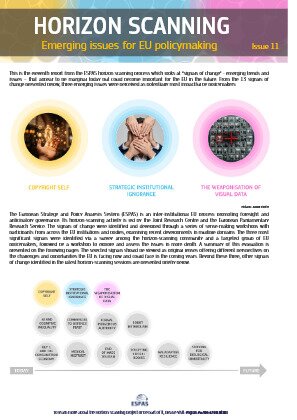
    Exploring Demographic Change for a Future-Oriented EU R&I SystemNovember 2025

    Key takeaways from a foresight study

    Europe’s research and innovation (R&I) system is under mounting pressure as demographic decline, rapid technological
    shifts, and constrained funding begin to alter student intake, the graduate pipeline, and research career prospects. By 2050, Europe could face 1.5 million fewer higher education students and a 12% decline in the labour force. These trends call for bold, future-oriented strategies.

    Comissionned by DG Research & Innovation, the Foresight-on-Demand project team adopted a structured foresight architecture designed to translate broad uncertainties into actionable strategy. A hybrid and multi-stage strategic foresight methodology was used to systematically assess the impact of demographic change on the European R&I system.

    What you'll find in this report:

    • Background data showing a shrinking youth population, a declining workforce, and growing fiscal pressures on R&I funding.
    • A six-step Foresight Process combining horizon scanning, scenario-building, and windtunneling to anticipate future challenges.
    • Four Scenarios illustrating different pathways for Europe’s R&I system.
    • Strategic actions to protect fundamental research, foster lifelong learning, strengthen regional innovation, and build societal trust in technology.

    Posted on: 25/09/2025

    Last Edited: 5 months ago

    Futures Thinking and Strategic Foresight in ActionApril 2025

    Insights from the Global South

    Our societies are facing increasingly complex sets of risks, and the rapid pace of change is challenging existing governance systems. There is a growing acknowledgement of the need to transform current approaches to policymaking and decision-making to become more futureoriented in support of anticipatory action and building long-term resilience.

    The UN Summit of the Future, held in September 2024, marked a pivotal moment in global governance. The Pact for the Future, including its annexes on a Global Digital Compact and a Declaration on Future Generations, was adopted by the UN General Assembly by consensus and committed to a broad range of priorities to ensure that the multilateral system is better able to
    address the realities of today and prepare for the challenges of tomorrow.

    To contribute to fostering a culture of anticipation and preparedness, and to building a multilateral system that remains relevant for current and future generations, the UN Futures Lab/Global Hub and the International Science Council (ISC) have collaborated to better understand the concrete and transformational role of futures thinking and strategic foresight in informing decision-making and action. Futures thinking and strategic foresight are key to helping us address complex issues and deal with significant uncertainty – and to embedding long-term perspectives that consider policy implications on future generations.

    Drawing on case studies from the Global South , this joint paper demonstrates the versatility of foresight practices with a focus on tangible actions for decision-makers and policymakers. It also illustrates how these approaches can support anticipatory governance and resilience building, offering lessons learned and practical recommendations.

    The selection of 14 case studies presented in this report reflect balance across geographies, themes, sectors, stakeholders, and foresight tools. The case studies illustrate a range of impacts, primarily through a typology of approaches by desired outcomes as outlined below:

    📌Local and Indigenous Knowledge, Sources, and Practices

            📌Building Local Capacities and Durable Solutions from Community-Led Initiatives

            📌Multistakeholder Partnerships and Collaborations

            📌Organizational Development

            📌Sector-Wide Policy Development and Innovation

            📌Futures Empowered by Technological Advancements and Innovation

            📌Improved Social Outcomes/Social Well-Being for Marginalized Communities

            📌Rebuilding Narratives

    🔗Source: UN Futures Lab/Global Hub and the International Science Council (2025). Futures Thinking and Strategic Foresight in Action: Insights from the Global South, New York. unfutureslab.org/project/futures-thinking-and-strategic-foresight-in-action-insights-from-the-global-south

    Posted on: 11/09/2025

    Post Image

    Last Edited: 5 months ago

    Supporting the institutionalisation of future-oriented policymaking

    A new initiative to support EU Member States in embedding long-term, anticipatory thinking into decision-making at every level—national, regional, and local. 

    Future-Oriented Policymaking is an ongoing joint project by the European Commission Directorate-General for Structural Reform Support (DG REFORM) and the EU Policy Lab of the Joint Research Centre. The project supports foresight capacity building in EU Member States and integrating future-oriented thinking into decision-making.

    The project supports foresight capacity building in EU Member States and integrating future-oriented thinking into decision-making.

    Get involved!
    The success of the project depends on the active participation of policymakers, practitioners, and citizens. Whether you are an experienced foresight practitioner or entirely new to the concept, we welcome your insights.

    Share ideas, take our survey*: Help us understand your needs and shape the final deliverables. What has worked well in your context? What challenges have you faced? How can we make foresight more relevant to your needs? > Survey

    Join our beta testing group**: Be among the first to try out our new toolkit and training materials. Your feedback will help us refine and improve these resources for everyone (fill in the survey and click join beta testing group at the end).

    * Preferably before 12 September 2025 to make full use of your ideas.

    * *Places for beta testing are limited, and we are committed to working with a diverse range of partners. If you are interested, please fill in the survey by 5/09/2025 . We will confirm participation after that date. Institutionalising future-oriented policymaking is a collective journey, which requires commitment, curiosity, and courage: from leaders, civil servants, and citizens alike. Let’s work together to make foresight a cornerstone of European policymaking. 

    Stay tuned for updates and don’t hesitate to reach out if you’d like to contribute to this exciting initiative.

    > Future-oriented Policymaking 

    Posted on: 29/08/2025

    Last Edited: 8 months ago

    Emerging applications of neurotechnology and their implications for EU governance

    A technology foresight study

    This report sums up recent developments in neurotechnology, that is, technology that can read and modify activity from the central nervous system. Some devices record information from the brain, and others deliver stimulation to the brain (and some do both).
    These technologies are rapidly advancing and are likely to have a profound impact on various aspects of society. In the near future, neurotechnology is set to revolutionise the way we approach a range of policy areas, from healthcare, education, employment, law enforcement and security, to more obvious areas such as technology, digital and research.
    The report analyses advances in the technologies for monitoring and stimulating the brain, some of which are incorporated into neurotechnology devices. It acts as a horizon-scan of new and emerging uses of these technologies, and takes these as inputs to pose a range of questions for the consideration of policymakers.

    Read more from the blogpost by the author.

    Posted on: 28/05/2025

    Last Edited: 9 months ago

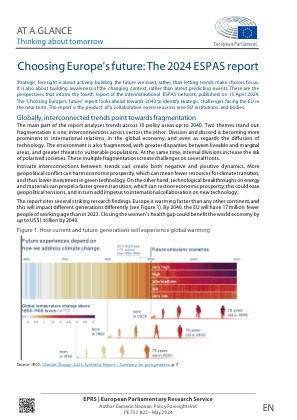
    Choosing Europe's FutureApril 2024

    The 2024 ESPAS report

    The latest report of the ESPAS network, Choosing Europe’s Future, analyses global trends in order to identify key strategic challenges for the EU as the next legislative cycle begins. It is the fruit of collaboration between nine EU institutions and bodies. Key takeaways include the importance of being able to act quickly, given that game-changing developments can happen suddenly. It notes the risk of false economies; in areas such as defence and security, for example, efforts to avoid costs now can mean far greater costs in the future. The report points to the importance of threat multipliers and gain multipliers. Action to mitigate social fragmentation can prevent knock-on effects in other domains; the development of effective clean technologies can bring dividends across the board.

    Think Tank European Parliament - Research - Advanced search - Choosing Europe's future: The 2024 ESPAS report

    Posted on: 30/04/2025

    Last Edited: 10 months ago

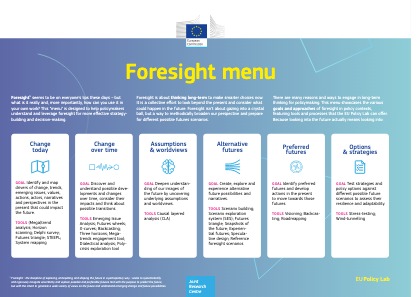
    Foresight MenuJanuary 2025

    Foresight Processes for Policymaking

    Foresight seems to be on everyone’s lips these days – but what is it really and, more importantly, how can you use it in your own work? This “menu” is designed to help policymakers understand and leverage foresight for more effective strategy- building and decision-making.

    Foresight is about thinking long-term to make smarter choices now. It is a collective effort to look beyond the present and consider what could happen in the future. Foresight isn’t about gazing into a crystal ball, but a way to methodically broaden our perspective and prepare for different possible futures scenarios.

    There are many reasons and ways to engage in long-term thinking for policymaking. This menu showcases the various goals and approaches of foresight in policy contexts, featuring tools and processes that the EU Policy Lab can offer. 

    Source: European Commission - Knowledge for policy  

    Posted on: 15/04/2025

    Last Edited: 10 months ago

    Shaping Norway’s Digital FutureMay 2024

    Norway is at the digital frontier in many areas. However, it needs to keep pace with rapid technological developments and competition, while improving performance in areas where it could catch up. Staying at the frontier requires agility, flexibility and well-co-ordinated digital policies. A national digital strategy can play an important role to ensure the policy framework in place makes the most of digital technologies and data for growth and well-being.

    Norway has identified several underlying priorities that will shape the content and structure of its forthcoming national digital strategy: ensuring high-quality information and communications infrastructure; developing the data economy; fostering data protection and information security; increasing the digitalisation of small and medium-sized enterprises; promoting an inclusive digital society in the context of an ageing population; supporting the green transition; and digitalising the public sector. These priorities will help realise Norway’s vision of a sustainable welfare society that safeguards a safe and simple everyday life for citizens and the non-governmental sector, a strengthened business sector and a better and renewed public sector.

    Norway’s digital policy landscape comprises relatively more initiatives related to Innovation than the other dimensions of the OECD Going Digital Integrated Policy Framework (the Framework), followed by Society, Access and Use. In terms of performance, Norway outperforms all OECD countries in indicators related to the effective use of digital technologies. It also outperforms the OECD and Nordic averages in societal indicators of digital transformation. Norway is above the OECD average on indicators of Trust and Access, although below the Nordic average. Norway has opportunities to catch up in indicators related to Market openness, Jobs and Innovation where there is the most potential to improve performance.

    Recommendations
    Key policy recommendations to achieve a more digital, innovative and inclusive Norway are structured around six areas:

    Encourage technology adoption and skills development to ensure a more digital-intensive economy and resilient workforce. This involves promoting adoption of digital technologies among small and medium-sized enterprises and empowering people with the skills to succeed in a digital world of work.

    Prioritise innovation to create a more digital Norway. This requires encouraging a culture of experimentation and risk taking, reducing regulatory burdens on start-ups and young firms, incentivising venture capital investment and support firms in scaling up, promoting investment in research and development, and harnessing the potential of “GovTech”.

    Maximise the potential of data, while maintaining Norway’s strong culture of trust. This includes leveraging Norway’s culture of trust to incentivise data sharing, realising the potential of open government data to drive digital innovation, taking a multifaceted approach to monitoring and addressing cyber risks, and supporting development of data-related skills and infrastructure.

    Harness the potential of digital technologies for society. This involves increasing digital inclusion through policies targeted at the groups most in need, discouraging e-waste production and encouraging e-waste recycling.

    Prepare for next generation networks and a future of unlimited connectivity everywhere. This entails upgrading fixed and mobile networks to 5G and beyond, closing geographic connectivity divides by focusing on the underserved, fostering competition and reducing red tape, and supporting businesses to improve their connectivity.

    Design holistic digital policies within effective governance and monitoring mechanisms. This involves using all dimensions of the Framework to design future digital policies; fostering interministerial and stakeholder co-operation in digital policy design and implementation; monitoring progress using the OECD Going Digital Toolkit as Norway’s national digital dashboard; and strengthening a whole-of-government approach to adoption of digital technologies in the public sector.

    Source: OECD - Publications  

    Posted on: 15/04/2025

    Last Edited: 10 months ago

    OECD Contributions to the 2030 Agenda and BeyondJune 2024

    Shaping a Sustainable Future for All

    The world is at a critical juncture, facing an array of interconnected global challenges. These challenges affect everyone, particularly the poorest and most vulnerable, and range from the triple planetary crises of climate change, biodiversity loss, and pollution, to pandemics, food and energy shortages, large-scale forced migration, rising domestic and global inequality, and escalating armed conflicts. In this context, there has been an alarming stagnation in progress towards achieving the Sustainable Development Goals (SDGs). The rise in public debt levels in many low- and middle-income countries is concerning. The United Nations (UN) Secretary-General's 2023 special edition report on SDG progress underscored that the next five years are critical, as failure to achieve the SDGs could lead to even greater poverty and inequalities, political instability, economic upheaval, and irreversible environmental damage.

    Yet, many countries are facing challenges in ensuring that their governance systems are capable of addressing these complex and interconnected challenges. A need for better governance, effective policy integration, sustainable investment choices as well as effective use of public resources, including Official Development Assistance (ODA), - as well as better international governance of SDGs - to meet sustainable development needs has never been more urgent. Delivering these improvements will require unprecedented action and decisions from public institutions and political leaders, effective and inclusive multilateral cooperation, with the goal of uniting diverse stakeholders to deliver nothing short of a rescue plan for people and the planet, in line with the call to action made by the UN Secretary General.

    As countries approach 2030, there is increasing recognition that the SDG commitments to “leave no one behind” and “reach those furthest behind first” need to extend beyond this timeline. In this context, the UN Summit of the Future presents a unique opportunity to tackle both current and future challenges, with a view to enhancing global collaboration on critical issues. The OECD’s policy work and active global engagement demonstrates its commitment to support all countries to individually and collectively achieve this objective.

    This Report aims to provide OECD support to inform decision making ahead of the UN Summit of the Future and following high-level events. It leverages OECD knowledge, data, tools, instruments and good practices to support national and international actions to respond to future challenges and opportunities. This report addresses two major breakthroughs proposed in the UN Secretary General's Rescue Plan for People and Planet: equipping governance and institutions for sustainable and inclusive transformation, and prioritising policies and investments with multiplier effects for sustainable development. It also aligns with the bold actions outlined in the anticipated Pact for the Future, addressing three of the five key priorities: sustainable development and financing for development; science, technology, innovation, and digital co-operation; and youth and future generations.

    Governance for equitable and sustainable transformation

    Transforming governance systems for sustainable development requires overcoming sectoral silos and policy fragmentation, as well as setting practical, and where feasible, ambitious and coherent economic, social, and environmental objectives that extend beyond short-term political cycles. Establishing robust policy coherence mechanisms is therefore needed to harmonise policy priorities and promote collaboration where most effective, with a view to reducing policy fragmentation, ensuring mutually reinforcing policies across sectors and government levels, and minimising negative transboundary effects of domestic policies.

    Sound governance for sustainable transformation also calls for the strategic use of various government tools - such as strategic foresight, people-centred public policy, mechanisms for stakeholder engagement, regulatory policy, public procurement and budgeting – in order to build resilient, sustainable and inclusive societies. It also calls for ensuring information integrity and providing access to justice for all, which are critical for the sound implementation of individual rights and government commitments.

    Effective governance systems also require the alignment of public investments with the public interest and sustainability priorities, including through the use of existing planning tools, such as National Sustainable Development Strategies, National Development and Decarbonisation Plans, strategic public investment decisions to foster inclusive and sustainable futures, stimulating further investments from private and other sectors, and leveraging transition finance to build resilient infrastructure and other strategic sectors. Integrity and building trust are also core objectives, crucial for fighting corruption and illicit financial flows, essential for effective public service delivery and sustainability. There is also a need to develop and maintain regulatory frameworks that facilitate compliance with SDGs, including the integration of the SDGs across the regulatory cycle and enhancing regulatory co-operation. In addition, developing new measures of progress that focus on both people and the planet will be crucial to a more holistic understanding of global economic prosperity and progress beyond GDP. To this end, the newly established International Forum on Total Official Support for Sustainable Development (TOSSD) could play a pivotal role.

    Finally, adopting a territorial approach to the SDGs is essential as cities and regions play a critical role in promoting a paradigm shift towards sustainability. At least 105 of the 169 SDGs targets will not be achieved without proper engagement and coordination with local and regional governments. The SDGs provide the appropriate framework to define and shape local and regional development visions, strategies, plans, and re-orient existing ones towards sustainable development.

    Policies and investments for sustainable transformation

    Sustainable transformation requires prioritising policies and investments that are mutually reinforcing and can catalyse progress across social, economic, and environmental dimensions, serving as multipliers to accelerate the achievement of the SDGs. This includes closing divides to leave no one behind, through strengthening policies and investments for social inclusion and identifying areas where social inclusion initiatives can be pursued in synergy with environmental protection. A key example of this is pursuing universal social protection, in light of its significant multiplier effects across different SDGs and incomparable potential for promoting just transitions. In addition, leveraging environment-human-well-being synergies is essential for coherent and effective SDG implementation. This requires enhancing transition finance credibility, strengthening domestic enabling conditions, addressing the labour and distributional impacts of climate policies, accelerating access to clean energy, and protecting biodiversity. In addition, there is a need to strengthen measures to protect lives in disaster situations by aligning disaster risk reduction and climate change adaptation responses.

    Additional financing for sustainable transformation

    Delivering an SDG stimulus requires innovative and collaborative solutions to unlock and scale up all sources of financing – public and private, domestic and international – for sustainable development and to address interlinked global crises. These need to harness productive trade and tax revenues, as well as international flows, to support SDG financing, including through innovative financing mechanisms, ensuring that financial flows, trade, development co-operation and other policies align with SDGs and promote inclusive and equitable outcomes, as well as encouraging green budgeting, developing effective tax policies, and improving tax administration, including via digitalisation of tax processes. This may also include innovative forms of financing, such as targeting support to enhance co-operation between public and private financial institutions through blended finance instruments, green, social, and sustainability bonds, and local currency solutions. Once again, integrity, compliance, anti-corruption and the fight against illicit finance are crucial for effective domestic resource mobilisation and attracting additional external financing from both private and public sources.

    Science, technology, and innovation (STI) for sustainable and inclusive transformation

    It is essential to design and implement STI policies in a manner to address societal challenges and achieve sustainable transformation, as set out in the OECD Transformative Agenda for STI Policies. Promoting trustworthy artificial intelligence (AI) is critical for digital transformation. AI is a powerful, versatile technology which has the potential to transform how we work, learn and interact, boosting productivity and economic growth and accelerating progress towards addressing global challenges, such as food security and climate change. However, we also need to address the risks raised by AI technology, including those related to privacy, safety, security, human rights and AI-generated disinformation and manipulated content. Beyond AI, policy efforts needed in the area of digital transformation also include enhancing broadband connectivity; achieving well-performing digital health systems through digital technologies; and, strengthening data governance frameworks while upholding human rights, including women’s and girls’ human rights, which face additional risks in the digital sphere. Strategic foresight should be used for anticipatory and innovative policy exploration about multiple futures, including by assessing emerging critical risks and opportunities in the face of various technological advancements and their implications on our economy and society. Strengthening data governance frameworks will be essential to ensure high standards of data protection, and facilitate data access and sharing across jurisdictions, including in the public sector.

    Empowering youth for a more equitable and sustainable future

    Addressing the needs and rights of youth and future generations is crucial to achieve sustainable development and intergenerational justice. This requires policies that promote formal job creation, high-quality employment services, and support for youth entrepreneurship, as well as social protection systems to meet the specific needs of youth, access to affordable housing, and outreach to vulnerable and disadvantaged young people. Promoting active, meaningful, and inclusive youth participation in decision-making processes at all levels will also help ensure that policies are reflective of their needs and aspirations.

    Source: OECD - Publications  
    Posted on: 15/04/2025

    Last Edited: 10 months ago

    Strategic Foresight Toolkit for Resilient Public PolicyDecember 2024

    A Comprehensive Foresight Methodology to Support Sustainable and Future-Ready Public Policy

    By exploring 25 evidence-based potential disruptions across environmental, technological, economic, social, and geopolitical domains, the Strategic Foresight Toolkit for Resilient Public Policy helps anticipate challenges and opportunities that could reshape the policy landscape between 2030 and 2050. These disruptions are not predictions, but hypothetical future developments identified through extensive research, expert consultations, and workshops. The Strategic Foresight Toolkit features a five-step foresight process, guiding users to challenge assumptions, create scenarios, stress-test strategies, and develop actionable plans. It includes facilitation guides and case studies to support effective implementation. Each disruption is accompanied by insights on emerging trends, potential future impacts, and both immediate and long-term policy options to ensure resilience and preparedness. Designed for policymakers, public administrators, and foresight practitioners, this publication is designed to promote holistic, strategic and evidence-informed decision-making. It aims to support countries and organisations in using strategic foresight to design and prepare robust and adaptable public policies for a range of possible futures. With its practical methodology and forward-looking approach, the Strategic Foresight Toolkit is a vital resource for building sustainable, resilient, and effective public policies.

    Source: OECD - Publications 

    Posted on: 15/04/2025

    Last Edited: 10 months ago

    Global Scenarios 2035April 2021

    Exploring Implications for the Future of Global Collaboration and the OECD

    In 2021, both the world and the OECD are at crossroads. The COVID-19 global pandemic has brought sudden disruption and heightened uncertainty on top of existing transformational changes such as digitalisation, geopolitical realignments, rising social inequalities and division, environmental crises and new threats to democratic governance. In this context, organisations everywhere face the challenge of modernising and adapting to remain relevant, without knowing what the future will look like or entail. The OECD in particular is entering an important period for reflection about its future, coinciding with the Organisation’s 60th anniversary and transition to a new Secretary-General.

    This report uses a strategic foresight approach to inform reflection on how best to prepare the OECD to meet the needs of a highly unpredictable future. It was developed by the OECD’s Strategic Foresight Unit to demonstrate how navigating the future of global collaboration and the Organisation’s role within it will require ongoing exploration and dialogue about what may be possible, and desirable, in the future.

    The report begins by exploring drivers of change that could significantly affect the future of global collaboration in public policy. For example, geopolitical realignments and heightened rivalries may undermine trust just as emerging risks to humanity make global collaboration more essential than ever before. The growing centrality of digital technologies may lead countries to develop separate digital ecosystems, threatening interconnection and interdependence between states. Platform companies are gaining significance in – and influence over – human lives, and may be poised to play an even greater role in shaping global standards and societal outcomes. Accelerated uptake of virtual reality could create new patterns of human settlement and interaction, and foster new powerful social movements and identities. Finally, an emerging bioeconomy and circular economy may transform global value chains, while a rapid expansion of private sector involvement in space opens new areas of economic activity.

    Next, the report presents three scenarios for how the world could be very different than expected in 2035. While representing just three of an infinite number of possibilities, these scenarios were selected and developed for their potential to challenge current assumptions and raise important questions for the future of global collaboration and the OECD.

    1.Multitrack World explores a scenario where humanity has formed into several separate and largely parallel clusters, each operating within its own data infrastructure and digital ecosystem. This scenario raises questions about how the OECD could best serve as a bridge between competing entities, and how to advance universal global principles in a context of potentially diverging values and definitions of well-being.

    2.Virtual Worlds explores a scenario where the majority of human experience takes place in highly immersive and engaging virtual reality spaces, and where there is strong pressure by citizens for such spaces to be globally connected and interoperable. This scenario raises questions about what kinds of governance may be needed to address policy issues in and concerning virtual space, and what relationships with non-state actors the OECD may need in order to make an effective contribution to global collaboration in this newly dominant dimension of human life.

    3.Vulnerable World explores a scenario where humanity faces a number of critical existential threats and opportunities that require an unprecedented level of near-perfect global collaboration in order to safeguard its vital common interests. This scenario raises questions of how effective governance of the global commons can be realised in these key areas, and the potential contribution of the OECD.

    Taken together, these scenarios suggest a number of strategic considerations for how the OECD could prepare to meet the evolving needs of the global community in the face of a highly dynamic and uncertain future. These considerations relate to the purpose, values, representation, operations and future readiness of the Organisation.

    In terms of purpose, the possibility of different future divisions and alliances in the global system suggest the OECD may need to strengthen its bridge-building role, particularly on key issues of global concern. This in turn requires an assessment of which values should guide various aspects of the Organisation’s work, with an emphasis on evidence-based analysis and well-being serving as a potential framework when working across competing economic and political systems.

    In terms of representation, the OECD may need a greater ability to work closely with non-member governments and various non-state actors in a world where these have a growing influence over global policy standards and outcomes. The scenarios also raise a number of operational considerations, including ensuring the OECD’s capacity to play a leadership role in virtual space. Finally, the scenarios suggest the OECD needs to strengthen its ability to prepare for uncertainty and respond to emerging priorities such as existential threats.

    The aim of this paper is to inform discussion on how best to prepare the OECD to meet the needs of a highly unpredictable future. Its intended audience is all those who have a stake and role in decisions about the future of the Organisation. This includes first and foremost member countries and OECD management and staff, but also the much broader community of countries, organisations and citizens who participate in and benefit from the activities of the OECD.

    Source: OECD - Publications 

    Posted on: 15/04/2025

    Last Edited: 10 months ago

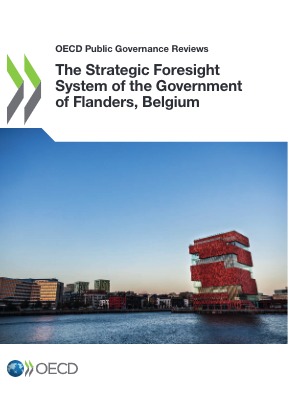
    The Strategic Foresight System of the Government of Flanders, BelgiumMay 2024

    Across OECD countries, the adoption of strategic foresight – defined as an established practice of an organisation to constantly perceive, make sense of, and act upon the future as it emerges – has become indispensable for governments seeking to anticipate and navigate complex and volatile policy landscapes. Strategic foresight guides the formulation of policies that are robust and adaptable in the face of uncertainty. It facilitates the establishment of shared objectives, the reframing of policy issues, the early detection of emerging trends, the rigorous testing of existing policies, and the fostering of innovation for better outcomes.

    Recognising the importance of strategic foresight, the European Union has significantly invested in developing its capabilities and networks and enhancing the resilience and recovery efforts of regions. OECD research underscores the importance of adopting a multi-level strategic foresight approach, fostering synergies and collaboration among different governmental actors to address global challenges. This requires a departure from traditional hierarchical structures towards more adaptive, multi-level and multi-actor frameworks that can effectively navigate uncertainty.

    The Government of Flanders, Belgium, is undertaking to strengthen its strategic foresight capacity to improve resilient policymaking. This report assesses the current state of strategic foresight initiatives within the Government of Flanders, examining their depth and systemic integration. The report also offers tailored recommendations to enhance the system.

    To date, Flanders’ strategic foresight endeavours have focused on project-based initiatives with a primarily regional scope. OECD analysis suggests that efforts to embed strategic foresight more systematically across government are still in their infancy. The report outlines key insights across five critical dimensions of strategic foresight: demand and mandate; capabilities and skills; institutional arrangements; integration into the policy cycle; and mechanisms for feedback and learning.

    The main findings underscore several critical areas for improvement in strategic foresight for the Government of Flanders:

    - Build a stronger case for strategic foresight. While strategic foresight is increasingly integrated into government initiatives, its potential as a core function is still unrecognised. There is opportunity to highlight its benefits by observing how the Government of Flanders has successfully used strategic foresight methods to explore and solve problems.

    - Establish clear mandates for co-ordination: Horizontal co-ordination is essential to breaking down silos and addressing cross-sectoral challenges effectively. An explicit mandate for co-ordination can facilitate this process and ensure strategic foresight initiatives are aligned with overarching goals.

    - Ensure leadership support and commitment: Leadership endorsement is vital for fostering a culture that values strategic foresight. Leaders should create an enabling environment for experimentation, knowledge-sharing and resource allocation, drawing upon regional and international networks for insights.

    - Provide tailored training for officials: Comprehensive training programmes can enhance understanding and appreciation of strategic foresight among elected and non-elected officials. They should address biases about foresight work and promote its effective use across government.

    - Develop guidelines for multi-level strategic foresight: Policymakers require clear guidance on how to incorporate multi-level strategic foresight into decision-making processes. Concrete instructions and manuals can facilitate this and ensure consistency in its application.

    - Allocate dedicated resources: Adequate resources, including funding, time, and expertise, are crucial for building and sustaining strategic foresight capabilities within government. This investment is essential for internal projects, external collaboration and professionalisation efforts.

    - Integrate foresight into policy priorities: Strategic foresight needs to be closely aligned with policy priorities and strategic planning processes. Demonstration cases and flagship projects can illustrate this alignment, while continuous monitoring ensures the integration of long-term perspectives into policymaking.

    - Clarify the role of public administration: It should be explicitly stated that strategic foresight is a fundamental component of policymaking, ensuring that long-term challenges are adequately considered when presenting policy options to decision makers.

    - Enhance engagement with stakeholders: Engaging with academia, civil society, businesses, and other stakeholders is essential for enriching long-term policy planning efforts. Collective intelligence and collaboration can enhance the effectiveness of strategic foresight initiatives.

    - Develop a multi-level anticipatory intelligence system: Strengthening international partnerships and data-gathering capabilities are critical for establishing a resilient anticipatory intelligence system. The system should seamlessly integrate current indicators with evidence gathered through strategic foresight methodologies.

    These findings on the Government of Flanders’ strategic foresight system serve as a foundation for further development, culminating in the co-creation of a blueprint for promoting strategic foresight practices within the region.

    Source: OECD - Publications 
    Posted on: 15/04/2025

    Last Edited: a year ago

    Innovation 2030

    Investigating & monitoring the changing conditions, trends and needs for the Region of Central Macedonia

    As radical innovations are having a profound impact globallyon the macroeconomic environment, the Region of Central Macedonia is monitoringclosely following the developments, trends and variables that favour or affect it or negatively affecting its development.
    Institutions and executives from the private and public sector have explored through a participatory and dynamic process (Thematic Participatory Workshop) the variables that will the innovation and entrepreneurship environment of the region with time horizon 2030, identified their dynamics and evaluated their interaction. The findings provided input to the working group for the development of four scenarios that will define the future of innovation in the region of Central Macedonia in the coming decade. These scenarios identified
    the development of a proposal of three strategic axes, developing in a stepwise manner in three different periods, which will strengthen the resilience of the region and prepare it to face the conditions in these four futures.

    The study is available in Greek.

    Posted on: 21/02/2025

    Post Image

    Last Edited: a year ago

    OECD Strategic Foresight Toolkit for Resilient Public Policy just released

    A Comprehensive Foresight Methodology to Support Sustainable and Future-Ready Public Policy

    OECD has released the Strategic Foresight Toolkit for Resilient Public Policy, designed to help policymakers anticipate and navigate future challenges and opportunities.

    By exploring 25 potential disruptions across environmental, technological, economic, social, and geopolitical domains, the Toolkit equips governments with a practical, five-step foresight methodology to challenge assumptions, create scenarios, stress-test strategies, and develop future-ready policies. It includes facilitation guides, case studies, and actionable insights to support resilience in an uncertain world.

    Posted on: 22/01/2025