Loading...

    sorted by publishing date

    Post Image

    Last Edited: 13 days ago

    Thus Spoke Arta

    How Our Planet Is Entering a New Era

    We are living through a transition that feels, at once, like collapse and awakening. The crises surrounding us—ecological breakdown, technological acceleration, geopolitical fragmentation—are often treated as separate problems. But they are not. They are symptoms of a deeper rupture: a failure in how we perceive reality itself.


    This is the beginning of the “Big Shift.” Not merely a historical turning point, but a transformation in consciousness. The dominant frameworks through which humanity has understood itself—nation, progress, even “humanity” as a unified moral subject—are no longer sufficient. They fragment under pressure because they were never grounded in the deeper fabric of existence. They abstracted us from the Earth, from each other, and ultimately from being itself.


    Long before modern crises, ancient traditions understood something we have forgotten: the Earth is not an object. It is a living, sacred reality. Early liturgical texts and cosmologies did not separate matter from meaning. To speak of the Earth was already to speak of order, of balance, of participation in a larger whole. This was not “ecology” in the modern scientific sense—it was a lived metaphysics.


    What has been lost is not knowledge in the narrow sense, but a way of knowing. The modern world, in its pursuit of control and clarity, reduced reality to what can be measured, extracted, and optimized. Technology is not the root problem; it is an extension of this perception. We did not simply build machines—we built a worldview that sees the world as machine.


    And so we arrive at a strange paradox: we speak constantly of “saving humanity,” yet we do not even know what “humanity” means. It is an abstraction, a moral placeholder, often detached from real conditions and embedded inequalities. In trying to center humanity, we displaced the Earth. And in doing so, we undermined the very conditions that make human life possible.


    A different orientation is needed. Not a rejection of humanity, but a re-centering within a larger field of existence. To love the Earth is not a poetic gesture—it is an ethical necessity. It means recognizing that harm to ecosystems is not external damage but a form of self-destruction. It means reframing ethics from human-centered to Earth-centered, from domination to participation.


    This is where the future becomes most uncertain—and most significant. Artificial intelligence and emerging technologies are often framed in terms of capability and risk. But the deeper question is ontological: what kind of intelligence are we creating? If intelligence is participation, then ethical design requires more than safeguards—it requires alignment with the structures of reality itself.


    We stand, then, at a threshold. The path forward is not a return to the past, nor a blind leap into technological futurism. It is a synthesis—a planetary civilization that draws from ancient wisdom while engaging modern knowledge. A civilization that recognizes the plurality of perspectives without losing sight of underlying unity.


    This requires new forms of leadership, new frameworks of foresight, and a redefinition of progress. Not growth for its own sake, but alignment with the conditions that sustain life and meaning.


    Ultimately, the future is not something we predict. It is something we participate in. Every action, every perception, contributes to the unfolding of reality. The question is not whether change is coming—it is whether we are capable of aligning with it.


    To become planetary beings is not to transcend the Earth, but to belong to it fully. To act with awareness that we are not separate observers, but active participants in a living, dynamic cosmos.


    The shift has already begun. The only question is whether we recognize it—and whether we are willing to follow it to its conclusion.


    Posted on: 28/05/2026

    Last Edited: 8 months ago

    Geopolitical & industrial decarbonisation scenarios to identify R&I opportunities for the EUMay 2025

    How can the EU navigate amidst global uncertainties to foster a more resilient and effective path toward industrial decarbonisation?

    This report presents the outcomes of the Geopolitical Industrial Decarbonisation Scenarios workshop, convened on behalf of the Eye of Europe Horizon Europe project by the Insight Foresight Institute. Bringing together 30 participants from across the European Union—including policymakers at EU, national, and regional levels, industry leaders, energy and climate specialists, and foresight and forecasting experts—the workshop explored how the EU can navigate mounting geopolitical uncertainty while accelerating industrial decarbonization on a 2050 horizon.

    The discussion was structured around two core aims. First, participants examined a suite of forward-looking geopolitical scenarios, assessing how divergent power dynamics, energy trade patterns, and technological trajectories could either hinder or catalyse the transition to a net-zero industrial base in the EU countries. Particular attention was paid to supply-chain resilience, strategic autonomy in critical materials, and the interplay between carbon border adjustments and global climate diplomacy. Second, the workshop sought to surface emergent research and innovation (R&I) needs and opportunities that would equip EU actors to thrive across the scenarios. Priorities highlighted include advanced electrification processes for hard-to-abate sectors, low-carbon hydrogen and synthetic-fuel value chains, circular-economy business models, and data-driven tools for real-time decarbonisation monitoring.

    Outputs from the session feed directly into the Eye of Europe project’s multi-workshop learning cycle. Immediate products comprise this extended report for attendees; aggregated insights captured in the public Pilot Logbook Part I – What we did and Part II – What we learned; and distilled policy recommendations to be released in the Eye of Europe Policy Brief: Foresight Perspectives on Key R&I Topics. Beyond documentation, the Insight Foresight Institute will leverage the findings to stimulate agenda-setting dialogues with EU bodies and industrial stakeholders, ensuring that identified R&I pathways inform Horizon Europe programming and other EU-level funding instruments. Workshop materials and presentations are retrievable via the futures4europe.eu knowledge-sharing portal, reinforcing the project’s commitment to an open foresight community.

    Posted on: 03/10/2025

    Last Edited: 9 months ago

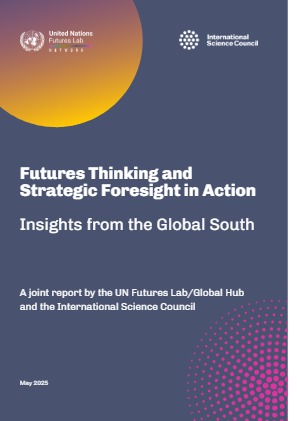
    Futures Thinking and Strategic Foresight in ActionApril 2025

    Insights from the Global South

    Our societies are facing increasingly complex sets of risks, and the rapid pace of change is challenging existing governance systems. There is a growing acknowledgement of the need to transform current approaches to policymaking and decision-making to become more futureoriented in support of anticipatory action and building long-term resilience.

    The UN Summit of the Future, held in September 2024, marked a pivotal moment in global governance. The Pact for the Future, including its annexes on a Global Digital Compact and a Declaration on Future Generations, was adopted by the UN General Assembly by consensus and committed to a broad range of priorities to ensure that the multilateral system is better able to
    address the realities of today and prepare for the challenges of tomorrow.

    To contribute to fostering a culture of anticipation and preparedness, and to building a multilateral system that remains relevant for current and future generations, the UN Futures Lab/Global Hub and the International Science Council (ISC) have collaborated to better understand the concrete and transformational role of futures thinking and strategic foresight in informing decision-making and action. Futures thinking and strategic foresight are key to helping us address complex issues and deal with significant uncertainty – and to embedding long-term perspectives that consider policy implications on future generations.

    Drawing on case studies from the Global South , this joint paper demonstrates the versatility of foresight practices with a focus on tangible actions for decision-makers and policymakers. It also illustrates how these approaches can support anticipatory governance and resilience building, offering lessons learned and practical recommendations.

    The selection of 14 case studies presented in this report reflect balance across geographies, themes, sectors, stakeholders, and foresight tools. The case studies illustrate a range of impacts, primarily through a typology of approaches by desired outcomes as outlined below:

    📌Local and Indigenous Knowledge, Sources, and Practices

            📌Building Local Capacities and Durable Solutions from Community-Led Initiatives

            📌Multistakeholder Partnerships and Collaborations

            📌Organizational Development

            📌Sector-Wide Policy Development and Innovation

            📌Futures Empowered by Technological Advancements and Innovation

            📌Improved Social Outcomes/Social Well-Being for Marginalized Communities

            📌Rebuilding Narratives

    🔗Source: UN Futures Lab/Global Hub and the International Science Council (2025). Futures Thinking and Strategic Foresight in Action: Insights from the Global South, New York. unfutureslab.org/project/futures-thinking-and-strategic-foresight-in-action-insights-from-the-global-south

    Posted on: 11/09/2025

    Post Image

    Last Edited: a year ago

    Planetary Foresight and Ethics

    New Book

    Summary

    Core Themes
    The book reimagines humanity’s future through planetary foresight, blending historical wisdom with planetary stewardship. It critiques linear Western progress narratives and advocates for a hybrid, cyclical vision of history, emphasizing pluralistic identities and reverence for life.

    Structural Framework
    Organized into thematic sections, the work begins with “The Mysterious Lord of Time,” challenging linear temporality and introducing non-linear, culturally diverse historical perspectives. “Evolving Belief Systems” contrasts Indo-Iranic, Mesopotamian, and Hellenic thought with Abrahamic traditions, highlighting ancient influences on modern pluralism.

    Imagination and Futures
    The “Histories of Imagination” section explores myth and storytelling as drivers of civilization, while “Scenarios of Future Worlds” applies foresight methodologies to geopolitical and technological evolution, emphasizing ecological consciousness. The final chapters expand to cosmic intelligence and ethics, framing humanity’s role within universal interconnectedness.

    Ethical Vision
    Central to the thesis is a call for planetary identity and stewardship, merging forgotten wisdom traditions with modern foresight to navigate ecological and technological uncertainties. The book positions itself as both a philosophical guide and practical framework for ethical transformation in an era of global crises.

    Key Argument
    Motti asserts that humanity is transitioning from a “Second Nomad Age” (characterized by fragmentation) toward a “Second Settlement Age” marked by planetary consciousness, requiring creative complexity and ethical vigilance.

    Posted on: 23/04/2025

    Last Edited: a year ago

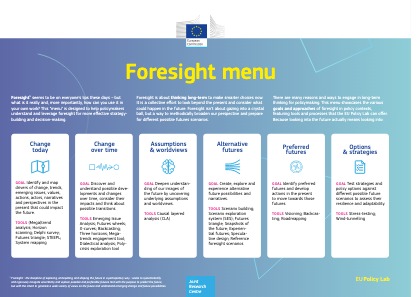
    Foresight MenuJanuary 2025

    Foresight Processes for Policymaking

    Foresight seems to be on everyone’s lips these days – but what is it really and, more importantly, how can you use it in your own work? This “menu” is designed to help policymakers understand and leverage foresight for more effective strategy- building and decision-making.

    Foresight is about thinking long-term to make smarter choices now. It is a collective effort to look beyond the present and consider what could happen in the future. Foresight isn’t about gazing into a crystal ball, but a way to methodically broaden our perspective and prepare for different possible futures scenarios.

    There are many reasons and ways to engage in long-term thinking for policymaking. This menu showcases the various goals and approaches of foresight in policy contexts, featuring tools and processes that the EU Policy Lab can offer. 

    Source: European Commission - Knowledge for policy  

    Posted on: 15/04/2025

    Last Edited: a year ago

    German Call for Papers: Foresight in Theorie und Praxis13 April - 03 May 2025

    As part of the "Foresight in Theory and Practice" track at the INFORMATIK FESTIVAL 2025 in Potsdam

    Die gegenwärtige Zeit ist geprägt von rasanten und oft gleichzeitig stattfindenden Veränderungen und
    Entwicklungen: Technologien wie Künstliche Intelligenz (KI), neue regulative Anforderungen wie die CSRD
    oder der EU AI Act sowie gesellschaftliche und politische Herausforderungen sorgen für dynamische und
    disruptive Zukunftsperspektiven mit spezifischen Anforderungen an die Resilienz und das
    Innovationsmanagement. Die strategische Vorausschau (Foresight) gewinnt aus diesem Grund sowohl in
    Unternehmen als auch in der Forschung zunehmend an Bedeutung.

    Der Workshop „Foresight in Theorie und Praxis“ dient daher als Forum, um Akteure aus Unternehmen und
    wissenschaftlichen Einrichtungen zusammenzubringen und Erfahrungswerte sowie Kooperationspotenziale
    der strategischen Vorausschau zu diskutieren. Insbesondere soll dabei auch die Bedeutung der Informatik
    für den Aufbau und die Weiterentwicklung eines Foresight-Prozesses berücksichtigt werden. 

    Folgende Fragestellungen bieten eine Orientierung über die thematischen Schwerpunkte des Workshops:

    1. Welche Forschungsansätze im Bereich Foresight existieren bereits? Wo gibt es weiteren
      Forschungsbedarf?
    2. Wie werden Forschungsansätze derzeit bereits in der Praxis angewandt? Wodurch zeichnen sich
      diese aus und wo liegen die Grenzen?
    3. Wie gestaltet sich strategische Vorausschau in Unternehmen? Wie unterscheidet sich diese in
      Großunternehmen und KMU?
    4. Wie kann strategische Vorausschau in wissenschaftlichen Einrichtungen umgesetzt werden? Wo
      liegen Unterschiede zur unternehmerischen Herangehensweise, wo gibt es Gemeinsamkeiten?
    5. Wie können digitale Technologien (z. B. IT-Anwendungen, KI) die strategische Vorausschau
      unterstützen und verbessern? Welche Ressourcen und Kompetenzen sind hierfür erforderlich?

    Die Beiträge zum Workshop können verschiedene Aspekte von Foresight bzw. strategischer Vorausschau
    behandeln. Mögliche Themen sind (nicht abschließend):

    • Methoden der strategischen Vorausschau
    • Anwendung von Foresight in Unternehmen
    • Anwendung von Foresight in wissenschaftlichen Einrichtung
    • Digitale Technologien zur Unterstützung von Foresight (z. B. KI, Big Data, Simulationen)
    • KI und Foresight
    • Simulationstechniken
    • Datenanalysen/Datenmangement
    • Szenariotechniken
    • Trendanalysen
    • Horizon Scanning
    • Innovationsmanagement
    • Organisatorische und kulturelle Herausforderungen der strategischen Vorausschau
    • Regulatorische und ethische Aspekte von Foresight
    • Unternehmensstrategie und Foresight
    • Risikomanagement mit Foresight
    • Best Practices und Praxisberichte

    Zielgruppe des Workshops sind Forschende und Anwendende aus dem Bereich strategische Vorausschau
    bzw. Foresight sowie:

    • Fach- und Führungskräfte aus Unternehmen, die strategische Vorausschau in ihre Planung
      integrieren
    • Beratende im Bereich Zukunftsforschung und Trendanalyse
    • Verantwortliche für Innovations- und Technologiemanagement
    • Entscheidungsträger*innen in Politik und Verwaltung, die zukunftsorientierte Strategien entwickeln
    • IT-Experten*innen und Entwickler*innen von digitalen Foresight-Tools
    • Wissenschaftler*innen und Studierende mit Interesse an Foresight-Methoden

    HINWEISE ZUR EINREICHUNG

    Einreichungsfrist für Workshop-Beiträge: 04.05.2025
    Benachrichtigung der Autoren: 02.06.2025
    Einreichungsfrist für LNI-Beiträge: 11.06.2025
    Workshop: 19.09.2025

    Die Einreichung der Beiträge erfolgt als PDF über EasyChair.

    Für die Beiträge sind die LNI-Vorlagen zu verwenden.

    Beiträge können in deutscher oder englischer Sprache verfasst werden und sollten folgenden Umfang nicht überschreiten:

    Full Paper: 10-12 Seiten

    Short Paper: 6 Seiten

    Work-In-Progress-Paper: 3-5 Seiten

    Praxisbeiträge aus der Industrie: 3-5 Seiten

    Posted on: 14/04/2025

    Post Image

    Last Edited: a year ago

    OECD Strategic Foresight Toolkit for Resilient Public Policy just released

    A Comprehensive Foresight Methodology to Support Sustainable and Future-Ready Public Policy

    OECD has released the Strategic Foresight Toolkit for Resilient Public Policy, designed to help policymakers anticipate and navigate future challenges and opportunities.

    By exploring 25 potential disruptions across environmental, technological, economic, social, and geopolitical domains, the Toolkit equips governments with a practical, five-step foresight methodology to challenge assumptions, create scenarios, stress-test strategies, and develop future-ready policies. It includes facilitation guides, case studies, and actionable insights to support resilience in an uncertain world.

    Posted on: 22/01/2025