Loading...

    Mentions of

    sorted by publishing date

    Last Edited: 18 days ago

    Foresight as a Key Social Infrastructure for EuropeDecember 2025

    A Manifesto of the Research&Innovation Foresight Community

    Preamble
    Across Europe, the use of foresight for Research and Innovation (R&I) policy is growing, but unevenly. In many places, it still sits at the margins of policymaking, and its full potential—to inspire broader societal change—is not yet realised.

    The European R&I foresight community, made up of practitioners, policymakers, researchers, and future-oriented thinkers, is
    becoming stronger and more connected. The Eye of Europe project, supported by the European Commission, helps this
    community grow through the online hub futures4europe.eu, as well as workshops, conferences and shared learning spaces.

    This manifesto stems from a “foresight on foresight” workshop held in Mamaia, Romania (18–19 September 2025), coordinated by UEFISCDI and the Austrian Institute of Technology. 30 foresight practitioners and R&I policy experts from across Europe gathered to imagine how foresight could better support R&I policy and practice. Furthermore, these contents have also been discussed and enriched during Eye of Europe’s final mutual learning event held in Chișinău, Moldova (23–24 October 2025).

    This manifesto recognises the growing importance of foresight—not only within European R&I systems but also at the interface between R&I and society—repositioning the field as a driver of inspiration and renewal in shaping Europe’s futures.

    Foresight as a Key Social Infrastructure for Europe
    Vision 2030 in a nutshell

    Research and Innovation (R&I) foresight is a shared space of imagination and inquiry, enabling Europe to live creatively with emergence and diversity. Beyond agenda-setting, it cultivates futures literacy across science, policy, and society — expanding our capacity to sense, interpret, and engage with novelty.

    Embracing the open and interdependent nature of the world, foresight complements evidence with creativity and plural ways of knowing. It guides Europe’s research and innovation ecosystems to act with openness, responsibility, and imagination — co-creating sustainable and just futures as a shared public good.

    🔵 EXTENDED ROLE OF R&I FORESIGHT
    In 2030 R&I foresight enables boundary spanning, connecting sectoral policies, disciplines, and perspectives. Its value lies not only in generating agendas or scenarios, but in reshaping worldviews, reframing challenges, cultivating agency, enabling collective reflection, and inspiring transformative action

    🔵 OPEN AND INCLUSIVE SPACES
    In 2030 foresight thrives on openness, diversity, and empathy. It creates spaces where people engage not only as experts or institutional actors, but as whole humans— bringing values, worldviews, emotions, and lived experiences into the co-creation of futures.
    Trust grows from transparency, fairness, and shared ownership of both processes and outcomes. While AI expands access to knowledge, human judgment, engagement creativity, and responsibility remain essential.

    🔵 FUTURES LITERACY AS A FOUNDATIONAL CAPACITY
    Futures literacy becomes both a foundation and a legacy of R&I foresight. It strengthens the collective ability to recognise assumptions, navigate uncertainty, and act with intention amid complexity.
    Foresight processes evolve into open spaces for learning and experimentation, cultivating anticipatory competence among experts, policymakers, and citizens. Through its practices and communication, R&I foresight contributes to a societal diffusion of futures thinking, enhancing collective intelligence and agency.

    🔵 A MATURE COMMUNITY OF PRACTICE
    Foresight gains professional depth through dedicated academic programmes and practitioner networks. A wide variety of organisations embed foresight cultures that encourage reflection, experimentation, and communication. Shared infrastructures such as futures4europe.eu evolve into open, dynamic platforms for collaboration, knowledge exchange, and innovation in foresight.

    Download the document at the top of the page to read the full version.

    Posted on: 21/01/2026

    Last Edited: 4 months ago

    Geopolitical & industrial decarbonisation scenarios to identify R&I opportunities for the EUMay 2025

    How can the EU navigate amidst global uncertainties to foster a more resilient and effective path toward industrial decarbonisation?

    This report presents the outcomes of the Geopolitical Industrial Decarbonisation Scenarios workshop, convened on behalf of the Eye of Europe Horizon Europe project by the Insight Foresight Institute. Bringing together 30 participants from across the European Union—including policymakers at EU, national, and regional levels, industry leaders, energy and climate specialists, and foresight and forecasting experts—the workshop explored how the EU can navigate mounting geopolitical uncertainty while accelerating industrial decarbonization on a 2050 horizon.

    The discussion was structured around two core aims. First, participants examined a suite of forward-looking geopolitical scenarios, assessing how divergent power dynamics, energy trade patterns, and technological trajectories could either hinder or catalyse the transition to a net-zero industrial base in the EU countries. Particular attention was paid to supply-chain resilience, strategic autonomy in critical materials, and the interplay between carbon border adjustments and global climate diplomacy. Second, the workshop sought to surface emergent research and innovation (R&I) needs and opportunities that would equip EU actors to thrive across the scenarios. Priorities highlighted include advanced electrification processes for hard-to-abate sectors, low-carbon hydrogen and synthetic-fuel value chains, circular-economy business models, and data-driven tools for real-time decarbonisation monitoring.

    Outputs from the session feed directly into the Eye of Europe project’s multi-workshop learning cycle. Immediate products comprise this extended report for attendees; aggregated insights captured in the public Pilot Logbook Part I – What we did and Part II – What we learned; and distilled policy recommendations to be released in the Eye of Europe Policy Brief: Foresight Perspectives on Key R&I Topics. Beyond documentation, the Insight Foresight Institute will leverage the findings to stimulate agenda-setting dialogues with EU bodies and industrial stakeholders, ensuring that identified R&I pathways inform Horizon Europe programming and other EU-level funding instruments. Workshop materials and presentations are retrievable via the futures4europe.eu knowledge-sharing portal, reinforcing the project’s commitment to an open foresight community.

    Posted on: 03/10/2025

    Last Edited: 6 months ago

    Futures of R&I Foresight18 September - 19 September 2025

    Vision building workshop

    𝗙𝘂𝘁𝘂𝗿𝗲𝘀 𝗼𝗳 𝗥&𝗜 𝗙𝗼𝗿𝗲𝘀𝗶𝗴𝗵𝘁 𝘄𝗼𝗿𝗸𝘀𝗵𝗼𝗽 unfolded on September 18-19th on Romania’s seaside coast — two breezy summer days that provided the perfect setting for a rich exploration of “foresight about foresight.”

    Co-hosted by Executive Agency for Higher Education, Research, Development and Innovation Funding - UEFISCDI and AIT Austrian Institute of Technology, and part of the 𝗘𝘆𝗲 𝗼𝗳 𝗘𝘂𝗿𝗼𝗽𝗲 𝗽𝗿𝗼𝗷𝗲𝗰𝘁 (a Coordination and Support Action funded by the European Commission), the event brought together the community of practice working to 𝘀𝘁𝗿𝗲𝗻𝗴𝘁𝗵𝗲𝗻 𝗥𝗲𝘀𝗲𝗮𝗿𝗰𝗵 & 𝗜𝗻𝗻𝗼𝘃𝗮𝘁𝗶𝗼𝗻 (𝗥&𝗜) 𝗳𝗼𝗿𝗲𝘀𝗶𝗴𝗵𝘁 𝗶𝗻 𝗘𝘂𝗿𝗼𝗽𝗲.

    Our shared ambition was to imagine a vision that is grounded in reality and lived experience, yet bold enough to inspire the next decade of foresight’s contribution to R&I.

    Discussions flowed through several stages:
    🌍 reflecting on today’s foresight landscape, particularly within R&I in Europe
    🔎 identifying likely drivers of change for R&I in society by 2040
    🧭 probing the forces that could reshape foresight itself by 2040 and finally,
    🚀 envisioning the role and capabilities foresight will need to support R&I in 2040.

    A vision document capturing the outcomes of the workshop will be shared in due course, once the many insights, contributions, and reflections have been carefully woven together. 

    Posted on: 17/08/2025

    Last Edited: 6 months ago

    Report on the assessment of the digital competencies needed in the Romanian civil serviceFebruary 2025

    Taking into account relevant policies at the national and European Union levels

    Romania’s public administration faces deep-rooted structural challenges that hinder the development of digital competencies and slow progress in both digital transformation and human resources management (HRM) reforms. While digital competencies are essential to achieving Romania’s public sector modernization goals, they are not a standalone solution. In this context, the government of Romania, assisted by the World Bank through the Technical Support Instrument (TSI), aims to develop a General Digital Competence Framework for Civil Servants.

    This report if one of the outputs of the TSI project; its goal is to identify the digital competencies necessary at the intersection of Romania’s digital transformation and HRM reform agendas, laying the groundwork for a more capable and future-ready public administration. The report employs a comprehensive multi-layered analysis, incorporating: a top-down review of national and EU strategies, policies, and regulations; a bottom-up analysis of job descriptions, focus groups, interviews, and working groups; international best practices in public sector digital competencies; and a foresight perspective to anticipate future digital skill needs.

    Chapter VI | Foresight: fit-for-future digital roles in the public administration describes the foresight exercise carried out by Institutul de Prospectiva and the World Bank, which was aimed at ensuring that the proposed digital competency framework will remain future-ready, enabling civil servants to navigate digital transformation, deliver citizen-centric services, and address complex policy challenges with agility and innovation. The process was meant to inform the definition of specific digital roles that are needed in the future, but also to allow the formulation of recommendations regarding the general digital competencies of public administration employees.

    The foresight methodology utilized horizon scanning and scenarios (both explorative and normative), as essential tools in helping policymakers navigate uncertainty by exploring various probable and/or desirable futures. This foresight exercise focused on the year 2032, a timeframe suited for significant structural transformation in public administration, allowing for the development and maturity of complex digital systems.

    In terms of process, the scenario-building process was based on an iterative consultation process. It built on inputs developed by the foresight team from Institutul de Prospectiva and was progressively refined through three online working sessions with international experts from the World Bank and the Joint Research Centre (JRC) and a final in-person workshop with local experts from the public administration and the private sector in Romania.
    The figure below provides a concise overview of the scenario-building steps.

    📌The Baseline Scenario “Romanian Digital Administration in 2032” provides a ‘current paradigm’ case: It takes the current Romanian strategic documents in the field of digital transformation as a starting point. It assumes that the key goals set in these
    documents are generally met by 2032. The logic is the following: assuming Romania’s current digitalization paradigm (and
    associated digital roles) turn out mostly as planned, what is the gap between this best-case baseline and the digital society scenarios for 2032?

    📌The Context Scenario about the “Digital society in Romania in 2032” is an exploratory scenario, meaning it describes a probable future rather than one driven by a deliberate vision of a desirable future society. The core scenario integrates high-impact, high-probability trends - or drivers of change -identified in the initial horizon scanning phase. While these drivers describe the evolution of the European and global contexts, their advancement has been partially adjusted to reflect specific conditions in Romania. In addition to the core scenario, four other narratives were built around drivers of change previously identified as having high impact as well as a rather high degree of uncertainty. These new dimensions largely complement rather than challenge the core scenario.

    📌The five Aspirational Scenarios 2032 describe visions regarding the digital transformation of the Romanian public administration, going beyond the trajectory set in the baseline scenario. They examine a range of potential paths/options that could contribute, individually or in various combinations, to a more ambitious and impactful digital transformation in the public administration. Each scenario revolves around a key dimension. Primarily, these dimensions emerge from Romania’s current policy discourse and strategic documents, where they are often mentioned but with limited precision or commitment. Additionally, they reflect elements of the context scenario, incorporating anticipated societal developments by 2032, as
    well as digital trends and paradigm shifts observed in public administrations in the EU and worldwide.

    A list of key digital roles follows the baseline and aspirational scenarios, outlining the expertise civil servants need to bring them to life. These roles do not distinguish between in-house and outsourced expertise, as that remains a separate decision.


    Posted on: 11/08/2025

    Last Edited: 8 months ago

    Emerging applications of neurotechnology and their implications for EU governance

    A technology foresight study

    This report sums up recent developments in neurotechnology, that is, technology that can read and modify activity from the central nervous system. Some devices record information from the brain, and others deliver stimulation to the brain (and some do both).
    These technologies are rapidly advancing and are likely to have a profound impact on various aspects of society. In the near future, neurotechnology is set to revolutionise the way we approach a range of policy areas, from healthcare, education, employment, law enforcement and security, to more obvious areas such as technology, digital and research.
    The report analyses advances in the technologies for monitoring and stimulating the brain, some of which are incorporated into neurotechnology devices. It acts as a horizon-scan of new and emerging uses of these technologies, and takes these as inputs to pose a range of questions for the consideration of policymakers.

    Read more from the blogpost by the author.

    Posted on: 28/05/2025

    Post Image

    Last Edited: 9 months ago

    Planetary Foresight and Ethics

    New Book

    Summary

    Core Themes
    The book reimagines humanity’s future through planetary foresight, blending historical wisdom with planetary stewardship. It critiques linear Western progress narratives and advocates for a hybrid, cyclical vision of history, emphasizing pluralistic identities and reverence for life.

    Structural Framework
    Organized into thematic sections, the work begins with “The Mysterious Lord of Time,” challenging linear temporality and introducing non-linear, culturally diverse historical perspectives. “Evolving Belief Systems” contrasts Indo-Iranic, Mesopotamian, and Hellenic thought with Abrahamic traditions, highlighting ancient influences on modern pluralism.

    Imagination and Futures
    The “Histories of Imagination” section explores myth and storytelling as drivers of civilization, while “Scenarios of Future Worlds” applies foresight methodologies to geopolitical and technological evolution, emphasizing ecological consciousness. The final chapters expand to cosmic intelligence and ethics, framing humanity’s role within universal interconnectedness.

    Ethical Vision
    Central to the thesis is a call for planetary identity and stewardship, merging forgotten wisdom traditions with modern foresight to navigate ecological and technological uncertainties. The book positions itself as both a philosophical guide and practical framework for ethical transformation in an era of global crises.

    Key Argument
    Motti asserts that humanity is transitioning from a “Second Nomad Age” (characterized by fragmentation) toward a “Second Settlement Age” marked by planetary consciousness, requiring creative complexity and ethical vigilance.

    Posted on: 23/04/2025

    Last Edited: 10 months ago

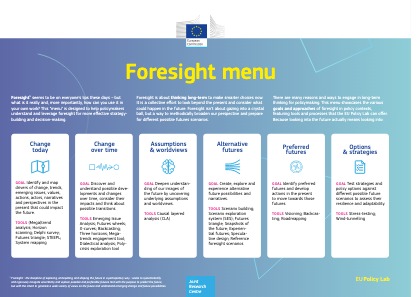
    Foresight MenuJanuary 2025

    Foresight Processes for Policymaking

    Foresight seems to be on everyone’s lips these days – but what is it really and, more importantly, how can you use it in your own work? This “menu” is designed to help policymakers understand and leverage foresight for more effective strategy- building and decision-making.

    Foresight is about thinking long-term to make smarter choices now. It is a collective effort to look beyond the present and consider what could happen in the future. Foresight isn’t about gazing into a crystal ball, but a way to methodically broaden our perspective and prepare for different possible futures scenarios.

    There are many reasons and ways to engage in long-term thinking for policymaking. This menu showcases the various goals and approaches of foresight in policy contexts, featuring tools and processes that the EU Policy Lab can offer. 

    Source: European Commission - Knowledge for policy  

    Posted on: 15/04/2025

    Last Edited: 10 months ago

    Constructing Scenarios for the Future of Teaching in WalesFebruary 2025

    After an extensive synthesis of the OECD’s existing work on the teaching profession over the years, the need to explore professional roles and identity became obvious. The roles and responsibilities of teachers have seen significant changes over the past decade. Education, childhood, labour markets and society as a whole have experienced considerable changes, prompting the need to think about the effects of changes on the teaching profession. The OECD Centre for Educational Research and Innovation (CERI) project on New Professionalism and the Future of Teaching project researched how professionalism has evolved, including the importance of working with others to confront increasingly complex contexts, so called “connective professionalism”. Based on the evidence base and ideas for next practice, the project developed a methodology to help diverse stakeholders in education to construct a shared vision on what the teaching profession could look like in the future.

    This study in Wales (United Kingdom) is the second in a series of three education system studies conducted in 2023 and 2024. Various stakeholders, including teachers, school leaders, researchers, teacher educators, teacher unions, and professionals (potentially) supporting teachers and schools provided feedback on their ambitions for the future of teaching in Wales. Choosing among a set of ambitions to better connect teachers with other professionals within the school community, other education providers (such as universities and teacher education colleges) and broader society, they shared their judgements of what would be high priority and also how big a change this would be from the current context. Would it be an ambition for transformation over a period of many years? Or would it be possible to build on existing mechanisms or initiatives? Or could this ambition be achieved by improvements over the short term?

    Different perspectives were gathered in two main ways. First, via an online survey. Second, via two stakeholder workshops in Bangor and Cardiff where a total of six working groups collectively constructed scenarios for the future of teaching. Each working group comprised individuals with different roles and responsibilities in or around schools. They worked with the results of the survey and selected priority ambitions to support their vision on the future of teaching. These provided stimulus for their discussions, but their specific visions grew out of a mutual exchange of professional experiences from different perspectives within and surrounding teaching in Wales.

    Of course, this study in no way aims to be representative or comprehensive. It draws on the work of a group of willing professionals with a stake in Wales education who offered to share their expertise. This initial effort to anticipate and increase deeper, structured thinking about medium- and long-term scenarios for teacher professionalism and empowerment offers input on how to strengthen the teaching profession in Wales. Potential benefits for the system include long-term strategic thinking regarding the Welsh teacher workforce and finding solutions to issues that transcend the short term.

    While constructing their scenarios for the future of teaching, stakeholders reflected on four research questions set for this study by the team at Welsh Government in consultation with the OECD.

    How do we develop teacher professional identity and a more collaborative profession? The set of future scenarios envisage a focus on collective professional identity at a school level. There would be particular focuses on peer-to-peer interactions as well as school-to-school exchanges. Time and space would be provided to support a variety of exploration that involves building innovations, following passions and interests, engaging in shared learning, working with colleagues, communities and other partners.

    How could a career development perspective for all staff in schools contribute to a vibrant and thriving workforce? Career development would be an integral focus to support the workforce. This would include visible and diverse career pathways that follow and invest in career journeys. Teachers would be supported to engage in their own professional growth journey and collaborations that enrich their professional work. Career pathways would allow for flexibility and lifelong learning opportunities that support a dynamic workforce.

    How can all who work in schools encourage innovation and the examination of professional roles in schools as learning organisations? Valuing innovative practices requires alignment at all levels to define what innovation looks like at a school level. This includes strengthening collaborative practices that support reflection, experimentation, partnering and sharing. Support includes time and space to work as part of a professional community. It is important to build connections across innovations to reduce duplication of effort and to maximise shared learning.

    And how could investment in the professional identity of teachers, especially in secondary schools, make the profession in those settings more attractive? Teachers should be able to align their intrinsic motivation to their teaching, keeping their practice closer to their professional interests and qualities, and having a sense of autonomy in their work. Investing in continuous, bespoke support and professional development enhances teacher well-being, strengthens their professional identity, and makes the teaching profession more attractive and rewarding. Meaningful development opportunities, recognition, and leadership roles enhances the profession’s appeal and fosters long-term commitment.

    The OECD identified seven key elements that feature across a set of four preferred future scenarios for the future of teaching in Wales. Arguably, all would be important to the future of teaching and many are common to several of the scenarios. In particular, diverse professional roles and careers, healthy working environment, school leadership, community support/ partnerships, school-university partnerships, innovation and communication feature to some extent across all four scenarios. Governance and accountability were explicitly featured in three scenarios.

    The study also underlines the importance of thinking in more nuanced ways about the existing teacher workforce and potential new recruits. There is a rich diversity of professionals working within schools in Wales, with different motivations, life phases, passions, ambitions and professional development needs. An evidence-informed set of seven Welsh teacher personas provides input to stress test the set of future scenarios. What would different teachers find attractive in the future scenarios that were developed? Would it be particularly attractive to experienced teachers? Would newer recruits hold some reservations? Would it match what younger people will be looking for in their working lives? Overall, the Welsh teacher personas responded positively to the suggested scenarios for the teaching profession in Wales.

    This report presents results of the initial reflection and provides tools to extend the exercise going forward.

    Source: OECD - Publications  

    Posted on: 15/04/2025

    Last Edited: a year ago

    Eye of Europe Mutual Learning Event07 April - 08 April 2025

    FORESIGHT FOR LONG-TERM VISIONING AND PRIORITY SETTING

    The fourth Mutual Learning Event of the 𝐄𝐲𝐞 𝐨𝐟 𝐄𝐮𝐫𝐨𝐩𝐞 project took place in beautiful Budapest, focusing on "𝐅𝐨𝐫𝐞𝐬𝐢𝐠𝐡𝐭 𝐟𝐨𝐫 𝐋𝐨𝐧𝐠-𝐓𝐞𝐫𝐦 𝐕𝐢𝐬𝐢𝐨𝐧𝐢𝐧𝐠 𝐚𝐧𝐝 𝐏𝐫𝐢𝐨𝐫𝐢𝐭𝐲 𝐒𝐞𝐭𝐭𝐢𝐧𝐠."

    The event featured presentations on European and national foresight exercises, highlighting diverse practices in shaping long-term visions and setting strategic priorities. These insights fueled lively discussions during two interactive sessions.

    Over twenty participants from diverse stakeholder groups joined the event held in Budapest, Hungary: Eye of Europe partner organizations, representatives from the European Commission, R&I funding agencies, representatives of governmental bodies. 

    Presentations

    • Opening and Introduction to the Eye of Europe project | Radu Gheorghiu, coordinator (UEFISCDI, Romania)
    • Introduction to Forward-looking Activities and Policy Making | Attila Havas (CERS, Hungary)
    • Introduction of the MLE4 context, objectives and agenda | Lenka Hebáková (TC Prague, Czechia)
    • Foresight for European R&I Priorities | Nicola Francesco Dotti, EC’s DG for Research and Innovation: Common R&I Strategy & Foresight Service
    • Building anticipatory governance as a core element of policymaking across OECD countries | Julia
      Staudt
    • Malta: Foresight and Visioning in the R&I policy cycle | Jennifer Cassingena Harper, Insight Foresight
      Institute
    • UK: Discussing strategies for positioning a country or region as a leader in specific R&I domains | Luke Georghiou, University of Manchester
    • Romania: Digital Transformation in the Romanian Public Administration: Scenarios and Associated
      Digital Roles for Civil Servants | Bianca Dragomir, Institutul de Prospectiva
    • Hungary: The Priorities and the Methodology of the Programme Strategy | Péter Racskó, NRDI
      Office

    This event is the fourth in a series of five MLEs planned in the project; the following event will be held in Chișinău, Moldova. All Eye of Europe MLEs are organized by Technology Centre Prague (TC), Eye of Europe partner and key Czech national think tank and academia based NGO with a rich experience with knowledge-based policy making support and (participatory as well as expert based) foresight activities.

    The fourth Mutual Learning Event addressed topic of long-term visioning and priority-setting. The two-day foresight event gathered experts, policymakers and foresight practitioners to discuss among others participatory foresight practices, and the integration of foresight into policymaking. Presentations emphasized the importance of preparedness, stakeholder engagement, and the need for quality standards in foresight methodologies. Discussions highlighted challenges in mainstreaming foresight, including institutional commitment, regional disparities, and balancing expert input with participatory inclusiveness. Key takeaways included the need for clearer principles, stronger political support, and context-specific tools. Looking ahead, upcoming events in Romania, Moldova will serve to consolidate learnings and strengthen the foresight community’s role in shaping resilient, future-ready policies.

    Posted on: 13/03/2025

    Last Edited: a year ago

    Foresight kit for entrepreneurial mindsJune 2023

    The FOReSiGHT project
    FOReSiGHT - Flexibility and Resilience in Digital Transformation and Intelligent Automation - Advanced Skills and Tools for Academia and Entrepreneurs is a 30-month roject implemented between 2020 - 2023 by a consortium of 7 partners universities, SMEs, NGOs) from 5 countries: Romania, Germany, Italy, Croatia and Belgium.
    Overall, FOReSiGHT aims at creating a digital collaboration platform between universities and companies to anticipate and deliver future skills on intelligent automation, digital transformation & algorithmic governance, and foresight, thus fostering resilience and flexibility.

    The Foresight Kit for Entrepreneurial Minds
    This generation of students needs to embrace the idea of the future with a sense of activism and design. We encourage them to regard the future as a malleable and constructible set of possibilities. This attitude is in stark contrast with people- the youth included- feeling they are witnesses to the future unfolding, or merely in the position to adapt to change as it occurs. Future minded students are the ones exploring, imagining and deliberating potential futures. Students with entrepreneurial ambitions are invited to use the tools in this kit to go even further than imagining and debating the future; they are invited to co-create futures that are desirable for the ecosystems/communities/ clients they aim to serve.
    We trust this foresight kit for entrepreneurial minds will provide useful guidance for young people interested in shaping the future. While this is an intellectual journey aimed at university students, the kit is meant to support facilitators in organizing and running a foresight experience. Thus, the kit describes the procedural steps for organizing a foresight process for students interested in generating entrepreneurial ideas that may address the challenges and opportunities of the future, as opposed to merely speculating the opportunities of the present.

    Posted on: 06/12/2024

    Post Image

    Last Edited: a year ago

    Présentation Intermédiaire Publique de la Vision Stratégique pour L'économie Luxembourgeoise en 2050

    I very much enjoyed the Luxembourg Strategy event on 5 June 2023 presenting its draft vision for the Economy in 2050. Here is a country leading the way by setting out how to reach a zero-carbon future.

    Posted on: 25/11/2024

    Post Image

    Last Edited: a year ago

    Connecting… Futures

    The Road to 6G and the Right to Connectivity

    Hexa-X’s 6G flagship research is shaping the design of European wireless technologies to be environmentally, socially, and economically sustainable, while ensuring competitiveness in the global market.

    Posted on: 25/11/2024

    Last Edited: a year ago

    S&T Foresight - Water

    Results for the working group Water are available at: http://foresight.cnr.it/working-groups/wg-water.html

    Posted on: 25/11/2024

    Last Edited: a year ago

    S&T Foresight - Complexity

    Results for the working group Complexity are available at: http://foresight.cnr.it/working-groups/wg-comple-xxi.html 

    Posted on: 25/11/2024

    Last Edited: a year ago

    S&T Foresight - Models, Algorithms, and Data for the Future

    Results for the working group Models, Algorithms, and Data for the Future are available at: http://foresight.cnr.it/working-groups/wg-mad4future.html 

    Posted on: 25/11/2024

    Last Edited: a year ago

    S&T Foresight - Materials

    Results for the working group Materials are available at: http://foresight.cnr.it/working-groups/wg-materials.html 

    Article "STEM materials: a new frontier for an intelligent sustainable world" by Pier Francesco Moretti is available at https://bmcmaterials.biomedcentral.com/articles/10.1186/s42833-019-0004-4 

    Posted on: 25/11/2024

    Last Edited: a year ago

    S&T Foresight - Health

    Results for the working group Health are available at: http://foresight.cnr.it/working-groups/wg-health.html

    Posted on: 25/11/2024

    Last Edited: a year ago

    S&T Foresight - Food

    Results for the working group Food are available at: http://foresight.cnr.it/working-groups/wg-food.html 

    Posted on: 25/11/2024

    Last Edited: a year ago

    S&T Foresight - Energy

    Results for the working group Energy are available at: http://foresight.cnr.it/working-groups/wg-energy.html 

    Posted on: 25/11/2024

    Last Edited: a year ago

    The Five Dimensions of Futures ConsciousnessMarch 2018

    Posted on: 09/11/2024