Loading...

    sorted by publishing date

    Post Image

    Last Edited: 8 months ago

    Imagination and metacognition in Futures & Foresight process

    The liminal dimension of anticipatory learning: imagination and metacognition in Futures & Foresight processes

    Imagination, in common discourse, is often relegated to a secondary domain of thought – a frivolous, playful, and unreliable mental activity confined to childhood, the arts, or, at best, applied creativity. A “magic box” that opens only when logical rigor relaxes, when attention drifts toward invention and fantasy. Yet this view, however seductive, is ultimately reductive – if not misleading.

    When examined through the lens of contemporary cognitive science, imagination instead reveals itself as a profound and complex cognitive function. Not only does it actively participate in processes of knowing, but it also constitutes one of their foundational dimensions. It is the mental faculty through which we construct alternative worlds, test hypothetical scenarios, and explore the unknown without needing to experience it directly. Far from being a mere appendage to rational thought, it serves as one of its key structural supports.

    Even more striking is what emerges from recent scientific research: imagination possesses a metacognitive character. This means it does not merely generate mental content that diverges from reality, but is also capable of reflecting on itself – monitoring and adjusting its own trajectories, becoming the object of awareness and intentional regulation. In other words, imagining is not just about conjuring what is absent from the world, but also about knowing one is imagining, directing that act toward specific goals, and assessing its quality, limitations, and implications.

    This represents a genuine epistemological shift – recasting imagination not as a passive or automatic process, but as a strategic ally of thought. Within this framework, imagination emerges as a faculty that weaves together multiple dimensions of our cognitive experience:

    • perception, which provides sensory input;
    • intuition, which enables rapid, non-linear associations;
    • intentionality, which channels imaginative effort toward a purpose;
    • and self-awareness, which allows us to revise and reinterpret what has been imagined, imbuing it with meaning and value.

    It is within this layered and dynamic space that imagination assumes a renewed role: no longer a retreat into the unreal, but a critical tool for probing the possible. It becomes the lens through which we may observe not only what is, but what could be – and, through this, reconfigure our relationship with the present.

    It enables us to anticipate without predicting, and to plan without constraining.

    In educational, professional, and social contexts – and even more so within the fields of Futures Thinking and Foresight – this reconceptualization of imagination as a metacognitive skill proves to be strategically essential. To anticipate the future is not to guess what will occur, but to cultivate a gaze that can recognize alternatives, navigate uncertainties, and imagine trajectories not yet in existence. Doing so requires more than creativity; it demands a deep literacy in conscious imagination.

    To rediscover imagination through a metacognitive lens is to restore its dignity as an epistemic, transformative, and educational faculty. A faculty not only capable of generating visions, but also of sustaining, interrogating, and refining them. A power to be reintegrated into our intellectual and civic formation – so that it may help us not only to imagine different worlds, but to understand the conditions that make them possible.

    Posted on: 09/06/2025

    Post Image

    Last Edited: 9 months ago

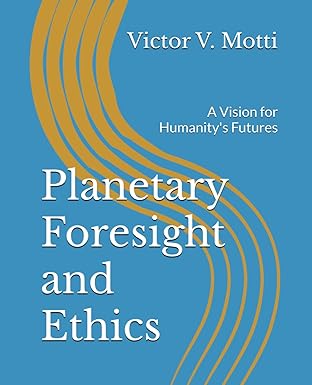
    Planetary Foresight and Ethics

    New Book

    Summary

    Core Themes
    The book reimagines humanity’s future through planetary foresight, blending historical wisdom with planetary stewardship. It critiques linear Western progress narratives and advocates for a hybrid, cyclical vision of history, emphasizing pluralistic identities and reverence for life.

    Structural Framework
    Organized into thematic sections, the work begins with “The Mysterious Lord of Time,” challenging linear temporality and introducing non-linear, culturally diverse historical perspectives. “Evolving Belief Systems” contrasts Indo-Iranic, Mesopotamian, and Hellenic thought with Abrahamic traditions, highlighting ancient influences on modern pluralism.

    Imagination and Futures
    The “Histories of Imagination” section explores myth and storytelling as drivers of civilization, while “Scenarios of Future Worlds” applies foresight methodologies to geopolitical and technological evolution, emphasizing ecological consciousness. The final chapters expand to cosmic intelligence and ethics, framing humanity’s role within universal interconnectedness.

    Ethical Vision
    Central to the thesis is a call for planetary identity and stewardship, merging forgotten wisdom traditions with modern foresight to navigate ecological and technological uncertainties. The book positions itself as both a philosophical guide and practical framework for ethical transformation in an era of global crises.

    Key Argument
    Motti asserts that humanity is transitioning from a “Second Nomad Age” (characterized by fragmentation) toward a “Second Settlement Age” marked by planetary consciousness, requiring creative complexity and ethical vigilance.

    Posted on: 23/04/2025

    Last Edited: a year ago

    Mission Area: Adaptation to Climate Change, Including Societal TransformationJuly 2021

    Foresight on Demand Brief in Support of the Horizon Europe Mission Board

    This final report summarises the results of the actions to support the Mission Board for “Adaptation to Climate Change, including Societal Transformation” with forward-looking evidence.

    In accordance with the Request, the proposed services, approaches to be adopted, and the concrete nature and form of the outputs have been shaped and validated through close interaction with the Mission Board (MB) via the Mission Secretariat, run by relevant European Commission (EC) services, throughout the implementation of the action.

    As a result of the interactions with the Mission Secretariat, the following actions were taken:

    1. Preparing a short paper Input to Mission Board on scoping activities & tasks
      (Deliverable 1)
    2. Analysing national and regional funding programmes of selected countries for
      projects on Climate Change Adaptation, and conducting interviews with selected
      Mission Board members in preparation of a foresight workshop.
    3. Preparing an input paper for the foresight workshop Input Document FoD CCA
      Workshop, 23 January 2020 (Deliverable 2).
    4. Holding a foresight workshop (23 January 2020) with Mission Board members,
      European Commission representatives (Mission Secretariat), and foresight experts,
      and summarising the results of the workshop. The workshop served to identify
      barriers and solutions, enablers and impacts of climate change adaptation in a variety
      of thematic fields, including health, water, food and agriculture.
    5. Developing and implementing a Delphi survey on assessing key aspects of the draft
      paper of the Mission Board. The survey addressed climate experts. They assessed
      future targets in thematic fields (e.g. financial risks, health, social infrastructure), and
      ranked related measures and R&I fields for importance.
    6. Preparing and analysing the results of the Delphi survey: Delphi Survey results,
      July/August 2020 (Deliverables 3 and 4).

    The report is structured along these deliverables.

    Posted on: 20/01/2025

    Post Image

    Last Edited: a year ago

    Futures of Civic Resilience in Europe – 2040

    Scenarios and Policy Implications

    Exploring alternative futures addressing radical changes in society can help better prepare for future crises and strengthen the resilience of civil society today. This post builds on the brief resulting from one of eight Deep Dive Foresight Studies in the project ‘European R&I Foresight and Public Engagement for Horizon Europe’ conducted by the Foresight on Demand’ consortium for the European Commission. During the autumn of 2023, the core group identified factors of change and organised two scenario and one policy implications workshops also engaging experts from academia, business, and public administration around Europe. We aimed to assist policy-makers by devising four possible future scenarios in 2040 and by considering their implications for today.

    Posted on: 25/11/2024

    Last Edited: a year ago

    Unleashing the Potential for CompetitivenessJanuary 2024

    Trends in the Western Balkans

    Commissioned by the RCC, the DLR-PT study "Unleashing the Potential for Competitiveness: Trends in the Western Balkans". It presents trends that are likely to shape the region's competitiveness until 2035. It examines the potential impact on inclusive growth and provides examples that could be useful for the economies of the Western Balkans (WB). Based on desk research, expert interviews and an online trends workshop, the DLR-PT's Foresight team prepared the study in March and April 2023. It provides stakeholders with evidence-based insights to prepare for future developments and help formulate effective policy options and strategies. The study focuses on four key areas defined by the World Economic Forum's Global Competitiveness Report 2020: the enabling environment, human capital, markets and the innovation ecosystem. Through desk research, qualitative interviews and expert workshops, it identifies trends that provide a comprehensive view of the likely evolution of competitiveness over the next 12 years, enabling policymakers to anticipate future challenges. 

    The study provides a methodological overview of Strategic Foresight and delves into the trends within the identified pillars, providing a summary of findings and recommendations for future action. By highlighting the trajectory of competitiveness and its implications, the study provides policymakers with valuable insights to effectively navigate the evolving landscape and foster sustainable growth in the Western Balkans.

    Posted on: 10/11/2024