Loading...

    Mentions of

    sorted by publishing date

    Last Edited: 9 days ago

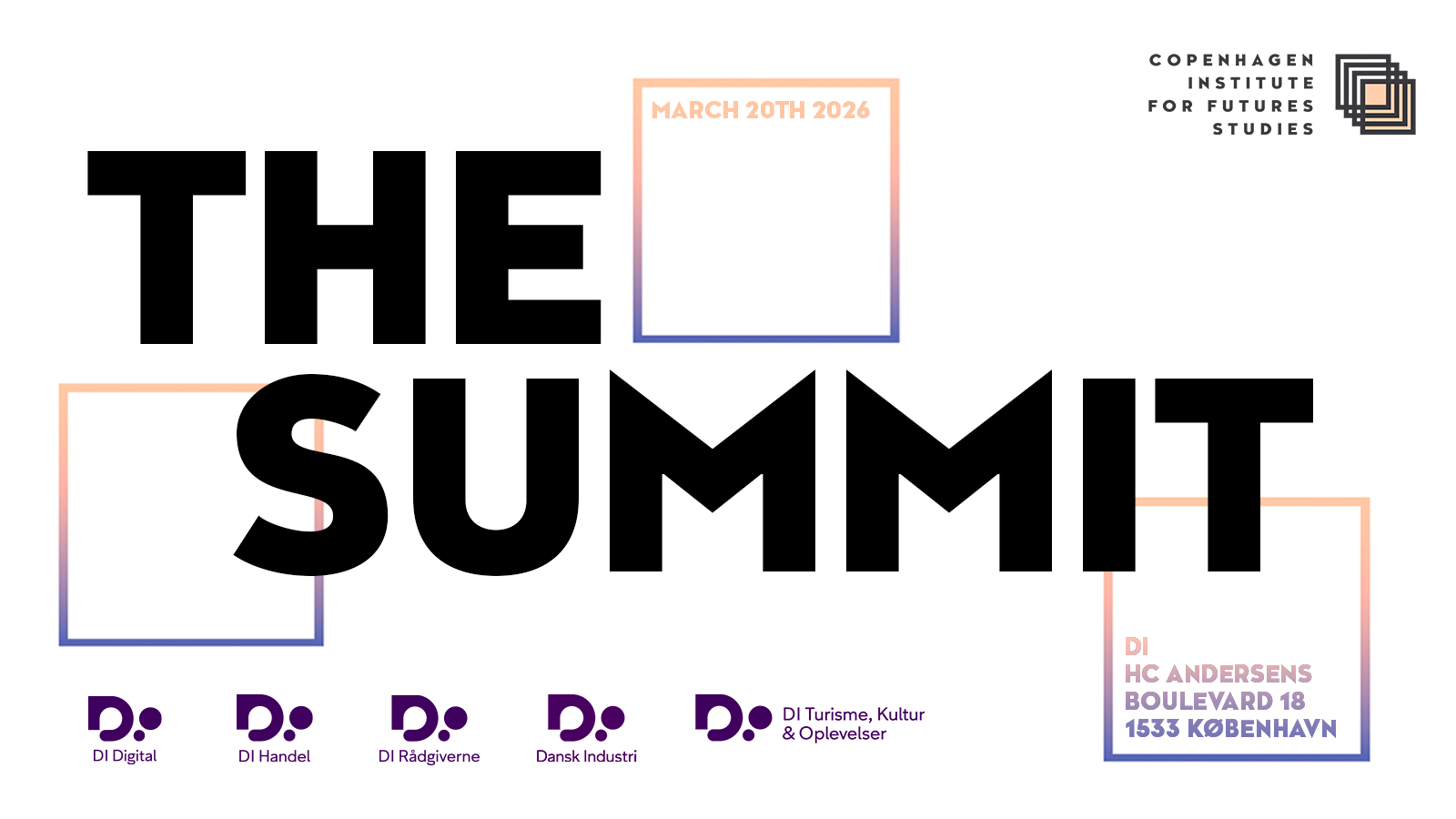
    The Summit 202620 March - 20 March 2026

    An annual gathering exploring the possible futures of emerging technologies. The Summit is a Nordic gathering for leaders, innovators, and forward-thinking organisations who want to explore the futures of emerging technologies and understand their profound impact on business, society, and organisational readiness. It serves as a meeting point for those who not only wish to follow developments in artificial intelligence, immersive experiences, and emerging technologies, but also want to shape how these forces influence the way we work, make decisions, and build future ecosystems. ‍ Hosted by the Confederation of Danish Industry (DI) and curated by the Copenhagen Institute for Futures Studies (CIFS), the conference focuses on foresight, technologies, preparedness, and futures-driven innovation. Through keynotes, panel discussions and focused dialogues, we examine both opportunity and risk, asking how innovation can be aligned with responsibility and long-term value creation. ‍ The Summit focuses on what lies ahead: Possible futures, strategic choices, and the readiness it takes to act responsibly as technologies evolve. It is not only about trends and tools, but about strategic foresight - identifying possible futures, and understanding the readiness it takes to act wisely and courageously as technologies continue to evolve.

    The 2026 edition takes place in Copenhagen on 20 March 2026 (09:00–18:00 CET) at H. C. Andersens Blvd. 18, 1553 København - Industriens Hus. Themes include the AI-mediated workplace, leadership in the future, emerging technologies (including AI agents, simulations and humanoids), the future consumer, retail in transformation, and the futures of foresight.

    The Summit is a Nordic gathering for leaders, innovators, and forward-thinking organisations exploring the futures of emerging technologies and their impact on business, society, and organisational readiness. Co-hosted by Danish Industry (DI) and curated by the Copenhagen Institute for Futures Studies (CIFS), the conference brings together keynotes, Nordic cases, and conversations on preparedness and responsible, meaningful action.

    The Summit 2026 – Industriens Hus, Copenhagen – exploring the possible futures of emerging technologies.

    Posted on: 23/02/2026

    Post Image

    Last Edited: 9 months ago

    Imagination and metacognition in Futures & Foresight process

    The liminal dimension of anticipatory learning: imagination and metacognition in Futures & Foresight processes

    Imagination, in common discourse, is often relegated to a secondary domain of thought – a frivolous, playful, and unreliable mental activity confined to childhood, the arts, or, at best, applied creativity. A “magic box” that opens only when logical rigor relaxes, when attention drifts toward invention and fantasy. Yet this view, however seductive, is ultimately reductive – if not misleading.

    When examined through the lens of contemporary cognitive science, imagination instead reveals itself as a profound and complex cognitive function. Not only does it actively participate in processes of knowing, but it also constitutes one of their foundational dimensions. It is the mental faculty through which we construct alternative worlds, test hypothetical scenarios, and explore the unknown without needing to experience it directly. Far from being a mere appendage to rational thought, it serves as one of its key structural supports.

    Even more striking is what emerges from recent scientific research: imagination possesses a metacognitive character. This means it does not merely generate mental content that diverges from reality, but is also capable of reflecting on itself – monitoring and adjusting its own trajectories, becoming the object of awareness and intentional regulation. In other words, imagining is not just about conjuring what is absent from the world, but also about knowing one is imagining, directing that act toward specific goals, and assessing its quality, limitations, and implications.

    This represents a genuine epistemological shift – recasting imagination not as a passive or automatic process, but as a strategic ally of thought. Within this framework, imagination emerges as a faculty that weaves together multiple dimensions of our cognitive experience:

    • perception, which provides sensory input;
    • intuition, which enables rapid, non-linear associations;
    • intentionality, which channels imaginative effort toward a purpose;
    • and self-awareness, which allows us to revise and reinterpret what has been imagined, imbuing it with meaning and value.

    It is within this layered and dynamic space that imagination assumes a renewed role: no longer a retreat into the unreal, but a critical tool for probing the possible. It becomes the lens through which we may observe not only what is, but what could be – and, through this, reconfigure our relationship with the present.

    It enables us to anticipate without predicting, and to plan without constraining.

    In educational, professional, and social contexts – and even more so within the fields of Futures Thinking and Foresight – this reconceptualization of imagination as a metacognitive skill proves to be strategically essential. To anticipate the future is not to guess what will occur, but to cultivate a gaze that can recognize alternatives, navigate uncertainties, and imagine trajectories not yet in existence. Doing so requires more than creativity; it demands a deep literacy in conscious imagination.

    To rediscover imagination through a metacognitive lens is to restore its dignity as an epistemic, transformative, and educational faculty. A faculty not only capable of generating visions, but also of sustaining, interrogating, and refining them. A power to be reintegrated into our intellectual and civic formation – so that it may help us not only to imagine different worlds, but to understand the conditions that make them possible.

    Posted on: 09/06/2025

    Last Edited: a year ago

    Stories from 2050September 2021

    Radical, inspiring and thought-provoking narratives around challenges and opportunities of our futures

    Stories and narratives are a powerful tool of Futures Literacy and Futures Thinking. In recent years, they have been fighting for attention next to scenarios and trend research within the Foresight discipline, and there is a good reason for it. Adding up to 21 stories, the narratives in this booklet deal with the planetary emergency, the existential threat of climate change and the biodiversity crisis, which are driving the European Green Deal. They were built on ideas by people from all around the world. Some were experts in the field, some purely engaged citizens with a story to tell. Stories from 2050 range from plausible sci-fi stories of the future to fictional fairy tales that provoke abstract thinking. Some stories are hopeful; others are concerning. They are going to stimulate your thinking by providing different perspectives and layers of understanding.

    Posted on: 12/11/2024