Loading...

    Mentions of

    sorted by publishing date

    Post Image

    Last Edited: 18 days ago

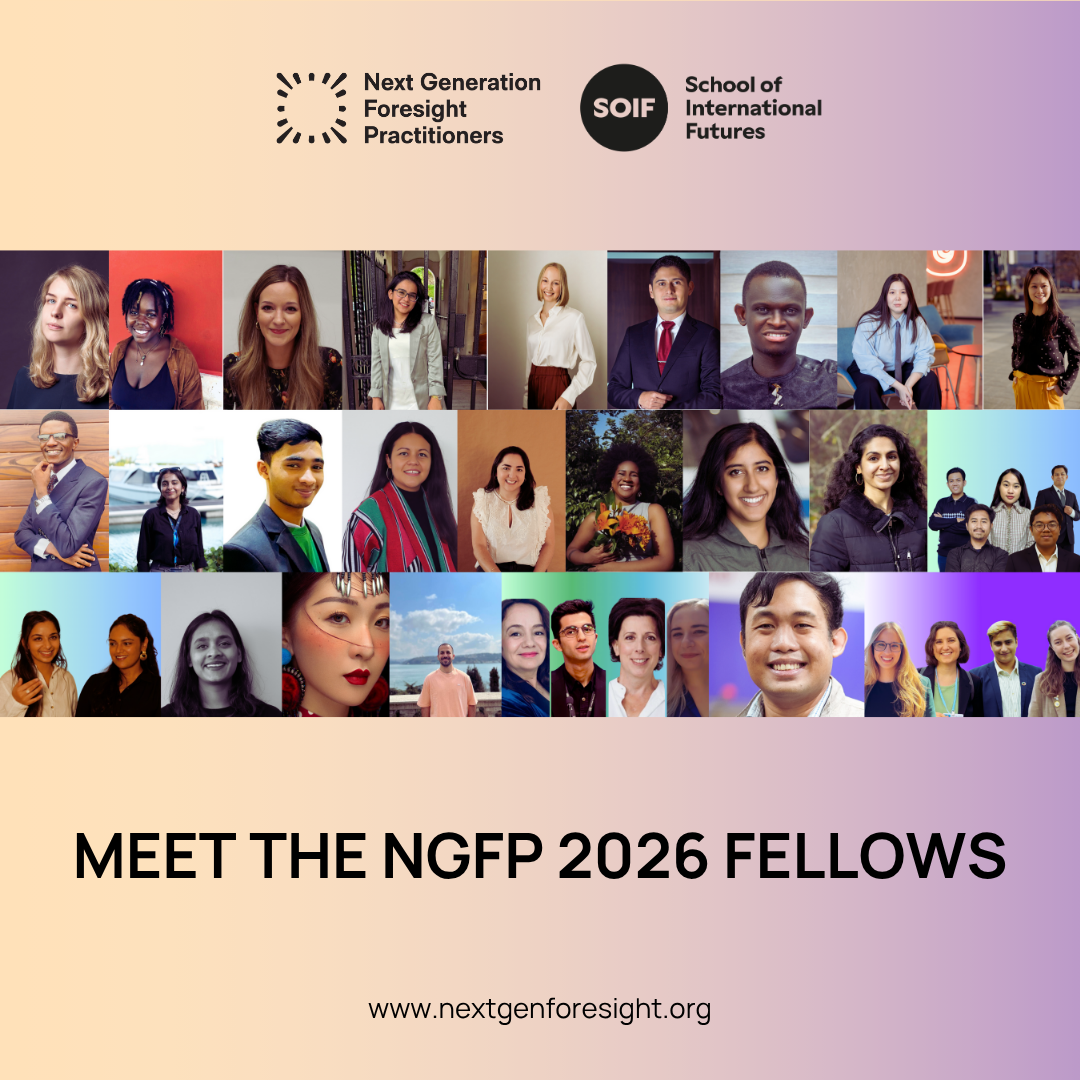
    Meet the NGFP 2026 Fellows

    This year’s fellowship features 25 projects, created by emerging futures and foresight practitioners from 24 countries.

    The Next Generation Foresight Practitioner (NGFP) Fellowship is an initiative of the School of International Futures (SOIF). The annual Fellowship is designed to help change the status quo and democratise the futures and foresight field with diverse perspectives from younger generations in under-represented geographies and communities.
    In addition, the Next Generation Foresight Practitioner – Young Voices (NGFP-YV) Awards, in partnership with Teach the Future, showcases the emerging ideas of youth 12-17 years of age.

    Over 6,000 expressions of interest were received this year, with 777 final submissions. Additionally, Young Voices Award partner organisation Teach the Future received 550 youth expressions of interest and 305 completed submissions.

    Posted on: 21/01/2026

    Post Image

    Last Edited: 5 months ago

    Supporting the institutionalisation of future-oriented policymaking

    A new initiative to support EU Member States in embedding long-term, anticipatory thinking into decision-making at every level—national, regional, and local. 

    Future-Oriented Policymaking is an ongoing joint project by the European Commission Directorate-General for Structural Reform Support (DG REFORM) and the EU Policy Lab of the Joint Research Centre. The project supports foresight capacity building in EU Member States and integrating future-oriented thinking into decision-making.

    The project supports foresight capacity building in EU Member States and integrating future-oriented thinking into decision-making.

    Get involved!
    The success of the project depends on the active participation of policymakers, practitioners, and citizens. Whether you are an experienced foresight practitioner or entirely new to the concept, we welcome your insights.

    Share ideas, take our survey*: Help us understand your needs and shape the final deliverables. What has worked well in your context? What challenges have you faced? How can we make foresight more relevant to your needs? > Survey

    Join our beta testing group**: Be among the first to try out our new toolkit and training materials. Your feedback will help us refine and improve these resources for everyone (fill in the survey and click join beta testing group at the end).

    * Preferably before 12 September 2025 to make full use of your ideas.

    * *Places for beta testing are limited, and we are committed to working with a diverse range of partners. If you are interested, please fill in the survey by 5/09/2025 . We will confirm participation after that date. Institutionalising future-oriented policymaking is a collective journey, which requires commitment, curiosity, and courage: from leaders, civil servants, and citizens alike. Let’s work together to make foresight a cornerstone of European policymaking. 

    Stay tuned for updates and don’t hesitate to reach out if you’d like to contribute to this exciting initiative.

    > Future-oriented Policymaking 

    Posted on: 29/08/2025

    Post Image

    Last Edited: 8 months ago

    Imagination and metacognition in Futures & Foresight process

    The liminal dimension of anticipatory learning: imagination and metacognition in Futures & Foresight processes

    Imagination, in common discourse, is often relegated to a secondary domain of thought – a frivolous, playful, and unreliable mental activity confined to childhood, the arts, or, at best, applied creativity. A “magic box” that opens only when logical rigor relaxes, when attention drifts toward invention and fantasy. Yet this view, however seductive, is ultimately reductive – if not misleading.

    When examined through the lens of contemporary cognitive science, imagination instead reveals itself as a profound and complex cognitive function. Not only does it actively participate in processes of knowing, but it also constitutes one of their foundational dimensions. It is the mental faculty through which we construct alternative worlds, test hypothetical scenarios, and explore the unknown without needing to experience it directly. Far from being a mere appendage to rational thought, it serves as one of its key structural supports.

    Even more striking is what emerges from recent scientific research: imagination possesses a metacognitive character. This means it does not merely generate mental content that diverges from reality, but is also capable of reflecting on itself – monitoring and adjusting its own trajectories, becoming the object of awareness and intentional regulation. In other words, imagining is not just about conjuring what is absent from the world, but also about knowing one is imagining, directing that act toward specific goals, and assessing its quality, limitations, and implications.

    This represents a genuine epistemological shift – recasting imagination not as a passive or automatic process, but as a strategic ally of thought. Within this framework, imagination emerges as a faculty that weaves together multiple dimensions of our cognitive experience:

    • perception, which provides sensory input;
    • intuition, which enables rapid, non-linear associations;
    • intentionality, which channels imaginative effort toward a purpose;
    • and self-awareness, which allows us to revise and reinterpret what has been imagined, imbuing it with meaning and value.

    It is within this layered and dynamic space that imagination assumes a renewed role: no longer a retreat into the unreal, but a critical tool for probing the possible. It becomes the lens through which we may observe not only what is, but what could be – and, through this, reconfigure our relationship with the present.

    It enables us to anticipate without predicting, and to plan without constraining.

    In educational, professional, and social contexts – and even more so within the fields of Futures Thinking and Foresight – this reconceptualization of imagination as a metacognitive skill proves to be strategically essential. To anticipate the future is not to guess what will occur, but to cultivate a gaze that can recognize alternatives, navigate uncertainties, and imagine trajectories not yet in existence. Doing so requires more than creativity; it demands a deep literacy in conscious imagination.

    To rediscover imagination through a metacognitive lens is to restore its dignity as an epistemic, transformative, and educational faculty. A faculty not only capable of generating visions, but also of sustaining, interrogating, and refining them. A power to be reintegrated into our intellectual and civic formation – so that it may help us not only to imagine different worlds, but to understand the conditions that make them possible.
    Posted on: 09/06/2025

    Last Edited: a year ago

    Vision beyond consensus - The Delphi method for collective foresightFebruary 2025

    Eye of Europe Foresight Starter Video #3

    This video introduces viewers to the Delphi method, a tool of futures research and foresight. Although it gets its name from the ancient Greek oracle, the modern incarnations of the method are powered by technology. Even so, the difficulties of reaching consensus and the influence of group dynamics on rational argumentation remain. If you are participating in a Delphi process, this video is an essential introduction to the method.

    This video is third part of a series of videos introducing foresight workshop methods for the Eye of Europe project funded by the EU.

    Posted on: 05/03/2025

    Last Edited: a year ago

    Horizon scanning — tips and tricksJuly 2023

    A practical guide - Eionet Report

    This document provides guidance on how to conduct a structured horizon scanning process to identify emerging developments that could have potential impact in the future, and in particular on the environment. It starts with an overview of the guide (Chapter 1) and an introduction to horizon scanning (Chapter 2) in connection with the concept of futures literacy. It then provides a step-by-step approach for conducting a structured horizon scanning process (Chapter 3), including a variety
    of diverse sources for spotting signals, different frameworks for signal scanning and several options to unpack and analyse the collected signals and patterns of change through creative methods and exercises. It also proposes a few different and complementary ways of communicating the findings to relevant stakeholders, networks and communities. Lastly, it suggests some tools (Chapter 4) that can be used to strengthen the scanning process. The annexes offer a detailed comparison of such tools and a glossary of terms related to futures literacy.

    Posted on: 30/01/2025

    Last Edited: a year ago

    Institutionalising foresight capability (and creating wide foresight communities) in the R&I system05 December - 06 December 2022

    Mutual Learning Exercise- Research and Innovation Foresight

    FCT, ISEG - Lisbon School of Economics and Management and the European Commission (Directorate-General for Research and Innovation) promoted, on December 5, a workshop with the active participation of representatives from all sectors of the National Research and Innovation System (R&I), and representatives of European states participating in this MLE-Mutual Learning Exercise, in order to discuss and agree on possible guidelines and joint work with a view to an institutionalization of capabilities and the creation of foresight communities in this system.

    The following day, December 6th, FCT hosted the meeting of this network that has, besides Portugal, representatives from Austria, Belgium, Czech Republic, Finland, Norway, Romania and Slovenia.   

    Posted on: 21/01/2025

    Last Edited: a year ago

    Foresight Starter VideosNovember 2024

    As part of the Eye of Europe project, the Finland Futures Research Centre is developing a brand new set of ‘Foresight Starter Videos’.

    A new series of 'Foresight Starter Sets' is an an essential part of Finland Futures Research Centre's (FFRC) contribution to the Eye of Europe project. One starter set component is a set of short videos. The videos introduce and clarify futures thinking and foresight, what to expect from a foresight workshop, and a variety of foresight workshop methods. The videos could serve as promotional material but also help organizers calibrate participants expectations prior to their participation in a foresight workshop.

    Finland Futures Research Centre is developing the video series to help participants prepare to participate in foresight workshops. The videos immediate use is related to the Eye of Europe Pilot Foresight Activities which will run through 2025 and 2026, but the videos will be freely available as a useful resource for foresight organizers outside the scope, and beyond the lifetime, of the project. 

    Reaching target audiences with foresight beyond text

    As the Work Package lead of Eye of Europe, the FFRC targets two unofficial ambitions underpinning all project activities: First, lowering the bar for organizing and participating in foresight workshops. Second, moving foresight beyond text. That is, finding new audiences via new formats compared to the classic domain of long text-based foresight reports. The set of Foresight Starter Videos aims to achieve both of these premises, as it uses a format of short videos (3-8 minutes per video) to introduce foresight, futures thinking, and futures methods to new audiences with a playful and welcoming tone. 

    The video set has two introductory videos that can be used in advance of any foresight workshop, while the ambition for the following videos relate to specific methods and approaches. The presumed use case is that foresight organizers can provide links to the introductory videos for foresight workshop participants in advance of their participation. We have found at the FFRC that sometimes people, even if they are domain experts in other fields, can be apprehensive prior to foresight workshops, as this may be unfamiliar territory for them (and for people used to being experts, unfamiliar can mean uncomfortable). 

    Foresight Starter Set Video Roadmap

    Launching the first videos

    The series of videos are developed by Martyn Richards and Zainab Yasin at the Finland Futures Research Centre. The videos will be hosted on the Finland Futures Research Centre’s YouTube Channel as well as feature on the Futures4Europe platform’s upcoming Toolbox, a set of useful methodologies and resources for advancing R&I foresight. 

    As of December 2024, the first video on “Untangling Futures and Foresight: An Essentials Guide” is now available on YouTube.  

    Posted on: 16/12/2024

    Last Edited: a year ago

    The Five Dimensions of Futures ConsciousnessMarch 2018

    Posted on: 09/11/2024

    Last Edited: a year ago

    On engaging meaningfully with futures with Peter BishopJune 2024

    Futures4Europe conversations

    This is the first episode of Futures4Europe conversations, initiated by the Eye of Europe project – a series of dialogues between Bianca Dragomir and professionals from all over the world, who engage in work that is future sensitive.

    About this episode - On engaging meaningfully with futures

    Often framed as a professional activity essential for 'planning', guiding 'decision making' or 'orienting strategies', futures studies could be more generously placed in the realm of humanities where, along other human capacities, imagination and anticipation should be nurtured and celebrated.

    In this light, futures education is more like a tending a garden. Like doing the soil work that turns it into the fertile ground for seeds to grow into 'flowers' such as human creativity, a heightened awareness of the mechanisms of change, agency coupled with humility, a sense of taking part into shaping something yet non-existent.

    Peter Bishop, founder of Teach the Future, argues that this garden should be welcoming everyone, including young people, or perhaps especially them.

    Posted on: 21/10/2024