Loading...

    Mentions of

    sorted by publishing date

    Last Edited: 15 days ago

    Shaping Angola's Future: Foresight and Youth EmpowermentJuly 2024

    Youth4Foresight Use Case

    The future of Angola and its youth are inextricably linked, as the country looks to capitalise on its demographic dividend, with over two-thirds of its population under the age of 25. The National Development Plan (2023-2027) prioritizes youth and human capital development to overcome barriers to long-term growth. The Youth4Foresight Toolkit, developed by Directorat e General for International Partnerships of the European Commission, youth experts and EU Delegations worldwide proved to be instrumental in engaging young Angolans.

    Engaging Young Voices for Change

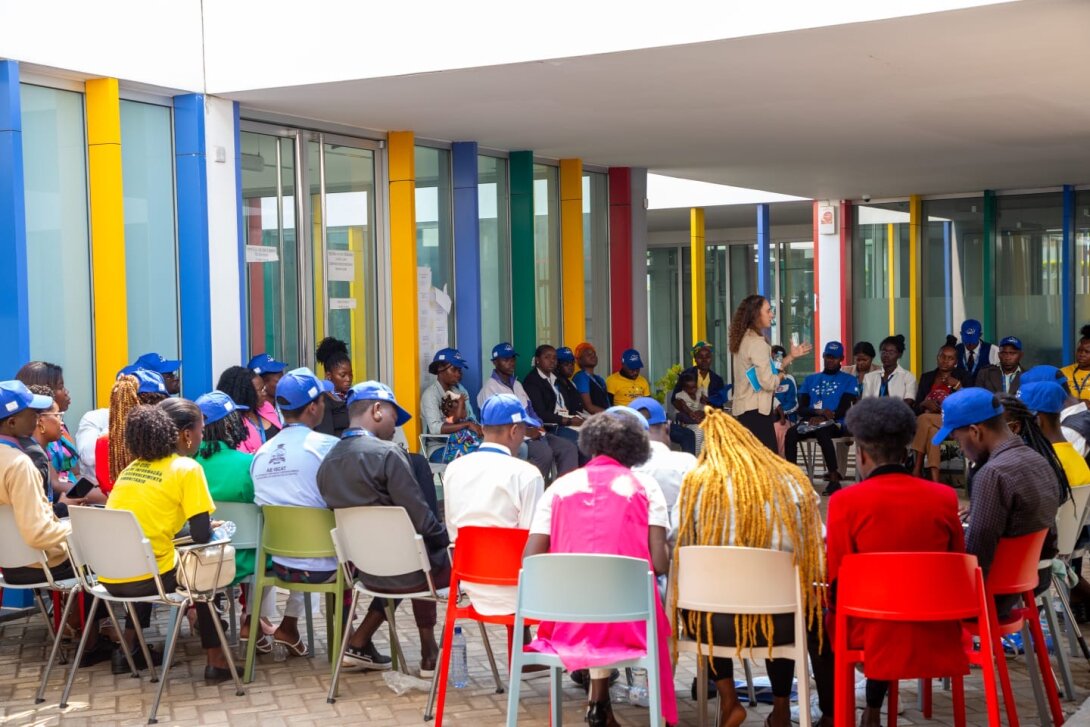
    The Youth Forum in Malanje (in July 2024) centred on "Youth participation in local governance and its impact on human capital development" and brought together 52 youth participants (including 24 women and some young mothers) from five municipalities in Malanje province. The event focused on helping youth better understand national policies and explore ways how they can contribute meaningfully to local governance.

    The Youth Forum was one of the events organised under the EU funded “Support to Civil Society in Local Governance in Angola (PASCAL)” action, which aims to contribute to economic growth and social development through an inclusive, heterogeneous and effective participation of civil society in the governance process.

    A key element of the forum was the application of structured long-term thinking by using the techniques and guidance from the Youth4Foresight Toolkit. Through Three Horizons methodology, young participants explored different future scenarios and created actionable recommendations.

    This same tool was also applied during the Youth Forum in Huambo, another Angolan province, where it proved equally successful in engaging youth and fostering forward-looking dialogue. 

    Foresight in Action: Three Horizons Methodology

    The Three Horizons technique enabled participants to envision a preferred future for their region and Angola. Divided into groups, they assessed the present, identified trends and challenges, and developed transition ideas.

    Discussions highlighted youth concerns: education, healthcare, and local economic development, alongside challenges like poor infrastructure, inadequate education quality and limited access to essential services.

    Participants formulated key recommendations for policymakers, such as creating youth-centred programs, youth centres and vocational training facilities, and stressed the importance of policies that improve access to education, healthcare, and economic opportunities, particularly in rural areas.

    Yong people found the forum groundbreaking and meaningful, with one stating, "We have never participated in such an experience," emphasizing the importance of youth voice. Young mothers expressed hope for their children's futures and appreciated meeting others outside their villages, reflecting the workshop's deep impact in fostering hope and agency and ownership over their future. 


    The Impact of Youth4Foresight

    The structured, adaptable methodologies of the toolkit encouraged inclusive discussions, giving youth a voice in shaping the strategies outlined in Angola’s National Development Plan 2023-2027. As a result, the recommendations produced in the workshop were directly relevant to local realities and can guide policymakers in enhancing youth participation and development.

    Using foresight techniques empowered young people to reflect on their aspirations, critically analyse their present situation, and propose realistic solutions. The Youth4Foresight Toolkit has been successfully used in several countries by EU Delegations to engage with youth as a part of the Youth Action Plan in EU external action. 

    Posted on: 26/03/2026

    Post Image

    Last Edited: 10 months ago

    Imagination and metacognition in Futures & Foresight process

    The liminal dimension of anticipatory learning: imagination and metacognition in Futures & Foresight processes

    Imagination, in common discourse, is often relegated to a secondary domain of thought – a frivolous, playful, and unreliable mental activity confined to childhood, the arts, or, at best, applied creativity. A “magic box” that opens only when logical rigor relaxes, when attention drifts toward invention and fantasy. Yet this view, however seductive, is ultimately reductive – if not misleading.

    When examined through the lens of contemporary cognitive science, imagination instead reveals itself as a profound and complex cognitive function. Not only does it actively participate in processes of knowing, but it also constitutes one of their foundational dimensions. It is the mental faculty through which we construct alternative worlds, test hypothetical scenarios, and explore the unknown without needing to experience it directly. Far from being a mere appendage to rational thought, it serves as one of its key structural supports.

    Even more striking is what emerges from recent scientific research: imagination possesses a metacognitive character. This means it does not merely generate mental content that diverges from reality, but is also capable of reflecting on itself – monitoring and adjusting its own trajectories, becoming the object of awareness and intentional regulation. In other words, imagining is not just about conjuring what is absent from the world, but also about knowing one is imagining, directing that act toward specific goals, and assessing its quality, limitations, and implications.

    This represents a genuine epistemological shift – recasting imagination not as a passive or automatic process, but as a strategic ally of thought. Within this framework, imagination emerges as a faculty that weaves together multiple dimensions of our cognitive experience:

    • perception, which provides sensory input;
    • intuition, which enables rapid, non-linear associations;
    • intentionality, which channels imaginative effort toward a purpose;
    • and self-awareness, which allows us to revise and reinterpret what has been imagined, imbuing it with meaning and value.

    It is within this layered and dynamic space that imagination assumes a renewed role: no longer a retreat into the unreal, but a critical tool for probing the possible. It becomes the lens through which we may observe not only what is, but what could be – and, through this, reconfigure our relationship with the present.

    It enables us to anticipate without predicting, and to plan without constraining.

    In educational, professional, and social contexts – and even more so within the fields of Futures Thinking and Foresight – this reconceptualization of imagination as a metacognitive skill proves to be strategically essential. To anticipate the future is not to guess what will occur, but to cultivate a gaze that can recognize alternatives, navigate uncertainties, and imagine trajectories not yet in existence. Doing so requires more than creativity; it demands a deep literacy in conscious imagination.

    To rediscover imagination through a metacognitive lens is to restore its dignity as an epistemic, transformative, and educational faculty. A faculty not only capable of generating visions, but also of sustaining, interrogating, and refining them. A power to be reintegrated into our intellectual and civic formation – so that it may help us not only to imagine different worlds, but to understand the conditions that make them possible.

    Posted on: 09/06/2025