Loading...

    Mentions of

    sorted by publishing date

    Post Image

    Last Edited: 13 days ago

    Thus Spoke Arta

    How Our Planet Is Entering a New Era

    We are living through a transition that feels, at once, like collapse and awakening. The crises surrounding us—ecological breakdown, technological acceleration, geopolitical fragmentation—are often treated as separate problems. But they are not. They are symptoms of a deeper rupture: a failure in how we perceive reality itself.


    This is the beginning of the “Big Shift.” Not merely a historical turning point, but a transformation in consciousness. The dominant frameworks through which humanity has understood itself—nation, progress, even “humanity” as a unified moral subject—are no longer sufficient. They fragment under pressure because they were never grounded in the deeper fabric of existence. They abstracted us from the Earth, from each other, and ultimately from being itself.


    Long before modern crises, ancient traditions understood something we have forgotten: the Earth is not an object. It is a living, sacred reality. Early liturgical texts and cosmologies did not separate matter from meaning. To speak of the Earth was already to speak of order, of balance, of participation in a larger whole. This was not “ecology” in the modern scientific sense—it was a lived metaphysics.


    What has been lost is not knowledge in the narrow sense, but a way of knowing. The modern world, in its pursuit of control and clarity, reduced reality to what can be measured, extracted, and optimized. Technology is not the root problem; it is an extension of this perception. We did not simply build machines—we built a worldview that sees the world as machine.


    And so we arrive at a strange paradox: we speak constantly of “saving humanity,” yet we do not even know what “humanity” means. It is an abstraction, a moral placeholder, often detached from real conditions and embedded inequalities. In trying to center humanity, we displaced the Earth. And in doing so, we undermined the very conditions that make human life possible.


    A different orientation is needed. Not a rejection of humanity, but a re-centering within a larger field of existence. To love the Earth is not a poetic gesture—it is an ethical necessity. It means recognizing that harm to ecosystems is not external damage but a form of self-destruction. It means reframing ethics from human-centered to Earth-centered, from domination to participation.


    This is where the future becomes most uncertain—and most significant. Artificial intelligence and emerging technologies are often framed in terms of capability and risk. But the deeper question is ontological: what kind of intelligence are we creating? If intelligence is participation, then ethical design requires more than safeguards—it requires alignment with the structures of reality itself.


    We stand, then, at a threshold. The path forward is not a return to the past, nor a blind leap into technological futurism. It is a synthesis—a planetary civilization that draws from ancient wisdom while engaging modern knowledge. A civilization that recognizes the plurality of perspectives without losing sight of underlying unity.


    This requires new forms of leadership, new frameworks of foresight, and a redefinition of progress. Not growth for its own sake, but alignment with the conditions that sustain life and meaning.


    Ultimately, the future is not something we predict. It is something we participate in. Every action, every perception, contributes to the unfolding of reality. The question is not whether change is coming—it is whether we are capable of aligning with it.


    To become planetary beings is not to transcend the Earth, but to belong to it fully. To act with awareness that we are not separate observers, but active participants in a living, dynamic cosmos.


    The shift has already begun. The only question is whether we recognize it—and whether we are willing to follow it to its conclusion.

    Posted on: 28/05/2026

    Last Edited: a month ago

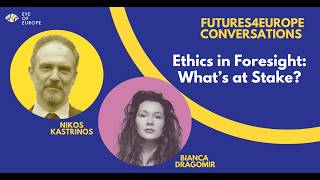
    Futures4Europe Conversations Ethics in Foresight: What's at Stake?April 2026

    In this episode of Futures4Europe Conversations, Bianca Dragomir speaks with Nikos Kastrinos, who brings over 25 years of experience at the European Commission and more than 35 years of academic work in science, technology and innovation policy and foresight.

    This conversation covers:

    • What foresight does, at its best, and how it differs from other approaches
    • Where the most difficult ethical tensions arise in foresight work
    • How foresight can engage with sustainability in ways that open up different pathways
    • The ways futures may be framed through techno-fixes
    • How the use of AI tools is changing foresight practice, and what this requires from practitioners
    • What it takes to do participatory foresight well
    • What changes in practice could help foresight remain relevant in the next decade

    Posted on: 04/05/2026

    Last Edited: 6 months ago

    Anticipation 2026 Conference01 July - 03 July 2026

    Anticipation 2026 is an interdisciplinary conference for rethinking how ideas about futures operate within conditions of uncertainty, indeterminacy, and unknowing. Bringing together researchers, designers, philosophers, policy makers, and practitioners, the conference opens space for exploring how futures are shaped through aesthetics, ethics, epistemologies and material practices. Registration opens on the 2nd of February 2026, but the call for abstracts is open now.

    From 1st to 3rd July 2026, the 6th Conference on Anticipation will be held at the Politecnico di Milano, Design Department. Anticipation 2026 invites participants to explore the entangled relations between futures, unknowing, and design. The overarching aim of the Conference Series and of the emerging field of Anticipation Studies is to create new perspectives on how individuals, groups, institutions, systems and cultures use ideas about futures to act in the present.

    The 6th International Conference on Anticipation will be held at the Design Department of Politecnico di Milano, one of Europe's leading institutions for design research and education. Located in the heart of Milan, a global capital of design, fashion, and innovation, the department stands as a site for examining the contemporary and future roles of design within complex societal, technological, and ecological systems. Politecnico di Milano’s Design Department is renowned for fostering experimental, practice-based, and transdisciplinary approaches that challenge conventional boundaries of design. It cultivates a vision of design as a powerful mode of inquiry.

    From critical design to foresight, from service design to post-human aesthetics, design at Politecnico di Milano nurtures an ecosystem where research, pedagogy, and practice interact to explore how futures are made and contested. The department brings together a diverse network of researchers, educators, and practitioners committed to advancing critical, speculative, and anticipatory design approaches while benefitting from ongoing exchanges with industry, cultural institutions, and grassroots communities. Its interdisciplinary structure includes dedicated labs and centers focused on areas such as communication and product design, service design, sustainable transitions, and design for social innovation. These spaces foster a culture of inquiry where prototyping, material experimentation, and reflective practice converge. The Bovisa campus offers state-of-the-art facilities, from fabrication workshops to immersive environments, supporting collaborative and transdisciplinary engagement.

    Posted on: 02/12/2025

    Post Image

    Last Edited: a year ago

    Planetary Foresight and Ethics

    New Book

    Summary

    Core Themes
    The book reimagines humanity’s future through planetary foresight, blending historical wisdom with planetary stewardship. It critiques linear Western progress narratives and advocates for a hybrid, cyclical vision of history, emphasizing pluralistic identities and reverence for life.

    Structural Framework
    Organized into thematic sections, the work begins with “The Mysterious Lord of Time,” challenging linear temporality and introducing non-linear, culturally diverse historical perspectives. “Evolving Belief Systems” contrasts Indo-Iranic, Mesopotamian, and Hellenic thought with Abrahamic traditions, highlighting ancient influences on modern pluralism.

    Imagination and Futures
    The “Histories of Imagination” section explores myth and storytelling as drivers of civilization, while “Scenarios of Future Worlds” applies foresight methodologies to geopolitical and technological evolution, emphasizing ecological consciousness. The final chapters expand to cosmic intelligence and ethics, framing humanity’s role within universal interconnectedness.

    Ethical Vision
    Central to the thesis is a call for planetary identity and stewardship, merging forgotten wisdom traditions with modern foresight to navigate ecological and technological uncertainties. The book positions itself as both a philosophical guide and practical framework for ethical transformation in an era of global crises.

    Key Argument
    Motti asserts that humanity is transitioning from a “Second Nomad Age” (characterized by fragmentation) toward a “Second Settlement Age” marked by planetary consciousness, requiring creative complexity and ethical vigilance.

    Posted on: 23/04/2025

    Post Image

    Last Edited: 2 years ago

    With Big Tech comes Big (Ethical) Responsibility

    In a world pervaded by the rapid entrance and development of new technologies, the pace at which ethical concerns are addressed is not always in sync. TechEthos, a Horizon 2020 project, wants to facilitate “ethics-by-design” in order to push forward ethical and societal values into the design and development of new and emerging technologies at the very beginning of the process.

    Posted on: 25/11/2024

    Last Edited: 2 years ago

    Deep Dive: Transhumanist RevolutionsDecember 2022

    The twelve scenarios in this deep dive are informed by transhumanism, portraying futures in which the human condition – our bodies, functions, and lives – and the features of societies are fundamentally transformed by technology. Even though scenarios are built along the lines of particular scientific and/or technological advancements, the discussion spreads over sociotechnical ensembles and the re-conceptualization of the relationship between technology and society by 2040.

    The work leading to this report started with a horizon scanning exercise to identify a series of technological innovations and scientific breakthroughs that may be considered key factors towards re-engineering human nature. In parallel, the authors explored diverse narratives regarding the human condition and significance in the world, dreams and fears embodied in the so-called collective imaginary, echoing through myths and fantasies to literature, cinematography and the wider culture. At the intersection of these explorations, twelve topics were selected and further expanded into scenarios. They are not intended to cover the full spectrum of themes regarding human enhancement, but present a relevant ‘sample’ of potential future trajectories.

    We propose these narratives as exploratory scenarios, describing futures where both positive and negative consequences are palpable. They are not normative, outlininga vision of the future deemed desirable. We invite readers to regard them as devices for imagining the future and debating the future. They aim to nurture a reflection on the dynamics of change, future opportunities and potential threats, and in doing so they contribute to future preparedness.

    Three types of scenarios were developed:

    • The first type describe futures where scientific and technological advancements enhance embodied experiences: Sensory augmentation: extending human senses beyond the natural limits and adding sensorial modalities which are not native to humans. Sensory and brain stimulation, psychedelic microdosing: inducing altered states of consciousness, for healing purposes or for fostering new perspectives on being human. Molecular therapies for delaying aging; and new artificial reproductive technologies allowing people to be fertile until much older age.
    • The second type explore futures where human capabilities are extended by embodying non-biological means: a significant share of elderly people using exoskeletons for prolonging active life, for maintaining their mobility or as a form of assisted living; brain-computer interfaces leveraged in semi-automatized work environments, to improve learning outcomes, and to control smart devices; Brain to brain communication supporting cognitive and emotion sharing, leading to the creation of ‘hive minds’ covering multiple aspects of life.
    • The third type focus on the simulation and replication of the human body and mind: Digital body twins allowing alert signals for disease prevention and the simulation of the short- and long-term effects of a person’s behavior on their health and body; Digital twins of the brain allowing testing hypotheses in cognitive science, in mental health studies, responses to different types of treatments; Digital immersive worlds – gaming/ fantasy worlds or ‘mirror worlds’ that are replicating real-life environments – hosting interactions among people and automated entities; Digital replicas of the deceased changing the socio-political understanding of grief; and Artificial agents with complex underlying computational procedures (including e.g. self-reflection, development of value system, affective computing) and sophisticated interfaces calling for new theoretical frameworks of consciousness.


      ***
      The twelve scenarios presented in this deep dive are part of the Foresight towards the 2nd Strategic Plan of Horizon Europe project, which was conducted by Foresight on Demand Consortium on behalf of the European Commission’s Directorate-General for Research and Innovation (DG RTD).

    Posted on: 28/10/2024

    Last Edited: 2 years ago

    How will we disgust our descendants

    It would be short-sighted to assume that we, as humanity, have reached such a level of maturity that our descendants will not find some aspects of our – apparently civilised – everyday life repulsive and sad.
    So we asked 60 futurists from around the world: “What will we disgust our descendants with?
    Many of the submitted ideas are already present in public discourse and confirm areas in which we need to change. But we were especially interested in novel barbarisms that humanity is still largely oblivious to.
    The study showcases the futurists’ answers grouped into 93 contemporary barbarisms ranked in a public vote according to how eye-opening they are.

    Posted on: 28/10/2024