

What will it mean to be a researcher in 2040 — and who will decide?
As part of the foresight study The Futures of Researchers' Careers: What Challenges for EU Policy?, funded by DG RTD, set of scenarios was developed to explore how research work in Europe could evolve over the next fifteen years. This summary presents the scenario component of the study: the world research is likely to operate in, and an aspirational alternative to it.
The context: Knowledge in Society 2040
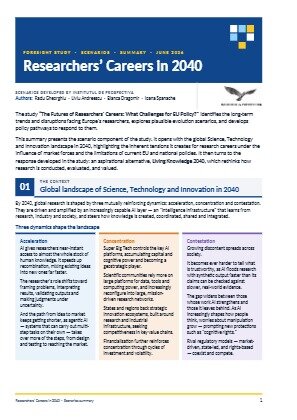
By 2040, at global level research runs on a powerful, ever-present AI layer — an "intelligence infrastructure" that learns from research, industry and society and shapes how knowledge is created, shared and used. It drives three linked shifts: research speeds up as AI opens access to almost all human knowledge and shortens the path from idea to market; power concentrates, as a few "Super Big Tech" actors control the key AI platforms and states compete for strategic advantage; and contestation grows, as trust erodes under a flood of AI-generated output and the gap widens between those AI strengthens and those it leaves behind.
Left on this trajectory, and with current policy lagging behind, research careers come under pressure: a workforce split into tiers with no bridge between them, the value of public research captured by the owners of AI platforms, AI deciding what becomes visible and fundable, and slow recognition of hands-on empirical work and the new roles emerging around AI.
The response: Living Knowledge 2040
Living Knowledge 2040 is the study's aspirational alternative. It assumes the same dynamics as the context scenario — acceleration, concentration and contestation — but channels them toward public value. It is built on four layers:
The core — a Glass Engine, advanced AI that Europe builds and runs as civic infrastructure: transparent, publicly governed, auditable and contestable; and a Commons Authority that keeps it and the wider knowledge ecology in the public interest.
A trustworthy, plural knowledge ecology — where empirical and synthetic knowledge are equally valued, credibility rests on traceability rather than the journal a work appears in, dissenting views are actively surfaced, and collective and once-invisible work is recognised.
New forms of operating — from human–AI swarms and public "Action-Networks" to quest-based research, automated public research infrastructures, and AI-powered entrepreneurship — with careers moving fluidly among them.
An explicit ethos — wellbeing, collective work, public value, openness, meaning and full expression as the values the system is built to serve.
***
How the scenarios were developed
The scenarios are exploratory tools, not predictions: they set out plausible, internally consistent futures against which today's policies can be tested. Three were developed by the Institutul de Prospectiva team and progressively validated and enriched through consultation with the project's International Advisory Board, with one dedicated meeting per scenario type between May and June 2026. Together they trace a path from the world research will operate in, through the gaps in current policy, to an aspirational alternative.
The context scenario ("Knowledge in Society 2040") is global in scope and focuses on how knowledge — and its embodied forms of technologies, policies and norms — is produced, circulated and translated into societal impact. It was built by extrapolating a set of key drivers of change and exploring how they interact and amplify one another, with particular attention to the major actors — scientific communities, states, private-sector actors and society at large — and to the evolving interplay between their strategic, economic and normative interests.
The inertial scenario provides the bridge. It sets out thirteen current challenges facing Europe's research and innovation workforce, grouped into four categories: a fragmented research market; funding and employment structures; the training and socialisation model; and assessment and recognition systems. Each challenge is examined along three dimensions — its current state ("the Now"); its likely 2040 trajectory, assuming balanced optimism about current EU and national policies; and a "context push" that tests that trajectory against the global picture from the context scenario. This surfaces two kinds of tension: those where existing policies fall short of the projected dynamics, and entirely new ones that current frameworks do not yet recognise as problems and that would require genuinely new policy categories.
The aspirational scenario ("Living Knowledge 2040") was built in three steps, starting from the key tensions projected for 2040. These were put through a simplified Causal Layered Analysis that reopened some of the system's underlying premises — who owns the AI infrastructure, how contribution is recognised, how value is capitalised — producing twelve dimensions, each described as a current perspective and a potential shift by 2040. Clustering these dimensions gave the scenario its four-layer structure: the AI infrastructure and its public governance; the principles of the knowledge ecology around it; that ecology's forms of operating; and the overarching values of the ecosystem. Deliberately ambitious but not utopian, it assumes the same forces as the context scenario — pervasive AI, platformisation, concentration and contestation — but channels them toward public value.