Loading...

    Mentions of

    sorted by publishing date

    Last Edited: 18 days ago

    Foresight as a Key Social Infrastructure for EuropeDecember 2025

    A Manifesto of the Research&Innovation Foresight Community

    Preamble
    Across Europe, the use of foresight for Research and Innovation (R&I) policy is growing, but unevenly. In many places, it still sits at the margins of policymaking, and its full potential—to inspire broader societal change—is not yet realised.

    The European R&I foresight community, made up of practitioners, policymakers, researchers, and future-oriented thinkers, is
    becoming stronger and more connected. The Eye of Europe project, supported by the European Commission, helps this
    community grow through the online hub futures4europe.eu, as well as workshops, conferences and shared learning spaces.

    This manifesto stems from a “foresight on foresight” workshop held in Mamaia, Romania (18–19 September 2025), coordinated by UEFISCDI and the Austrian Institute of Technology. 30 foresight practitioners and R&I policy experts from across Europe gathered to imagine how foresight could better support R&I policy and practice. Furthermore, these contents have also been discussed and enriched during Eye of Europe’s final mutual learning event held in Chișinău, Moldova (23–24 October 2025).

    This manifesto recognises the growing importance of foresight—not only within European R&I systems but also at the interface between R&I and society—repositioning the field as a driver of inspiration and renewal in shaping Europe’s futures.

    Foresight as a Key Social Infrastructure for Europe
    Vision 2030 in a nutshell

    Research and Innovation (R&I) foresight is a shared space of imagination and inquiry, enabling Europe to live creatively with emergence and diversity. Beyond agenda-setting, it cultivates futures literacy across science, policy, and society — expanding our capacity to sense, interpret, and engage with novelty.

    Embracing the open and interdependent nature of the world, foresight complements evidence with creativity and plural ways of knowing. It guides Europe’s research and innovation ecosystems to act with openness, responsibility, and imagination — co-creating sustainable and just futures as a shared public good.

    🔵 EXTENDED ROLE OF R&I FORESIGHT
    In 2030 R&I foresight enables boundary spanning, connecting sectoral policies, disciplines, and perspectives. Its value lies not only in generating agendas or scenarios, but in reshaping worldviews, reframing challenges, cultivating agency, enabling collective reflection, and inspiring transformative action

    🔵 OPEN AND INCLUSIVE SPACES
    In 2030 foresight thrives on openness, diversity, and empathy. It creates spaces where people engage not only as experts or institutional actors, but as whole humans— bringing values, worldviews, emotions, and lived experiences into the co-creation of futures.
    Trust grows from transparency, fairness, and shared ownership of both processes and outcomes. While AI expands access to knowledge, human judgment, engagement creativity, and responsibility remain essential.

    🔵 FUTURES LITERACY AS A FOUNDATIONAL CAPACITY
    Futures literacy becomes both a foundation and a legacy of R&I foresight. It strengthens the collective ability to recognise assumptions, navigate uncertainty, and act with intention amid complexity.
    Foresight processes evolve into open spaces for learning and experimentation, cultivating anticipatory competence among experts, policymakers, and citizens. Through its practices and communication, R&I foresight contributes to a societal diffusion of futures thinking, enhancing collective intelligence and agency.

    🔵 A MATURE COMMUNITY OF PRACTICE
    Foresight gains professional depth through dedicated academic programmes and practitioner networks. A wide variety of organisations embed foresight cultures that encourage reflection, experimentation, and communication. Shared infrastructures such as futures4europe.eu evolve into open, dynamic platforms for collaboration, knowledge exchange, and innovation in foresight.

    Download the document at the top of the page to read the full version.

    Posted on: 21/01/2026

    Last Edited: 2 months ago

    THE DEMOGRAPHIC TURN09 December - 09 December 2025

    ACTIONS NEEDED FOR RESEARCH, INNOVATION, AND POLICY IN EUROPE?

    Curious about how Europe’s demographic trends may transform the R&I landscape?


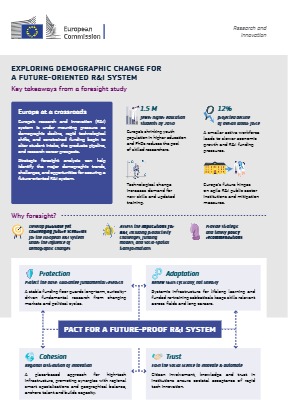
    On 10 December 2025, DG Research & Innovation hosted a hybrid event at the DG RTD Library in Brussels to present the Foresight-on-Demand (FOD) study: “The Demographic Turn: Actions Needed for Research, Innovation and Policy in Europe?”


    FOD team members guided the audience through:

    • Background data showing a shrinking youth population, a declining workforce, and growing fiscal pressures on R&I funding.
    • A six-step Foresight Process combining horizon scanning, scenario-building, and windtunneling to anticipate future challenges.
    • Four Scenarios illustrating different pathways for Europe’s R&I system.
    • Strategic actions to protect fundamental research, foster lifelong learning, strengthen regional innovation, and build societal trust in technology.


    👏 A big thank you to the panelists and speakers:

    • Erik Canton (Deputy Head of Unit – Common R&I Strategy and Foresight Service, DG Research & Innovation)
    • Nicola Francesco Dotti (Chief Economist Unit – Common R&I Strategy and Foresight Service, DG Research & Innovation)
    • Brikena Xhomaqi (The Lifelong Learning Platform)
    • Alex Petropoulos (Centre for Future Generations)
    • Thomas Estermann (European University Association)
    • Maciej Krysztofowicz (EU policy Lab, Joint Research Centres)
    • Viola Peter (FOD team, Technopolis Group)
    • Michal Nadziak (FOD team, 4CF)
    • Katarzyna Figiel (FOD team, 4CF)

    And to all participants for an engaging exchange on how to build a more adaptive and resilient EU R&I system.


    Missed the event? Explore the below documentation !


    Posted on: 27/11/2025

    Last Edited: 4 months ago

    Geopolitical & industrial decarbonisation scenarios to identify R&I opportunities for the EUMay 2025

    How can the EU navigate amidst global uncertainties to foster a more resilient and effective path toward industrial decarbonisation?

    This report presents the outcomes of the Geopolitical Industrial Decarbonisation Scenarios workshop, convened on behalf of the Eye of Europe Horizon Europe project by the Insight Foresight Institute. Bringing together 30 participants from across the European Union—including policymakers at EU, national, and regional levels, industry leaders, energy and climate specialists, and foresight and forecasting experts—the workshop explored how the EU can navigate mounting geopolitical uncertainty while accelerating industrial decarbonization on a 2050 horizon.

    The discussion was structured around two core aims. First, participants examined a suite of forward-looking geopolitical scenarios, assessing how divergent power dynamics, energy trade patterns, and technological trajectories could either hinder or catalyse the transition to a net-zero industrial base in the EU countries. Particular attention was paid to supply-chain resilience, strategic autonomy in critical materials, and the interplay between carbon border adjustments and global climate diplomacy. Second, the workshop sought to surface emergent research and innovation (R&I) needs and opportunities that would equip EU actors to thrive across the scenarios. Priorities highlighted include advanced electrification processes for hard-to-abate sectors, low-carbon hydrogen and synthetic-fuel value chains, circular-economy business models, and data-driven tools for real-time decarbonisation monitoring.

    Outputs from the session feed directly into the Eye of Europe project’s multi-workshop learning cycle. Immediate products comprise this extended report for attendees; aggregated insights captured in the public Pilot Logbook Part I – What we did and Part II – What we learned; and distilled policy recommendations to be released in the Eye of Europe Policy Brief: Foresight Perspectives on Key R&I Topics. Beyond documentation, the Insight Foresight Institute will leverage the findings to stimulate agenda-setting dialogues with EU bodies and industrial stakeholders, ensuring that identified R&I pathways inform Horizon Europe programming and other EU-level funding instruments. Workshop materials and presentations are retrievable via the futures4europe.eu knowledge-sharing portal, reinforcing the project’s commitment to an open foresight community.

    Posted on: 03/10/2025

    Last Edited: 4 months ago

    Future of Sustainable Fashion IIMay 2025

    The Future of Sustainable Fashion event took place on Monday, April 14, 2025, at the MOMus - Museum of Modern Art in Thessaloniki, Greece. The workshop was implemented surrounded by the relative with the subject exhibition Collective Threads: Anna Andreeva at the Red Rose Silk Factory. This initiative was implemented by Helenos Consulting, a partner of the Eye of Europe Project, and aimed at engaging domain professionals, including foresight and fashion experts.

    Posted on: 01/10/2025

    Last Edited: 9 months ago

    Foresight and Policy: Future-Proofing the Assumptions Behind Policies for a Greener EuropeFebruary 2025

    Insights into Circular Economy, Clean Air, Transport and Bioeconomy Policies

    This report offers an in-depth foresight assessment that critically evaluates and questions the foundational assumptions of European environmental policies related to the Green Deal. To enhance the resilience of these frameworks, the two-year study utilises a comprehensive set of methods, including impact wheel analysis, Ishikawa diagrams, cross-impact analysis, semi-structured interviews, and causal layered analysis. This approach reveals the cascading effects, entrenched cognitive biases, and intricate interdependencies present in policy design. These techniques facilitate a detailed examination of specific policy areas while providing a systemic perspective on how the connections among circular economy, bioeconomy, clean air and health, and the decarbonisation of transport impact overall sustainability results. By harnessing these diverse foresight techniques, the assessment reveals that conventional policy narratives are often oversimplified, obscuring risks and trade-offs that, if unchallenged, may impede a successful transition to a sustainable Europe. The impact wheel and Ishikawa diagrams facilitate the structured identification of primary and secondary effects, while the cross-impact analysis maps the interactive dynamics between assumptions. Semi-structured interviews provide nuanced stakeholder perspectives that uncover underlying worldviews and metaphors shaping policy discourse when synthesised via causal layered analysis. The study offers actionable recommendations for enhancing policy resilience, promoting integrated governance, and fostering adaptive strategies capable of addressing the multipronged challenges posed by environmental uncertainty.

    Source: Eionet - ETCs- ETC Sustainability transitions (ETC ST) - Products  

    Posted on: 30/04/2025

    Last Edited: 10 months ago

    Navigating New HorizonsJune 2024

    A Global Foresight Report on Planetary Health and Human Wellbeing

    To help navigate current and future uncertainty and disruptive change, while effectively delivering on its mandate, UNEP has been implementing an institutionalized approach to strategic foresight and horizon scanning with the view to developing an anticipatory and future-oriented culture. This mirrors the growing interest and demand for foresight that is also reinforced by the United Nations reform agenda and the Secretary-General’s report on ‘Our Common Agenda’, which calls for all UN agencies, as well as all UN member states, to engage foresight practices more deeply and apply the derived insights to address global systemic risks. This process has culminated in the development of the present report “Navigating New Horizons – A Global Foresight Report on Planetary Health and Human Wellbeing”, produced by UNEP in collaboration with the International Science Council. The report calls for the world to pay heed and respond to a range of emerging challenges that could disrupt planetary health and wellbeing. It presents insights on eight critical global shifts that are accelerating the triple planetary crisis of climate change, biodiversity and nature loss and pollution and waste. Eighteen signals of change – identified by hundreds of global experts and distilled through regional and stakeholder consultations that included youth – offer a glimpse into potential disruptions, both positive and negative, that the world needs to keep a watching brief on. 

    The report outlines how to create an enabling environment for better decision-making by creating a new social contract, embracing agile and adaptive governance, and increasing integrated accessible data and knowledge. The report offers a stark reminder of the interconnectedness and fragility of our systems in the 21st Century and warns that prioritizing short-term gains over anticipatory action and preparedness jeopardizes long-term prosperity and planetary health. However, it also points to the tremendous potential and human ingenuity that can be leveraged in the spirit of discovery and cooperation to deliver solutions across the triple crisis. The outcomes of the report will be integrated into UNEP’s strategic planning, potentially influencing the next UNEP Medium-Term Strategy, presenting an opportunity to consider expanding programmes in areas like artificial intelligence, new technology, and robotics in agriculture, prompting discussions on the level of engagement in these issues. This will ultimately serve UNEP in adopting a proactive posture and modernize tools for efficiency and cost savings.

    Source: UN Environment - Document Repository - Knowledge Repository - UNEP Publications - Technical Reports  

    Posted on: 15/04/2025

    Last Edited: 10 months ago

    Strategic Foresight Toolkit for Resilient Public PolicyDecember 2024

    A Comprehensive Foresight Methodology to Support Sustainable and Future-Ready Public Policy

    By exploring 25 evidence-based potential disruptions across environmental, technological, economic, social, and geopolitical domains, the Strategic Foresight Toolkit for Resilient Public Policy helps anticipate challenges and opportunities that could reshape the policy landscape between 2030 and 2050. These disruptions are not predictions, but hypothetical future developments identified through extensive research, expert consultations, and workshops. The Strategic Foresight Toolkit features a five-step foresight process, guiding users to challenge assumptions, create scenarios, stress-test strategies, and develop actionable plans. It includes facilitation guides and case studies to support effective implementation. Each disruption is accompanied by insights on emerging trends, potential future impacts, and both immediate and long-term policy options to ensure resilience and preparedness. Designed for policymakers, public administrators, and foresight practitioners, this publication is designed to promote holistic, strategic and evidence-informed decision-making. It aims to support countries and organisations in using strategic foresight to design and prepare robust and adaptable public policies for a range of possible futures. With its practical methodology and forward-looking approach, the Strategic Foresight Toolkit is a vital resource for building sustainable, resilient, and effective public policies.

    Source: OECD - Publications 

    Posted on: 15/04/2025

    Last Edited: a year ago

    Futures of Science and Conflict27 March - 27 March 2025

    Influencing Factors and Scenario Development Workshop

    The increase of geopolitical tensions gives rise to several uncertainties for scientific communities and their respective research. On the one hand, the sciences have a role to play in keeping up peaceful cooperation between national or regional rivals (science diplomacy). On the other hand, questions of dual use and research security become ever more relevant across fields as both hot and cold conflicts emerge.

     
    The Futures of Science and Conflict workshop (March 27th, 2025, 10:00-13:00 CET) will gather experts from multiple fields to share and discuss the factors, trends, and topics that will shape the future role of scientists, their research, and their working relationships in times of increased geopolitical tensions and conflict. During the workshop, participants will co-create scenarios outlining the challenges and opportunities presented by uncertain futures. This workshop is organised through the Eye of Europe project – a Horizon Europe funded CSA initiative. 

    The workshop will undertake the following activities
    • Influencing Factor Assessment Survey (pre-workshop, ~15 min.)
    • Discussion of Factor Assessment
    • Co-production of Scenarios
    • Discussion of challenges, opportunities, and implications for research and innovation ecosystems

    Posted on: 13/03/2025

    Last Edited: a year ago

    Scenarios for the future of school education in the EUSeptember 2023

    A Foresight Study

    The foresight study focused on school education (ISCED levels 1-3) in the EU. It aimed at:

    • developing four scenarios, describing potential alternative futures of the school education in the EUby 2040.
    • identifying the preferred scenario developments.
    • providing recommendations on the policy measures that could be introduced, or strengthened, tohelp school education in the EU move towards the preferred future scenario.

    The development of the scenarios was based on the factors of change1, identified through desk research, horizon scanning, and extensive stakeholder involvement. More than 80 European Commission officials, school education experts, representatives of teacher, student and headmaster umbrella organisations, and other stakeholders, from across the EU, contributed to the study, by participating in four workshops, a Delphi survey, and interviews.

    Posted on: 29/01/2025

    Last Edited: a year ago

    Mission Area: Cancer Foresight on Demand Brief in Support of the Horizon Europe Mission BoardJuly 2021

    The activities reported in this foresight brief reflect the foresight knowledge in support of the Mission Board and its strategies towards a consolidated mission within the broader goal to fight cancer in the European Union. The support of the FOD Cancer project team consisted of several interactive events with the Mission Board, horizon scanning, and the provision of three specific reports. This synthesis report gives a concise overview of the deliverables, which are provided in full as annexes.

    Based on the “Scoping Paper” (Annex I) this synthesis report demonstrates the challenges for future cancer research. It summarises some major aspects behind the urgency of the cancer topic – not only medical aspects but a broader spectrum that includes prevention, prediction, care, diagnosis and treatment as well as other economic and social aspects. The report is the result of a targeted literature review of recent documents where the future of the fight against cancer is discussed. The main goal of the review was to identify and assess both consolidated trends and drivers, and other phenomena at the periphery that are likely to have impacts on the future of cancer. Mission Board members revised the report and gave additional inputs online (since an onsite scoping meeting had to be sacrificed to meet the COVID-19 containment measures).

    Building on the outcome of the revised Scoping Paper, two scenarios were developed discussing diverging directions of cancer development and the measures to fight cancer (Annex II). The two future health scenarios were based on scenarios from an earlier EU-funded project entitled "FRESHER - FoResight and Modelling for European HEalth Policy and Regulation", which aimed to identify future research policies to effectively address the burden of noncommunicable diseases (NCD) using emerging health scenarios with a time horizon up to 2050. 

    Within the online scenario workshop with members from the Mission Board on ‘Fighting Cancer’ and members from the European Commission, the two FRESHER scenarios were discussed, revised and feedback for desirable futures with regard to fighting cancer was collected. The two scenarios are briefly presented in this report as well. Under the impression of the two scenarios, the Mission Board members and EC representatives were guided by the FOD Cancer team to discuss online in five focus groups - in parallel - different stakeholder perspectives with regard to desirable milestones that may be achieved in the future to make prevention, diagnosis, treatment and survival of cancer more effective. These stakeholder perspectives comprised “Members of the European Parliament against Cancer”, “General Practitioners”, “Pharmaceutical Companies”, “Patient Organisations”, and “Survivors”. Out of these discussions, the FOD team developed three roadmaps (Annex III): milestones for prevention, milestones for diagnosis and treatment, and milestones for survivorship. The roadmaps are also briefly summarised.

    Posted on: 28/01/2025

    Last Edited: a year ago

    Mission Area: Climate-Neutral and Smart CitiesJuly 2021

    Foresight on Demand Brief in Support of the Horizon Europe Mission Board

    The EU introduced missions as a new instrument in Horizon Europe. Mission Boards were appointed to elaborate visions for the future in five Areas: Adaptation to Climate Change, Including Societal Transformation; Cancer; Healthy Oceans, Seas, and Coastal and Inland Waters; Climate-Neutral and Smart Cities; Soil Health and Food. Starting in autumn 2019, five Foresight on Demand projects supported them with foresight expertise and methodology.

    This report provides the work in support of the Mission Board on Climate-Neutral and Smart Cities. Starting with a systemic analysis, the project identified urban challenges in existing forward-looking studies in order to determine the thematic scope together with the Mission Board. It collected data about consolidated external and internal drivers, trends and practices as well as weak signals, potential disruptive events or incremental changes with a potentially substantial positive impact on cities.

    Posted on: 20/01/2025

    Last Edited: a year ago

    Mission Area: Adaptation to Climate Change, Including Societal TransformationJuly 2021

    Foresight on Demand Brief in Support of the Horizon Europe Mission Board

    This final report summarises the results of the actions to support the Mission Board for “Adaptation to Climate Change, including Societal Transformation” with forward-looking evidence.

    In accordance with the Request, the proposed services, approaches to be adopted, and the concrete nature and form of the outputs have been shaped and validated through close interaction with the Mission Board (MB) via the Mission Secretariat, run by relevant European Commission (EC) services, throughout the implementation of the action.

    As a result of the interactions with the Mission Secretariat, the following actions were taken:

    1. Preparing a short paper Input to Mission Board on scoping activities & tasks
      (Deliverable 1)
    2. Analysing national and regional funding programmes of selected countries for
      projects on Climate Change Adaptation, and conducting interviews with selected
      Mission Board members in preparation of a foresight workshop.
    3. Preparing an input paper for the foresight workshop Input Document FoD CCA
      Workshop, 23 January 2020 (Deliverable 2).
    4. Holding a foresight workshop (23 January 2020) with Mission Board members,
      European Commission representatives (Mission Secretariat), and foresight experts,
      and summarising the results of the workshop. The workshop served to identify
      barriers and solutions, enablers and impacts of climate change adaptation in a variety
      of thematic fields, including health, water, food and agriculture.
    5. Developing and implementing a Delphi survey on assessing key aspects of the draft
      paper of the Mission Board. The survey addressed climate experts. They assessed
      future targets in thematic fields (e.g. financial risks, health, social infrastructure), and
      ranked related measures and R&I fields for importance.
    6. Preparing and analysing the results of the Delphi survey: Delphi Survey results,
      July/August 2020 (Deliverables 3 and 4).

    The report is structured along these deliverables.

    Posted on: 20/01/2025

    Last Edited: a year ago

    After the new normal: Scenarios for Europe in the post Covid-19 worldNovember 2021

    The Covid-19 pandemic has shattered our sense of ‘normal’, and amplified uncertainties and issues at the core of what the future may hold. The project ‘After the new normal: Scenarios for Europe in the post Covid-19 world’ examined possible futures of 2040 for the EU emerging from the crisis of the pandemic, as possible contexts for EU R&I. The five scenarios described in this report chart different possible post-Covid-19 evolution paths, creating new perspectives on key EU R&I policy issues.

    Control over technological development

    Across all scenarios, the ability of the European Union to exert control over future technological development - through regulation, standardisation, and the enforcement of policy - entails wide ranging socio-economic implications for the broader society.

    The EU share of global R&D is shrinking, and there is an unavoidable, growing EU dependence on technologies developed and produced elsewhere in the world, most notably in the US or China. There is also an ever-increasing influence of private firms on technological development, including large multinationals, which remain largely outside public control as regards potential societal consequences of the deployment of those technologies. The challenges these trends may pose to the ability of the EU to exercise control over technological development will depend on the speed of the recovery from the Covid-19 crisis and on the character of the relationships that will be built during the recovery effort.

    Resilience, adaptability and preparedness for future crises

    Resilience, adaptability and preparedness require an anticipatory R&I policy including ways of identifying, monitoring and addressing threats and developing new emergency response capacities that involve science in systemic roles: as a generator of advice, as a capacity for quick analysis, monitoring of the challenge and evaluating the efficacy of responses, as well as a generator of new responses and tools against the crisis. Preparedness should include:

    1. ‘Wind-tunnelling’ new plans, policies, and institutions through worst-case scenarios for alternative crises.
    2. Exploring regularly new modes of assessing threats and trialing emergency responses, which offer the possibility to explore hidden opportunities.
    3. Engaging research with all branches of government to share findings about threats and opportunities, and to foster more integrated and coordinated responses.

    The key role of education

    The Covid-19 crisis precipitates the introduction of a new wave of educational technologies, opening up new possibilities and engendering new challenges and risks. This could be heralding new opportunities for improving the relations
    between science and education, and therefore strengthening the contributions of science to society, as well as new challenges of fracturing value and belief systems, populism and fake news. The availability of public funds for education and the role that private companies will play in new educational developments will be critical. EU R&I policy can contribute to improving the links between science, technology and education by supporting local experimentation in education in a framework that could help diffuse good practices across the EU.

    EU level financing for R&I

    After nearly 50 years of Framework Programme, EU direct funding for R&I projects has become part of the institutional backbone of the EU. The scenarios remind us that this is not given and that the EU budget is subject to political negotiations despite its importance for the maintenance of R&I capacity in different Member States. There is a continuous need for ensuring that the EU gets value for money out of its investments in R&I including the recognition of the benefit that Member States and EU policies across the board gain from the EU Framework Programme.

    Regional disparities in R&I performance

    The persistence of regional disparities in R&I performance has been a problem for the EU for a long time, and one that the EU has yet to resolve. The scenarios remind us that such disparities can develop into deep divide across the economy and politics of the European Union. Furthermore, the scenarios demonstrate how some modes of recovery can be better suited for enabling the more equitable generation of economic and social value from R&I, particularly in those regions facing greater present day challenges. Emphasis in social innovation, social entrepreneurship and frugal innovation in the EU instruments may make important contributions to overcoming regional disparities.

    Defining future priorities in R&I policy

    R&I policy priority-setting processes and the extent to which R&I priorities are driven by concerns with the past, current and future challenges vary across Member States of the EU. This affects the definiton of joint priorities as well as the diversity and vibrancy of the EU innovation ecosystem. Scenarios that explored conditions of challenging polarisation between different national interests and between public and private interests, highlight the importance of public engagement and especially of engagement with new actors, such as social-purpose companies, in the definition of future priorities of EU R&I policy as well as in the governance and implementation of the R&I effort.

    Other emerging issues of relevance to EU R&I policy

    Additional emerging issues that may deserve particular attention in the coming years include:

    • Several scenarios suggest that there will be both a greater need and stronger willingness for Member States to collaborate closely on matters of R&I policy.
    • The widening of the range of actors as well as of policies that matter for R&I, linked to the growing policy attention to system change will become an important challenge for coordination of efforts and policy coherence.
    • With their strong emphasis on competitiveness and growth objectives, the established rationales underpinning EU R&I policy are increasingly out of synch with the needs of societal and world challenges.
    • As the landscape of European knowledge systems continues to evolve, R&I policy must realise its influential role in shaping broader change and adopt socio-economic disparities and environmental concerns as guiding principles.

    All scenarios suggest the need for stepping up collective capability and willingness to actively engage in open and collaborative R&I relationships, both within Europe and with the world beyond Europe. This is obvious in relation to some of the global challenges Europe is aiming to address, but also with regard to emerging technologies where international alliances are decisive for establishing common standards and regulation. In order to ensure a relevant global role of Europe in the world, it is essential to build upon a strong, stable and coherent home base in R&I.

    This report is also available on Zenodo.  
    Posted on: 07/01/2025

    Post Image

    Last Edited: a year ago

    Czech Priorities

    Megatrends and Grand Societal Challenges Summary

    A proposal for a methodology to identify Megatrends and Grand societal challenges with a significance for Research and Innovation in the Czech Republic

    Posted on: 25/11/2024

    Last Edited: a year ago

    Harvesting ChangeDecember 2022

    Harnessing Emerging Technologies and Innovations for Agrifood System Transformation

    FAO’s Office of Innovation is working with partners on an FAO Chief Scientist initiative on Foresight on emerging agrifood technologies and innovations, aligned with the UN 2.0 process and the FOFA 2022: engaging all key actors of agricultural innovation systems in the foresight on emerging technologies and innovations to better prepare for alternative futures, feeding it into anticipatory action, and convening the global community for constructive dialogue and knowledge exchange. The aim is to support policymakers, investors and innovation actors in their approaches and decision-making. The study assesses a selection of technologies and innovations, which potentially could be of paramount importance in addressing agrifood challenges until 2050, as well as the most important trends and drivers that will influence the emergence of agrifood technologies and innovations and their triggers of change, including some regional aspects. The goal is also to build plausible future scenarios for the evolvement of the emerging technologies and innovations in the future with the time horizon of 2050 to inform future-oriented policymaking. The report is built with inputs from a multistakeholder Delphi survey and online workshops with experts.

    Posted on: 10/11/2024

    Last Edited: a year ago

    Chem4EU February 2023

    Foresight for Chemicals

    The chemical industry is a significant contributor to the EU’s economy. It is simultaneously instrumental to the green and digital transition and exposed to its effects. A steady supply of (green) chemicals is required to deploy renewable energy generators, insulate Europe’s building stock and create reusable and recyclable consumer goods. On the other hand, chemical synthesis is an energy-intensive process inherently dependent on carbon-based feedstock (currently derived almost exclusively from fossil fuels). In addition, chemistry is a global industry with international value chains, where the EU both collaborates and competes with other countries for materials, knowledge and skills. Transforming the European chemical industry into a sustainable motor for the green and digital transition will require investments in infrastructure, assets and skills. Focus should be placed on chemicals that are crucial to this Twin Transition, Europe’s resilience, or both. The long lead time required for the deployment of infrastructure and the development of skills means that such investments must be made now to achieve targets set for 2050. In connection with these issues, the report at hand aims to give insights into a number of value chains that are strategic to EU economy. It considers which chemicals and innovations are vital to transforming these value chains as well as rendering them more resilient and future-fit. To this end, a participatory workshop-based foresight approach was implemented to provide a unique set of insights from stakeholders and translate them into actions and policy recommendations.

    Posted on: 09/11/2024