Loading...

    Mentions of

    sorted by publishing date

    Last Edited: 2 months ago

    THE DEMOGRAPHIC TURN09 December - 09 December 2025

    ACTIONS NEEDED FOR RESEARCH, INNOVATION, AND POLICY IN EUROPE?

    Curious about how Europe’s demographic trends may transform the R&I landscape?


    On 10 December 2025, DG Research & Innovation hosted a hybrid event at the DG RTD Library in Brussels to present the Foresight-on-Demand (FOD) study: “The Demographic Turn: Actions Needed for Research, Innovation and Policy in Europe?”


    FOD team members guided the audience through:

    • Background data showing a shrinking youth population, a declining workforce, and growing fiscal pressures on R&I funding.
    • A six-step Foresight Process combining horizon scanning, scenario-building, and windtunneling to anticipate future challenges.
    • Four Scenarios illustrating different pathways for Europe’s R&I system.
    • Strategic actions to protect fundamental research, foster lifelong learning, strengthen regional innovation, and build societal trust in technology.


    👏 A big thank you to the panelists and speakers:

    • Erik Canton (Deputy Head of Unit – Common R&I Strategy and Foresight Service, DG Research & Innovation)
    • Nicola Francesco Dotti (Chief Economist Unit – Common R&I Strategy and Foresight Service, DG Research & Innovation)
    • Brikena Xhomaqi (The Lifelong Learning Platform)
    • Alex Petropoulos (Centre for Future Generations)
    • Thomas Estermann (European University Association)
    • Maciej Krysztofowicz (EU policy Lab, Joint Research Centres)
    • Viola Peter (FOD team, Technopolis Group)
    • Michal Nadziak (FOD team, 4CF)
    • Katarzyna Figiel (FOD team, 4CF)

    And to all participants for an engaging exchange on how to build a more adaptive and resilient EU R&I system.


    Missed the event? Explore the below documentation !


    Posted on: 27/11/2025

    Last Edited: 4 months ago

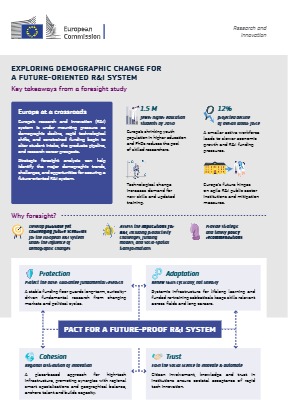
    Exploring Demographic Change for a Future-Oriented EU R&I SystemNovember 2025

    Key takeaways from a foresight study

    Europe’s research and innovation (R&I) system is under mounting pressure as demographic decline, rapid technological
    shifts, and constrained funding begin to alter student intake, the graduate pipeline, and research career prospects. By 2050, Europe could face 1.5 million fewer higher education students and a 12% decline in the labour force. These trends call for bold, future-oriented strategies.

    Comissionned by DG Research & Innovation, the Foresight-on-Demand project team adopted a structured foresight architecture designed to translate broad uncertainties into actionable strategy. A hybrid and multi-stage strategic foresight methodology was used to systematically assess the impact of demographic change on the European R&I system.

    What you'll find in this report:

    • Background data showing a shrinking youth population, a declining workforce, and growing fiscal pressures on R&I funding.
    • A six-step Foresight Process combining horizon scanning, scenario-building, and windtunneling to anticipate future challenges.
    • Four Scenarios illustrating different pathways for Europe’s R&I system.
    • Strategic actions to protect fundamental research, foster lifelong learning, strengthen regional innovation, and build societal trust in technology.

    Posted on: 25/09/2025

    Post Image

    Last Edited: 5 months ago

    The Future of Sustainability in a Post-Global World

    A New Sustainability Agenda Rooted in Access and Stability

    Sustainability in the Post-Global Era

    In the aftermath of decades of global integration, the model of hyperconnected markets is showing signs of retreat. Geopolitical instability, trade disputes, and resource scarcity are catalysing a structural shift that could reshape not only economies, but the very principles underpinning sustainability. Drawing from trend intelligence by Nextatlas, two pivotal developments emerge, developments that invite foresight professionals to rethink sustainability not as a static ideal, but as a dynamic field responsive to systemic transformation.


    The post-global era is not simply a reconfiguration of trade routes or supply chains; it marks a fundamental reframing of what society deems “sustainable.” In a world where inflation, scarcity, and volatility dominate headlines, environmental goals are becoming increasingly intertwined with economic and geopolitical concerns. 

    Nowhere is this reframing more evident than in the European Union, which has positioned itself as a global leader in linking sustainability with regulatory and economic frameworks. Through initiatives such as the European Green Deal, the Carbon Border Adjustment Mechanism, and stricter ESG reporting standards, the EU is setting benchmarks that extend far beyond its borders and reshape how sustainability is understood in practice.


    Nextatlas’ foresight model suggests a pivot: environmental degradation is no longer perceived as the singular sustainability threat. Instead, resource access, economic resilience, and supply chain transparency are becoming the new fault lines. This conclusion is grounded in more than a decade of Nextatlas’ machine learning work in cultural trend forecasting, built on a proprietary pipeline that ingests millions of data points each month from over 300,000 carefully selected sources, including social media users, niche influencers, scientific literature, design portfolios, and startup ecosystems. 


    Through natural language processing, semantic clustering, and visual analysis, these unstructured signals are structured into a dynamic semantic knowledge graph of thousands of interconnected micro-trends. By identifying early adopters with a demonstrated history of trend foresight, the model captures weak signals and emergent cultural dynamics before they reach the mainstream. With a 93% accuracy rate in trend prediction, this methodology provides a robust foundation for understanding the evolution from ecological awareness as individual virtue to sustainability as collective infrastructure.

    The Wasteless Economy
    The intentional rejection of overconsumption

    What was once framed as consumer minimalism is evolving into a more resilient, system-conscious behaviour: the Wasteless Economy. As global citizens face the tangible consequences of rising costs and diminished availability, consumption habits are adjusting accordingly. But unlike past recessions where thrift was reactive, today’s restraint is increasingly proactive and value-driven. In this new context, value is redefined by longevity, utility, and purpose. Careful selection, durability, and circular practices now consciously outweigh constant acquisition.


    This transformation has implications beyond market dynamics. It reflects a recalibration of what constitutes value and well-being in an era of systemic constraint. The Wasteless Economy aligns closely with long-term sustainability goals, emphasising durability, circularity, and resource efficiency, not just as ethical choices, but as strategies for social and economic stability. Amid persistent inflation and renewed tariffs on consumer goods, households are tightening their belts and are naturally drawn to buying less, buying smarter, and investing in lasting value. 

    Feeling the squeeze of both rising operational costs and evolving regulations, businesses are pivoting toward circular models, designing for durability, repairability, and reuse, not for sustainability branding, but as a smart financial strategy. Circular design reduces exposure to volatile supply chains and tariff-prone imports, while reinforcing consumer loyalty through accountability.


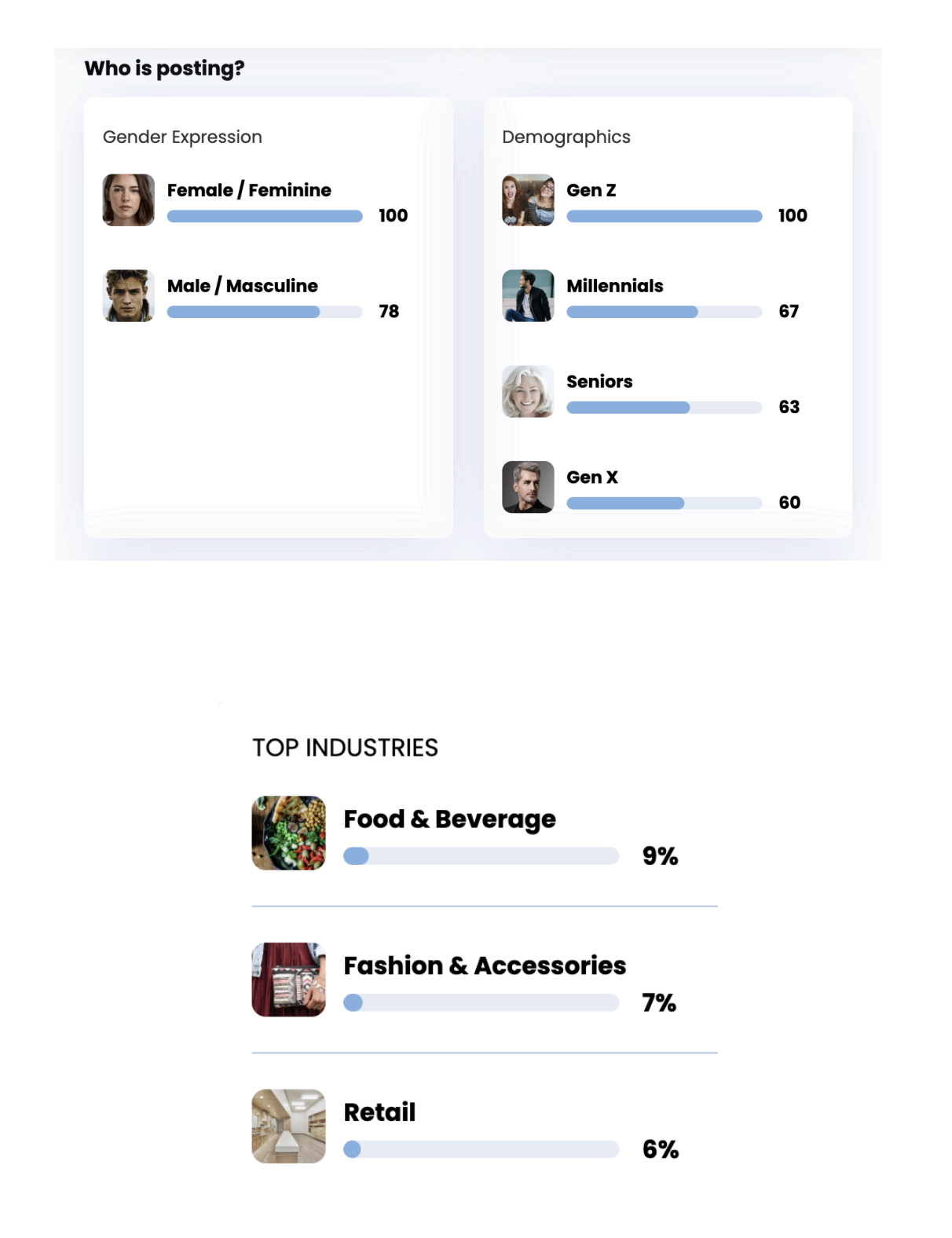
    This shift is most visible in food & beverage, fashion, and retail, industries where overproduction and disposability once defined the norm. Food companies must now design out surplus, embracing precision, seasonality, and resourcefulness as new standards of value. In fashion, longevity and modularity are replacing trend cycles, with resale and repair moving from fringe to fundamental. Retailers, in turn, are being called to transform from providers of endless choice into curators of care, offering fewer but better options that align with the values of restraint and longevity.

    For foresight practitioners, the shift underscores a key signal: in strained environments, sustainability flourishes not through moral appeal but through necessity. Efforts to design policy or governance around future-proofed systems must therefore centre not only on carbon metrics, but also on material longevity, repair ecosystems, and new models of sufficiency.
    Posted on: 23/09/2025

    Last Edited: 5 months ago

    Futures Thinking and Strategic Foresight in ActionApril 2025

    Insights from the Global South

    Our societies are facing increasingly complex sets of risks, and the rapid pace of change is challenging existing governance systems. There is a growing acknowledgement of the need to transform current approaches to policymaking and decision-making to become more futureoriented in support of anticipatory action and building long-term resilience.

    The UN Summit of the Future, held in September 2024, marked a pivotal moment in global governance. The Pact for the Future, including its annexes on a Global Digital Compact and a Declaration on Future Generations, was adopted by the UN General Assembly by consensus and committed to a broad range of priorities to ensure that the multilateral system is better able to
    address the realities of today and prepare for the challenges of tomorrow.

    To contribute to fostering a culture of anticipation and preparedness, and to building a multilateral system that remains relevant for current and future generations, the UN Futures Lab/Global Hub and the International Science Council (ISC) have collaborated to better understand the concrete and transformational role of futures thinking and strategic foresight in informing decision-making and action. Futures thinking and strategic foresight are key to helping us address complex issues and deal with significant uncertainty – and to embedding long-term perspectives that consider policy implications on future generations.

    Drawing on case studies from the Global South , this joint paper demonstrates the versatility of foresight practices with a focus on tangible actions for decision-makers and policymakers. It also illustrates how these approaches can support anticipatory governance and resilience building, offering lessons learned and practical recommendations.

    The selection of 14 case studies presented in this report reflect balance across geographies, themes, sectors, stakeholders, and foresight tools. The case studies illustrate a range of impacts, primarily through a typology of approaches by desired outcomes as outlined below:

    📌Local and Indigenous Knowledge, Sources, and Practices

            📌Building Local Capacities and Durable Solutions from Community-Led Initiatives

            📌Multistakeholder Partnerships and Collaborations

            📌Organizational Development

            📌Sector-Wide Policy Development and Innovation

            📌Futures Empowered by Technological Advancements and Innovation

            📌Improved Social Outcomes/Social Well-Being for Marginalized Communities

            📌Rebuilding Narratives

    🔗Source: UN Futures Lab/Global Hub and the International Science Council (2025). Futures Thinking and Strategic Foresight in Action: Insights from the Global South, New York. unfutureslab.org/project/futures-thinking-and-strategic-foresight-in-action-insights-from-the-global-south

    Posted on: 11/09/2025

    Last Edited: 8 months ago

    Eye of Europe Mutual Learning Event 523 October - 24 October 2025

    FORESIGHT CULTURE IN EUROPE: How to use foresight for (STI) knowledge-based policy making?

    The event was the last out of five Mutual Learning Events series, each with over thirty foresight practitioners and/or research and innovation policy-makers experts from across the European Union (EU). The format of these workshops has been designed to allow for mutual exchange and learning among participants: a few keynotes as well as interactive sessions where all participants can share their experience, ideas and questions.

    The series of events was organised as part of the project Eye of Europe, a Coordination and Support Action funded by the Horizon Europe Programme, aimed at enhancing the integration of foresight practices into science, technology, and innovation (STI) policymaking across the EU. The Technology Centre Prague (TC Prague, Czechia) together with the National Agency for Research and Development of Republic of Moldova as the local organiser have overseen organising this event. Technology Centre Prague, which is responsible for all the MLEs and their content, is a key Czech national think tank and academia-based NGO which has a long and rich experience in supporting knowledge-based policymaking as well as in foresight processes and expert-based forward-looking exercises and trainings. National Agency for Research and Development (NARD) is the Moldovan government authority responsible for implementing the national programme on research and innovation, promoting excellence, and supporting collaborative projects through competitive funding and partnership initiatives.

    The topic of Foresight culture in Europe: How to use foresight for (STI) knowledge-based policy making? The topic brought discussions on importance of collaboration among researchers, policymakers, and industry experts in
    foresight activities and explored ways to break down silos and promote knowledge exchange across disciplines in
    Moldova as well as in the rest of Europe or even globally.

    On 23–24 October 2025, we gathered in Chișinău, Moldova, for the final chapter of the Eye of Europe Mutual Learning series. Hosted by the National Agency for Research and Development of Moldova, this two-day event brought together over 40 foresight practitioners, policy makers, and representatives from ministries and research support agencies across Europe. The agenda was rich with presentations, case studies, and interactive sessions exploring how foresight is shaping research and innovation policy in diverse national contexts—from Moldova to Austria, Czechia, Estonia, Poland, Romania, and beyond. The event was an opportunity to reflect on the many faces of foresight across Europe and to present the diversity of approaches that shape how we anticipate and plan for the future.
    Key Objectives
    • Foster a shared European foresight culture supporting strategic R&I policymaking.
    • Highlight diverse foresight practices and institutional approaches across member states.
    • Strengthen capacity for future-oriented policy design and implementation.
    • Transition from vision to action through practical foresight integration.
    Key Takeaways
    • Foresight is a strategic tool for innovation policy, resilience, and inclusiveness.
    • There is growing momentum toward systematic foresight integration in governance.
    • Co-creation, citizen engagement, and knowledge exchange are vital for foresight maturity in Europe.
    • MLE in Chisinau highlighted the need to move from dialogue to tangible policy actions and institutional embedding.

    The Eye of Europe project was recognised as a potential hub for foresight community-building and greater institutionalisation.

    Posted on: 16/06/2025

    Post Image

    Last Edited: 8 months ago

    What is Emerging Technologies Scanning and how it fits into Futures Studies practices

    Emerging Technologies Scanning (ETS) emerges as a practice within Futures & Foresight (Futures Thinking & Strategic Foresight)

    The introduction of a new technology is never an isolated event and never concerns only one market or one domain. There are invariably socio-cultural, political, economic, and environmental implications, as well as impacts, influences, “cross-pollination”, and correlations among different technologies.

    The very broad definition of technology itself betrays its intrinsic complexity: a vast field of research involving various technical and scientific disciplines, which examines the application and use of everything that can serve to solve problems. The term “technology” also refers to the aggregate of knowledge, skills, and tools used to design, create, and utilise objects, processes, systems, or services to meet human needs.

    An emerging technology, in particular, is one that is radically new and relatively fast-growing technology [it is not necessarily exponential, as the common dialectics of recent years have conditioned us to expect, yet this has little to do with the mathematical concepts of exponentiality; rapid growth does not imply exponentiality]. It is characterised by a certain degree of coherence (or consistency) that persists over time and has the potential to have a substantial impact on the socio-economic-political domains (understood as the players, institutions, and models of interactions between them, as well as all the processes of knowledge production associated with these domains).

    Its most significant impact lies in the future and thus in the emergency phase: an emerging technology is still quite uncertain and ambiguous. For this reason, it would be prudent to analyse its potential impacts in a timely manner, to avoid getting trapped in Amara’s Law.

    Posted on: 09/06/2025

    Last Edited: 9 months ago

    𝗙𝗼𝗰𝘂𝘀 𝗼𝗻 𝗨𝗿𝗯𝗮𝗻 𝗔𝗴𝗿𝗶𝗰𝘂𝗹𝘁𝘂𝗿𝗲April 2025

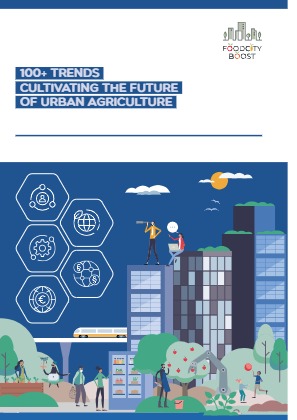
    𝗙𝗼𝗿𝗲𝘀𝗶𝗴𝗵𝘁 𝗕𝗿𝗼𝗰𝗵𝘂𝗿𝗲 𝗙𝗲𝗮𝘁𝘂𝗿𝗶𝗻𝗴 𝗢𝘃𝗲𝗿 𝟭𝟬𝟬 𝗧𝗿𝗲𝗻𝗱𝘀 𝗣𝘂𝗯𝗹𝗶𝘀𝗵𝗲𝗱

    How will the city of tomorrow grow? How is food production changing in the future? In their new brochure “100+ Trends Cultivating Urban Agriculture”, Dr. Anna Kirstgen and Dr. Björn Moller from Fraunhofer ISI Foresight Department provide answers within the framework of the FOODCITYBOOST project – and show just how diverse and dynamic urban agriculture is becoming.

    📌 Included in the brochure:
    • A trend radar featuring over 100 key developments, offering a structured overview and strategic orientation on emerging trends and future perspectives
    • 15 deep dives exploring key topics such as social innovations, new technologies, regulations, new business models, and ecological challenges like food waste

    A compact overview for anyone involved in urban development, agricultural innovation, or sustainable food systems.

    Posted on: 03/05/2025

    Last Edited: 9 months ago

    Future of Space ExplorationOctober 2023

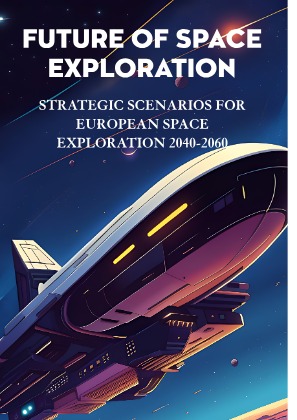
    Strategic Scenarios for European Space Exploration 2040-2060

    To discern the trends that will influence space exploration in the long term, the European Space Policy Institute (ESPI) and the Copenhagen Institute for Future Studies (CIFS) collaboratively conducted a foresight analysis on the Future of Space Exploration in Europe between 2040-2060.

    The study delineates four scenarios for the long-term future of space exploration, emphasizing the critical uncertainties and forces that will shape its trajectory and underscore its significance. As the future of European space exploration is anticipated to incorporate elements from each of these scenarios, strategic foresight is essential for current decision-making that aspires to be alert, enduring and forward-thinking.

    Source: ESPI - Home- Reports

    Posted on: 30/04/2025

    Last Edited: 9 months ago

    Global Trends to 2040March 2024

    Choosing Europe’s Future

    This is the fourth ESPAS (European Strategy and Policy Analysis System) global trends report since the establishment of this inter-institutional EU foresight process in the early 2010s. As on previous occasions, it is being published in a year when the European Union embarks on a new five-year institutional cycle. The report analyses the key global trends towards the year 2040 and their possible impact on the Union, and sets out some strategic choices and questions that Europe's leaders may need to address in the coming five years and beyond. The report is the product of a unique collaborative process over the past year involving officials from across the nine ESPAS institutions and bodies.

    The report sets the centrality of geopolitics as a transversal trend, given the on-going shift from an era of cooperation to an era of competition as well as the deepening fragmentation of the international system and the acceleration of major global transitions. The Report highlights how the borders between EU internal policy and external policy are blurring nowadays and will probably blur even more in the future. The primacy of geopolitics is outlined across the various trends identified in the report: from the economic challenges to demography, from the environmental and climate crisis to the energy transition, from the quest for equality to the technological acceleration, and including health, democracy and the broader changes on how we live.

    The publication concludes by outlining the strategic imperatives for the incoming EU leadership. It calls for a multifaceted approach to establish the EU as a smart global power, ensure a socially equitable green transition, navigate economic risks, update the economic model, innovate within a balanced regulatory framework, and strengthen social cohesion.

    Between now and 2040, Europe and the world will undergo profound geopolitical, economic, technological and social change. The generation now growing up will live in a world that we can only imagine. However, integrating long-term goals into short to medium-term decision-making can boost our chances of leaving a world that is in better shape to the next generation. The more we understand the challenges ahead, the better we can anticipate and prepare for the changes to come. There are grounds for optimism. The EU has arguably been able to make progress in the past precisely when the challenges seemed overwhelming. When pressed, it can marshal reserves of determination and ingenuity. The next EU leadership will need to draw deeply on these reserves in the years ahead.

    Source: EEAS Global Trends to 2040: Choosing Europe’s Future

    Posted on: 30/04/2025

    Last Edited: 9 months ago

    Choosing Europe's FutureApril 2024

    The 2024 ESPAS report

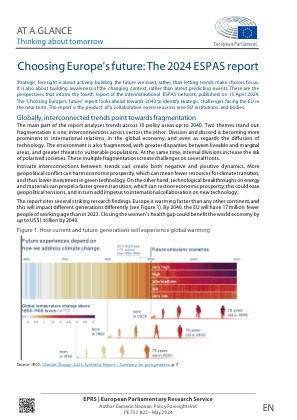
    The latest report of the ESPAS network, Choosing Europe’s Future, analyses global trends in order to identify key strategic challenges for the EU as the next legislative cycle begins. It is the fruit of collaboration between nine EU institutions and bodies. Key takeaways include the importance of being able to act quickly, given that game-changing developments can happen suddenly. It notes the risk of false economies; in areas such as defence and security, for example, efforts to avoid costs now can mean far greater costs in the future. The report points to the importance of threat multipliers and gain multipliers. Action to mitigate social fragmentation can prevent knock-on effects in other domains; the development of effective clean technologies can bring dividends across the board.

    Think Tank European Parliament - Research - Advanced search - Choosing Europe's future: The 2024 ESPAS report

    Posted on: 30/04/2025

    Post Image

    Last Edited: 9 months ago

    Planetary Foresight and Ethics

    New Book

    Summary

    Core Themes
    The book reimagines humanity’s future through planetary foresight, blending historical wisdom with planetary stewardship. It critiques linear Western progress narratives and advocates for a hybrid, cyclical vision of history, emphasizing pluralistic identities and reverence for life.

    Structural Framework
    Organized into thematic sections, the work begins with “The Mysterious Lord of Time,” challenging linear temporality and introducing non-linear, culturally diverse historical perspectives. “Evolving Belief Systems” contrasts Indo-Iranic, Mesopotamian, and Hellenic thought with Abrahamic traditions, highlighting ancient influences on modern pluralism.

    Imagination and Futures
    The “Histories of Imagination” section explores myth and storytelling as drivers of civilization, while “Scenarios of Future Worlds” applies foresight methodologies to geopolitical and technological evolution, emphasizing ecological consciousness. The final chapters expand to cosmic intelligence and ethics, framing humanity’s role within universal interconnectedness.

    Ethical Vision
    Central to the thesis is a call for planetary identity and stewardship, merging forgotten wisdom traditions with modern foresight to navigate ecological and technological uncertainties. The book positions itself as both a philosophical guide and practical framework for ethical transformation in an era of global crises.

    Key Argument
    Motti asserts that humanity is transitioning from a “Second Nomad Age” (characterized by fragmentation) toward a “Second Settlement Age” marked by planetary consciousness, requiring creative complexity and ethical vigilance.

    Posted on: 23/04/2025

    Last Edited: 10 months ago

    Strategic Foresight ReportJune 2023

    Sustainability and People’s Wellbeing at the Heart of Europe’s Open Strategic Autonomy

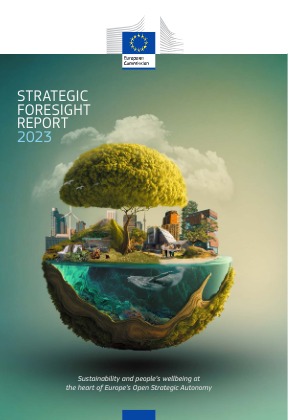
    The EU is engaged in a profound and ambitious transition to achieve climate neutrality and sustainability in the next few decades. This sustainability transition will be key to strengthen the EU's Open Strategic Autonomy, ensure its long-term competitiveness, uphold its social market economy model and consolidate its global leadership in the new net-zero economy. To succeed, the EU will need to address several challenges and make choices that will affect our societies and economies at an unprecedented pace and scale.

    The 2023 report provides an overview of the challenges we face and proposes ten areas for action to achieve a successful transition. To equip policymakers with economic indicators which also consider wellbeing, it proposes to adjust Gross Domestic Product (GDP) to take account of different factors such as health and the environment.

    This approach will bolster the EU's Open Strategic Autonomy and global standing in its pursuit of a resilient net-zero economy. 

    Overcoming key social and economic challenges

    As it goes through the sustainability transition – which encompasses both economic and social sustainability ­– the EU is facing several challenges. For example:

    • Evolving geopolitical shifts are shaping public opinion and how governments across the globe act, challenging international cooperation on global issues, such as climate change or the energy transition.
    • The need for a new economic model, focused on the wellbeing of people and nature, decoupling economic growth from resource use and shifting to more sustainable production and consumption. Up to 75% of Eurozone businesses are highly dependent on natural resources. Economic, social and environmental sustainability are inextricably linked.
    • Growing demand for adequate skills for a sustainable future. The availability of workers equipped with appropriate technical and soft skills will be crucial for the EU's competitiveness: 85% of EU firms today lack staff with the competences needed to navigate the green and digital transitions.
    • The sustainability transition requires unprecedented investments. Achieving it will depend on securing sufficient funding both from the public and private sectors.

    Ten areas for action
    Today's report identifies ten areas where our policy response is needed to ensure that the sustainability transition remains focused on the wellbeing of people and society:

    1. Ensure a new European social contract with renewed welfare policies and a focus on high-quality social services.
    2. Deepen the Single Market to champion a resilient net-zero economy, with a focus on Open Strategic Autonomy and economic security.
    3. Boost the EU's offer on the global stage to strengthen cooperation with key partners.
    4. Support shifts in production and consumption towards sustainability, targeting regulation and fostering balanced lifestyles.
    5. Move towards a ‘Europe of investments' through public action to catalyse financial flows for the transitions.
    6. Make public budgets fit for sustainability through an efficient tax framework and public spending.
    7. Further shift policy and economic indicators towards sustainable and inclusive wellbeing, including by adjusting GDP for different factors.
    8. Ensure that all Europeans can contribute to the transition by increasing labour market participation and focusing on future skills.
    9. Strengthen democracy with generational fairness at the heart of policymaking to reinforce the support for the transitions.
    10. Complement civil protection with ‘civil prevention' by reinforcing the EU's toolbox on preparedness and response.

    Source: European Commission - Press Corner - 2023 Strategic Foresight Report

    Posted on: 15/04/2025

    Last Edited: 10 months ago

    German Call for Papers: Foresight in Theorie und Praxis13 April - 03 May 2025

    As part of the "Foresight in Theory and Practice" track at the INFORMATIK FESTIVAL 2025 in Potsdam

    Die gegenwärtige Zeit ist geprägt von rasanten und oft gleichzeitig stattfindenden Veränderungen und
    Entwicklungen: Technologien wie Künstliche Intelligenz (KI), neue regulative Anforderungen wie die CSRD
    oder der EU AI Act sowie gesellschaftliche und politische Herausforderungen sorgen für dynamische und
    disruptive Zukunftsperspektiven mit spezifischen Anforderungen an die Resilienz und das
    Innovationsmanagement. Die strategische Vorausschau (Foresight) gewinnt aus diesem Grund sowohl in
    Unternehmen als auch in der Forschung zunehmend an Bedeutung.

    Der Workshop „Foresight in Theorie und Praxis“ dient daher als Forum, um Akteure aus Unternehmen und
    wissenschaftlichen Einrichtungen zusammenzubringen und Erfahrungswerte sowie Kooperationspotenziale
    der strategischen Vorausschau zu diskutieren. Insbesondere soll dabei auch die Bedeutung der Informatik
    für den Aufbau und die Weiterentwicklung eines Foresight-Prozesses berücksichtigt werden. 

    Folgende Fragestellungen bieten eine Orientierung über die thematischen Schwerpunkte des Workshops:

    1. Welche Forschungsansätze im Bereich Foresight existieren bereits? Wo gibt es weiteren
      Forschungsbedarf?
    2. Wie werden Forschungsansätze derzeit bereits in der Praxis angewandt? Wodurch zeichnen sich
      diese aus und wo liegen die Grenzen?
    3. Wie gestaltet sich strategische Vorausschau in Unternehmen? Wie unterscheidet sich diese in
      Großunternehmen und KMU?
    4. Wie kann strategische Vorausschau in wissenschaftlichen Einrichtungen umgesetzt werden? Wo
      liegen Unterschiede zur unternehmerischen Herangehensweise, wo gibt es Gemeinsamkeiten?
    5. Wie können digitale Technologien (z. B. IT-Anwendungen, KI) die strategische Vorausschau
      unterstützen und verbessern? Welche Ressourcen und Kompetenzen sind hierfür erforderlich?

    Die Beiträge zum Workshop können verschiedene Aspekte von Foresight bzw. strategischer Vorausschau
    behandeln. Mögliche Themen sind (nicht abschließend):

    • Methoden der strategischen Vorausschau
    • Anwendung von Foresight in Unternehmen
    • Anwendung von Foresight in wissenschaftlichen Einrichtung
    • Digitale Technologien zur Unterstützung von Foresight (z. B. KI, Big Data, Simulationen)
    • KI und Foresight
    • Simulationstechniken
    • Datenanalysen/Datenmangement
    • Szenariotechniken
    • Trendanalysen
    • Horizon Scanning
    • Innovationsmanagement
    • Organisatorische und kulturelle Herausforderungen der strategischen Vorausschau
    • Regulatorische und ethische Aspekte von Foresight
    • Unternehmensstrategie und Foresight
    • Risikomanagement mit Foresight
    • Best Practices und Praxisberichte

    Zielgruppe des Workshops sind Forschende und Anwendende aus dem Bereich strategische Vorausschau
    bzw. Foresight sowie:

    • Fach- und Führungskräfte aus Unternehmen, die strategische Vorausschau in ihre Planung
      integrieren
    • Beratende im Bereich Zukunftsforschung und Trendanalyse
    • Verantwortliche für Innovations- und Technologiemanagement
    • Entscheidungsträger*innen in Politik und Verwaltung, die zukunftsorientierte Strategien entwickeln
    • IT-Experten*innen und Entwickler*innen von digitalen Foresight-Tools
    • Wissenschaftler*innen und Studierende mit Interesse an Foresight-Methoden

    HINWEISE ZUR EINREICHUNG

    Einreichungsfrist für Workshop-Beiträge: 04.05.2025
    Benachrichtigung der Autoren: 02.06.2025
    Einreichungsfrist für LNI-Beiträge: 11.06.2025
    Workshop: 19.09.2025

    Die Einreichung der Beiträge erfolgt als PDF über EasyChair.

    Für die Beiträge sind die LNI-Vorlagen zu verwenden.

    Beiträge können in deutscher oder englischer Sprache verfasst werden und sollten folgenden Umfang nicht überschreiten:

    Full Paper: 10-12 Seiten

    Short Paper: 6 Seiten

    Work-In-Progress-Paper: 3-5 Seiten

    Praxisbeiträge aus der Industrie: 3-5 Seiten

    Posted on: 14/04/2025

    Post Image

    Last Edited: 10 months ago

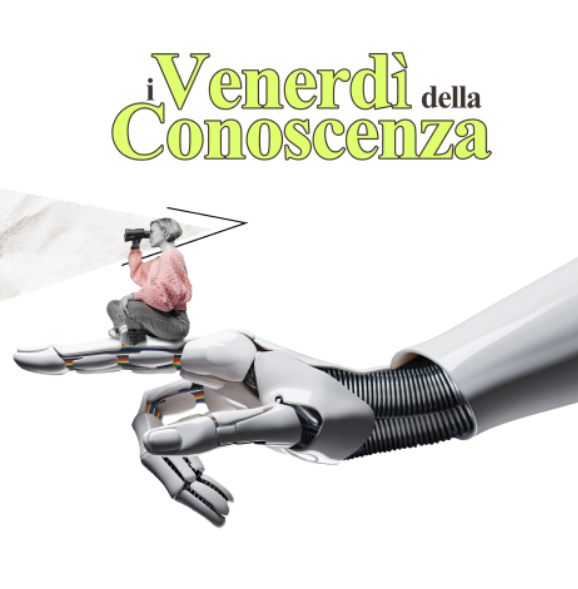
    Making the Future More Tangible for Citizens Through ‘Fridays of Knowledge’

    In the small seaside township of Diano Marina, Liguria Region, Italy, the local community has been organising frequent meetings to help people overcome growing fears of an increasingly uncertain future. This initiative, called ‘Fridays of Knowledge’, aims to equip the local community with scientific tools and knowledge to understand the risks and implications of new technologies in a dialogue together with students, academics, and journalists. Communication Manager for Fridays of Knowledge, Damiana Biga, tells Futures4Europe how this initiative sparks debates across different generations and backgrounds, fostering a sense of shared responsibility and curiosity.

    Posted on: 27/03/2025

    Last Edited: a year ago

    Futures of Science and Conflict27 March - 27 March 2025

    Influencing Factors and Scenario Development Workshop

    The increase of geopolitical tensions gives rise to several uncertainties for scientific communities and their respective research. On the one hand, the sciences have a role to play in keeping up peaceful cooperation between national or regional rivals (science diplomacy). On the other hand, questions of dual use and research security become ever more relevant across fields as both hot and cold conflicts emerge.

     
    The Futures of Science and Conflict workshop (March 27th, 2025, 10:00-13:00 CET) will gather experts from multiple fields to share and discuss the factors, trends, and topics that will shape the future role of scientists, their research, and their working relationships in times of increased geopolitical tensions and conflict. During the workshop, participants will co-create scenarios outlining the challenges and opportunities presented by uncertain futures. This workshop is organised through the Eye of Europe project – a Horizon Europe funded CSA initiative. 

    The workshop will undertake the following activities
    • Influencing Factor Assessment Survey (pre-workshop, ~15 min.)
    • Discussion of Factor Assessment
    • Co-production of Scenarios
    • Discussion of challenges, opportunities, and implications for research and innovation ecosystems

    Posted on: 13/03/2025

    Last Edited: a year ago

    "The future of quantum computing: what matters now"

    Foresight study on behalf of the German Federal Ministry for Economic Affars and Climate Action

    The DLR-PT conducted a comprehensive foresight study for the BMWK to explore the current progress and challenges in quantum computing. Using DLR-PT's innovative Strategic Impact Navigation Assessment Model (SINAVI), the study employed a range of methods including trend analysis, expert interviews and multi-stage Delphi surveys. Based on these findings, DLR-PT created a forward-looking scenario for 2032 and used the backcasting method to identify key strategies for advancing quantum computing in Germany. The findings were enriched with data from an accompanying performance review of the funding initiative, for which DLR-PT was also responsible. The result was a holistic, actionable roadmap that highlights both the achievements and future potential of the funding programme.

    Posted on: 17/02/2025

    Last Edited: a year ago

    Mission Area: Climate-Neutral and Smart CitiesJuly 2021

    Foresight on Demand Brief in Support of the Horizon Europe Mission Board

    The EU introduced missions as a new instrument in Horizon Europe. Mission Boards were appointed to elaborate visions for the future in five Areas: Adaptation to Climate Change, Including Societal Transformation; Cancer; Healthy Oceans, Seas, and Coastal and Inland Waters; Climate-Neutral and Smart Cities; Soil Health and Food. Starting in autumn 2019, five Foresight on Demand projects supported them with foresight expertise and methodology.

    This report provides the work in support of the Mission Board on Climate-Neutral and Smart Cities. Starting with a systemic analysis, the project identified urban challenges in existing forward-looking studies in order to determine the thematic scope together with the Mission Board. It collected data about consolidated external and internal drivers, trends and practices as well as weak signals, potential disruptive events or incremental changes with a potentially substantial positive impact on cities.

    Posted on: 20/01/2025

    Post Image

    Last Edited: a year ago

    ‘Going rural’

    Managing Land Access (and Use) to Support Rural Futures

    Renewing rural generations, via the provision of green jobs and accessible farming enterprises, has powered the EU-sponsored RURALIZATION project looking to promote synergies between agriculture policymakers and local rural communities in painting attractive rural futures.

    Posted on: 25/11/2024

    Last Edited: a year ago

    Horizon Futures Watch Workshop #3:Future of Science for Policy in Europe28 June - 28 June 2023

    The third Horizon Futures Watch Workshop on the Future of Science for Policy in Europe took place on 28th June 2023. 

    The workshop began with a presentation by members of the Foresight on Demand Consortium, aiming to explore the future of science for policy and more specifically knowledge exchange processes between knowledge actors and policymakers, with the intention to produce scientifically informed policy in Europe. The presentation outlined scenarios rooted in developments, trends, and drivers that are currently underway providing a glimpse into potential characteristics that might define the landscape in the 2030s. The scenarios were developed around two key dimensions for the governance of science: the extent to which government directs science and the extent of stakeholder engagement in the shaping of scientific agendas. Drawing from previously identified trends such as Citizen Science, Open Science, Mission-driven research and innovation, and data-driven policy, the team identified five scenario narratives as shown below.

    All scenarios, departed from trends already identified within the European R&I system and opened the floor for in-depth discussions concerning the future Science for Policy and policy governance. The discussion that ensued between the speakers and the workshop participants raised points about the future of science for policy and the potential evolution of current R&I policy: 

    Foresight and Science for Policy: Certain scenarios speculated that Foresight will not, in the future, be practiced as it was before – as a response to crises – but will be integrated in political agenda setting for R&I. This could render traditional Science for Policy redundant, as it could become an intrinsic element of policy initiatives. In this setting, scientific advice would be co-created through diverse frameworks rather than coming from a single institutionalized source. 

    Mapping Scenarios: During the discussions, the intricate nature of European R&I systems was highlighted. Participants proposed that Member States be encouraged to undertake similar scenario-building exercises, which can have the benefit of drawing all relevant stakeholders around the table. This approach could enable the creation of viable roadmaps based on these scenarios and assess the alignment of these streams with National and European initiatives.

    Addressing Systemic Failures in Science and Democracy: The discussion also touched upon the democratization of scientific processes leading to considerations about cultivating openness and transparency and encouraging the multidisciplinary nature and the involvement of actors beyond just the scientific realm. Bio Agora, for example, which aims to develop the Science Service for European Research and Biodiversity Policy Making, actively contributes to breaking the silo thinking in science, society and policy, and showcased its approach in a subsequent presentation. Similarly, the PHIRI project (Population Health and Research Infrastructure, PHIRI) presented its approach for best gathering available evidence for research on health and well-being of populations impacted by Covid-19. Through the input gathered from various stakeholders in different member states, PHIRI showcased how they adopted a multi-stakeholder approach to develop scenarios that are insightful for understanding the challenges for public health in the short and long term using the expertise of people from diverse backgrounds. 

    Indeed, audience feedback suggested broadening the scope of the prospective analysis conducted on the Future of Science for Policy. This expansion could encompass the involvement and contributions of stakeholders in policy governance who extend beyond the scientific community. This approach aims to achieve a more comprehensive and systemic understanding of the subject matter. 

    The project presentations further led to insightful conversations on the strategic significance of Foresight and collaborative governance methods as valuable aspects for addressing deliberative issues, including:

    • The concept of Temporality: While it is essential to strive for a better understanding of the future, equal emphasis should be placed on comprehending the present. As Henk Hilderink, Public Health Foresight Expert at the Dutch National Institute for Public Health and the Environment (RIVM) said: "If we wait until we understand what the present is, then we are never going to look at the future”.
    • Collaborative governance methods: Discussions revolved around identifying the appropriate Collaborative Governance Practices. This entails a keen focus on leveraging Emerging Technologies to facilitate methods conducive to achieving collaborative multilevel governance.

    Posted on: 25/11/2024