Loading...

    Mentions of

    sorted by publishing date

    Last Edited: 9 months ago

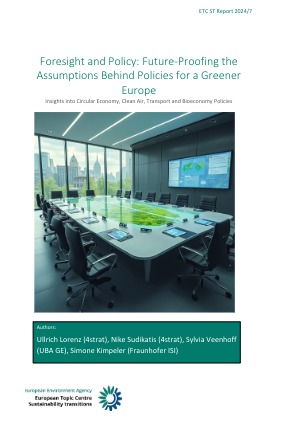
    Foresight and Policy: Future-Proofing the Assumptions Behind Policies for a Greener EuropeFebruary 2025

    Insights into Circular Economy, Clean Air, Transport and Bioeconomy Policies

    This report offers an in-depth foresight assessment that critically evaluates and questions the foundational assumptions of European environmental policies related to the Green Deal. To enhance the resilience of these frameworks, the two-year study utilises a comprehensive set of methods, including impact wheel analysis, Ishikawa diagrams, cross-impact analysis, semi-structured interviews, and causal layered analysis. This approach reveals the cascading effects, entrenched cognitive biases, and intricate interdependencies present in policy design. These techniques facilitate a detailed examination of specific policy areas while providing a systemic perspective on how the connections among circular economy, bioeconomy, clean air and health, and the decarbonisation of transport impact overall sustainability results. By harnessing these diverse foresight techniques, the assessment reveals that conventional policy narratives are often oversimplified, obscuring risks and trade-offs that, if unchallenged, may impede a successful transition to a sustainable Europe. The impact wheel and Ishikawa diagrams facilitate the structured identification of primary and secondary effects, while the cross-impact analysis maps the interactive dynamics between assumptions. Semi-structured interviews provide nuanced stakeholder perspectives that uncover underlying worldviews and metaphors shaping policy discourse when synthesised via causal layered analysis. The study offers actionable recommendations for enhancing policy resilience, promoting integrated governance, and fostering adaptive strategies capable of addressing the multipronged challenges posed by environmental uncertainty.

    Source: Eionet - ETCs- ETC Sustainability transitions (ETC ST) - Products  

    Posted on: 30/04/2025

    Last Edited: 10 months ago

    Foresight Study on Fishers of the FutureNovember 2024

    Final Report

    The study represents the Commission’s commitment, outlined in its 2023 Communication on the functioning of the Common Fisheries Policy (CFP), to address emerging challenges in the sector. It aligns with the Commission's definition of foresight as “the discipline of exploring, anticipating, and shaping the future to inform today’s decision-making.” This participatory study places fishers at its core, integrating their perspectives into the development of future scenarios and fisher profiles to inform strategic policymaking for a sustainable, competitive and resilient EU fishing sector, as part of the wider blue economy. It does not present policy proposals, which was never the intention, rather it serves to stimulate further the important debate on securing and giving a perspective on the future of EU fishers.

    European Commission: European Climate, Infrastructure and Environment Executive Agency, F&S, IPSOS, POSEIDON, Tetra Tech, Davies, M., Macfadyen, G., Brugere, C., Chiarelli, N., Dale, F.Caillart, B., Foresight study on fishers of the future – Final report , Publications Office of the European Union, 2024;

    Posted on: 15/04/2025

    Last Edited: a year ago

    "The future of quantum computing: what matters now"

    Foresight study on behalf of the German Federal Ministry for Economic Affars and Climate Action

    The DLR-PT conducted a comprehensive foresight study for the BMWK to explore the current progress and challenges in quantum computing. Using DLR-PT's innovative Strategic Impact Navigation Assessment Model (SINAVI), the study employed a range of methods including trend analysis, expert interviews and multi-stage Delphi surveys. Based on these findings, DLR-PT created a forward-looking scenario for 2032 and used the backcasting method to identify key strategies for advancing quantum computing in Germany. The findings were enriched with data from an accompanying performance review of the funding initiative, for which DLR-PT was also responsible. The result was a holistic, actionable roadmap that highlights both the achievements and future potential of the funding programme.

    Posted on: 17/02/2025

    Last Edited: a year ago

    Scenarios for the future of school education in the EUSeptember 2023

    A Foresight Study

    The foresight study focused on school education (ISCED levels 1-3) in the EU. It aimed at:

    • developing four scenarios, describing potential alternative futures of the school education in the EUby 2040.
    • identifying the preferred scenario developments.
    • providing recommendations on the policy measures that could be introduced, or strengthened, tohelp school education in the EU move towards the preferred future scenario.

    The development of the scenarios was based on the factors of change1, identified through desk research, horizon scanning, and extensive stakeholder involvement. More than 80 European Commission officials, school education experts, representatives of teacher, student and headmaster umbrella organisations, and other stakeholders, from across the EU, contributed to the study, by participating in four workshops, a Delphi survey, and interviews.

    Posted on: 29/01/2025

    Last Edited: a year ago

    Mission Area: Adaptation to Climate Change, Including Societal TransformationJuly 2021

    Foresight on Demand Brief in Support of the Horizon Europe Mission Board

    This final report summarises the results of the actions to support the Mission Board for “Adaptation to Climate Change, including Societal Transformation” with forward-looking evidence.

    In accordance with the Request, the proposed services, approaches to be adopted, and the concrete nature and form of the outputs have been shaped and validated through close interaction with the Mission Board (MB) via the Mission Secretariat, run by relevant European Commission (EC) services, throughout the implementation of the action.

    As a result of the interactions with the Mission Secretariat, the following actions were taken:

    1. Preparing a short paper Input to Mission Board on scoping activities & tasks
      (Deliverable 1)
    2. Analysing national and regional funding programmes of selected countries for
      projects on Climate Change Adaptation, and conducting interviews with selected
      Mission Board members in preparation of a foresight workshop.
    3. Preparing an input paper for the foresight workshop Input Document FoD CCA
      Workshop, 23 January 2020 (Deliverable 2).
    4. Holding a foresight workshop (23 January 2020) with Mission Board members,
      European Commission representatives (Mission Secretariat), and foresight experts,
      and summarising the results of the workshop. The workshop served to identify
      barriers and solutions, enablers and impacts of climate change adaptation in a variety
      of thematic fields, including health, water, food and agriculture.
    5. Developing and implementing a Delphi survey on assessing key aspects of the draft
      paper of the Mission Board. The survey addressed climate experts. They assessed
      future targets in thematic fields (e.g. financial risks, health, social infrastructure), and
      ranked related measures and R&I fields for importance.
    6. Preparing and analysing the results of the Delphi survey: Delphi Survey results,
      July/August 2020 (Deliverables 3 and 4).

    The report is structured along these deliverables.

    Posted on: 20/01/2025

    Last Edited: a year ago

    Strenthening foresight and the role of future generations in Finnish lawmakingOctober 2022

    POLICY BRIEF 2022:33

    This is the short English-language Policy Brief from the research project Foresight and Future Generations in Law-Making (FORGE). FORGE examined issues of future-regarding lawmaking in an interdisciplinary manner, combining expertise on futures studies, political science, and jurisprudence. The aim of the study was to analyse the status of future generations and their rights in current legislative processes, and to map and compare practices for foresight and consideration of future generations in different political contexts, nationally and internationally. The purpose of the project was to increase understanding on i) how future generations can be better taken into account in policymaking; ii) how foresight can be better utilised in lawmaking. 

    The FORGE-project was unique – there had not previously been a study with a similar scope in Finland and comparable international examples are, to the best knowledge of the authors, extremely rare. FORGE supported the preparation of the second part
    of the Government Report on the Future. The project was funded by the Government’s analysis, assessment and research activities (VN TEAS) and was conducted during 1/2022–11/2022 by researchers of the University of Turku, Åbo Akademi University and Tampere University.

    Findings:

    From an international comparison, Finland already has an advanced national foresight system and can be regarded as a pioneer in futureregarding policymaking. However, there is still room for improvement in terms of using foresight and considering future generations as a part of lawmaking. Such improvement could be achieved by developing and upgrading the existing institutions and practices and by making more incremental changes in practices, modes of interaction, and attitudes. For example, foresight should be conducted more as a continuous activity, and future generations’ interests and rights should be considered more systematically in legislative processes, while acknowledging the plurality of future interests.

    Development proposals:

    Full lenght-report available in Finnish

    In addition to the 12-page Policy Brief summarising the FORGE projects' finding in English, The Prime Minister's Office has published the full 203-page report in Finnish. This can be found here below.

    Posted on: 08/01/2025