Last Edited: a month ago
Scenarios of future socio-economic development of the Czech Republic until 2100July 2026
Posted on: 03/09/2026
sorted by publishing date
Last Edited: a month ago
Posted on: 03/09/2026
Last Edited: a month ago
How could technological developments affect the functioning of democracy in the coming decades? This was the central question addressed by the pilot foresight workshop “Technology and Democracy", organized by the Technology Centre Prague on March 13, 2026, as part of the international Eye of Europe project.
The workshop brought together citizens of different age groups who share an interest in technology and its impacts on society. The discussion thus offered a diverse range of perspectives – from younger generations growing up in a digital environment to older generations with life experience in a system with undemocratic institutions.
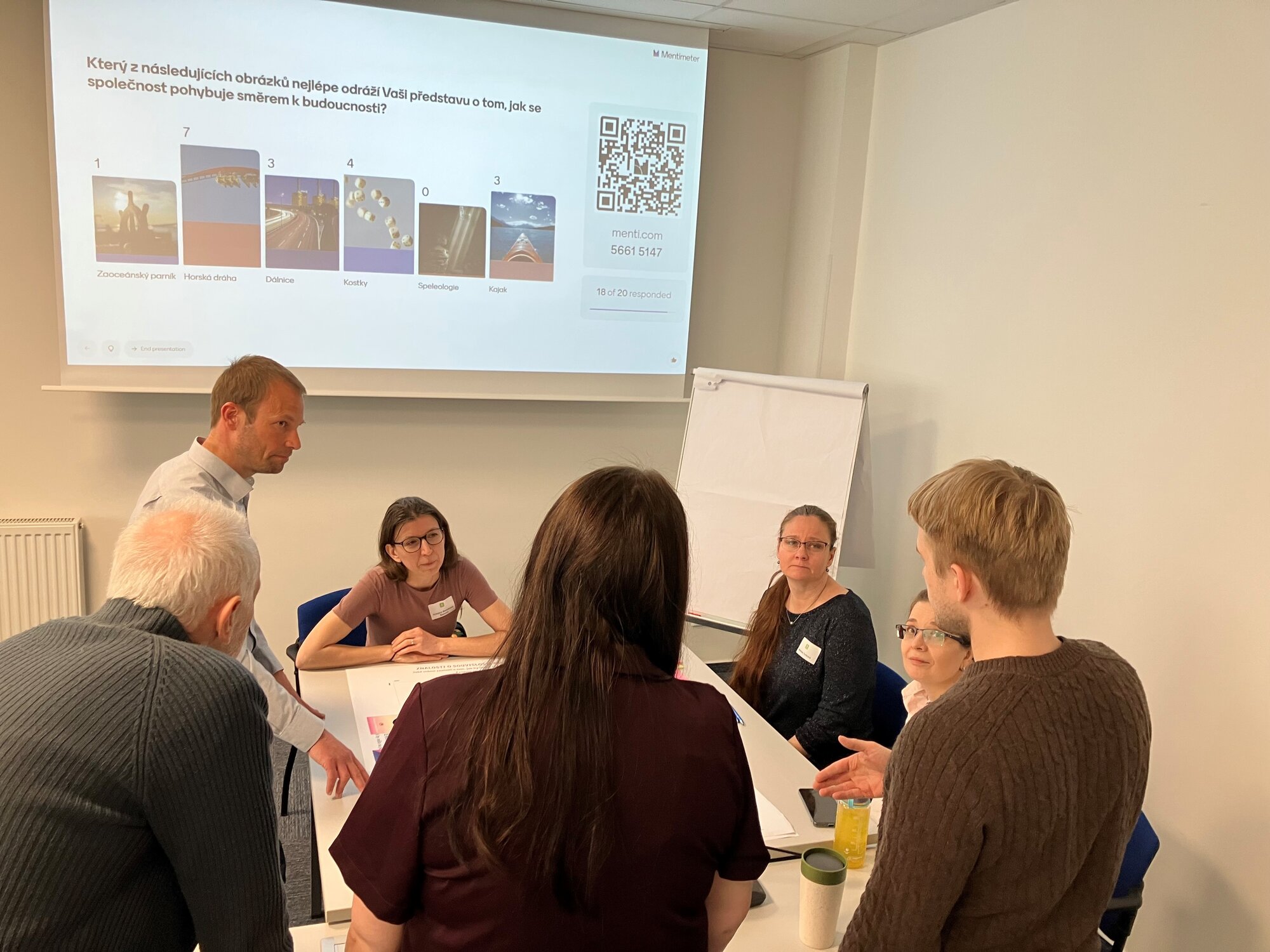
Following an introductory presentation in which participants were briefed on the Eye of Europe project and the importance of foresight, a short icebreaker followed - using visualization, the participants were asked to express their perception of how the society moves into the future. Most of them perceived the movement as a roller coaster ride, where we are sometimes down and sometimes up, or as uncertain as when playing dice. "Highway" suggests that the goal is clear, but we never know what we will encounter on the way (broken roads, traffic jams, etc.). "Ocean liner" reminded us of the Titanic - today's civilized and wealthy society often tends to ignore possible risks.
The workshop drew on specific foresight methodological tools developed by the European Commission’s Joint Research Centre, in particular the so-called “cards of potential future crises” and the “matrix of uncertainties and impacts”. The participants, divided into three groups, analysed key drivers of change, identified uncertainties and their potential impacts. The foresight tools enabled them to systematically examine their interconnections and identify potential chains of events. The result was three distinct scenarios for development up to 2050, which were based on the same initial assumptions but differed in their implications for democracy. In addition, each group supplemented its scenarios with a specific “one-person story” illustrating life in that future.
The process proceeded in the following steps:
Enhancing the risk awareness by exploring the broad spectrum of risks: Each group worked with 12 selected risk cards. They were asked to consider and discuss how aware they are of the potential impact of this risk (from each person´s own perspective). “Is there uncertainty or certainty with regards to how the risk might develop? And how significantly could this risk affect the future?” The group expressed its collective opinion by placing the cards on the “Evaluation of selected risks” matrix.
Selection of 3 key risks: Participants were instructed to select 3 risks that, in their view, we will face most in the future for further work. That risks that emerge slowly over a longer period or have a low likelihood of occurring are often overlooked other priorities – but they could be the most important ones to be focused on. Independently of the other groups, each group selected "Loss of Human Control" as one of their key risk cards.
Mapping and exploring future potential impacts: Participants “travelled to the future” with a selected number of risks to explore the possible consequences of their occurrence. Using the “Future Impact” matrix, they examined their impacts in the context of technology’s influence on democracy, looking for connections between individual impacts and how they are interlinked and influence one another. Cascading effects were brainstormed too. Finally, the participants identified the main impacts, which served as the basis for developing scenarios.
Posted on: 08/04/2026
Last Edited: 8 months ago
Democracy, its principles, as well as societal challenges and public debates are increasingly influenced by new and emerging technologies. To strengthen democratic principles, participation, public engagement, and citizens’ understanding of technology-related policies and strategies, it is necessary to deepen research into the interactions between technology and society. This also requires examining potential health, environmental, ethical, and other risks associated with new technological applications, as well as their impacts on different societal groups (for example, age groups, women and men, and social groups).
This face-to-face workshop with citizens will focus on assessing the impacts of new technologies on society and democracy as a whole. With a group of 30–50 participants, various long-term scenarios and their key drivers will be discussed and developed through group discussions. The workshop will use the Manoa foresight method, which explores long-term impacts and their interconnections by considering current weak signals, trends, and ongoing changes. The method incorporates cultural, environmental, and other assumptions, not only technological or economic factors. The outcomes may include surprising or even radical scenarios, encouraging participants to expand their imagination and test strategies under extreme conditions.
The workshop is open to the general public. Participation requires being at least 18 years old, having completed primary education, and ensuring gender balance among participants. Everyone who wishes to contribute to the topic is welcome, drawing on their own experience as citizens who use modern technologies daily and live in democratic societies that are increasingly challenged by geopolitical changes.
The workshop is part of a series of “Eye of Europe” pilot activities taking place during 2026, aimed at exploring possible futures and their implications for research and innovation (R&I) policy.
Date: 13/03/2026
Location: Ve Struhách 27, Prague 6, Czech Republic
Format: In-person
Language: Czech
For more information and registration, please contact: vacatkova@tc.cz
Posted on: 27/01/2026
Last Edited: 10 months ago
The report provides a brief overview of the insights captured during the second Mutual Learning Event (MLE2) which was held online on September 26, 2024.
The MLE2 addressed topic of policy oriented communication of foresight results.
The topic brought information on:
• The strategies for effective communication of foresight results to policymakers and gaining stakeholders buy-in,
• The role of clear communication in translating foresight into actionable policies,
• Fostering foresight in R&I policy making process,
• Translating of complex foresight results into clear, concise and policy relevant messages,
• The identification of key stakeholders in policy making process,
• Tailoring engagement strategies.
The format of the Mutual Learning Events is designed with an emphasis on the interactive sessions where all participants can share their experience, ideas and questions. As part of the last event, group and plenary discussions in three interactive sessions were framed by five keynotes.
The following MLE2 highlights emerged from the discussion:
• Forward-looking activities face a range of challenges in communication,
• Presenting data only seems to be insufficient for the modern communication of foresight results,
• The rapid evolution of digital technology including generative AI and social media offer for foresight practitioners new approaches to communicate,
• Different media can be used for targeting different groups of audience,
• Tailoring forward-looking messages for different audiences is an approach to avoiding misunderstanding or misinterpretation,
• Uncertainty may also depend whether the forward-looking activities can predict future risk and benefits., therefore is always necessary to rely on evidence-based materials.
Five MLEs are planned in the Eye of Europe project, a Horizon Europe project which aims to enhance the integration of foresight practices into Research & Innovation policy-making across Europe and to foster a vibrant, cohesive R&I foresight community that contribute significantly, as a collective intelligence to shaping and guiding policy decisions. The third Mutual Learning Event “Integration of Foresight into the Research & Innovation Policy Cycle will be held on January 21st, 2025 also in an online format. The event will open a discussion on the need for adaptive and flexible policy frameworks to respond to rapidly changing technological, economic and societal landscapes.
All Eye of Europe MLEs are organized by the Technology Centre Prague (TC), Eye of Europe partner and key Czech national think tank and academia based NGO with a rich experience with knowledge-based policy making support and participatory as well as expert based foresight activities.
Posted on: 10/12/2024
Last Edited: 10 months ago
How to build foresight capacities within the public sector - join our knowledge sharing session, where Alexandre presents results and insights from past foresight projects, as well as perspectives for the future(s) of foresight in Czechia.
In the last 2 years, České priority delivered foresight studies for various clients within the Czech public sector (Office of the Government, Municipality of Prague) and is currently setting up its own project aiming at building foresight capacities within the public sector. This session will thus cover the results and insights from past foresight projects, as well as perspectives for the future(s) of foresight in Czechia.
About Alexandre Reznikow
Alexandre Reznikow is a researcher and policy analyst in the independent think-tank "Czech priorities" (České priority ), which aims at promoting and supporting evidence-informed decision making in the Czech public sector.
Posted on: 05/12/2024
Last Edited: 10 months ago
The report provides a brief overview of the insights captured during the second Mutual Learning Event (MLE2) which was held online on September 26, 2024.
Posted on: 27/11/2024