Loading...

    Mentions of

    sorted by publishing date

    Last Edited: a month ago

    A Dynamic Model for an Ecological Approach to Policy Design for Finnish Creative Ecosystems

    ECOCRIN project result

    Posted on: 09/01/2026

    Last Edited: 4 months ago

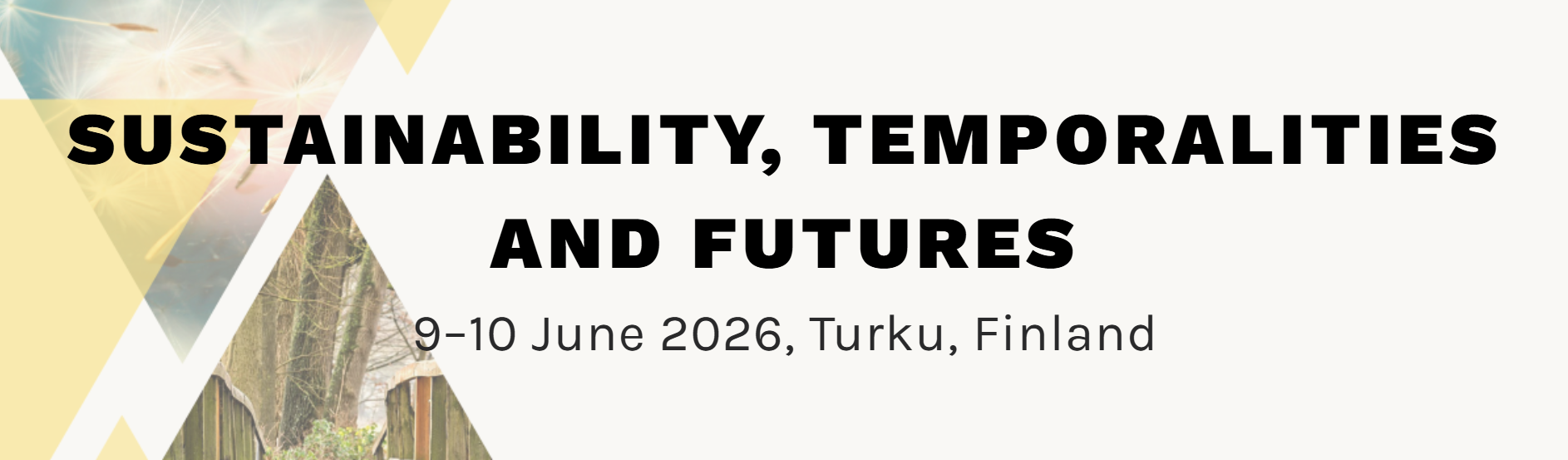
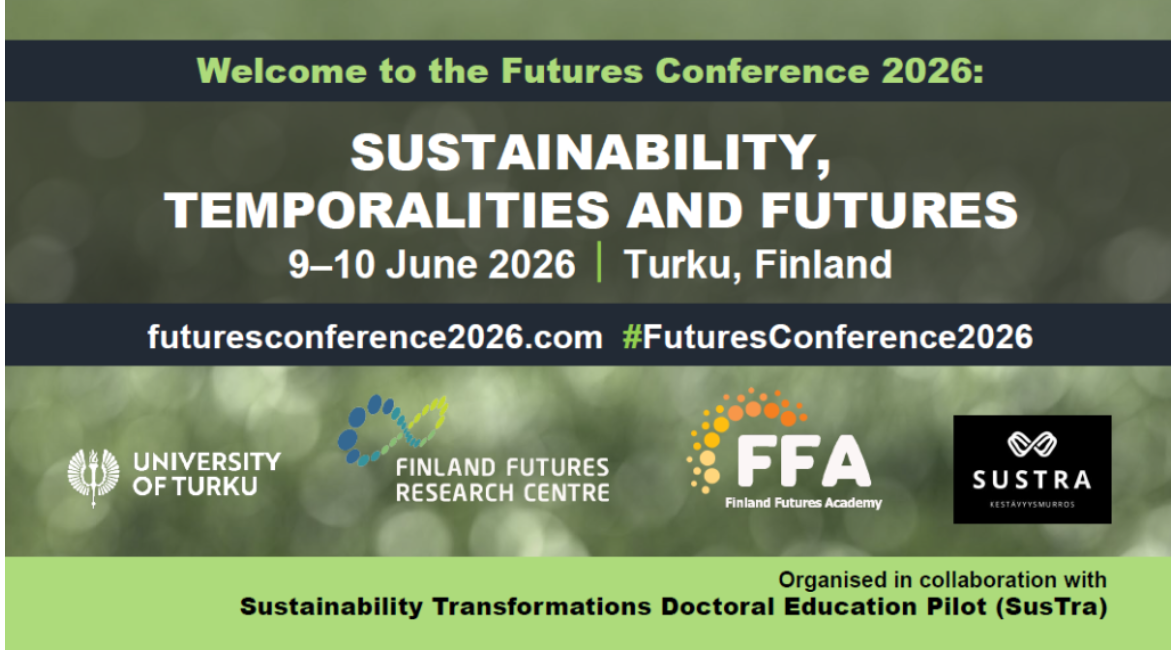
    Sustainability, temporalities and and futures08 June - 09 June 2026

    Futures Conference 2026

    Sustainability, Temporalities and Futures
    9–10 June 2026, Turku, Finland.

    Welcome to the 26th Futures Conference organised by Finland Futures Research Centre and Finland Futures Acacemy, University of Turku in collaboration with Sustainability Transformations Doctoral Education Pilot - SusTra.

    CALL FOR PAPERS AND WORKSHOPS

    Futures Conference 2026 focuses on the critical theme of the sustainability transformation. This fundamental shift will renew societal and economic systems and practices, while also enhances human agency, well-being and quality of life.

    The conference explores sustainability transformation through various themes, like everyday life and cultural transformation; planetary well-being and health; sustainable production and consumption; technological transformation; governance, justice, trust, and institutional transformations in public administration, politics, and business; and the role of humans, culture, and collective efforts in building a just and sustainable society.

    The conference emphasises the importance of temporality by asking what intergenerational decision-making within the limits of planetary boundaries means in practice. How can geological time perspectives, historical understanding, and futures thinking guide individuals, societies, and humankind towards more sustainable outcomes? How does various individual and collective memories and anticipations impact on unfolding futures and planetary wellbeing?

    Sustainability and temporality can be approached through a multidisciplinary lens, particularly emphasising futures studies, social sciences, humanities, heritage studies, the arts, natural sciences, sustainability science, and business studies. Bridging different fields in an interdisciplinary and intersectoral approach is essential for advancing sustainability transformation. Achieving this in the conference, demands the active and intersectional inclusion of different socio-cultural and more-than-human perspectives through participation of decision-makers, researchers, practitioners, and students.

    Submission of abstracts
    We invite researchers, scholars, practitioners, decision-makers and students from universities, research institutes, companies, and governmental and non-governmental organisations to share the latest research results, findings and thoughts on these key topics:

    1. Beyond Sustainability – Regeneration and restoration
    2. Cultural sustainability transformation as an enabler of just sustainability transformation
    3. Human and more-than-human agency toward planetary well-being and health
    4. Individual and collective understandings of time and temporalities in sustainability transformation
    5. Sustainable production and consumption in the light of different economic models
    6. Justice, trust and sustainability in institutional transformations of governance and working life in public administration, politics, and business
    7. Leadership, governance, and the management of short-term and long-term sustainability transformations
    8. The role of AI in sustainability
    9. Methods and methodology of futures research and sustainability transformation

    Submit your abstract for a) paper presentation, b) special session or c) interactive workshop via following Webropol form no later than 2 February 2026. More information here: https://futuresconference2026.com/cfp/. 

    Posted on: 29/09/2025

    Post Image

    Last Edited: 8 months ago

    Reflections from the 2025 Futures Conference

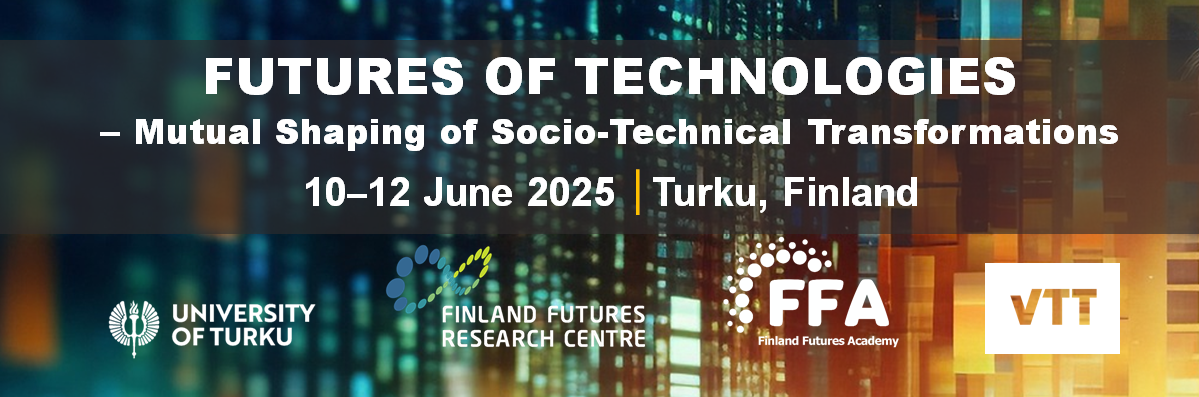
    Futures of Technologies, 10-12 June 2025, Turku, Finland (Finland Futures Research Centre)

    The 25th Futures Conference focused on the futures of technologies, their development, importance, role and risks as a driver of social change. A record number of 330+ participants from more than 35 different countries met up in Turku (Finland) to discuss the effects of social and environmental changes on technological development and vice versa.

    Posted on: 23/06/2025

    Last Edited: 8 months ago

    From Leaf to Root - Deepening Conversations with Causal Layered AnalysisMay 2025

    Eye of Europe Foresight Starter Video #5

    A new foresight starter toolkit video from the Eye of Europe team at the Finland Futures Research Centre. This time focusing on CLA - Sohail Inayatullah's Causal Layered Analysis. 

    The accessible 8-minute video takes its viewers through the background and the theoretical framework of CLA with its emphasis on multiple layers. Following the classic tradition, the video highlights the layers of Headlines, Systems, Worldviews, and Metaphor - and how reframing metaphors might assist in bringing about needed and desired systemic changes. 

    The video also prepares thos who are about to participate in a workshop with CLA exercises. Three major tips are provided: i. Stay curious and avoid trying to solve problems "too early", ii. Practice slow thinking: notice, reflect and vocalise your insights, and iii. Do bring your own personal experiences, stories, and cultural background to the table.

    Posted on: 23/06/2025

    Post Image

    Last Edited: 10 months ago

    Nokia Corporation Hosted the LFF Consortium Meeting

    The consortium of LifeFactFuture (LFF) gathered for a successful event on 12 March 2025 at Nokia in Espoo. Nokia provided an exceptional venue for the event, showcasing t...

    The consortium of LifeFactFuture (LFF) gathered for a successful event on 12 March 2025 at Nokia in Espoo. Nokia provided an exceptional venue for the event, showcasing their advanced facilities and ongoing development efforts.

    Our host, Veli-Pekka Luoma, who opened the event, introduced the magnificent facilities of the Executive Experience Center in Espoo.

    Nokia shared valuable insights into their LifeFactFuture activities. Tomi Lahti presented the new Nokia factory campus in Oulu and discussed Nokia’s initiatives in MTP and Modular Automation within the Biopharmaceutical Industry. His presentation emphasised Nokia’s cutting-edge capabilities, the significance of data architecture and common reference models (OPC UA), and the benefits of Edge computing over Cloud solutions for latency-critical operations, especially in times of geopolitical uncertainty.

    Perry Suojoki supplemented the discussion with a fascinating view on how RXRM (Real-time eXtended Reality Multimedia) can enhance industrial productivity, particularly in the life science sector.

    See the presentations from Nokia:

    Veli-Pekka Luoma: LifeFactFuture at Nokia Espoo Campus
    Nokia Oulu New Campus
    Tomi Lahti: MTP and Modular Automation in the Biopharmaceutical Industry
    Perry Suojoki: Nokia RXRM for Pharmaceutical Industry
    After the introduction to Nokia and their ongoing projects, each university-based Work Package presented the state of their research. Finally, each company partner briefly introduced where they are with their internal projects. All consortium partners demonstrated progress in their projects and showed strong commitment to the LifeFactFuture initiative. Several companies already reported demonstrable results, for example a solution that after successful deployment in Finland is now already being rolled out to company locations elsewhere.

    Key Takeaways:

    Excellent facilities and development work at Nokia
    Insights into Nokia’s LifeFactFuture activities, including MTP and Modular Automation
    The importance of data architecture, common reference models, and Edge computing
    The potential of RXRM to boost industrial productivity
    The importance of joint ecosystem cooperation
    Strong progress and commitment from all partners
    Veli-Pekka Luoma has also already summed up in LinkedIn the event with additional photos from the day.

    As he writes beautifully in the comments:

    “We may see that ‘everything’ circulates around the Data, and AI as a toolkit consuming, processing, assessing, operationalising it. Data is the new Soil.”  

    Posted on: 08/04/2025

    Post Image

    Last Edited: a year ago

    University of Turku Invites Applications for the Pentti Malaska Futures Award

    The University of Turku opened the call for applications to the Pentti Malaska Futures Award on 27 January 2025. We are looking for bold, research-based, visionary, and boundary-crossing solutions supporting the building of a more sustainable global future.

    Posted on: 25/02/2025

    Last Edited: a year ago

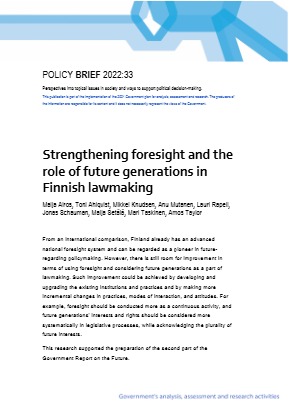
    Strenthening foresight and the role of future generations in Finnish lawmakingOctober 2022

    POLICY BRIEF 2022:33

    This is the short English-language Policy Brief from the research project Foresight and Future Generations in Law-Making (FORGE). FORGE examined issues of future-regarding lawmaking in an interdisciplinary manner, combining expertise on futures studies, political science, and jurisprudence. The aim of the study was to analyse the status of future generations and their rights in current legislative processes, and to map and compare practices for foresight and consideration of future generations in different political contexts, nationally and internationally. The purpose of the project was to increase understanding on i) how future generations can be better taken into account in policymaking; ii) how foresight can be better utilised in lawmaking. 

    The FORGE-project was unique – there had not previously been a study with a similar scope in Finland and comparable international examples are, to the best knowledge of the authors, extremely rare. FORGE supported the preparation of the second part
    of the Government Report on the Future. The project was funded by the Government’s analysis, assessment and research activities (VN TEAS) and was conducted during 1/2022–11/2022 by researchers of the University of Turku, Åbo Akademi University and Tampere University.

    Findings:

    From an international comparison, Finland already has an advanced national foresight system and can be regarded as a pioneer in futureregarding policymaking. However, there is still room for improvement in terms of using foresight and considering future generations as a part of lawmaking. Such improvement could be achieved by developing and upgrading the existing institutions and practices and by making more incremental changes in practices, modes of interaction, and attitudes. For example, foresight should be conducted more as a continuous activity, and future generations’ interests and rights should be considered more systematically in legislative processes, while acknowledging the plurality of future interests.

    Development proposals:

    Full lenght-report available in Finnish

    In addition to the 12-page Policy Brief summarising the FORGE projects' finding in English, The Prime Minister's Office has published the full 203-page report in Finnish. This can be found here below.

    Posted on: 08/01/2025

    Last Edited: a year ago

    Foresight Starter VideosNovember 2024

    As part of the Eye of Europe project, the Finland Futures Research Centre is developing a brand new set of ‘Foresight Starter Videos’.

    A new series of 'Foresight Starter Sets' is an an essential part of Finland Futures Research Centre's (FFRC) contribution to the Eye of Europe project. One starter set component is a set of short videos. The videos introduce and clarify futures thinking and foresight, what to expect from a foresight workshop, and a variety of foresight workshop methods. The videos could serve as promotional material but also help organizers calibrate participants expectations prior to their participation in a foresight workshop.

    Finland Futures Research Centre is developing the video series to help participants prepare to participate in foresight workshops. The videos immediate use is related to the Eye of Europe Pilot Foresight Activities which will run through 2025 and 2026, but the videos will be freely available as a useful resource for foresight organizers outside the scope, and beyond the lifetime, of the project. 

    Reaching target audiences with foresight beyond text

    As the Work Package lead of Eye of Europe, the FFRC targets two unofficial ambitions underpinning all project activities: First, lowering the bar for organizing and participating in foresight workshops. Second, moving foresight beyond text. That is, finding new audiences via new formats compared to the classic domain of long text-based foresight reports. The set of Foresight Starter Videos aims to achieve both of these premises, as it uses a format of short videos (3-8 minutes per video) to introduce foresight, futures thinking, and futures methods to new audiences with a playful and welcoming tone. 

    The video set has two introductory videos that can be used in advance of any foresight workshop, while the ambition for the following videos relate to specific methods and approaches. The presumed use case is that foresight organizers can provide links to the introductory videos for foresight workshop participants in advance of their participation. We have found at the FFRC that sometimes people, even if they are domain experts in other fields, can be apprehensive prior to foresight workshops, as this may be unfamiliar territory for them (and for people used to being experts, unfamiliar can mean uncomfortable). 

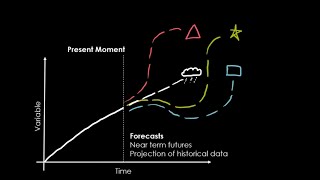
    Foresight Starter Set Video Roadmap

    Launching the first videos

    The series of videos are developed by Martyn Richards and Zainab Yasin at the Finland Futures Research Centre. The videos will be hosted on the Finland Futures Research Centre’s YouTube Channel as well as feature on the Futures4Europe platform’s upcoming Toolbox, a set of useful methodologies and resources for advancing R&I foresight. 

    As of December 2024, the first video on “Untangling Futures and Foresight: An Essentials Guide” is now available on YouTube.  

    Posted on: 16/12/2024

    Last Edited: a year ago

    Future Directions and Possibilities for the UniversitySeptember 2024

    Report on Literature Review and Delphi Study

    What lies ahead for universities? A new futures research study from the University of Turku maps multiple pathways and tensions that could transform how universities teach, research, and serve society.

    Introduction
    Researchers of the University of Turku have published a comprehensive report "Future directions and possibilities for the university: Report on literature review and Delphi study" (Virmajoki et al. 2024) about the possible future trajectories of the university of Turku. The report, which is uploaded here and also available on utupub.fi, is part of a larger project - Strategic Foresight and Futures Thinking Initiative.   

    The report, conducted by the Strategic Planning Unit of the University of Turku together with Finland Futures Research Centre (FFRC), contains the results of the analysis of the operating environment of universities. Operating environment here refers to the broader context of trends, challenges, and conditions - both nationally and globally - that affect how universities function and perform their core activities in teaching and research. While the report has as its scope the University of Turku, its findings and especially the approach are more broadly relevant, particularly in Europe.

    Analysis of Operating Environment as Research
    The analysis of the operating environment was primarily based on a literature review and a subsequent Delphi survey. We reviewed over 200 scientific texts relevant to the subject. It quickly became evident how multifaceted and unique universities are. Scenarios—a common tool in foresight—would not be sufficient on their own to understand the possible futures of universities. Therefore, we first categorised universities into 10 different dimensions, such as societal purpose, international orientation, and educational organization, and identified different directions for development for each dimension. This allowed us to create a multidimensional description of possible development paths for universities, yielding in total 30 different paths and their combinations. The reality is somewhere between the idealized end-points.

    In addition to helping understand various possible futures, the analysis where several dimensions and their paths are explained also provides a tool for the university units to examine their own position in relation to these possible developments. University units can differ significantly from one another, and no analytical tool that accounts for these differences can be sufficient. Our report offers such a tool by enabling discussion – with agreements and disagreements – of different development trajectories from the perspectives of diverse traditions and practices that can be found within any university.

    Possibilities and Desirability – The Delphi Study
    It was not only important to understand the possible futures universities may face. Equally crucial at the University of Turku was to understand what university members – researchers, students, administration, and other staff – think about these futures. To achieve such understanding, we conducted a Delphi study to ask what university members consider probable and desirable when it comes to the future. The statements were designed to provoke thoughts and bring out views that might not emerge in more traditional discussions. In addition to the probability and desirability assessments, we gathered valuable insights from the open comment sections, which often reveal perspectives that might be overlooked in the literature review.

    Some Key Results
    While the most interesting results cannot all be included in this text, some should be highlighted to provide a sense of the nature of the study.

    First, universities are continuously balancing societal impact, economic goals, and fundamental research. The demands from the side of the wider society often pull in different directions. The Delphi study showed that working towards a societal mission is seen as desirable, but market orientation is expected to be more likely. A common thought and worry seems to be that universities are likely to shift towards more commercial interests, despite the tension this creates with their social responsibilities not measurable in economic terms.

    Second, global research collaboration and local relevance create a significant tension. Universities aim to be part of global networks, while also expected to contribute to their local communities. The Delphi study revealed varying opinions on this balance. Some see global engagement as essential, while others stress the importance of local ties. Whether a university can succeed in both areas or must focus on one is a central question. The geopolitical tensions and the regional clusters this might create adds another path that might make the question between local and global even more difficult and multidimensional.

    Third, in teaching, the main tension seems to lie between scalable, mass-oriented education and more personalised, tailored teaching. Scalable teaching allows universities to reach more students, but the Delphi study showed that personalized methods are considered more desirable. Yet, the study also indicated that standardised models are, according to the members of the university, more likely to prevail due to the scarcity of resources. Technology and its development will be an integral part of both scalable and personalised teaching paths (and everything in between) but different technological solutions might be associated with different paths.

    Significance for the University Sector
    The project and the report highlight the value of combining an analysis of the university operating environment and a more detailed study of the views of the university community. On the one hand, an analysis of the environment and the paths therein provides a tool to navigate the prospects and risks. On the other hand, the analysis of the members’ perspective helps the university understand where we stand now and what are the paths that the members recognise. Together, these two provide a robust view on the strategic status and importance of different possible trajectories for universities’ operating environment.

    The research has broad applicability across universities worldwide. Through its dimensions and models, any higher education institution can map out and discuss likely trajectories, desired directions, and concerning paths ahead - regardless of their unique features. By combining extensive research literature with a Delphi study, the report opens a window into the possible futures of universities – or rather a map that can be used to navigate the long-term issues that these long-standing institutions face.

    References
    Virmajoki, V., Ahokas, I., Witoon, S., Ahlqvist, T., Kirveennummi, A., & Suomalainen, K.-M. (2024). Future directions and possibilities for the university: Report on literature review and Delphi study. A Report by University of Turku Strategic Planning Unit in collaboration with the Finland Futures Research Centre (FFRC). ISBN 978-952-249-617-1.


    Posted on: 13/12/2024

    Post Image

    Last Edited: a year ago

    Futures of Natural Resources

    The 24th International Futures Conference of Finland Futures Research Centre

    The 24th edition of the International Futures Research Conference was not short of insightful keynotes, newly published studies, and constructive exchanges in the field of foresight for the sustainable management of natural resources.

    Posted on: 25/11/2024

    Last Edited: a year ago

    Futures of Technologies09 June - 11 June 2025

    Mutual Shaping of Socio-Technical Transformations

    Futures Conference 2025 focuses on the futures of technologies, their development, importance, role and risks as a driver of social change. What are the effects of social and environmental changes on technological development and vice versa?

    ‘Futures of Technologies’ is the 25t h international Futures Conference of the Finland Futures Research Centre and Finland Futures Academy, University of Turku. It is organised together with the VTT Technical Research Centre of Finland Ltd during 10–12 June 2025 in Turku, Finland.

    Keynote Speakers
    Ali Aslan Gümüşay is professor of Innovation, Entrepreneurship & Sustainability at LMU Munich and head of research group Innovation, Entrepreneurship & Society at the Humboldt Institute for Internet & Society Berlin. His research focuses on values, meaning and hybridity in entrepreneurship; grand challenges, sustainability and new forms of organizing; digitalization, management and innovation as well as impact, scholarship and futures.

    Cynthia Selin is a pioneering social scientist and strategic foresight expert known for developing innovative methodologies to navigate complex change and advance the theoretical boundaries of anticipation. An Associate Fellow at the Saïd Business School, University of Oxford, and core faculty in the Oxford Scenarios Programme, Dr. Selin also founded Scenaric, a consulting firm that equips organizations to tackle uncertainty and shape resilient futures.

    Philip Brey is professor of Philosophy and Ethics of Technology at the University of Twente. He is member of the management team (and former chairman) of the 4TU Center for Ethics & Technology, a partnership of the universities of Twente, Delft, Eindhoven and Wageningen with more than 60 researchers.

    Jerome C. Glenn co-founded and directs The Millennium Project, a leading global participatory think tank with over 70 Nodes around the world. He is assisting the UN Council of Presidents of the General Assembly on the UNGA’s role in governance of Artificial General Intelligence, author/editor forthcoming Global Governance of Artificial General Intelligence (De Gruyter), lead author State of the Future 20.0 and Future Work/Tech 2050: Scenarios and Actions and co-editor Futures Research Methodology 3.0 with Ted Gordon. Glenn has directed over 80 futures research projects and is a member of the IEEE SA P2863 Organizational Governance of AI working group.

    Rohit Talwar (CEO, Fast Futures, UK) was recently in the top three in 'the Global Gurus Top 30 futuris' rankings for 2025. He is an inspirational futurist and the CEO of Fast Future, delivering award-winning keynote speeches, executive education, foresight, research, consultancy, and coaching. Rohit was delivered over 2000 speeches, workshops, and consulting assignments for clients in 80+ countries across six continents. He is the co-author and lead editor of nine books and over 50 reports on the emerging future and appears regularly on TV and in print media around the world. 

    Read more about the Keynotes. 

    Conference Newsletters

    Posted on: 25/11/2024

    Last Edited: a year ago

    Foresight Europe Network (FEN) Summer 2024 Meeting12 June - 12 June 2024

    The leadership team of Foresight Europe Network (FEN) cordially invites you to the upcoming in-person meeting on Wednesday 12 June 2024 in Turku, Finland - University of Turku, building: Medisiina D, room: ’Skooppi 1–2’, address: Kiinamyllynkatu 10, Turku, Finland

    The meeting is free and open to all who are interested in futures and foresight in Europe. Whether you have signed up as a FEN Member, are wise and experienced in futures or newly starting in this field, professor or student of futures – we welcome you.

    Agenda*

    Welcoming Remarks (5 minutes) Nicolas Balcom Raleigh, FEN President

    Icebreaker (10 minutes) Lena Tünkers, FEN Future President

    Presentations: (á 15 minutes)

    • Eye of Europe project and futures4europe.eu platform: Project coordinator Dr. Radu Gheorghiu, UEFISCDI, Romania & Bianca Dragomir, Institutul de Prospectiva, Romania
    • Updates from The Millennium Project: Executive Director and Co-Founder Jerome Glenn & Deputy Director Ibon Zugasti
    • Parliamentary/National Committees for Future: Dr. Sofi Kurki, VTT Technical Research Centre of Finland Ltd

    Group Discussions (30 minutes) & Plenary (20 minutes) FEN members discuss emergent topics sparked by the presentations.

    Closing Remarks (10 minutes) Lena Tünkers, FEN Future President

    Foresight Europe Network brings together foresight practitioners and users, futures educators and researchers, and futures studies/foresight students doing futures work in European contexts. FEN thanks the organizers of Futures Conference 2024 for providing the meeting space in conjunction with the conference. This meeting is free and open. All who are interested are welcome to attend, even if you are not already a member of FEN.

    * Agenda is subject to change.

    https://futuresconference2024.com/side-events/120624-fen/

    Posted on: 05/11/2024