Loading...

    Mentions of

    sorted by publishing date

    Last Edited: 5 months ago

    INNOVATION LANDSCAPE 2040

    Exploring & monitoring changing conditions, trends and needs for the region of Central Macedonia

    As innovation has a profound impact on many aspects of political, economic, social, and
    geostrategic environment worldwide, the Region of Central Macedonia closely follows the
    developments, trends and variables that favor and support it or negatively affect its development.
    Stakeholders, private and public sector executives and citizens, explored through a
    participatory and dynamic process (Thematic Participatory Workshop) the variables that will
    affect the innovation and entrepreneurship environment of the region by 2040, identified their
    dynamics and evaluated their interaction. The findings were the input of the working group
    for the development of five scenarios that will determine the future of innovation in Central
    Macedonia over the next fifteen years. Building upon scenario-driven insights, seven strategic
    policy recommendations have been formulated to systematically strengthen regional resilience
    mechanisms and prepare communities for diverse conditions across different alternative
    futures (five scenarios): Development, Collapse, Transformation and Discipline.
    The seven examined Megatrends that directly or indirectly affect the region and may affect
    innovation developments are Climate Change & Environmental Degradation, Resource
    Depletion, the Demographic Problem, Urbanization and Growth of the Middle Class,
    Technological Explosion, Hyperconnectivity and Cybersecurity, the Dawn of the Global
    South and Polarization. Digital transformation, changes in the employment model, digital
    nomads, the rise of populist parties and woke agendas, trust in institutions, urban farming, a
    shift in urban agriculture, pressure on social welfare systems and the health sector, geopolitical
    turmoil, brain drain, crowdfunding, tightening of the legislative framework for the protection of
    intellectual rights and personal data, strict environmental regulations and greenwashing will
    be some of the effects of these forces.

    In a narrow context, scanning the future identified four Drivers of Change that have a significant
    impact on the area of innovation and require the attention of policymakers: (a) Political Unrest
    and Confused Democracy, (b) Employment 4.0: Transition to new work conditions, (c) The
    Era of Convergence: Digital Superiority and Skills, and finally (d) Social Values as a Lever
    for Legislative Change."
    However, the innovative environment in the future can be identified through a wide range of
    scenarios. The need to develop a set of distinct scenarios led to the study of uncertainties
    that affect the environment in an unpredictable way, interact with each other drastically and
    play a key role in understanding the conditions that will be created in the future of innovation
    in the region, and in choosing five uncertainties that their developments over time define the
    futures we chose, as most likely to shape the innovation and entrepreneurship ecosystem in
    the region of Central Macedonia. The five Uncertainties highlighted by the working group are:
    [1] Political and Geopolitical Uncertainty: Buckle up, turbulence expected
    [2] Business Uncertainty: Anticipated Outcomes and Corporate Transformations
    [3] Regulatory Frameworks for Innovation: Ethics Considerations, Strategic Directions
    and Development
    [4] Navigating the Era of Disconnection: Addressing Workplace Loneliness and Social
    Uncertainty [5] The Impact of Climate Change on Tourism.

    This study was realized for the Region of Central Macedonia, GR and was co-funded from the European Union (ΕΣΠΑ 2021-2027)

    Posted on: 12/09/2025
    Post Image

    Last Edited: 8 months ago

    What is Emerging Technologies Scanning and how it fits into Futures Studies practices

    Emerging Technologies Scanning (ETS) emerges as a practice within Futures & Foresight (Futures Thinking & Strategic Foresight)

    The introduction of a new technology is never an isolated event and never concerns only one market or one domain. There are invariably socio-cultural, political, economic, and environmental implications, as well as impacts, influences, “cross-pollination”, and correlations among different technologies.

    The very broad definition of technology itself betrays its intrinsic complexity: a vast field of research involving various technical and scientific disciplines, which examines the application and use of everything that can serve to solve problems. The term “technology” also refers to the aggregate of knowledge, skills, and tools used to design, create, and utilise objects, processes, systems, or services to meet human needs.

    An emerging technology, in particular, is one that is radically new and relatively fast-growing technology [it is not necessarily exponential, as the common dialectics of recent years have conditioned us to expect, yet this has little to do with the mathematical concepts of exponentiality; rapid growth does not imply exponentiality]. It is characterised by a certain degree of coherence (or consistency) that persists over time and has the potential to have a substantial impact on the socio-economic-political domains (understood as the players, institutions, and models of interactions between them, as well as all the processes of knowledge production associated with these domains).

    Its most significant impact lies in the future and thus in the emergency phase: an emerging technology is still quite uncertain and ambiguous. For this reason, it would be prudent to analyse its potential impacts in a timely manner, to avoid getting trapped in Amara’s Law.

    Posted on: 09/06/2025

    Post Image

    Last Edited: 9 months ago

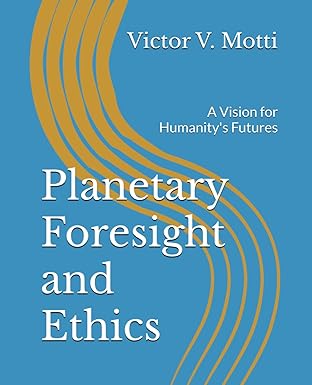
    Planetary Foresight and Ethics

    New Book

    Summary

    Core Themes
    The book reimagines humanity’s future through planetary foresight, blending historical wisdom with planetary stewardship. It critiques linear Western progress narratives and advocates for a hybrid, cyclical vision of history, emphasizing pluralistic identities and reverence for life.

    Structural Framework
    Organized into thematic sections, the work begins with “The Mysterious Lord of Time,” challenging linear temporality and introducing non-linear, culturally diverse historical perspectives. “Evolving Belief Systems” contrasts Indo-Iranic, Mesopotamian, and Hellenic thought with Abrahamic traditions, highlighting ancient influences on modern pluralism.

    Imagination and Futures
    The “Histories of Imagination” section explores myth and storytelling as drivers of civilization, while “Scenarios of Future Worlds” applies foresight methodologies to geopolitical and technological evolution, emphasizing ecological consciousness. The final chapters expand to cosmic intelligence and ethics, framing humanity’s role within universal interconnectedness.

    Ethical Vision
    Central to the thesis is a call for planetary identity and stewardship, merging forgotten wisdom traditions with modern foresight to navigate ecological and technological uncertainties. The book positions itself as both a philosophical guide and practical framework for ethical transformation in an era of global crises.

    Key Argument
    Motti asserts that humanity is transitioning from a “Second Nomad Age” (characterized by fragmentation) toward a “Second Settlement Age” marked by planetary consciousness, requiring creative complexity and ethical vigilance.

    Posted on: 23/04/2025

    Last Edited: 10 months ago

    Foresight Study on Fishers of the FutureNovember 2024

    Final Report

    The study represents the Commission’s commitment, outlined in its 2023 Communication on the functioning of the Common Fisheries Policy (CFP), to address emerging challenges in the sector. It aligns with the Commission's definition of foresight as “the discipline of exploring, anticipating, and shaping the future to inform today’s decision-making.” This participatory study places fishers at its core, integrating their perspectives into the development of future scenarios and fisher profiles to inform strategic policymaking for a sustainable, competitive and resilient EU fishing sector, as part of the wider blue economy. It does not present policy proposals, which was never the intention, rather it serves to stimulate further the important debate on securing and giving a perspective on the future of EU fishers.

    European Commission: European Climate, Infrastructure and Environment Executive Agency, F&S, IPSOS, POSEIDON, Tetra Tech, Davies, M., Macfadyen, G., Brugere, C., Chiarelli, N., Dale, F.Caillart, B., Foresight study on fishers of the future – Final report , Publications Office of the European Union, 2024;

    Posted on: 15/04/2025

    Last Edited: 10 months ago

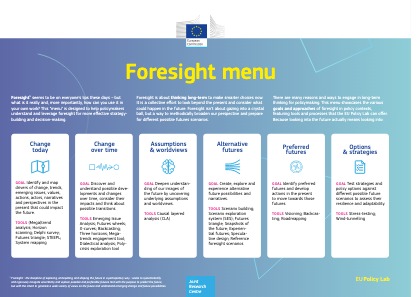
    Foresight MenuJanuary 2025

    Foresight Processes for Policymaking

    Foresight seems to be on everyone’s lips these days – but what is it really and, more importantly, how can you use it in your own work? This “menu” is designed to help policymakers understand and leverage foresight for more effective strategy- building and decision-making.

    Foresight is about thinking long-term to make smarter choices now. It is a collective effort to look beyond the present and consider what could happen in the future. Foresight isn’t about gazing into a crystal ball, but a way to methodically broaden our perspective and prepare for different possible futures scenarios.

    There are many reasons and ways to engage in long-term thinking for policymaking. This menu showcases the various goals and approaches of foresight in policy contexts, featuring tools and processes that the EU Policy Lab can offer. 

    Source: European Commission - Knowledge for policy  

    Posted on: 15/04/2025

    Post Image

    Last Edited: 10 months ago

    Giving Future Generations a Voice - The Welsh Approach to Futures Thinking

    At Futures4Europe, we had the pleasure of chatting with Petranka Malcheva, Policy Lead for Health, Long Term Thinking and Prevention at the Office of the Future Generations Commissioner of Wales. Her mission is to reduce health inequalities in Wales and to shift the focus from treatment to prevention guided by Wales’ pioneering Futures Generations Act. Petranka also leads the work on long-term thinking, supporting Wales’ public sector organisations to increase capabilities, skills and balancing short-term urgent issues without compromising the well-being of people living in the future.

    Petranka will address the role of “Collective Intelligence” in Foresight for Research and Innovation Policy at the upcoming
    Futures4Europe Conference 2025, held in Vienna on the 15-16 May 2025.

    Posted on: 26/03/2025

    Last Edited: a year ago

    Innovation 2030

    Investigating & monitoring the changing conditions, trends and needs for the Region of Central Macedonia

    As radical innovations are having a profound impact globallyon the macroeconomic environment, the Region of Central Macedonia is monitoringclosely following the developments, trends and variables that favour or affect it or negatively affecting its development.
    Institutions and executives from the private and public sector have explored through a participatory and dynamic process (Thematic Participatory Workshop) the variables that will the innovation and entrepreneurship environment of the region with time horizon 2030, identified their dynamics and evaluated their interaction. The findings provided input to the working group for the development of four scenarios that will define the future of innovation in the region of Central Macedonia in the coming decade. These scenarios identified
    the development of a proposal of three strategic axes, developing in a stepwise manner in three different periods, which will strengthen the resilience of the region and prepare it to face the conditions in these four futures.

    The study is available in Greek.

    Posted on: 21/02/2025

    Post Image

    Last Edited: a year ago

    ‘Going rural’

    Managing Land Access (and Use) to Support Rural Futures

    Renewing rural generations, via the provision of green jobs and accessible farming enterprises, has powered the EU-sponsored RURALIZATION project looking to promote synergies between agriculture policymakers and local rural communities in painting attractive rural futures.

    Posted on: 25/11/2024

    Post Image

    Last Edited: a year ago

    Portugal’s Path Forward

    Key Insights from Recent Foresight Publications

    The following recently published and upcoming reports and books shed light on future-oriented insights with a special focus on Portugal. These materials explore a range of topics, from economic development and technological innovation to environmental sustainability and social trends specific to the region. By delving into these resources, readers can gain a comprehensive understanding of the challenges and opportunities that Portugal may face in the coming years.

    Posted on: 25/11/2024