Loading...

    Mentions of

    sorted by publishing date

    Last Edited: 4 months ago

    Geopolitical & industrial decarbonisation scenarios to identify R&I opportunities for the EUMay 2025

    How can the EU navigate amidst global uncertainties to foster a more resilient and effective path toward industrial decarbonisation?

    This report presents the outcomes of the Geopolitical Industrial Decarbonisation Scenarios workshop, convened on behalf of the Eye of Europe Horizon Europe project by the Insight Foresight Institute. Bringing together 30 participants from across the European Union—including policymakers at EU, national, and regional levels, industry leaders, energy and climate specialists, and foresight and forecasting experts—the workshop explored how the EU can navigate mounting geopolitical uncertainty while accelerating industrial decarbonization on a 2050 horizon.

    The discussion was structured around two core aims. First, participants examined a suite of forward-looking geopolitical scenarios, assessing how divergent power dynamics, energy trade patterns, and technological trajectories could either hinder or catalyse the transition to a net-zero industrial base in the EU countries. Particular attention was paid to supply-chain resilience, strategic autonomy in critical materials, and the interplay between carbon border adjustments and global climate diplomacy. Second, the workshop sought to surface emergent research and innovation (R&I) needs and opportunities that would equip EU actors to thrive across the scenarios. Priorities highlighted include advanced electrification processes for hard-to-abate sectors, low-carbon hydrogen and synthetic-fuel value chains, circular-economy business models, and data-driven tools for real-time decarbonisation monitoring.

    Outputs from the session feed directly into the Eye of Europe project’s multi-workshop learning cycle. Immediate products comprise this extended report for attendees; aggregated insights captured in the public Pilot Logbook Part I – What we did and Part II – What we learned; and distilled policy recommendations to be released in the Eye of Europe Policy Brief: Foresight Perspectives on Key R&I Topics. Beyond documentation, the Insight Foresight Institute will leverage the findings to stimulate agenda-setting dialogues with EU bodies and industrial stakeholders, ensuring that identified R&I pathways inform Horizon Europe programming and other EU-level funding instruments. Workshop materials and presentations are retrievable via the futures4europe.eu knowledge-sharing portal, reinforcing the project’s commitment to an open foresight community.

    Posted on: 03/10/2025
    Last Edited: 9 months ago

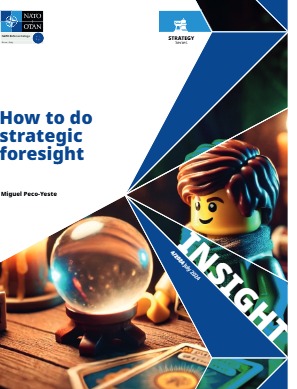
    How to do Strategic ForesightMarch 2024

    INSIGHT Series, by NATO Defence College

    This guide aims to provide a simple tool for policy practitioners to start navigating the foresight discipline and help foster foresight thinking in policy teams and organizations.

    It does not intend to present a set of last-generation methodologies. Instead, this guide offers some simple tools and techniques of proven effectiveness that can be used by non-expert personnel. Nevertheless, simplicity is not equivalent to a lack of rigour, so the guide proposes a complete foresight process, starting with driver identification and scenario-building and ending with preparing and monitoring subsequent policies. Available at https://www.ndc.nato.int/news/news.php?icode=1960

    Posted on: 11/05/2025

    Post Image

    Last Edited: a year ago

    Foresight and Societal Resilience: How FUTURESILIENCE walks the talk

    Foresight and societal resilience are intimately linked. Foresight processes generate insights and relationships that help communities in dealing with uncertainty. Through Foresight – so scholars argue – communities gain a richer understanding of the potential of the present and strengthen the social fabric in its ability to act upon these insights, from coping and adaptation to transformation.
    So far goes the theory …
    The FUTURESILIENCE project has set out on a jour ney exploring foresight’s contribution to societal resilience in practice.
    Ten “FUTURESILIENCE Labs ” located in ten different regions across Europe have embarked on a scenario process to strengthen resilience in the face of very different challenges. In the meantime, the ten Labs are in the middle of their journey - here is a sneak preview into two of the Labs:
    The IMMER Lab aims at strengthening the local resilience of mobility and energy-related activities in the cross-border Strasbourg-Kehl region. To this end, the Lab is using a science fiction-based Futures Café approach where actors from municipalities co-develop and discuss a range of science-fiction based crisis scenarios such as e.g. a Tsunami in the Rhine River Valley. In its recent Futures Café workshop , after exploring a range of different scenarios, the group discovered seven actions that were useful across scenarios and therefore highly likely to underpin crisis resilience.
    The COSIGHT Lab is located in the German city of Hamburg. It aims to mitigate societal polarization and enhance societal resilience by increasing conflict resolution and problem-solving skills. This involves developing resilience-promoting citizen processes. To this end it is complementing an existing participatory process, the “CoSaturday”, with the FUTURESILIENCE scenario approach. The first COSIGHT workshop focused on the integration of migrant populations – a much-contested issue in Hamburg. The first workshop gathered more than 35 integration stakeholders from a wide range of backgrounds. Participants identified key influencing factors of integration, barriers for successful integration and tools to address these barriers. COSIGHT is now looking to transfer these findings to local policy makers.
    Experience from these Labs seems to confirm the theoretical argument. A particular strength lies in the rich diversity of approaches. Even though the FUTURESILIENCE project provided an overarching guideline for a scenario process, each Lab interpreted this process according to the local specific requirements and capacities as IMMER and COSIGHT illustrate. As FUTURESILIENCE evolves, we will highlight further glimpses into the manifold discoveries made during the Labs’ foresight journey.

    Posted on: 13/12/2024

    Last Edited: a year ago

    Futures of Green Skills and Jobs: 1st Scenario Building Workshop26 September - 26 September 2023

    We organise a series of three workshops: the first two are devoted to devise scenarios, while the third one will derive policy implications.

    Alongside digitalisation and automation trends, the shift towards greener and more sustainable economies is a game changer in EU labour markets. Grounded in long-term transformative trends spanning several decades, the green transitions are picking up speed. The resulting changes in skill needs will have impacts far beyond the key occupations driving them, affecting all economic sectors. An important challenge for the coming years is accelerating up- and reskilling so that people have the green skills to thrive in greener jobs.

    In this workshop, we seek to develop scenarios for the future of green skills and jobs. The series is part of the "European R&I foresight and public engagement for Horizon Europe" project. It supports the work of the Horizon Europe Foresight Network and provides intelligence and supports the development of a European R&I foresight community.

    Posted on: 29/11/2024

    Last Edited: a year ago

    Futures of Green Skills and Jobs: 2nd Scenario Building Workshop29 September - 29 September 2023

    We organise a series of three workshops: the first two are devoted to devise scenarios, while the third one will derive policy implications.

    Alongside digitalisation and automation trends, the shift towards greener and more sustainable economies is a game changer in EU labour markets. Grounded in long-term transformative trends spanning several decades, the green transitions are picking up speed. The resulting changes in skill1 needs will have impacts far beyond the key occupations driving them, affecting all economic sectors. An important challenge for the coming years is accelerating up- and reskilling so that people have the green skills to thrive in greener jobs.
    In this workshop, we seek to develop scenarios for the future of green skills and jobs. The series is part of the "European R&I foresight and public engagement for Horizon Europe" project. It supports the work of the Horizon Europe Foresight Network and provides intelligence and supports the development of a European R&I foresight community.

    Posted on: 29/11/2024

    Last Edited: a year ago

    HORIZON FUTURES WATCH WORKSHOP #4: Futures of interpenetration of criminal and lawful activities11 October - 11 October 2023

    The evolving complexity of global challenges is increasingly affecting the steering of European Research and Innovation which aims at addressing important present and future societal concerns. The idea of ‘watching futures’ to anticipate future possibilities and analyse the consequences of current choices to inform and shape a forward-looking EU R&I policy is continuously gaining ground. 

    In this light, as part of the ‘European R&I foresight and public engagement for Horizon Europe’ study launched by the European Commission in connection to the Horizon Europe Foresight Network, a second series of online workshops will take place during October – November 2023.

    The workshops, which will run for two hours each, will discuss insights stemming from thematic policy briefs compiled by expert panels, addressing possible future scenarios for critical issues (i.e., Interpretation of Criminal and Lawful Activities, Green Skills and Jobs, Big Tech, etc.). Following the presentation of each policy brief, each workshop will feature two focus groups: one involving the group of experts from the panel who developed the policy brief and one including representatives from topic-relevant EU-funded R&I projects. All events will foster extensive engagement with participants, including policymakers.

    Posted on: 29/11/2024