Loading...

    Mentions of

    sorted by publishing date

    Last Edited: 2 months ago

    THE DEMOGRAPHIC TURN09 December - 09 December 2025

    ACTIONS NEEDED FOR RESEARCH, INNOVATION, AND POLICY IN EUROPE?

    Curious about how Europe’s demographic trends may transform the R&I landscape?


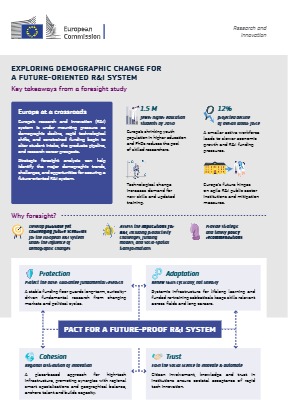
    On 10 December 2025, DG Research & Innovation hosted a hybrid event at the DG RTD Library in Brussels to present the Foresight-on-Demand (FOD) study: “The Demographic Turn: Actions Needed for Research, Innovation and Policy in Europe?”


    FOD team members guided the audience through:

    • Background data showing a shrinking youth population, a declining workforce, and growing fiscal pressures on R&I funding.
    • A six-step Foresight Process combining horizon scanning, scenario-building, and windtunneling to anticipate future challenges.
    • Four Scenarios illustrating different pathways for Europe’s R&I system.
    • Strategic actions to protect fundamental research, foster lifelong learning, strengthen regional innovation, and build societal trust in technology.


    👏 A big thank you to the panelists and speakers:

    • Erik Canton (Deputy Head of Unit – Common R&I Strategy and Foresight Service, DG Research & Innovation)
    • Nicola Francesco Dotti (Chief Economist Unit – Common R&I Strategy and Foresight Service, DG Research & Innovation)
    • Brikena Xhomaqi (The Lifelong Learning Platform)
    • Alex Petropoulos (Centre for Future Generations)
    • Thomas Estermann (European University Association)
    • Maciej Krysztofowicz (EU policy Lab, Joint Research Centres)
    • Viola Peter (FOD team, Technopolis Group)
    • Michal Nadziak (FOD team, 4CF)
    • Katarzyna Figiel (FOD team, 4CF)

    And to all participants for an engaging exchange on how to build a more adaptive and resilient EU R&I system.


    Missed the event? Explore the below documentation !


    Posted on: 27/11/2025

    Last Edited: 4 months ago

    Future of Sustainable Fashion IIMay 2025

    The Future of Sustainable Fashion event took place on Monday, April 14, 2025, at the MOMus - Museum of Modern Art in Thessaloniki, Greece. The workshop was implemented surrounded by the relative with the subject exhibition Collective Threads: Anna Andreeva at the Red Rose Silk Factory. This initiative was implemented by Helenos Consulting, a partner of the Eye of Europe Project, and aimed at engaging domain professionals, including foresight and fashion experts.

    Posted on: 01/10/2025

    Last Edited: 4 months ago

    ESPAS Horizon Scanning Issue 8June 2025

    This is the eighth report from the ESPAS horizon scanning process which looks at “signals of change” – emerging trends and
    issues – that may appear marginal today but could become important for the EU in the future.

    Read all the Issues here.  

    Posted on: 23/09/2025

    Last Edited: 5 months ago

    Futures Thinking and Strategic Foresight in ActionApril 2025

    Insights from the Global South

    Our societies are facing increasingly complex sets of risks, and the rapid pace of change is challenging existing governance systems. There is a growing acknowledgement of the need to transform current approaches to policymaking and decision-making to become more futureoriented in support of anticipatory action and building long-term resilience.

    The UN Summit of the Future, held in September 2024, marked a pivotal moment in global governance. The Pact for the Future, including its annexes on a Global Digital Compact and a Declaration on Future Generations, was adopted by the UN General Assembly by consensus and committed to a broad range of priorities to ensure that the multilateral system is better able to
    address the realities of today and prepare for the challenges of tomorrow.

    To contribute to fostering a culture of anticipation and preparedness, and to building a multilateral system that remains relevant for current and future generations, the UN Futures Lab/Global Hub and the International Science Council (ISC) have collaborated to better understand the concrete and transformational role of futures thinking and strategic foresight in informing decision-making and action. Futures thinking and strategic foresight are key to helping us address complex issues and deal with significant uncertainty – and to embedding long-term perspectives that consider policy implications on future generations.

    Drawing on case studies from the Global South , this joint paper demonstrates the versatility of foresight practices with a focus on tangible actions for decision-makers and policymakers. It also illustrates how these approaches can support anticipatory governance and resilience building, offering lessons learned and practical recommendations.

    The selection of 14 case studies presented in this report reflect balance across geographies, themes, sectors, stakeholders, and foresight tools. The case studies illustrate a range of impacts, primarily through a typology of approaches by desired outcomes as outlined below:

    📌Local and Indigenous Knowledge, Sources, and Practices

            📌Building Local Capacities and Durable Solutions from Community-Led Initiatives

            📌Multistakeholder Partnerships and Collaborations

            📌Organizational Development

            📌Sector-Wide Policy Development and Innovation

            📌Futures Empowered by Technological Advancements and Innovation

            📌Improved Social Outcomes/Social Well-Being for Marginalized Communities

            📌Rebuilding Narratives

    🔗Source: UN Futures Lab/Global Hub and the International Science Council (2025). Futures Thinking and Strategic Foresight in Action: Insights from the Global South, New York. unfutureslab.org/project/futures-thinking-and-strategic-foresight-in-action-insights-from-the-global-south

    Posted on: 11/09/2025

    Last Edited: 5 months ago

    Aging and Assisted Living TechnologiesAugust 2025

    Eye of Europe Foresight Workshop Report

    The Eye of Europe project conducted a pilot workshop focused on Aging and Assisted Living Technologies (AALT) to examine their potential impact on European society and research and innovation (R&I) policy, particularly in the context of demographic changes such as aging populations and increased chronic health issues. The workshop aimed to anticipate the societal and policy implications of integrating smart and digital technologies into assisted living and care for older adults. Using the futures wheel method, participants explored future developments across three main areas: institutional long-term care, home-based care, and the inclusion of individuals with special needs in the workplace. The workshop was structured around three future assumptions for the year 2035, envisioning that AALT will become standard practice in long-term care facilities, widely used in private households, and successfully integrated in workplaces to support employees with special needs. Through this anticipatory approach, the workshop identified overarching effects of AALT on society and highlighted the importance of these technologies in shaping future policy and innovation strategies. This workshop was part of a broader series of foresight pilots designed to engage diverse stakeholders, test foresight methodologies, and contribute lessons to the Eye of Europe community and its online foresight platform. The attached report summarizes the results of the workshop and discusses the findings in the context of Europe R&I policy.

    Posted on: 04/09/2025

    Last Edited: 8 months ago

    Aging and Assisted Living Technologies20 May - 20 May 2025

    Eye of Europe Pilot Workshop

    On May 20, 2025, the international workshop “Eye of Europe: Aging and Assisted Living Technologies (AALT)” took place at the headquarters of VDI/VDE Innovation + Technik GmbH in Berlin. The event was organized within the framework of the EU-funded project Eye of Europe, which aims to strengthen the integration of foresight methods into European research and innovation (R&I) policy-making.
    The workshop’s objective was to analyze the societal impacts and potential of assistive technologies for aging, from both demographic and technological innovation perspectives. It particularly focused on the relevance of AALT for future policy strategies across the European Research Area (ERA).
    23 international experts from academia, policy, civil society, social care, engineering, and business took part in the event. Two keynote contributions from the fields of technology foresight (Dr. Simone Ehrenberg-Silies, VDI/VDE-IT) and smart health (Christian Gräff, Smart Health Living Center Berlin) set the stage. Participants then applied the “Futures Wheel” foresight method to systematically map direct and indirect effects of technological developments in the AALT field.
    The Futures Wheel proved to be a highly effective tool for visualizing complex cause-and-effect relationships under uncertainty and initiating future-oriented planning processes. The workshop offered an interdisciplinary platform for exchange, discussion, and strategic foresight.
    The program was complemented by an informal pre-event on May 19, which included a visit to the Futurium museum and a joint dinner at a traditional Berlin restaurant.

    Posted on: 18/06/2025

    Last Edited: 8 months ago

    Future Topics for European Research AreaMay 2025

    Eye of Europe Policy Brief No. 1

    This policy brief provides insights into the thematic areas addressed in the first five Eye of Europe workshops. It also informs about the upcoming workshops and the futures4europe platform, the online home of the European foresight community, where visitors can explore a rich collection of foresight projects, showcase their work, and discover foresight-related upcoming events.

    Posted on: 17/06/2025

    Last Edited: 8 months ago

    Emerging applications of neurotechnology and their implications for EU governance

    A technology foresight study

    This report sums up recent developments in neurotechnology, that is, technology that can read and modify activity from the central nervous system. Some devices record information from the brain, and others deliver stimulation to the brain (and some do both).
    These technologies are rapidly advancing and are likely to have a profound impact on various aspects of society. In the near future, neurotechnology is set to revolutionise the way we approach a range of policy areas, from healthcare, education, employment, law enforcement and security, to more obvious areas such as technology, digital and research.
    The report analyses advances in the technologies for monitoring and stimulating the brain, some of which are incorporated into neurotechnology devices. It acts as a horizon-scan of new and emerging uses of these technologies, and takes these as inputs to pose a range of questions for the consideration of policymakers.

    Read more from the blogpost by the author.

    Posted on: 28/05/2025

    Last Edited: 9 months ago

    04 Mapping Ripple Effects - Exploring cascading consequences with the Futures WheelMarch 2025

    Eye of Europe Foresight Starter Video #4

    This Eye of Europe Foresight Starter video introduces viewers to the Futures Wheel, a tool of futures research and foresight. The video briefly explains the history of the method, describes how faciliators can carry out exercises with Futures Wheels, and discusses why the method is a valuable component of the foresight and futures thinking toolbox. If you are organizing or participating in a Futures Wheel exercise, this video is an essential introduction to the method.

    The Futures Wheel method is particularly effective for identifying non-linear relationships and the long-term implications of trends. It can be used to broaden discussion around a given development, sensing out towards the implications of the implications, extending the very boundaries of what we can imagine.

    As an example of use, the video uses the 1st order, 2nd order, and 3rd order implications of accessible AI tools, which, for example, enables that "Students use AI to write essays".

    Posted on: 25/04/2025

    Post Image

    Last Edited: a year ago

    GIZ‘s latest foresight work on geopolitics and sustainable development

    Future-proofing the organization

    For years, the world has been described as being in a state of perma-crisis. As a federal enterprise working in the fields of international cooperation for sustainable development and international education, the Deutsche Gesellschaft für Internationale Zusammenarbeit (GIZ) GmbH is strongly affected by the political and economic environment in which it operates. This is why it is important for GIZ to understand the underlying drivers of change and possible future developments so that it can prepare for the future and the challenges it will face, ultimately making the organization and its staff more resilient.

    With its broad network of staff and international experts in over 120 partner countries, GIZ is well equipped to monitor and differentiate relevant signals and developments. At headquarters, a dedicated foresight team addresses future issues at a corporate level and contributes to the company's strategic decision-making.

    GIZ’ foresight report 2024

    Sustainable development is GIZ’s core business. The 2030 Agenda provides the framework for GIZ’s global activities. As the year 2030 is getting closer, the question is: will the negotiations on a new agenda be successful? But one thing is clear: any negotiation process and subsequent implementation will be increasingly shaped by geopolitical factors. This is why, the 2024 foresight report of GIZ, focuses on geopolitics, sustainable development and the global agenda for the next decade.

    In total, the views of more than 100 GIZ colleagues from GIZ's HQ and the field structure were incorporated into the report through various workshops. In addition, the report is based on extensive analysis of secondary sources, and interviews with more than 30 experts from various (international) institutions to ensure that the report also reflects perspectives from outside GIZ.

    The scenarios (strongly condensed for this post) are based on the four archetypes of the Manoa School of Futures Studies and Jim Dator, which represent four recurring paths of human civilization found in all cultures. Each scenario is supplemented by two to three short wildcards, some of which are listed here as examples.

    Posted on: 18/03/2025

    Last Edited: a year ago

    Workshop | Futures Wheels27 April - 27 April 2022

    The Futures Wheel is a form of structured brainstorming that helps participants visualize the impact of trends or emerging signals.
    Registration is closed

    In this workshop, we will use the method Futures Wheel to explore the following futures topics:

    • Smart Spaces
    • Climate Change
    • Global Commons
    • Social Confrontation
    • Criminal and Lawful Activities
    • Transhumanist Revolution
    • General AI
    • Alternative Energy Sources

    The participants can decide between different breakout rooms to discuss the impacts of the topics on the near and far future.

    Purpose of the method
    The Futures Wheel is a form of structured brainstorming that helps participants visualize how and to what extent trends or events might impact the organization, society or strategy area in question. It is particularly useful for identifying and mapping connections and causalities. It also helps us think far into the future as it is a very flexible, yet powerful tool.

    Read more: https://millennium-project.org/wp-content/uploads/2020/02/06-Futures-Wheel.pdf

    Posted on: 07/12/2024