Last Edited: 5 months ago
Empowering Mozambique’s youth to shape their country’s futureDecember 2025
Youth4Foresight Toolkit Use Case

Mozambique is one of the youngest countries in the world, with more than 50% of the population under the age of 18. This youth bulge presents a unique demographic and economic opportunity but also places a significant strain on public services, particularly education. Facing challenges such as high unemployment, climate vulnerability, insecurity, and limited access to digital infrastructure, youth-led solutions are critical for building a “future-ready” country.
The European Union Delegation (EUD) established a Youth Sounding Board (YSB) in 2023 to get input on EU policies by young Mozambicans, as a part of the EU’s Youth Action Plan, and since then they have been consulting them regularly, including for the latest Annual Action Plan 2026.
In the context of the EU Global Gateway initiative and t he preparation for the EU's next long-term budget 2028-2034, the EU Delegation invited the YSB for a foresight exercises using the Youth4Foresight Toolkit to reflect on the long-term role of the youth and on the strategic priorities for energy, digital, and education in Mozambique. The exercise objectives were to strengthen the YSB members’ capacities and enhance their agency using foresight tools to critically engage with and influence policymaking processes, while providing insights for the upcoming EU programming in Mozambique.
The Three Horizons Workshop
An online workshop for 20 YSB members, facilitated by the young people themselves, took place on 5 December 2025. The online format allowed for participation from YSB members from all over the country and both the preparation and the workshop were held in Portuguese, based on the Portuguese version of the Youth4Foresight Toolkit.
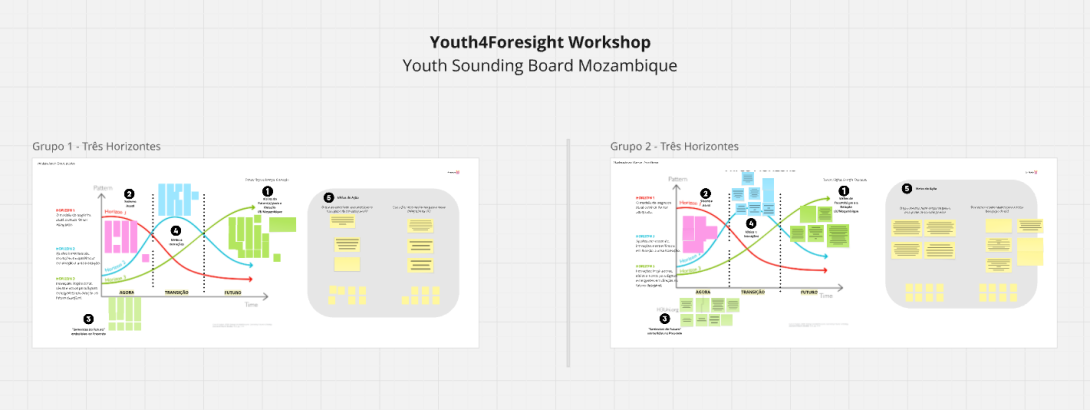
The Youth Sounding Board used the Three Horizons tool to struc ture their brainstorming in steps:
Horizon 3 (the desired future): participants imagined their inspirational future focusing on their aspired changes for the domains of energy, digital and education.
Horizon 1 (the current system): groups travelled back to the present to identify "business as usual" patterns that are no longer fit for purpose.
Seeds of the Future: participants identified existing pioneers and grassroots initiatives that are already starting to bring their future vision to life.
Horizon 2 (the transition): groups brainstormed innovations and collaborations needed to remove blockers and transition from the current system to the desired future.
Action board: finally, considering the three horizons that they have outlined, the groups defined action statements for the YSB and recommendations for the EU Delegation.
The Outcomes
Participants drafted a Declaration of Action and Commitments, outlining steps for current and future Youth Sounding Boards while providing recommendations for EU programming in energy, digital, and education sectors. Feedback was highly positive; members praised the tool's ability to foster structured creative thinking, with several planning to replicate the exercise in their local communities.
The Three Horizons tool successfully empowered youth by enhancing their futures thinking skills. The outcomes will now inform EU planning for Mozambique, allowing YSB members to actively architect their country's development.
Posted on: 26/03/2026