Last Edited: a month ago
Technology and Democracy13 March - 13 March 2026
A pilot foresight workshop on the impact of technology on democracy hosted by the Technology Centre Prague

How could technological developments affect the functioning of democracy in the coming decades? This was the central question addressed by the pilot foresight workshop “Technology and Democracy", organized by the Technology Centre Prague on March 13, 2026, as part of the international Eye of Europe project.
The workshop brought together citizens of different age groups who share an interest in technology and its impacts on society. The discussion thus offered a diverse range of perspectives – from younger generations growing up in a digital environment to older generations with life experience in a system with undemocratic institutions.
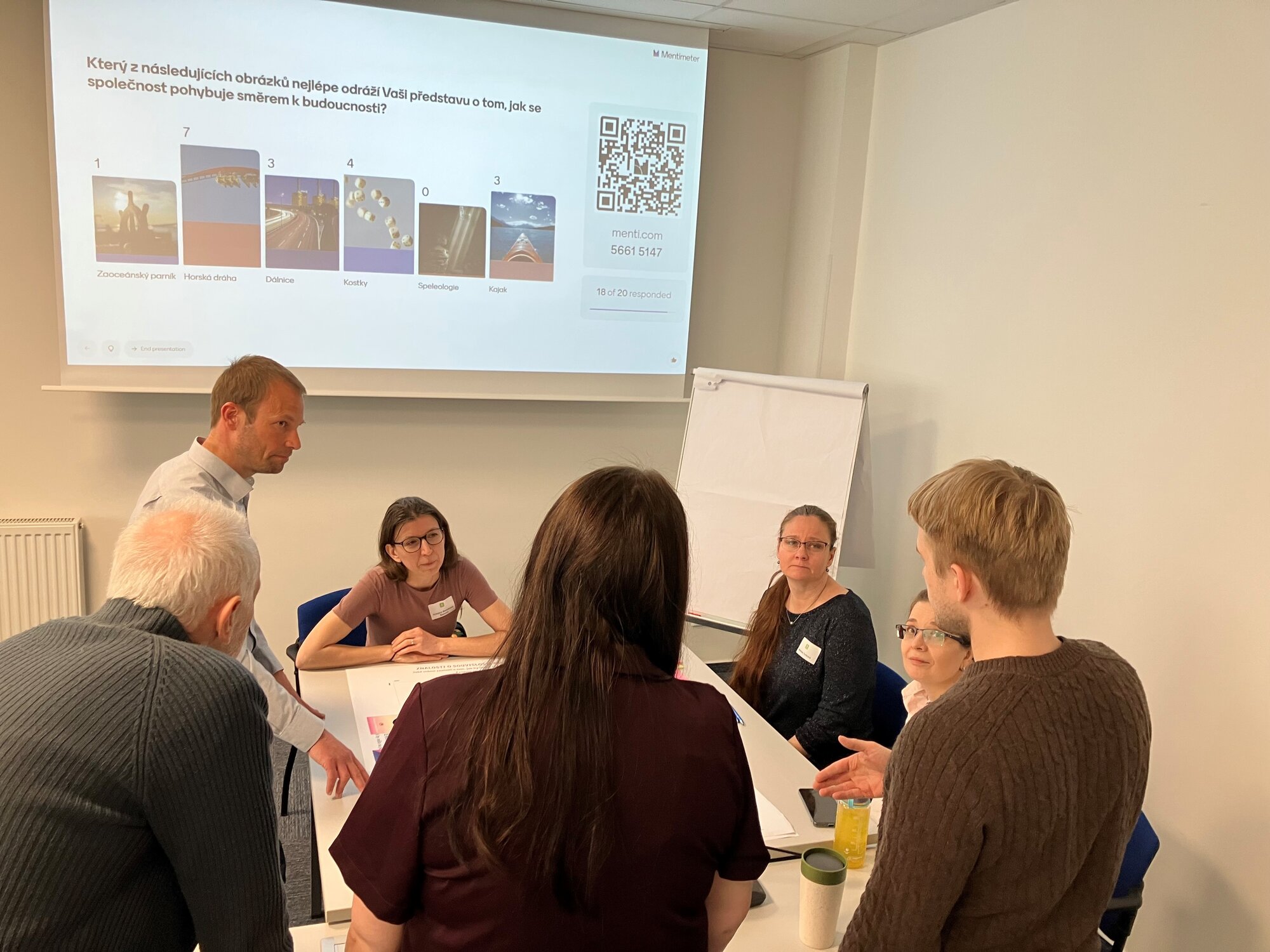
Following an introductory presentation in which participants were briefed on the Eye of Europe project and the importance of foresight, a short icebreaker followed - using visualization, the participants were asked to express their perception of how the society moves into the future. Most of them perceived the movement as a roller coaster ride, where we are sometimes down and sometimes up, or as uncertain as when playing dice. "Highway" suggests that the goal is clear, but we never know what we will encounter on the way (broken roads, traffic jams, etc.). "Ocean liner" reminded us of the Titanic - today's civilized and wealthy society often tends to ignore possible risks.
The workshop drew on specific foresight methodological tools developed by the European Commission’s Joint Research Centre, in particular the so-called “cards of potential future crises” and the “matrix of uncertainties and impacts”. The participants, divided into three groups, analysed key drivers of change, identified uncertainties and their potential impacts. The foresight tools enabled them to systematically examine their interconnections and identify potential chains of events. The result was three distinct scenarios for development up to 2050, which were based on the same initial assumptions but differed in their implications for democracy. In addition, each group supplemented its scenarios with a specific “one-person story” illustrating life in that future.
The process proceeded in the following steps:
Enhancing the risk awareness by exploring the broad spectrum of risks: Each group worked with 12 selected risk cards. They were asked to consider and discuss how aware they are of the potential impact of this risk (from each person´s own perspective). “Is there uncertainty or certainty with regards to how the risk might develop? And how significantly could this risk affect the future?” The group expressed its collective opinion by placing the cards on the “Evaluation of selected risks” matrix.
Selection of 3 key risks: Participants were instructed to select 3 risks that, in their view, we will face most in the future for further work. That risks that emerge slowly over a longer period or have a low likelihood of occurring are often overlooked other priorities – but they could be the most important ones to be focused on. Independently of the other groups, each group selected "Loss of Human Control" as one of their key risk cards.
Mapping and exploring future potential impacts: Participants “travelled to the future” with a selected number of risks to explore the possible consequences of their occurrence. Using the “Future Impact” matrix, they examined their impacts in the context of technology’s influence on democracy, looking for connections between individual impacts and how they are interlinked and influence one another. Cascading effects were brainstormed too. Finally, the participants identified the main impacts, which served as the basis for developing scenarios.
Posted on: 08/04/2026