Loading...

    Mentions of

    sorted by publishing date

    Last Edited: 5 days ago

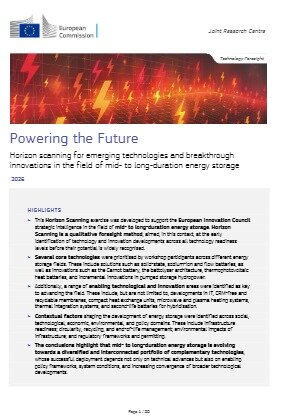
    Powering the FutureMay 2026

    Horizon scanning for emerging technologies and breakthrough innovations in the field of mid- to long-duration energy storage

    This technology foresight report presents the process and findings of a Horizon Scanning exercise conducted in the context of FUTURINNOV (FUTURe-oriented detection and assessment of emerging technologies and breakthrough INNOVation), a collaboration between the European Innovation Council (EIC) and the Joint Research Centre (JRC). The exercise aims to support EIC strategic intelligence through foresight and other anticipatory methodologies.


    The workshop, held online on 4 February 2026, focused on the identification, evaluation, and prioritisation of emerging technologies and breakthrough innovations across all technology readiness levels (TRLs) in the field of mid- to long-duration energy storage. Signals were collected through expert inputs, desk research, and text and data mining of patents, scientific publications, and EU-funded research and innovation projects.


    These signals were subsequently assessed by a multidisciplinary group of experts, leading to the prioritisation of a diverse set of energy storage technologies. These include electrochemical solutions such as solid-state, sodium-ion, and flow batteries; thermal systems such as Carnot and thermophotovoltaic heat batteries; and mechanical and hybrid approaches including pumped storage hydropower and battolyser architectures. In addition, several enabling technological and innovation areas were identified as critical to advancing the field, including developments in digital technologies, CRM-free and recyclable materials, advanced heat exchange and heating systems, and second-life batteries for hybridisation.


    The report also highlights a range of contextual factors shaping the development and deployment of energy storage technologies across social, technological, economic, environmental, and policy domains. These include infrastructure readiness, circularity and end-of-life management, environmental impacts, and regulatory and permitting frameworks. The findings point to an increasingly diversified and interconnected portfolio of energy storage solutions, where convergence and hybridisation across technologies are becoming central.


    The outcomes of this exercise can inform future EIC Challenges and other European Commission funding calls, contribute to EIC and EC strategic intelligence, and support broader EU policy initiatives related to energy systems, decarbonisation, and industrial competitiveness.

    Posted on: 10/06/2026
    Last Edited: 3 months ago

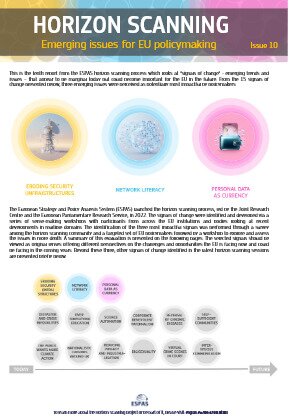
    ESPAS Horizon Scanning Issue 10February 2026

    Aiming to build on existing early warning mechanisms across the EU institutions, agencies and bodies, the ESPAS horizon scanning project has a two-fold goal. On the one hand, to establish a rolling process to produce reports that engage colleagues across the ESPAS institutions and bodies in a continuous, longer-term, cross-cutting reflection around emerging and potential future trends. On the other hand, to create an EU community of practitioners and experts (‘future scanners’) able to identify and inform about emerging signals of change.

    This is the tenth report from the ES PAS horizon scanning process which looks at “signals of change” - emerging trends and
    issues – that appear to be marginal today but could become important for the EU in the future. From the 15 signals of
    change presented below, three emerging issues were perceived as potentially most impactful by policymakers:Eroding security (infra)structures, Network literacy, Personal data as currency.

    Posted on: 12/03/2026

    Last Edited: 3 months ago

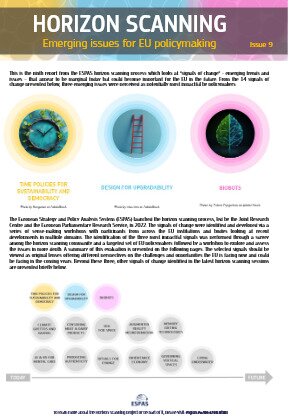
    ESPAS Horizon Scanning Issue 9

    Posted on: 12/03/2026

    Last Edited: 4 months ago

    The Summit 202620 March - 20 March 2026

    An annual gathering exploring the possible futures of emerging technologies. The Summit is a Nordic gathering for leaders, innovators, and forward-thinking organisations who want to explore the futures of emerging technologies and understand their profound impact on business, society, and organisational readiness. It serves as a meeting point for those who not only wish to follow developments in artificial intelligence, immersive experiences, and emerging technologies, but also want to shape how these forces influence the way we work, make decisions, and build future ecosystems. ‍ Hosted by the Confederation of Danish Industry (DI) and curated by the Copenhagen Institute for Futures Studies (CIFS), the conference focuses on foresight, technologies, preparedness, and futures-driven innovation. Through keynotes, panel discussions and focused dialogues, we examine both opportunity and risk, asking how innovation can be aligned with responsibility and long-term value creation. ‍ The Summit focuses on what lies ahead: Possible futures, strategic choices, and the readiness it takes to act responsibly as technologies evolve. It is not only about trends and tools, but about strategic foresight - identifying possible futures, and understanding the readiness it takes to act wisely and courageously as technologies continue to evolve.

    The 2026 edition takes place in Copenhagen on 20 March 2026 (09:00–18:00 CET) at H. C. Andersens Blvd. 18, 1553 København - Industriens Hus. Themes include the AI-mediated workplace, leadership in the future, emerging technologies (including AI agents, simulations and humanoids), the future consumer, retail in transformation, and the futures of foresight.

    The Summit is a Nordic gathering for leaders, innovators, and forward-thinking organisations exploring the futures of emerging technologies and their impact on business, society, and organisational readiness. Co-hosted by Danish Industry (DI) and curated by the Copenhagen Institute for Futures Studies (CIFS), the conference brings together keynotes, Nordic cases, and conversations on preparedness and responsible, meaningful action.

    The Summit 2026 – Industriens Hus, Copenhagen – exploring the possible futures of emerging technologies.

    Posted on: 23/02/2026

    Last Edited: 4 months ago

    Trasformative personal health technologies in 2040May 2024

    Technology Foresight of Politecnico di Milano has conducted foresight activities to explore potential opportunities and challenges, preparing for a technological paradigm shift in personal health. The aim was to identify the most disruptive technologies in the realm of personal health and assess their impact on shaping future scenarios. The time frame extends from the present to 2040.

    Consult the original source here.

    Methodology:

    • Mapping the landscape: Desk Research on the Future of Health: Selection, from foresight studies and scientific publications, the 50 most recurrent technologies and innovations expected to be transformative.  
    • Experts’ preliminary analysis: identification of 28 core technologies.
    • Extended and in-depth analysis to identify the most promising 10 technologies, engaging Politecnico di Milano’s community and a group of physicians through a dedicated survey. 
    • Impact and Relevance Assessment to shape the final outcome.

    The top 10 technologies are:

    • Applied Artificial Intelligence (Applied AI)
    • Biomedical imaging techniques
    • Biosensors
    • Data Science
    • Digital Twin/Modelling
    • Drug Delivery Smart Systems
    • Genetic Editing
    • Implantable devices
    • Neurotechnology
    • Next Generation Vaccines

    Each technology description includes: examples of potential fields of application, the phase(s) in which the technology is relevant (prediction/prevention/diagnosis/treatment/rehabilitation), opportunities, requirements, risks, impacts.

    The report continues with a series of insights, derived from the analysis of alternative visions of the future associated with health, with both positive and negative elements, aiming at understanding the opportunities and challenges posed by each context and at identifying the conditions that will allow moving in the preferred direction, without neglecting risks and possible barriers.

    Posted on: 11/02/2026