Last Edited: 2 days ago
Six Scenarios for International Power Configurations 20351December 2024 - August 2025
Global Block Formation? Implications of the New World (Dis)order for Europe
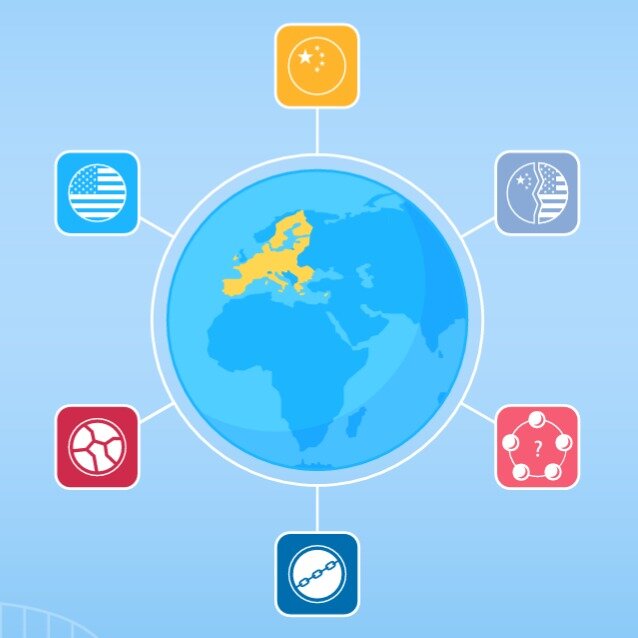
The world order is changing, with the outcome uncertain. What power configuration could the EU face internationally in 2035, and how can it prepare for this? In a scenario process, the Bertelsmann Foundation collaborated with Fraunhofer ISI and experts from business, academia and politics to develop six scenarios for the world (dis)order in 2035, which differ in the number of power centres and the degree of stability. The project produced a report on the scenarios and a policy brief for European policymakers. The following scenarios were developed:
• “World Order Made in China”: China has established itself as the hegemonic power over the United States and dominates the world order.
• “America Great Again”: The United States dominates the world order again, acting autocratically and often erratically under the influence of the MAGA movement.
• “Two-Men Show”: Two powerful blocs, China and the United States, face each other in a fragile balance.
• “Five-Body Problem”: A polycentric world order with five largely self-sufficient, protectionist power centres – the United States, China, Russia, the EU and India.
• “Authoritarian International”: An authoritarian-populist power structure, supported by personal diplomacy and ideological proximity.
• “Beyond States”: A world in which state authority is waning and non-state actors are shaping the global order.
The process was aimed at informing European policymakers. Besides the project’s report on the developed scenarios a policy brief was published. Four fields of action applicable to all scenarios were identified:
1. Effective decision-making: The EU should break down decision-making deadlocks by making strategic use of minilateral formats and underpinning them with a shared set of values. At the same time, it should expand partnerships with (like-minded) third countries in order to increase the EU’s international influence.
2. Credible deterrence: Europe should strengthen its defence capabilities through closer integration of national armed forces, joint procurement and innovation structures, and better coordinated investment – in close coordination with NATO.
3. Strategic resilience: The EU should prioritise critical key industries and technologies and create targeted strategic indispensability by establishing technological ecosystems and positioning itself in selected market and technology niches.
4. Social sustainability: EU institutions and Member States should strengthen social cohesion through credible narratives for the future that legitimise reforms and provide guidance, even in difficult transition phases.
The project’s report and policy brief conclude that if the EU takes consistent, collective and, above all, immediate action in these fields, this will best prepare the EU to assert itself as an, at least partially, independent actor capable of taking action in different international configurations by 2035.
Posted on: 12/11/2026