Loading...

    Mentions of

    sorted by publishing date

    Last Edited: a year ago

    Horizon Futures Watch Newsletter #3August 2023

    Welcome to the third issue of Horizon Futures Watch. Here, we delve into two interrelated themes that may frequently be paired together (or seen in isolation): the future of green skills and the future of big tech.  

    Sustainability meets technological progress. A focus on green skills may be amplified with the entrance of innovative, data-driven technologies. Technology may sometimes be viewed as the answer to the need for more sustainable processes, while green skills may provide the essential human touch necessary to ensure these advancements are effectively and ethically applied. But is this always the case? And is there a universally optimal balance between the two? Such questions are explored in the six different projects that follow.

    An overview of the latest selection of news about foresight projects and topics opens the issue. The Foresight in the Field section presents a report on the EEA’s recently published Horizon Scanning – Tips and Tricks.

    Posted on: 13/02/2025

    Last Edited: a year ago

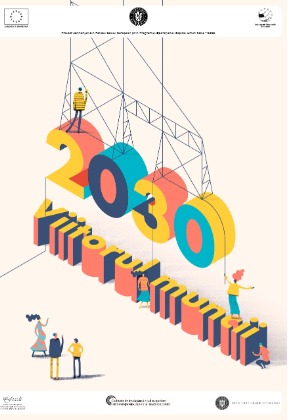
    The future of work in 2030March 2020

    An argument-based top of emerging professions

    There is a fascination with the future, as a repository of both opportunities and threats that affects all of us. Concern for what we call "the future of work" is part of this mosaic. Regardless of their geographical space, people think of their work as being, in varying doses, a source of material well-being, but also a component of their identity. Uncertainties about how will people work in the future – how will they earn income and build a purpose, a meaning through their work – is an important topic, and often a source of concern.
    What are we heading for? What kind of future is desirable? What is possible, respectively probable, from what we deem desirable? What can be done to get there? All these are legitimate questions that deserve our attention.
    In the context of recent waves of technological progress, the future of work is the subject of intensive controversy. Often in the public space there is an overwhelming emphasis on the impact of new technologies on work, neglecting other shaping forces relevant to labor market dynamics. Therefore, the purpose of this study is to open a wider conversation about the future of work on the 2030 horizon.

    The perspective used in this paper is a causal and hierarchical one: from drivers of change towards their impact on labor. Most studies on labor market developments start from a context modeled by several global megatrends. Following this logic, the second chapter describes the four main trends identified in literature: i) technological developments, especially automation; ii) globalization, especially cross-border flows and widening inequalities; iii) demographic changes, in particular the ageing population in the global North; iv) climate change, environmental degradation and the development of the green economy.
    Within these trends, ongoing or likely transformations have been identified that have or could have an impact on global labor market dynamics. The section describing each megatrend is accompanied by a box with what we call "signals of change" - contextualizing empirical data that serve as justifications/explanations of the phenomena described in that section. In the context of the global transformations we outline here, the fourth chapter presents a catalogue of emerging occupations, by which we mean both existing (highly dynamic) or incipient occupations and occupations that do not yet exist but are likely to exist in 2030 or beyond
    The third chapter was added later in the context of the Covid-19 pandemic and is a brief overview of the transformations in the global labor market – some already visible, others likely - due to this global crisis.

    ***

    The study was published in Romanian as part of the project POCU INTL - Quality in higher education: internationalization and databases for the development of Romanian higher education.

    Project webpage: pocu-intl.uefiscdi.ro

    Posted on: 09/12/2024

    Last Edited: a year ago

    Futures of Green Skills and Jobs: 1st Scenario Building Workshop26 September - 26 September 2023

    We organise a series of three workshops: the first two are devoted to devise scenarios, while the third one will derive policy implications.

    Alongside digitalisation and automation trends, the shift towards greener and more sustainable economies is a game changer in EU labour markets. Grounded in long-term transformative trends spanning several decades, the green transitions are picking up speed. The resulting changes in skill needs will have impacts far beyond the key occupations driving them, affecting all economic sectors. An important challenge for the coming years is accelerating up- and reskilling so that people have the green skills to thrive in greener jobs.

    In this workshop, we seek to develop scenarios for the future of green skills and jobs. The series is part of the "European R&I foresight and public engagement for Horizon Europe" project. It supports the work of the Horizon Europe Foresight Network and provides intelligence and supports the development of a European R&I foresight community.

    Posted on: 29/11/2024

    Last Edited: a year ago

    Futures of Green Skills and Jobs: 2nd Scenario Building Workshop29 September - 29 September 2023

    We organise a series of three workshops: the first two are devoted to devise scenarios, while the third one will derive policy implications.

    Alongside digitalisation and automation trends, the shift towards greener and more sustainable economies is a game changer in EU labour markets. Grounded in long-term transformative trends spanning several decades, the green transitions are picking up speed. The resulting changes in skill1 needs will have impacts far beyond the key occupations driving them, affecting all economic sectors. An important challenge for the coming years is accelerating up- and reskilling so that people have the green skills to thrive in greener jobs.
    In this workshop, we seek to develop scenarios for the future of green skills and jobs. The series is part of the "European R&I foresight and public engagement for Horizon Europe" project. It supports the work of the Horizon Europe Foresight Network and provides intelligence and supports the development of a European R&I foresight community.

    Posted on: 29/11/2024

    Last Edited: a year ago

    HORIZON FUTURES WATCH WORKSHOP #5: Futures of Green Skills and Jobs25 October - 25 October 2023

    The evolving complexity of global challenges is increasingly affecting the steering of European Research and Innovation which aims at addressing important present and future societal concerns. The idea of ‘watching futures’ to anticipate future possibilities and analyse the consequences of current choices to inform and shape a forward-looking EU R&I policy is continuously gaining ground.

    In this light, as part of the ‘European R&I foresight and public engagement for Horizon Europe’ study launched by the European Commission in connection to the Horizon Europe Foresight Network, a second series of online workshops will take place during October – November 2023.

    The workshops, which will run for two hours each, will discuss insights stemming from thematic policy briefs compiled by expert panels, addressing possible future scenarios for critical issues (i.e., Interpretation of Criminal and Lawful Activities, Green Skills and Jobs, Big Tech, etc.). Following the presentation of each policy brief, each workshop will feature two focus groups: one involving the group of experts from the panel who developed the policy brief and one including representatives from topic-relevant EU-funded R&I projects. All events will foster extensive engagement with participants, including policymakers.

    Posted on: 28/11/2024

    Post Image

    Last Edited: a year ago

    Shaping the Skills Needed for the Future of Automated Mobility

    In the fast-moving realm of mobility, one fact stands out: the road to success requires new skills. To meet evolving customer needs, embrace cutting-edge technologies, and fulfil environmental commit-ments, the transport sector is turning to automation for sustainable, cost-effective, and inclusive mobility solutions. However, the interplay between automation, reskilling, and sustainability is more complex than meets the eye.

    Posted on: 25/11/2024

    Post Image

    Last Edited: a year ago

    Connected Factories and their pathways for a circular economy

    A successful shift to a circular economy requires multidisciplinary skillsets that integrate both business and technology aspects. However, circular economy or sustainability practices are not often seen as competitive advantages for companies. The ConnectedFactories project focussed on devising potential pathways to digital manufacturing, including circular economy from a broader perspective.

    Posted on: 25/11/2024

    Post Image

    Last Edited: a year ago

    Now Hiring: Low-Carbon Specialists for a Sustainable Europe

    Project INNOPATHS explores different forward-looking scenarios leading to a completely decarbonised Europe by 2050. How attainable are these pathways and what are the skills in demand?

    Posted on: 25/11/2024

    Last Edited: a year ago

    Horizon Futures Watch Workshop #5: The Future of Green Skills and Jobs25 October - 25 October 2023

    The fifth online event in the series of Horizon Futures Watch dissemination workshops eas held on October 25th 2023 and delved into the theme of the future of green skills and jobs. The importance of this topic and its relevance for the green transition was underlined by its many interpretations. Its definition is often difficult to grasp, as the meaning of ‘green’ is comparative and constantly reconfigured. The urgency of meeting the need for green skills, through workforce up-skilling and reskilling, in order to thrive in greener jobs in the future guided the workshop. A broad definition of green jobs was shared early on, taking into account (i) new and emerging green occupations; (ii) green and enhanced skills and knowledge occupations and (iii) green increased-demand occupations.

    The green transition’s potential to lead to important implications for reskilling was a key concept running throughout the workshop. In many places, the lack of green skills may in fact be a barrier to the green transition, but there is also ambiguity on what the green transition actually is and which skills it depends on. This uncertainty set the scene for an exploration of the future and for understanding how research policy can approach green skills and jobs. The relevance of green skills spans beyond research and innovation, touching on education, industry, and environmental policy.

    The policy brief introduced by the expert team assessed what the green jobs landscape might look like in 2050 and pointed to the existence of 571 skills and knowledge concepts labelled as ‘green’ which cut across all sectors of the economy, ranging from information to communication and management roles. These include new and emerging green occupations, green and enhanced skills and knowledge occupations, and positions in high demand due to green practices.

    The proposed scenarios considered dimensions such as environmental pressures, EU leadership in green technologies, along with demand and supply of green workforce, to generate 16 alternative futures. Four of these were examined in more depth:

    A – Green, technology-intensive Europe – struggling to fill all the green jobs

    B – Apocalypse soon – fighting skills mismatches in a degraded environment

    C – Feeling the pain – a workforce left behind in a non-green world

    D – Green leapfrogging – old, mismatched Europe surrounded by new green giants

    In response to the above scenarios, the workshop discussed overarching themes concerning the interaction between humans and the environment, as well as between humans and technology. The discussion also explored what defines a 'quality' green job and considered the integration of these concepts into R&I policy and the management of related uncertainties. One participant proposed taking into account the fluctuating numbers of incoming and outgoing workers from the EU.For example, if expertise in carbon capture is not locally available, it may be necessary to source this specialized knowledge outside and draw it into the EU. Therefore, green skills and jobs could be viewed as workforce flows, rather than as static sectors and fixed competencies.

    Another participant identified the need to harvest the necessary ability to accompany change processes across all sectors. For example, farmers would need guidance to adopt less chemical-intensive methods and must possess the adaptability to frequently reassess their practices.

    In their foresight exercise, the experts concluded that a circular economy would likely result from either intense, crisis-driven pressure, or unprecedented cooperation among current industry players. A major requirement is, therefore, cross-sectoral collaboration, thinking in terms of value chains instead of single products. Additionally, the real challenge lies not just in identifying the necessary skills but in determining who will ensure the training and development of these required skills. This would call for an investment in specialised education, making a compelling case for employers to invest in reskilling their workforce. Thus, a synergy between innovation and educational institutions is essential to equip the workforce with future-oriented skills, including AI and data science expertise.

    In the second part of the workshop, perspectives on the scenarios were shared by various foresight project representatives. WE TRANSFORM, a project researching the skills needed for the transition to automated mobility, suggested that the scenarios could have depicted not only probable futures but also aspirational ones. Thus, illustrating pathways and actions necessary to achieve those preferred futures would have enriched the scenarios. This point was also echoed by the Connected Factories Project, whose aim was to identify the enablers and cross-cutting factors of sustainability and manufacturing through specific pathways. According to this project, the scenarios presented were valuable not just for road mapping, but also for potential risk analysis. The assessment of AI’s potential impact on the scenarios was considered a relevant addition to make, considering the topic’s prevalence in the discussions.

    Consequently, the MLE project pondered on how the EU could maintain control amid growing environmental vulnerability, appreciating the scenarios’ consideration of the relationship between humans and machines, and the implications these dynamics have for the relationship between digitalization and sustainability. A similar point was also made by Strategic Foresight for Sustainabilit project representatives, emphasizing the need for continuous learning and stressing the importance of narrative skills for highlighting transformation points across industries.

    The workshop underlined the potential complexity of green skills agendas, acknowledging that while technology will certainly play a key role in the future of green skills, our ‘solution’ lies in our ability to innovate responsibly and integrate technology with sustainable practices.
    Posted on: 25/11/2024

    Post Image

    Last Edited: a year ago

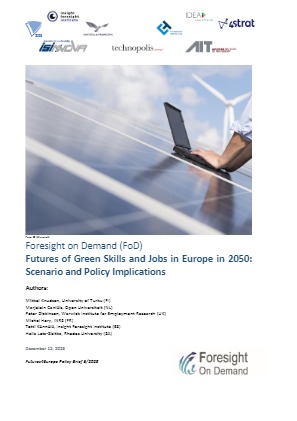
    Futures of Green Skills and Jobs in Europe 2050: Scenarios and Policy Implications

    A new policy brief explores alternative future outcomes for green skills and jobs in Europe 2050. Based on participatory workshops and a foresight deep dive, the policy brief presents four alternative scenarios and their implications for R&I policy.

    Posted on: 25/11/2024

    Last Edited: a year ago

    Futures of Green Skills and Jobs in EuropeNovember 2023

    Scenario and Policy Implications

    Climate change and environmental degradation are an existential threat to the European Union and to the world. As a response, among other things, the European Green Deal aims to make Europe climate-neutral by 2050, boost the economy through green technology, create sustainable industry and transport, and cut pollution. The transition towards greener and more sustainable economies is a game changer in the EU labour market alongside digitalisation and automation. Skill needs will change with impacts far beyond the key occupations driving them, affecting all economic sectors.

    Europe needs to promote and support green employment, address the skilling and reskilling of workers, and anticipate changes in workplaces of the future. In order to get a better grasp on potential future outcomes, and better anticipate their potential policy implications, a foresight Deep Dive has been carried out. The Deep Dive uses a broad conceptualization of skills that encompasses the full palette from scientific and engineering skills to vocational and crafts-like skills. All are needed in the green labour market, although the scenario-led focus here for the most part is on skills of vocational professions. This policy brief presents the main findings.

    A set of four different scenarios for the futures of green skills and jobs in Europe in 2050 were crafted:

    • Scenario A: Green technology-intensive Europe: Struggling to fill all the green jobs
    • Scenario B: Apocalypse Soon: Fighting skills mismatches in a degraded environment
    • Scenario C: Feeling the pain: A workforce left behind in a non-green world
    • Scenario D: Green leapfrogging: Old, mismatched Europe surrounded by new green giants

    Posted on: 30/10/2024