Loading...

    sorted by publishing date

    Last Edited: 8 months ago

    Synthetic Drugs 20501December 2024 - November 2025

    Increasing EU resilience to future developments in the availability and use of synthetic drugs by 2050

    The European Union Drugs Agency’s (EUDA) project “Synthetic Drugs 2050” addressed the growing uncertainty surrounding the future availability, spread, and use of synthetic drugs in Europe up to 2050. Synthetic drugs represent a rapidly evolving and systemic challenge for Europe, affecting public health, security, social cohesion, productivity, and overall wellbeing. Accelerated technological change, globalised supply chains, digitalisation, and increasingly blurred boundaries between legal, illegal, controlled, and uncontrolled substances further amplify the complexity of this issue.


    The project applied a participatory strategic foresight approach to explore possible futures of synthetic drugs in Europe, moving beyond short-term monitoring and reactive policy responses. By systematically analysing global and regional drivers of change, emerging trends, weak signals, and deep uncertainties, the project built a shared understanding of how synthetic drugs markets, uses, and impacts may evolve in the medium- and long-term.

    Through horizon scanning, trend analysis, scenario building, and sense-making activities, Synthetic Drugs 2050 supports EU-level and national stakeholders in anticipating risks, identifying opportunities, and strengthening policy resilience. The project explicitly linked foresight insights to strategic reflection, policy options, and research priorities, while embedding capacity-building components to enhance futures literacy and long-term preparedness within the EU drug policy ecosystem.

    Objectives

    The Synthetic Drugs 2050 project encompassed:

    • A comprehensive, methodologically robust foresight study on the future availability and use of synthetic drugs in Europe up to 2050, exploring systemic drivers, uncertainties, and disruptive developments across social, technological, economic, environmental, political, legal, and ethical dimensions.
    • Development of multiple plausible future scenarios describing how synthetic drugs diffusion in Europe could evolve by 2050, challenging prevailing assumptions and highlighting non-obvious risks and opportunities.
    • Mapping of first-, second-, and third-order implications of synthetic drugs diffusion across Europe, identifying cause–effect pathways, time-bound consequences, and cross-sectoral impacts on health, public safety, governance, and society.
    • Support for strategic preparedness and policy resilience by co-developing policy responses, strategic options, and research and innovation priorities at EU and national levels.
    • Further development of strengthened foresight capacity and futures literacy within EUDA and its stakeholder community through learning-by-doing, participatory engagement, and the development of reusable foresight tools and frameworks.

    Outputs

    • Horizon scanning and trend analysis reports
    • A set of four future scenarios for synthetic drugs in Europe by 2050
    • A mapped system of time-bound implications and cause–effect pathways
    • Policy responses and strategic recommendations
    • A foresight manual and horizon scanning framework for future use

    Find more information here: https://www.euda.europa.eu/index_en

    Posted on: 18/02/2026

    Last Edited: 3 hours ago

    Futures4Europe Short TalksJanuary 2026

    In this short talks video series, the Eye of Europe Project team highlights the breadth and diversity of the EU foresight community, offering an insightful snapshot of the many voices shaping Europe’s futures.

    Futures4Europe talks #1 : Radu Gheorghiu, coordinator of the Eye of Europe project, introduces the Futures4Europe platform and explains how foresight can evolve into a collective and transformative practice to better understand both the future and the present.

    Futures4Europe talks #2 : In this episode, members of the European foresight community share their own definitions of what foresight is.

    Futures4Europe talks #3: Some members of the European foresight community share their views on the main challenges to be tackled in the decades to come.

    Futures4Europe talks #4 : In this episode, community members explore what collective intelligence is and the value it brings to foresight.

    Futures4Europe talks #5 : In this closing video, community members send an invitation to come together and, above all, dare to imagine otherwise.

    Posted on: 18/02/2026

    Last Edited: a year ago

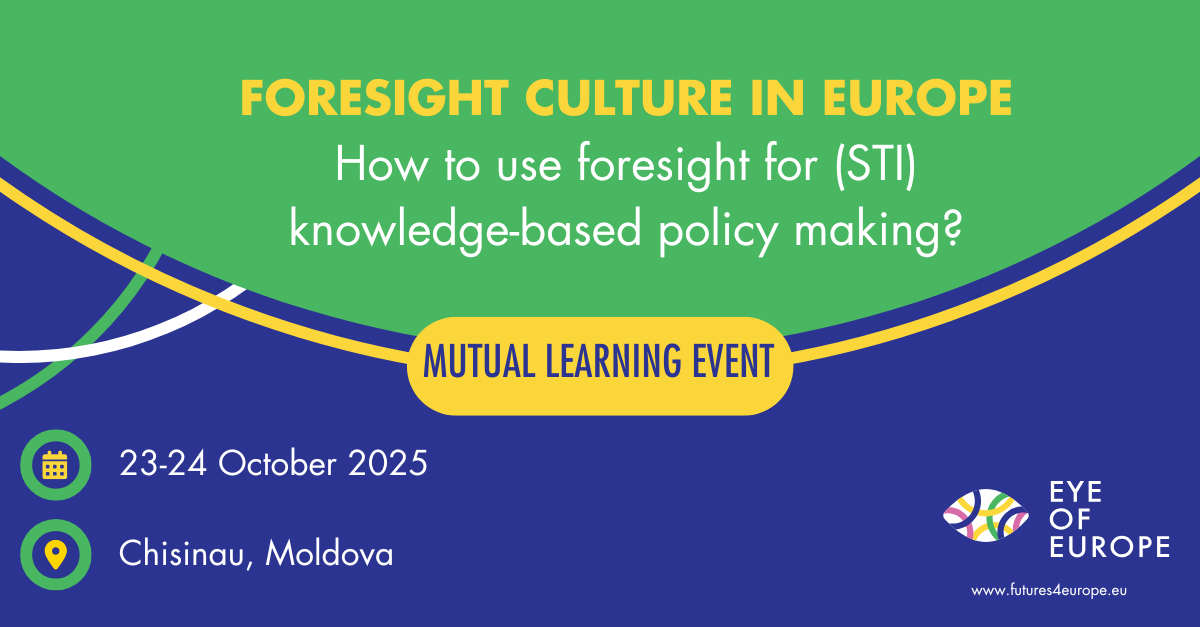
    Eye of Europe Mutual Learning Event 523 October - 24 October 2025

    FORESIGHT CULTURE IN EUROPE: How to use foresight for (STI) knowledge-based policy making?

    The event was the last out of five Mutual Learning Events series, each with over thirty foresight practitioners and/or research and innovation policy-makers experts from across the European Union (EU). The format of these workshops has been designed to allow for mutual exchange and learning among participants: a few keynotes as well as interactive sessions where all participants can share their experience, ideas and questions.

    The series of events was organised as part of the project Eye of Europe, a Coordination and Support Action funded by the Horizon Europe Programme, aimed at enhancing the integration of foresight practices into science, technology, and innovation (STI) policymaking across the EU. The Technology Centre Prague (TC Prague, Czechia) together with the National Agency for Research and Development of Republic of Moldova as the local organiser have overseen organising this event. Technology Centre Prague, which is responsible for all the MLEs and their content, is a key Czech national think tank and academia-based NGO which has a long and rich experience in supporting knowledge-based policymaking as well as in foresight processes and expert-based forward-looking exercises and trainings. National Agency for Research and Development (NARD) is the Moldovan government authority responsible for implementing the national programme on research and innovation, promoting excellence, and supporting collaborative projects through competitive funding and partnership initiatives.

    The topic of Foresight culture in Europe: How to use foresight for (STI) knowledge-based policy making? The topic brought discussions on importance of collaboration among researchers, policymakers, and industry experts in
    foresight activities and explored ways to break down silos and promote knowledge exchange across disciplines in
    Moldova as well as in the rest of Europe or even globally.

    On 23–24 October 2025, we gathered in Chișinău, Moldova, for the final chapter of the Eye of Europe Mutual Learning series. Hosted by the National Agency for Research and Development of Moldova, this two-day event brought together over 40 foresight practitioners, policy makers, and representatives from ministries and research support agencies across Europe. The agenda was rich with presentations, case studies, and interactive sessions exploring how foresight is shaping research and innovation policy in diverse national contexts—from Moldova to Austria, Czechia, Estonia, Poland, Romania, and beyond. The event was an opportunity to reflect on the many faces of foresight across Europe and to present the diversity of approaches that shape how we anticipate and plan for the future.
    Key Objectives
    • Foster a shared European foresight culture supporting strategic R&I policymaking.
    • Highlight diverse foresight practices and institutional approaches across member states.
    • Strengthen capacity for future-oriented policy design and implementation.
    • Transition from vision to action through practical foresight integration.
    Key Takeaways
    • Foresight is a strategic tool for innovation policy, resilience, and inclusiveness.
    • There is growing momentum toward systematic foresight integration in governance.
    • Co-creation, citizen engagement, and knowledge exchange are vital for foresight maturity in Europe.
    • MLE in Chisinau highlighted the need to move from dialogue to tangible policy actions and institutional embedding.

    The Eye of Europe project was recognised as a potential hub for foresight community-building and greater institutionalisation.

    Posted on: 16/06/2025

    Last Edited: a year ago

    IDEALIST1November 2023 - October 2026

    3 InDustrial Ecosystems tAckLing supply chains dISrupTions and boosting advanced technologies uptake

    The overall objective of "3 InDustrial Ecosystems tAckLing supply chain dISrupTions and driving the adoption of advanced technologies" (IDEALIST) is to support SMEs in energy-intensive industries, aerospace and defence, mobility, transport & automotive industrial ecosystems in their ability to understand and adapt to changes brought about by rapid and unexpected developments in the world such as the COVID-19 crisis or the Russia-led war in Ukraine.

    These three sectors are of capital importance for the European economy and despite their specificity, have common challenges that the project helps address: transition to more sustainable practices, competitiveness issues in a context of scarcer raw materials and more expensive energy, change in consumption habits and more. Being more resilient means giving SMEs the opportunity to be a player in these changes and no longer just a spectator or follower. To do this, the project evolves around three pillars: strategic foresight to establish relevant tools and behaviors to anticipate and better prepare for change in an orderly and systematic way; technology uptake to overcome obstacles related to the implementation work of Advanced Technologies and lay the foundations of alliances between tech-savvy and traditional SMEs; and supply chains to identify critical dependencies and weaknesses in order to limit the impacts of disruptions on value chains. This work will lead to the realization of Pilot Projects promoting the meeting between ecosystems, facilitated by the use of the Hack&Match method. The mobilization of the AGORA platform led by EIT Manufacturing will support this objective of matchmaking and community building. The project is carried by a relevant consortium of 14 partners from 6 European countries and Ukraine representing several thousand manufacturing companies.

    Find more information here.
     

    Posted on: 03/01/2025

    Last Edited: a year ago

    FOD II Kick-off Meeting09 October - 10 October 2024

    Brussels meeting of the Foresight on Demand (FOD) consortium to kick-off FOD II

    Foresight on Demand (FOD) is a rapid foresight response mechanism organised in a framework contract, and aims at providing quick forward-looking inputs to policymaking by leveraging the best available foresight knowledge. It addresses the growing need for quicker and more responsive foresight to inform policymaking in an increasingly turbulent environment.

    Representatives of all twenty FOD partner organisations and representatives of different client authorities met in person during a lunch-to-lunch meeting in Brussels taking place at IDEA consult premises from October 10 to October 11, 2024.

    47 people participated in the meeting that focussed on getting to know all FOD partners, especially the new partner organisations of FOD II, gaining insights on expectations of client authorities, as well as on updating the FOD consortium on ongoing and upcoming requests and discussing the FOD service provision processes. The meeting offered the opportunity to exchange in group discussions, during the FOD partner art gallery, where partners presented their organisations and services through art pieces and creative work, and informally during lunch, coffee and at the social dinner.

    The meeting revealed inspiring insights on lessons learned during FOD I (2019-2023), on promoting the FOD framework for potential projects, as well as on emerging topics potentially relevant to the current FOD II (2024-2028) period.


    Posted on: 09/12/2024