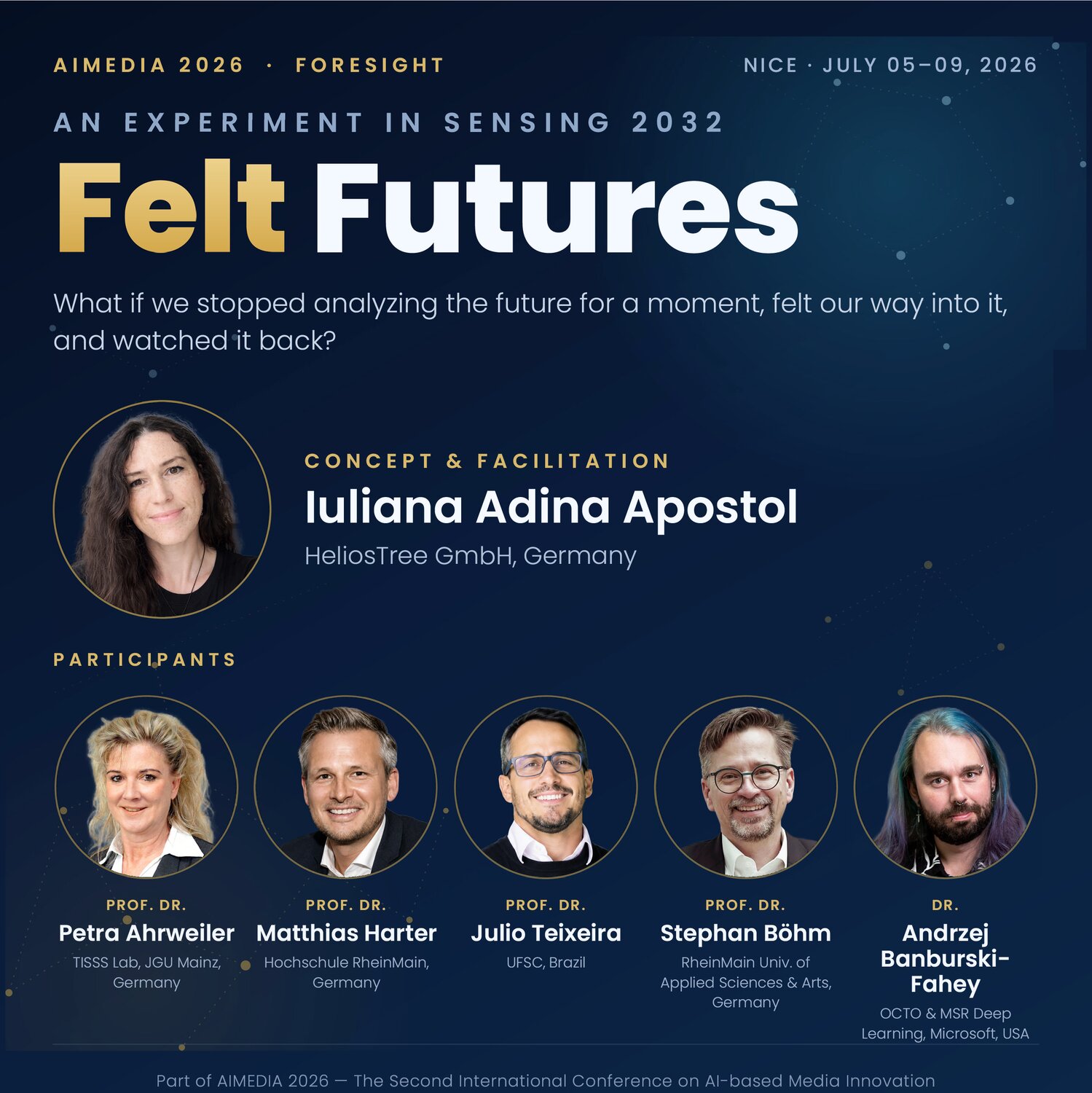
Concept & facilitation: Iuliana Adina Apostol
AIMEDIA 2026 - The Second International Conference on AI-based Media Innovation
Nice, 5–9 July 2026
part of IARIA - International Academy, Research, and Industry Association
Felt Futures is an experiential foresight project taking place at AIMEDIA 2026, the Second International Conference on AI-based Media Innovation, in Nice, France in July 2026. It begins from a proposition most foresight leaves untouched: a future is not only something a team analyses, but something they can be brought to feel — in the body, in the present tense — before the analysis begins.
Conventional foresight maps the terrain. It produces scenarios, trends and probabilities, and tells a group what is plausible. What it rarely settles is whether anyone in the room recognises themselves in the future being described. Teams routinely assemble an intellectualised future — mapped, weighted, argued — that no one actually inhabits, and then wonder why it fails to move them. The gap between an abstract projection and a future as it is felt from the inside is what Experiential Futures scholarship calls the experiential gulf. Felt Futures is an attempt to work directly in that gap.
Method. The project applies an adapted version of the Resonant Future Self Framework (RFSF), a facilitated protocol that guides a participant into a present-tense, sensory inhabitation of an ordinary working day in 2032 — not a forecast of it. Across five positions, the session moves from a temporal warm-up into the texture of the day itself, the relational field of who else is present, the threshold of what in the 2026 self is no longer recognised, and finally a single sentence sent from 2032 back to now. The wager is that a vividly simulated future runs on much the same emotional and physiological circuitry as a real one, so that a person — and, in application, a team — can try a future on at the level of sensation rather than argument.
Two capacities are easily collapsed into one. Affective foresight is the anticipatory projection of a future emotional state: a reading, made now, of how a coming situation is likely to feel. It works predictively, which is why it inherits the fragilities catalogued in the affective-forecasting literature — we overestimate intensity and duration, and we fixate on the triggering event while the rest of life fades from view. Emotional foresight, as I use it, works on the near side of the same process. Here the affect is generated in the present through simulation and registered in the body: a felt state produced now, and treated as evidence about the future it belongs to. Affective foresight estimates a future feeling; emotional foresight elicits one. RFSF operates entirely in the second register.
This is deliberately not affective forecasting, the well-documented and error-prone act of predicting how one will feel later. The relevant construct is affective episodic future thinking, or pre-experiencing: generating a genuine present affective response through simulation, rather than a cold estimate of a distant one. The distinction is what keeps the method out of reach of the classic "impact bias" critique — the claim here is about present elicitation, not predictive accuracy. It also has a current mechanistic basis: under predictive accounts of emotion, affect is constructed partly from the brain's reading of internal bodily signals, which is why the felt channel carries information an analytical read-out skips.
Lineage. Felt Futures does not claim to invent this terrain; it stands on it and says so. Its overall arc — interview participants about their felt futures, mediate the material into concrete artefacts, and show it back to a wider audience — independently reconstructs the Ethnographic Experiential Futures cycle described by Candy and Kornet, within the broader Experiential Futures tradition developed by Candy and Dunagan. What RFSF contributes is a tightened five-position protocol and, because the setting is a media-innovation conference, a specific role for AI-generated film and sound: here they are treated as part of the method, not merely its output — a way to reach senses and emotions that pure analysis passes over.
The pilot. Ahead of the conference, a first phase of individual sessions brings together five participants from different fields and countries:
Prof. Dr. Stephan Böhm (RheinMain University of Applied Sciences),
Prof. Dr. Petra Ahrweiler (TISSS Lab, JGU Mainz),
Prof. Dr. Matthias Harter (Hochschule RheinMain),
Prof. Dr. Júlio Monteiro Teixeira (UFSC, Brazil), and
Dr. Andy Banburski-Fahey (OCTO & MSR Deep Learning, Microsoft).
They are deliberately not a leadership team. Comparing the felt futures of five people who share no company, no decision and no stake in the same outcome is the harder case; a team that already shares context stops looking like the difficult part.
On site, and what follows. The centrepiece takes place in person in Nice, where the group convenes — original participants plus new voices — to work through where their felt futures converge, diverge, or do not match at all. As a pilot (n = 5), its outputs are provisional interpretive instruments, not measurements: the affective maps drawn across participants encode ordering and resemblance, not coordinates, and any applied use is aggregate and anonymised by design. Findings from the Nice sessions will be reported in a second contribution.
Results to follow.
References
Barrett & Simmons (2015) — Nature Reviews Neuroscience 16(7), 419–429
https://doi.org/10.1038/nrn3950
Candy (2010) — dissertation, The Futures of Everyday Life
https://doi.org/10.13140/RG.2.1.1840.0248
Candy & Dunagan (2017) — Futures 86, 136–153
https://doi.org/10.1016/j.futures.2016.05.006
Candy & Kornet (2019) — Journal of Futures Studies 23(3), 3–22 (open access)
https://jfsdigital.org/articles-and-essays/vol-23-no-3-march-2019/turning-foresight-inside-out-an-introduction-to-ethnographic-experiential-futures/
Moeck, Grewal, Mehta, Greenaway, Koval & Kalokerinos (2026) — Affective Science
https://doi.org/10.1007/s42761-026-00364-x
Schacter, Kalinowski & Wilson (2025) — Cerebral Cortex 35(1), 77–83
https://doi.org/10.1093/cercor/bhae388
Schreiber, Schneider, Newen & Voigt (2024) — Emotion 24(6), 1481–1493
https://doi.org/10.1037/emo0001345
Wilson & Gilbert (2005) — Current Directions in Psychological Science 14(3), 131–134
https://doi.org/10.1111/j.0963-7214.2005.00355.x — free PDF: https://dtg.sites.fas.harvard.edu/WILSON%20&%20GILBERT%20(2005).pdf