Loading...

    sorted by publishing date

    Last Edited: 5 days ago

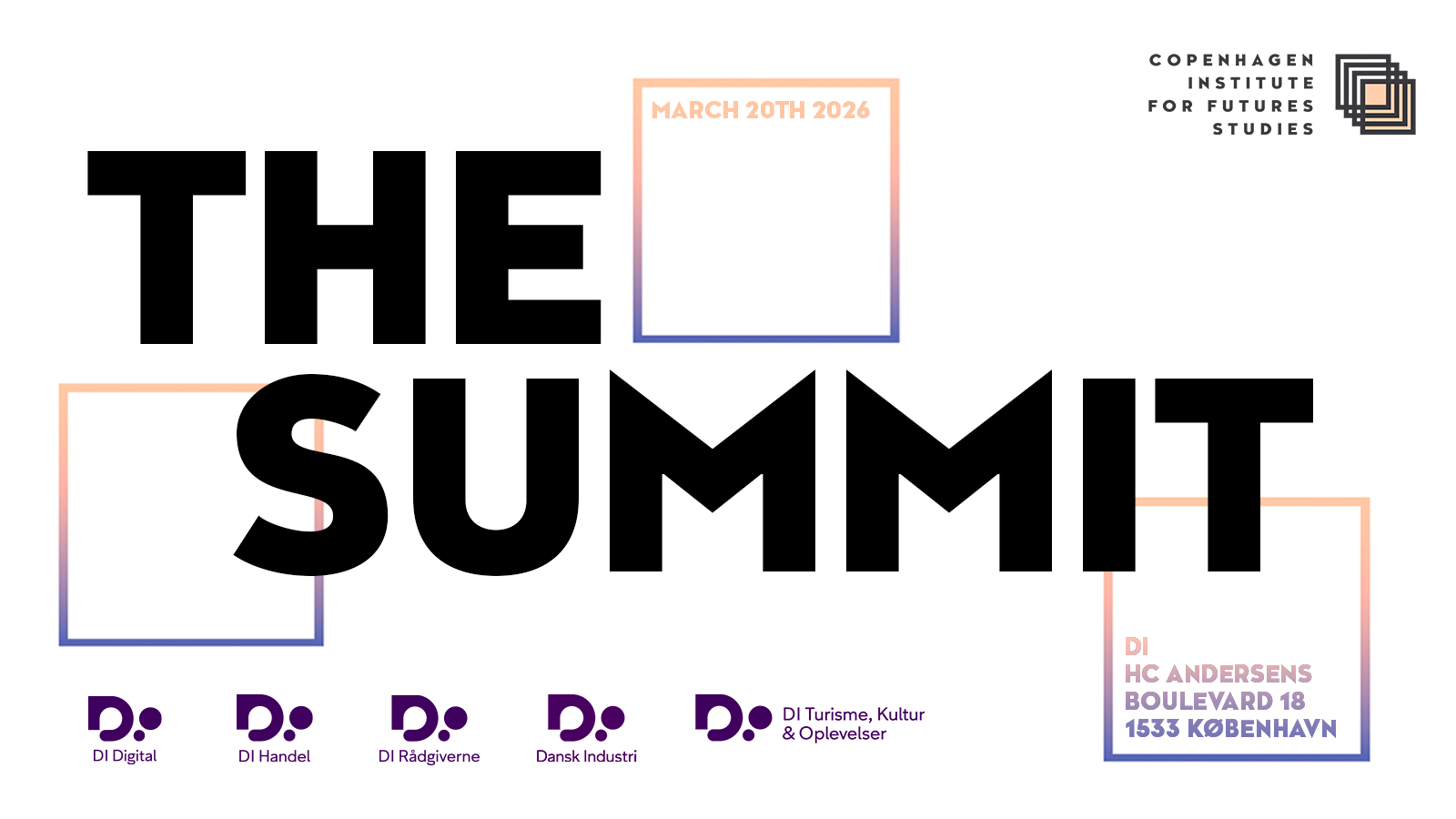
    The Summit 202620 March - 20 March 2026

    An annual gathering exploring the possible futures of emerging technologies. The Summit is a Nordic gathering for leaders, innovators, and forward-thinking organisations who want to explore the futures of emerging technologies and understand their profound impact on business, society, and organisational readiness. It serves as a meeting point for those who not only wish to follow developments in artificial intelligence, immersive experiences, and emerging technologies, but also want to shape how these forces influence the way we work, make decisions, and build future ecosystems. ‍ Hosted by the Confederation of Danish Industry (DI) and curated by the Copenhagen Institute for Futures Studies (CIFS), the conference focuses on foresight, technologies, preparedness, and futures-driven innovation. Through keynotes, panel discussions and focused dialogues, we examine both opportunity and risk, asking how innovation can be aligned with responsibility and long-term value creation. ‍ The Summit focuses on what lies ahead: Possible futures, strategic choices, and the readiness it takes to act responsibly as technologies evolve. It is not only about trends and tools, but about strategic foresight - identifying possible futures, and understanding the readiness it takes to act wisely and courageously as technologies continue to evolve.

    The 2026 edition takes place in Copenhagen on 20 March 2026 (09:00–18:00 CET) at H. C. Andersens Blvd. 18, 1553 København - Industriens Hus. Themes include the AI-mediated workplace, leadership in the future, emerging technologies (including AI agents, simulations and humanoids), the future consumer, retail in transformation, and the futures of foresight.

    The Summit is a Nordic gathering for leaders, innovators, and forward-thinking organisations exploring the futures of emerging technologies and their impact on business, society, and organisational readiness. Co-hosted by Danish Industry (DI) and curated by the Copenhagen Institute for Futures Studies (CIFS), the conference brings together keynotes, Nordic cases, and conversations on preparedness and responsible, meaningful action.

    The Summit 2026 – Industriens Hus, Copenhagen – exploring the possible futures of emerging technologies.
    Posted on: 23/02/2026
    Last Edited: 10 days ago

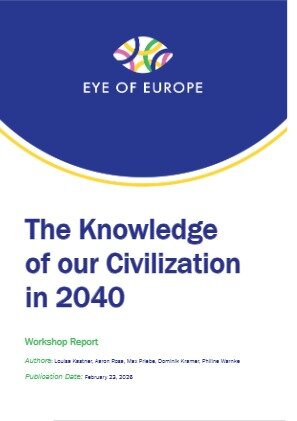
    The Knowledge of our Civilization in 2040January 2026

    Workshop report

    The Knowledge of our Civilizations in 2040 — a foresight workshop hosted by the Foresight Team of the Fraunhofer Institute for Systems and Innovation Research ISI — took place on 20–21 November 2025 at the Berlin-Brandenburg Academy of Sciences and Humanities, as part of the project Eye of Europe.

    At the heart of the two-day workshop was the open question of how future civilizations might define, create, harness,
    value, share, embed and apply knowledge. The workshop’s aim was to explore both conceivable and desirable alternative
    futures for the knowledge of our civilization in Europe by the year 2040 by letting participants explore the theme of the
    knowledge of our civilization through a facilitated process consisting of three main stages.

    Across four working groups, participants started off by identifying different key domains of trouble in the current state of knowledge, with the notion of trouble being interpreted in a positive way as an area of investigation and exploration where things are in deep flux.

    To delve into these areas of trouble, participants then applied the Causal Layered Analysis (CLA) framework twice: first, to critically examine the present by unpacking common narratives, systemic structures, shared worldviews and deep cultural metaphors; and then again, in a creative turn, to imagine desirable alternative futures. This second phase involved reconstructing alternative metaphors, beliefs, and systemic designs, eventually boiling down to a transformed litany.


    The workshop set out to explore how future civilizations might define, create, value, and apply knowledge in 2040. Across four “troubles of knowledge,” participants showed that debates about knowledge are never purely technical but deeply political, ethical and cultural. The discussions revealed that today’s knowledge regimes are under pressure, making transformation both necessary and imaginable.

    A first major theme concerned power and hierarchy. Many groups described current knowledge systems as exclusionary, dominated by majority viewpoints, elite institutions, economic logics and narrow validation mechanisms. Knowledge was seen as concentrated in authorities, shaped by growth paradigms and entangled with private or geopolitical interests. Declining trust and ideological polarization further destabilize what counts as shared truth. The central question recurring across groups was: Who defines knowledge, and for whom?

    A second controversy focused on the purpose of knowledge. Is it primarily a tool for efficiency and competition, or a foundation for collective well‑being and long‑term responsibility? Several groups criticized current reward systems, the reduction of humans to “resources” and the dominance of problem‑solving logic over ethical and relational dimensions. The tension lies between knowledge as power and knowledge as care.

    In the reconstruction phase, however, a shared horizon of hope emerged. Knowledge in 2040 was reimagined as relational, processual and co-created. Groups used metaphors such as mycelium networks, symphonies, assemblies, rivers and verbs to describe knowledge as something circulating, regenerative and sustained through relationships. Uncertainty, discomfort and failure were reframed as essential to meaningful knowledge creation.

    Participants also envisioned new valuation systems: rewarding intrinsic motivation, collective achievement and planetary well‑being rather than market success. Ideas ranged from re‑commoning knowledge and revising metrics of excellence to fostering transdisciplinarity, citizen participation and relational education.

    While the groups differed in where they anchored transformation - epistemic critique, moral renewal, valuation systems or institutional reform - they converged on a broader reorientation: from knowledge as possession to knowledge as relationship; from authority to dialogue; from scarcity to regenerative abundance.

    Ultimately, the knowledge of our civilization in 2040 is imagined as being less about mastering complexity than about inhabiting it responsibly. It emphasizes shared meaning over information production and stewardship over competition. Whether such a transformation unfolds will depend not only on institutional reforms, but on the metaphors that guide our imagination. As the workshop demonstrated, changing how we speak about knowledge may be one of the most powerful steps toward changing how we imagine and eventually live it.

    Posted on: 18/02/2026

    Last Edited: a month ago

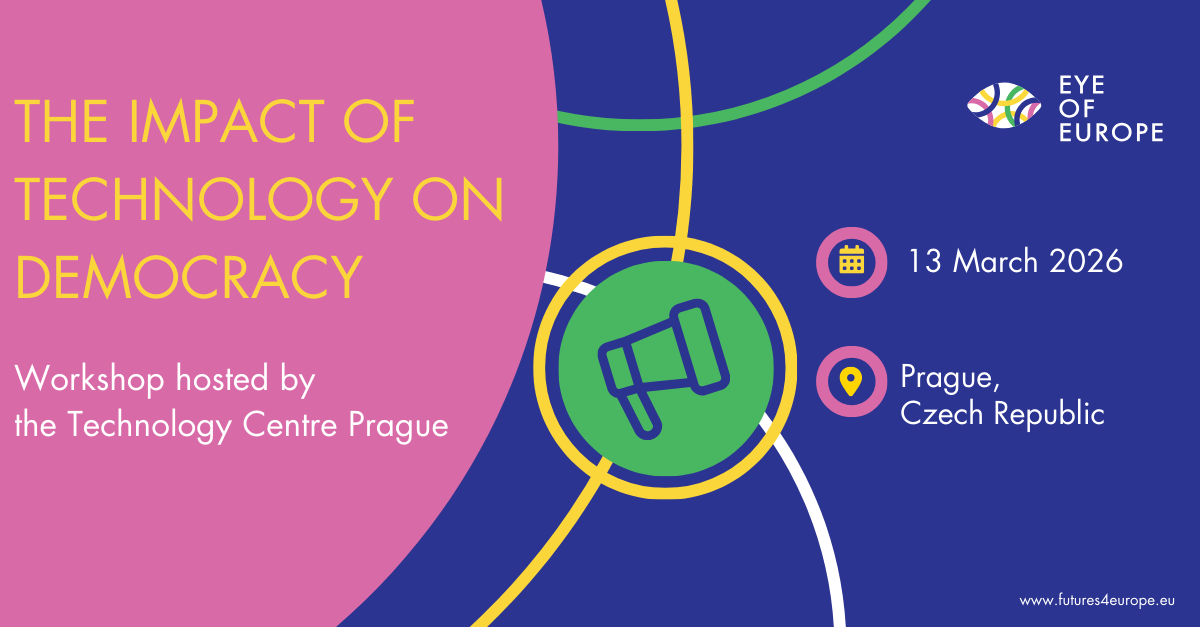
    Workshop “Democracy and Technology“13 March - 13 March 2026

    A foresight workshop on the impact of technology on democracy, organised by the Technology Centre Prague on 13 March 2026

    Democracy, its principles, as well as societal challenges and public debates are increasingly influenced by new and emerging technologies. To strengthen democratic principles, participation, public engagement, and citizens’ understanding of technology-related policies and strategies, it is necessary to deepen research into the interactions between technology and society. This also requires examining potential health, environmental, ethical, and other risks associated with new technological applications, as well as their impacts on different societal groups (for example, age groups, women and men, and social groups).

    This face-to-face workshop with citizens will focus on assessing the impacts of new technologies on society and democracy as a whole. With a group of 30–50 participants, various long-term scenarios and their key drivers will be discussed and developed through group discussions. The workshop will use the Manoa foresight method, which explores long-term impacts and their interconnections by considering current weak signals, trends, and ongoing changes. The method incorporates cultural, environmental, and other assumptions, not only technological or economic factors. The outcomes may include surprising or even radical scenarios, encouraging participants to expand their imagination and test strategies under extreme conditions.

    The workshop is open to the general public. Participation requires being at least 18 years old, having completed primary education, and ensuring gender balance among participants. Everyone who wishes to contribute to the topic is welcome, drawing on their own experience as citizens who use modern technologies daily and live in democratic societies that are increasingly challenged by geopolitical changes.

    The workshop is part of a series of “Eye of Europe” pilot activities taking place during 2026, aimed at exploring possible futures and their implications for research and innovation (R&I) policy.

    Date: 13/03/2026
    Location: Ve Struhách 27, Prague 6, Czech Republic
    Format: In-person
    Language: Czech

    For more information and registration, please contact: vacatkova@tc.cz

    Posted on: 27/01/2026

    Last Edited: 5 months ago

    The Knowledge of our Civilization in 204020 November - 21 November 2025

    A Foresight Workshop on Future Knowledge Systems hosted by the Fraunhofer Institute for Systems and Innovation Research ISI

    The Knowledge of our Civilizations in 2040 — a foresight workshop hosted by the Foresight Team of the Fraunhofer Institute for Systems and Innovation Research ISI — took place on 20–21 November 2025 at the Berlin-Brandenburg Academy of Sciences and Humanities.

    The workshop brought together 28 people from a wide range of academic disciplines as well as artists and futurists from across Europe.

    At the heart of the workshop was the open question of how future civilizations might define, create, harness, value, share, embed and apply knowledge. Our aim was to explore both conceivable and desirable alternative futures for the knowledge of our civilization in Europe by the year 2040.

    Posted on: 07/10/2025