Loading...

    Mentions of

    sorted by publishing date

    Post Image

    Last Edited: 8 days ago

    Foresight as a Key Social Infrastructure for Europe1

    A Manifesto of the Research&Innovation Foresight Community

    Preamble
    Across Europe, the use of foresight for Research and Innovation (R&I) policy is growing, but unevenly. In many places, it still sits at the margins of policymaking, and its full potential—to inspire broader societal change—is not yet realised.

    The European R&I foresight community, made up of practitioners, policymakers, researchers, and future-oriented thinkers, is
    becoming stronger and more connected. The Eye of Europe project, supported by the European Commission, helps this
    community grow through the online hub futures4europe.eu, as well as workshops, conferences and shared learning spaces.

    This manifesto stems from a “foresight on foresight” workshop held in Mamaia, Romania (18–19 September 2025), coordinated by UEFISCDI and the Austrian Institute of Technology. 30 foresight practitioners and R&I policy experts from across Europe gathered to imagine how foresight could better support R&I policy and practice. Furthermore, these contents have also been discussed and enriched during Eye of Europe’s final mutual learning event held in Chișinău, Moldova (23–24 October 2025).

    This manifesto recognises the growing importance of foresight—not only within European R&I systems but also at the interface between R&I and society—repositioning the field as a driver of inspiration and renewal in shaping Europe’s futures.

    Foresight as a Key Social Infrastructure for Europe
    Vision 2030 in a nutshell

    Research and Innovation (R&I) foresight is a shared space of imagination and inquiry, enabling Europe to live creatively with emergence and diversity. Beyond agenda-setting, it cultivates futures literacy across science, policy, and society — expanding our capacity to sense, interpret, and engage with novelty.

    Embracing the open and interdependent nature of the world, foresight complements evidence with creativity and plural ways of knowing. It guides Europe’s research and innovation ecosystems to act with openness, responsibility, and imagination — co-creating sustainable and just futures as a shared public good.

    🔵 EXTENDED ROLE OF R&I FORESIGHT
    In 2030 R&I foresight enables boundary spanning, connecting sectoral policies, disciplines, and perspectives. Its value lies not only in generating agendas or scenarios, but in reshaping worldviews, reframing challenges, cultivating agency, enabling collective reflection, and inspiring transformative action

    🔵 OPEN AND INCLUSIVE SPACES
    In 2030 foresight thrives on openness, diversity, and empathy. It creates spaces where people engage not only as experts or institutional actors, but as whole humans— bringing values, worldviews, emotions, and lived experiences into the co-creation of futures.
    Trust grows from transparency, fairness, and shared ownership of both processes and outcomes. While AI expands access to knowledge, human judgment, engagement creativity, and responsibility remain essential.

    🔵 FUTURES LITERACY AS A FOUNDATIONAL CAPACITY
    Futures literacy becomes both a foundation and a legacy of R&I foresight. It strengthens the collective ability to recognise assumptions, navigate uncertainty, and act with intention amid complexity.
    Foresight processes evolve into open spaces for learning and experimentation, cultivating anticipatory competence among experts, policymakers, and citizens. Through its practices and communication, R&I foresight contributes to a societal diffusion of futures thinking, enhancing collective intelligence and agency.

    🔵 A MATURE COMMUNITY OF PRACTICE
    Foresight gains professional depth through dedicated academic programmes and practitioner networks. A wide variety of organisations embed foresight cultures that encourage reflection, experimentation, and communication. Shared infrastructures such as futures4europe.eu evolve into open, dynamic platforms for collaboration, knowledge exchange, and innovation in foresight.

    Download the document at the top of the page to read the full version.

    Posted on: 21/01/2026

    Last Edited: 5 months ago

    Futures of R&I Foresight18 September - 19 September 2025

    Vision building workshop

    𝗙𝘂𝘁𝘂𝗿𝗲𝘀 𝗼𝗳 𝗥&𝗜 𝗙𝗼𝗿𝗲𝘀𝗶𝗴𝗵𝘁 𝘄𝗼𝗿𝗸𝘀𝗵𝗼𝗽 unfolded on September 18-19th on Romania’s seaside coast — two breezy summer days that provided the perfect setting for a rich exploration of “foresight about foresight.”

    Co-hosted by Executive Agency for Higher Education, Research, Development and Innovation Funding - UEFISCDI and AIT Austrian Institute of Technology, and part of the 𝗘𝘆𝗲 𝗼𝗳 𝗘𝘂𝗿𝗼𝗽𝗲 𝗽𝗿𝗼𝗷𝗲𝗰𝘁 (a Coordination and Support Action funded by the European Commission), the event brought together the community of practice working to 𝘀𝘁𝗿𝗲𝗻𝗴𝘁𝗵𝗲𝗻 𝗥𝗲𝘀𝗲𝗮𝗿𝗰𝗵 & 𝗜𝗻𝗻𝗼𝘃𝗮𝘁𝗶𝗼𝗻 (𝗥&𝗜) 𝗳𝗼𝗿𝗲𝘀𝗶𝗴𝗵𝘁 𝗶𝗻 𝗘𝘂𝗿𝗼𝗽𝗲.

    Our shared ambition was to imagine a vision that is grounded in reality and lived experience, yet bold enough to inspire the next decade of foresight’s contribution to R&I.

    Discussions flowed through several stages:
    🌍 reflecting on today’s foresight landscape, particularly within R&I in Europe
    🔎 identifying likely drivers of change for R&I in society by 2040
    🧭 probing the forces that could reshape foresight itself by 2040 and finally,
    🚀 envisioning the role and capabilities foresight will need to support R&I in 2040.

    A vision document capturing the outcomes of the workshop will be shared in due course, once the many insights, contributions, and reflections have been carefully woven together. 

    Posted on: 17/08/2025

    Last Edited: a year ago

    Foresight on Demand: “Foresight towards the 2nd Strategic Plan for Horizon Europe”July 2023

    This is the final report from a foresight study that aimed at supporting the development of the Strategic Plan of Horizon Europe (2025-2027). The study lasted for 18 months and involved a wide range of activities that this report aims at presenting.

    These activities aimed at providing early-stage strategic intelligence and sense-making contributions – issues, trends, perspectives, ideas - that could contribute novel elements to the more structured processes of strategic planning that were to follow. The work followed two important directions that were recommended by EFFLA (2012)1 as core elements of bringing foresight into EU R&I policy: knowledge-based review and broad engagement.

    Knowledge based review was conducted with the help of the 40 experts who constituted the team that worked on the project. All these experts have contributed as authors to the authorship of the different chapters of this report. About 300 additional experts contributed to the project through its numerous workshops that helped shape the scenarios and ideas about their policy implications, and through membership in the on-line platform of the project at www.futures4europe.eu, which reached 307 people. Last, we acknowledge the 943 experts who responded to our final consultation survey on the implications of our foresight for the directions of EU R&I policy.

    The foresight process
    The foresight process in support of the 2nd Strategic Plan comprised a wide spectrum of activities:
    • As a reference point for the exploratory work, the explicit and implicit impact assumptions of the 1st Strategic Plan were identified and visualised with the help of a qualitative system analysis and modelling tool for causal loop analysis.
    • An exploratory analysis of forward-looking sources (e.g. foresight reports, web-based horizon scanning) was conducted to identify relevant trends and signals of unexpected developments. These were discussed in online workshops and on www.futures4europe.eu.
    • An outlook on emerging developments in the global and European context of EU R&I policy was developed drawing on a major online workshop in autumn 2021 with some 60 participants, experts and policy makers, who worked with multi-level context scenarios and specific context narratives about emerging disruptions.
    • On that basis and in close consultation with the European Commission involving another major workshop in February 2022 which brought together 80 participants, Expert Teams were set up to develop disruptive scenarios in five areas of major interest. Each team ran several internal workshops but also involved further experts and Commission staff in their work, both through the online platform and through a final policy-oriented workshop. The foresight work within the areas of interest resulted in five deep dives on the following topics:
    > Climate change, Research, and Innovation: Radical Options from Social Change to Geoengineering
    > Hydrogen Economy – A radical alternative
    > The EU in a Volatile New World - The challenge of global leadership
    > Global Commons
    > Transhumanist Revolutions
    • Further areas of interest identified since were explored through review papers aiming to capture major trends, developments and scenario sketches in relation to further disruptive developments
    > Social Confrontations
    > Artificial General Intelligence: Issues and Opportunities
    > The Interpenetration of Criminal and Lawful Economic Activities
    > The Future of Health
    • A third major workshop took place in October 2022 bringing together all the thematic strands of work and addressing possible R&I policy implications from this work. Participation in this workshop reached 250 individuals over 2 days.
    • Building on the workshop, the online Dynamic Argumentative Delphi survey Research4Futures collect suggestions from further experts and citizens about the implications of this foresight work for the priorities of EU R&I policy.

    This foresight study has been the most widely engaging foresight exercise yet aiming to support EU R&I policy. Through this broad engagement, the study did not only develop intelligence for the 2nd Strategic Plan of Horizon Europe but also contributed to the development of an EU R&I foresight community, one that is an asset for future R&I policies across Europe. 

    Posted on: 30/11/2024

    Last Edited: a year ago

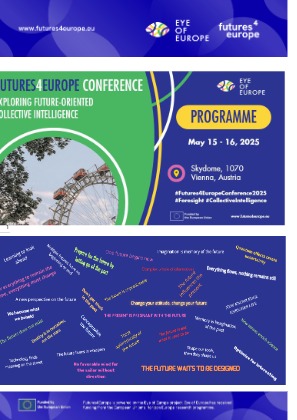
    Futures4Europe Conference 202515 May - 16 May 2025

    Exploring Future-Oriented Collective Intelligence

    The concept of Future-Oriented Collective Intelligence (FOCI) offers a transformative approach to making sense of and addressing future challenges that are complex and interconnected. 

    The topic was at the centre of the Futures4Europe Conference that took place on 15-16 May 2025 in Vienna, Austria, at the Skydome in Vienna’s thrilling 7th district.   

    We are deeply grateful to all 140 participants from 32 countries who joined us for these two days of exploration, dialogue, and inspiration. To gain an overview of the diverse themes, methods, and perspectives presented, you may consult the book of abstracts.

    We also invite you to revisit the highlights of the conference through our photo gallery and short wrap-up video

    Feel free to share them with your networks! We look forward to meeting again in 2026.

    The Conference is organised by AIT Austrian Institute of Technology, as part of the Eye of Europe project, which envisions a more cohesive and influential R&I foresight community that contributes significantly, as collective intelligence, to shaping and guiding policy decisions. The project has received funding from the EU’s Horizon Europe Research Programme under Grant Agreement n°101131738. 

    #Futures4EuropeConference2025 #Foresight #CollectiveIntelligence

    Posted on: 05/11/2024

    Last Edited: a year ago

    Deep Dive: The emergence of global commons: A new opportunity for science, business, and governanceOctober 2022

    The concept of the global commons refers to resource domains that fall outside national jurisdiction, to which all have access, including high seas, airspace, outer space, and cyberspace. Given the growing significance of these domains and related resources for states and other global and local players across a range of purposes, defining the concept of the global commons has become more complex. The Global Commons Alliance network of concerned organisations refers to two definitions of the concept.


    The first is based on geopolitics, where the global commons are areas whose potential economic resources lie beyond national jurisdiction: the atmosphere, the high seas, Antarctica, and outer space. The second definition has its roots more in economics and how shared resources can be overused by some at the expense of others, regardless of national jurisdiction. The strategic access and use of resource domains for military/commercial purposes put pressure on their status. Recent geopolitical developments highlight the need for exploring appropriate forms of global governance or stewardship to ensure responsible (sustainable) management to benefit present and future generations.

    This deep dive aims to address the following questions:

    • What constitutes a global commons? How do global commons differ? How is the concept of global commons likely to evolve up to 2040? Adapting a taxonomy of global commons for the emerging geopolitical, environmental, and economic context.
    • What are the main emerging disruptors of global commons up to 2040? What could change and upset established global commons regimes? How can laws be introduced and implemented in emerging global commons? The emphasis is on geopolitics and how legal frameworks can survive technological change. How can innovation reinforce the commons?
    • How is the economics of common property evolving (from Hardin's very influential work to the massive critique of Hardin by Elinor Ostrom)? linking to major policy debates such as privatisation. Can Ostrom’s approach be scaled up to the level of states? and extended to the common property of the atmosphere or oceans? What would be necessary for such a large-scale negotiation process?
    • How can we govern the commons as a different type of ownership? The emergence of global commons-orientation in innovation? In particular mission-oriented innovation. Exploring the rights and personality of ecosystems and other entities as right holders. Ecological services as transversal.
    • How can we make the global commons work? - the need for cooperative behaviour if global commons and sustainability are to be achieved. Multilateralism 2.0. and emerging role of science diplomacy up to 2040. Ukraine war as an epochal war: the dangers of the war (state of permanent cold war) for acting seriously on the global commons. Potential split with China and new hegemonies in Africa (e.g Belt and Road debt).


      The aim is to identify cross impacts of the global commons areas and key drivers.

    Posted on: 28/10/2024