Loading...

    sorted by publishing date

    Last Edited: 7 days ago

    Empowering Mozambique’s youth to shape their country’s futureDecember 2025

    Youth4Foresight Toolkit Use Case

    Mozambique is one of the youngest countries in the world, with more than 50% of the population under the age of 18. This youth bulge presents a unique demographic and economic opportunity but also places a significant strain on public services, particularly education. Facing challenges such as high unemployment, climate vulnerability, insecurity, and limited access to digital infrastructure, youth-led solutions are critical for building a “future-ready” country.

    The European Union Delegation (EUD) established a Youth Sounding Board (YSB) in 2023 to get input on EU policies by young Mozambicans, as a part of the EU’s Youth Action Plan, and since then they have been consulting them regularly, including for the latest Annual Action Plan 2026.

    In the context of the EU Global Gateway initiative and t he preparation for the EU's next long-term budget 2028-2034, the EU Delegation invited the YSB for a foresight exercises using the Youth4Foresight Toolkit to reflect on the long-term role of the youth and on the strategic priorities for energy, digital, and education in Mozambique. The exercise objectives were to strengthen the YSB members’ capacities and enhance their agency using foresight tools to critically engage with and influence policymaking processes, while providing insights for the upcoming EU programming in Mozambique. 


    The Three Horizons Workshop

    An online workshop for 20 YSB members, facilitated by the young people themselves, took place on 5 December 2025. The online format allowed for participation from YSB members from all over the country and both the preparation and the workshop were held in Portuguese, based on the Portuguese version of the Youth4Foresight Toolkit.

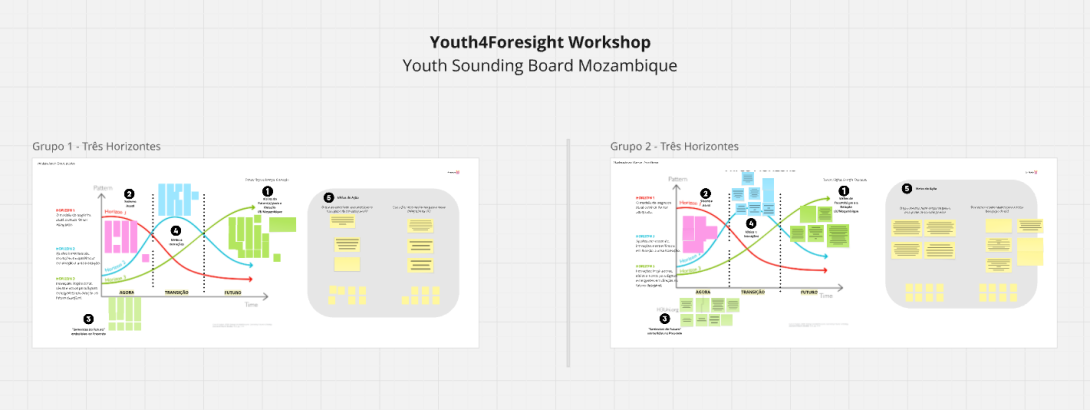
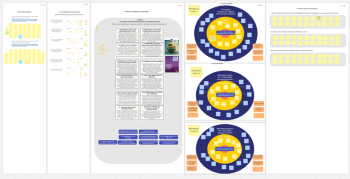
    The Youth Sounding Board used the Three Horizons tool to struc ture their brainstorming in steps:

    Horizon 3 (the desired future)
    : participants imagined their inspirational future focusing on their aspired changes for the domains of energy, digital and education. 


    Horizon 1 (the current system): groups travelled back to the present to identify "business as usual" patterns that are no longer fit for purpose.


    Seeds of the Future:
    participants identified existing pioneers and grassroots initiatives that are already starting to bring their future vision to life.


    Horizon 2 (the transition): groups brainstormed innovations and collaborations needed to remove blockers and transition from the current system to the desired future.


    Action board: finally, considering the three horizons that they have outlined, the groups defined action statements for the YSB and recommendations for the EU Delegation. 

    The Outcomes

    Participants drafted a Declaration of Action and Commitments, outlining steps for current and future Youth Sounding Boards while providing recommendations for EU programming in energy, digital, and education sectors. Feedback was highly positive; members praised the tool's ability to foster structured creative thinking, with several planning to replicate the exercise in their local communities.

    The Three Horizons tool successfully empowered youth by enhancing their futures thinking skills. The outcomes will now inform EU planning for Mozambique, allowing YSB members to actively architect their country's development. 

    Posted on: 26/03/2026
    Last Edited: 7 days ago

    Vietnamese Youth use foresight to act and collaborateAugust 2024

    Youth4Foresight Toolkit Use Case

    Facing uncertainty around climate change, AI, and job security, youth in Vietnam took part in two foresight workshops where they explored future trends, used strategic tools, and built skills to respond to challenges and shape long-term solutions. 


    Why Futures Thinking Skills Matter for the Youth in Vietnam

    Young people across Vietnam and Southeast Asia are navigating a future shaped by climate change, environmental degradation, and the rapid rise of automation and AI. Many are concerned about job security and feel uncertain about what lies ahead. There’s also a growing sense of mistrust toward institutions and doubts about whether a sustainable and just future is truly being safeguarded. In the face of these realities, learning how to think strategically about the future - and take action - is becoming an essential skillset for youth.

    Exploring the Future Through Youth Collaboration & Foresight

    With the support of the European Commission, the EU Delegation in Vietnam organised two online foresight workshops for the Vietnam Youth Advisory Board (VYAB). The sessions were held in September 2024 and each session lasted 1.5 hours, tailored to the participants’ availability across time zones.

    The workshops brought together young people from VYAB and participants from neighboring countries to explore how futures thinking could help youth shape Southeast Asia’s future, especially around three EU priorities: the digital and circular economy, responsible entrepreneurship, and governance.

    Using the Youth4Foresight toolkit, participants engaged in interactive sessions via Miro, an online collaboration tool that was well received. The energy was high, especially as youth connected across the region and from different professional backgrounds to share ideas and build new perspectives. 


    Tools to Shift Mindsets and Spark Ideas


    To kick off, participants explored three warm-up exercises: imagining the world in 2050, rating uncertainties about the future, and identifying trends likely to shape the region. These activities encouraged reflection and helped shift thinking from the present to long-term possibilities. The future holds many paths, but once we begin to recognize them and take action, we can shape those possibilities into something better. 

    From Trends to Actions

    The workshops introduced two main foresight tools: the Futures Wheel and 3 Horizons.

    With the Futures Wheel, participa nts mapped the ripple effects of trends like digital transition, shifting global power dynamics, and resource scarcity. This helped them understand how one change could lead to another, revealing both risks and opportunities for regional action.


    The 3 Horizons exercise in vited participants to reflect on current realities, imagine more desirable futures, and propose ways to get there. Working in teams based on EU priorities, they turned broad visions into concrete ideas and short-term actions. 


    Shared Futures, Shared Responsibility: A Key Takeaway


    Futures thinking proved to be a powerful tool in times of uncertainty. It allowed participants to think more strategically, adaptively, and collaboratively. As they described: "It gave structure to our ideas. We felt more in control of shaping what’s next."

    One of the strongest takeaways was the value of working together. By sharing ideas across the region and professional backgrounds, participants saw how collective thinking leads to more creative, inclusive, and actionable outcomes. It’s not just about imagining what’s coming - it’s about imagining it together.

    Youth left the workshops with stronger skills, renewed motivation, and a clearer sense of how they can lead change in their communities and beyond.

    Check out the toolkit and star t building your future-thinking muscles! 

    Posted on: 26/03/2026

    Last Edited: 7 days ago

    Youth Futures in LesothoAugust 2024

    Youth4Foresight Toolkit Use Case

    Lesotho faces some of the highest inequality levels in the world, leaving young people vulnerable to poverty, unemployment, and forced migration. Nearly a third of the population is under 24, yet youth voices can stay absent from decision-making. Cultural norms discourage open deliberation between young people and adults, leaving many — especially young herders, returnees from South Africa, and young women and girls — without opportunities to shape their futures.

    The European Union, UNICEF, and the International Organization for Migration (IOM) launched the Youth Power Hub Programme in September 2024, with the goal of empowering young people as key players in governance and development at both local and national levels. To make the activities also future facing, the Youth4Foresight toolkit was used at the launch event. 


    Training foresight facilitators

    The toolkit, produced by European Commission, foresight experts and young people worldwide, offers a set of foresight techniques tailored for young people. Rather than relying on external foresight experts for a one-off workshop at the launch event, the EU and partners focused on embedding foresight within the Youth Power Hub itself. Local youth leaders participated in hybrid training on foresight fundamentals, specific tools, and facilitation skills.

    These facilitators then led a futures workshop for 100 participants, exploring ‘The Future of Youth Advocacy in Lesotho.’ A key tool used, part of the Youth4Foresight toolkit, was Three Horizons , a structured approach to understanding systems change and transitions. 

    Shifting mindsets, creating space for new ideas

    For many participants, this was the first time they had been invited to systematically and critically think about the future — not as something distant and abstract, but as something they could actively shape. One facilitator described the experience as “a permission slip to imagine beyond the immediate struggles we are navigating.” Others found clarity in seeing how interconnected issues like climate resilience, youth unemployment, and political participation required systemic solutions. By framing discussions in terms of possible futures rather than fixed positions, it created space for conversations that might otherwise have been constrained by political or institutional barriers.

    The workshop also empowered the young participants collectively convey their views on the Lesotho of the future to the decision makers present at the launch event, as a practical example of the dialogue that the Power Hub seeks to encourage.


    What’s next for foresight in the Youth Power Hub?


    Foresight is not a one-off intervention; it is a capability that grows over time. In a world where youth engagement is often reduced to consultation rather than real agency, the Youth4Foresight Toolkit offers young people a way to navigate uncertainty and define alternative futures they can build towards.

    Spanning from 2024 to 2029, the Youth Power Hub in Lesotho will actively involve young people in decision-making to strengthen citizen participation and build stronger, more inclusive communities. The project supports the Youth Action Plan in European Union external action for 2022-2027 , the first ever policy framework for a strategic partnership with young people around the world. 

    Posted on: 26/03/2026

    Last Edited: 7 days ago

    Cambodian Youth: Using futures thinking to anticipate change and lead boldlyAugust 2024

    Youth4Foresight Toolkit Use Case

    As the future grows more complex and uncertain, young people in Cambodia are learning to navigate it with curiosity, creativity, and clarity. In September 2024, the European Union Delegation (EUD) to Cambodia hosted a 2.5-hour online foresight workshop with its Youth Sounding Board (YSB), using the Youth4Foresight Toolkit. The session introduced strategic foresight tools to help youth anticipate change, collaborate on ideas, and shape sustainable futures. Using Miro, participants explored trends related to climate action, public service transformation, and governance. 


    Why futures thinking matters

    Cambodian youth are facing a web of intersecting challenges - from climate risks and water scarcity to inequities in education, healthcare, and digital access. Futures thinking offers them a way to not only react but lead proactively. The ability to think strategically about long-term possibilities, and act accordingly, is becoming a critical skill. 


    Methodology

    Prior to the session, youth had participated in an introductory workshop to familiarize themselves with key foresight concepts. From that, five trends emerged as most relevant to Cambodia: shifting geopolitical power, green and digital transitions, resource scarcity, new governance systems, and "Basic Services 3.0" (health, education, justice).

    During the main session, participants selected resource scarcity and basic services as the two core trends to explore through the Futures Wheel. They mapped i mmediate and secondary impacts—such as income inequality, food insecurity, and weak infrastructure—then identified strategies like improved public-private partnerships, climate legislation, and innovation in resource use to build long-term resilience.

    Next, youth moved into a Three Horizons exercise, which helped them ref lect on current realities, envision desirable futures, and chart a pathway of innovation and action between the two.

    Horizon 1 highlighted structural challenges: limited access to clean water, energy, and internet; weak healthcare; unskilled labor; and poor transport. These reinforced the sense that "business as usual" is no longer sustainable.


    Horizon 2 focused on transitional innovations already emerging. Youth emphasized the importance of public-private collaboration, digital literacy, green skills, and inclusive transport. Highly supported ideas included promoting green tourism, separate city bus lanes, and youth networks.


    Horizon 3 captured bold visions for a more inclusive Cambodia—with universal access to clean water and air, waste-free cities, thriving green public spaces, and stronger digital governance. 


    Participants also identified “Seeds of the Future”—existing initiatives like food banks, grassroots movements, and water treatment projects—that reflect Horizon 3 values but need scaling up.

    Results & Discussion

    Participants reported a mindset shift:

    🗣️ “Before this, I didn’t give much thought to the future. Now, I find it essential for both my career and our community.”
    🗣️ “Foresight helps me understand, predict, and align my work with long-term goals.”
    🗣️ “The Three Horizons model was simple but powerful.”

    While the session was well received, some challenges were noted:

    - The online format limited peer-to-peer engagement.
    - Some participants were hesitant to speak up; deeper facilitation could help.
    - The single-session format was dense, splitting it into two shorter sessions may enhance reflection.
    - Still, the session sparked high engagement and showed foresight’s value in building youth leadership and agency. 


    Looking Ahead

    This Cambodia workshop is part of the broader Youth4Foresight initiative sup ported by INTPA. It signals growing momentum for inclusive, future-focused engagement in EU partner countries. Cambodian youth aren’t just imagining the future - they’re preparing to lead it. 

    Posted on: 26/03/2026

    Last Edited: 7 days ago

    Shaping Angola's Future: Foresight and Youth EmpowermentJuly 2024

    Youth4Foresight Use Case

    The future of Angola and its youth are inextricably linked, as the country looks to capitalise on its demographic dividend, with over two-thirds of its population under the age of 25. The National Development Plan (2023-2027) prioritizes youth and human capital development to overcome barriers to long-term growth. The Youth4Foresight Toolkit, developed by Directorat e General for International Partnerships of the European Commission, youth experts and EU Delegations worldwide proved to be instrumental in engaging young Angolans.

    Engaging Young Voices for Change

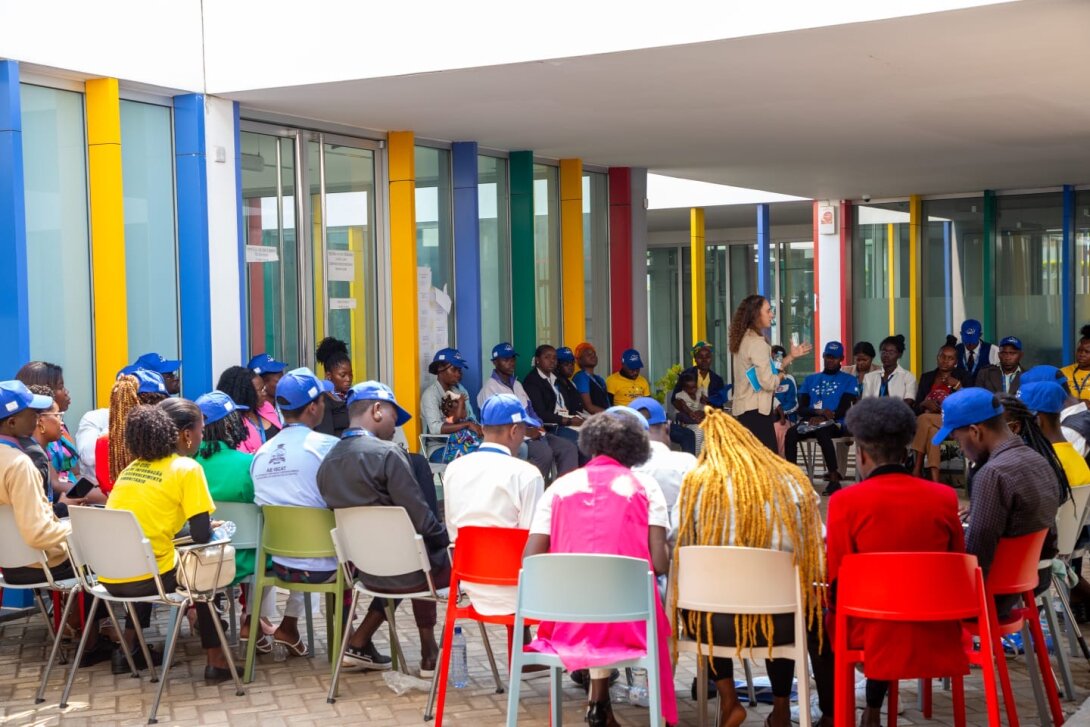
    The Youth Forum in Malanje (in July 2024) centred on "Youth participation in local governance and its impact on human capital development" and brought together 52 youth participants (including 24 women and some young mothers) from five municipalities in Malanje province. The event focused on helping youth better understand national policies and explore ways how they can contribute meaningfully to local governance.

    The Youth Forum was one of the events organised under the EU funded “Support to Civil Society in Local Governance in Angola (PASCAL)” action, which aims to contribute to economic growth and social development through an inclusive, heterogeneous and effective participation of civil society in the governance process.

    A key element of the forum was the application of structured long-term thinking by using the techniques and guidance from the Youth4Foresight Toolkit. Through Three Horizons methodology, young participants explored different future scenarios and created actionable recommendations.

    This same tool was also applied during the Youth Forum in Huambo, another Angolan province, where it proved equally successful in engaging youth and fostering forward-looking dialogue. 

    Foresight in Action: Three Horizons Methodology

    The Three Horizons technique enabled participants to envision a preferred future for their region and Angola. Divided into groups, they assessed the present, identified trends and challenges, and developed transition ideas.

    Discussions highlighted youth concerns: education, healthcare, and local economic development, alongside challenges like poor infrastructure, inadequate education quality and limited access to essential services.

    Participants formulated key recommendations for policymakers, such as creating youth-centred programs, youth centres and vocational training facilities, and stressed the importance of policies that improve access to education, healthcare, and economic opportunities, particularly in rural areas.

    Yong people found the forum groundbreaking and meaningful, with one stating, "We have never participated in such an experience," emphasizing the importance of youth voice. Young mothers expressed hope for their children's futures and appreciated meeting others outside their villages, reflecting the workshop's deep impact in fostering hope and agency and ownership over their future. 


    The Impact of Youth4Foresight

    The structured, adaptable methodologies of the toolkit encouraged inclusive discussions, giving youth a voice in shaping the strategies outlined in Angola’s National Development Plan 2023-2027. As a result, the recommendations produced in the workshop were directly relevant to local realities and can guide policymakers in enhancing youth participation and development.

    Using foresight techniques empowered young people to reflect on their aspirations, critically analyse their present situation, and propose realistic solutions. The Youth4Foresight Toolkit has been successfully used in several countries by EU Delegations to engage with youth as a part of the Youth Action Plan in EU external action. 

    Posted on: 26/03/2026