Loading...

    sorted by publishing date

    Last Edited: 5 months ago

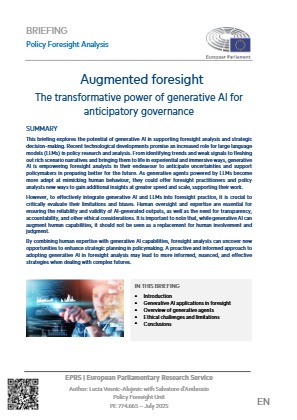
    Augmented foresightJune 2025

    The transformative power of generative AI for anticipatory governance

    This briefing explores the potential of generative AI in supporting foresight analysis and strategic decision-making. Recent technological developments promise an increased role for large language models (LLMs) in policy research and analysis. From identifying trends and weak signals to fleshing out rich scenario narratives and bringing them to life in experiential and immersive ways, generative AI is empowering foresight analysts in their endeavour to anticipate uncertainties and support
    policymakers in preparing better for the future. As generative agents powered by LLMs become more adept at mimicking human behaviour, they could offer foresight practitioners and policy analysts new ways to gain additional insights at greater speed and scale, supporting their work.

    However, to effectively integrate generative AI and LLMs into foresight practice, it is crucial to critically evaluate their limitations and biases. Human oversight and expertise are essential for ensuring the reliability and validity of AI-generated outputs, as well as the need for transparency, accountability, and other ethical considerations. It is important to note that, while generative AI can augment human capabilities, it should not be seen as a replacement for human involvement and judgment.

    By combining human expertise with generative AI capabilities, foresight analysts can uncover new opportunities to enhance strategic planning in policymaking. A proactive and informed approach to adopting generative AI in foresight analysis may lead to more informed, nuanced, and effective strategies when dealing with complex futures.

    In this briefing: 📌Introduction; 📌Generative AI applications in foresight; 📌Overview of generative agents; 📌Ethical challenges and limitations; 📌Conclusions

    Posted on: 11/09/2025
    Last Edited: a year ago

    Stress-testing of Policy Options Using Foresight ScenariosMarch 2024

    A Pilot Case

    Posted on: 13/11/2024

    Last Edited: a year ago

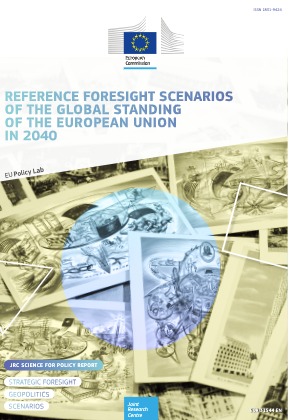
    Reference Foresight ScenariosMay 2023

    Scenarios on the Global Standing of the EU in 2040

    This report summarizes the results of a foresight process that started at the end of 2020 with the goal to develop reference foresight scenarios. Foresight scenarios are a tool to improve strategy development and decision making in a context of turbulence, uncertainty, novelty, and ambiguity. Recent events, such as the COVID pandemic or the Russian invasion of Ukraine, made clear that being prepared for the unknown and unexpected becomes increasingly important. The reference scenarios presented in this report aim to help decision makers to increase the preparedness of their organisations under increasingly unpredictable circumstances.

    Posted on: 13/11/2024

    Last Edited: a year ago

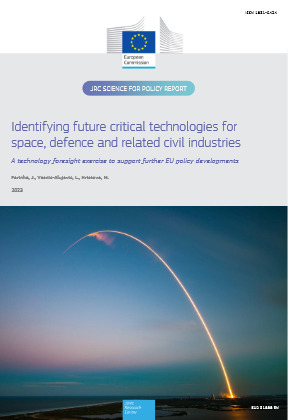
    Identifying Future Critical Technologies for Space, Defence and Related Civil IndustriesDecember 2022

    A Technology Foresight Exercise to Support Further EU Policy Developments

    This publication is a Science for Policy report by the Joint Research Center (JRC), the European Commissions's science and knowledge service.

    It aims to provide evidence-based scientific support to the European policymaking process. The contents of this publication do not necessarily reflect the position or opinion of the European Commission. Neither the European Commission nor any person acting on behalf of the Commission is responsible for the use that might be made of this publication. This report is based on research of the JRC. It does neither include any information or data collected in the context of the EU Observatory of Critical Technologies, nor does it prejudge the future work of the Observatory. For information on the methodology and quality underlying the data used in this publication for which the source is neither Eurostat nor other Commission services, users should contact the referenced source. The designations employed and the presentation of material on the maps do not imply the expression of any opinion whatsoever on the part of the European Union concerning the legal status of any country, territory, city or area or of its authorities, or concerning the delimitation of its frontiers or boundaries. 

    Posted on: 10/11/2024

    Last Edited: a year ago

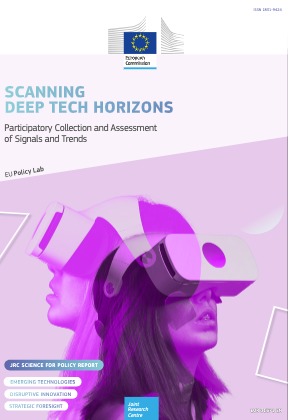
    Scanning Deep Tech HorizonsAugust 2023

    Participatory Collection and Assessment of Signals and Trends

    The Joint Research Centre (JRC) and the European Innovation Council (EIC) conducted a series of Horizon Scanning exercises across six EIC programme managers’ (PM) portfolios as part of an ongoing collaborative effort to strengthen EIC strategic intelligence capacity through the use and development of anticipatory approaches. The fields covered include: Space Systems & Technologies; Quantum Technologies; Agriculture & Food; Solar Fuels & Chemicals; Responsible Electronics and Architecture, Engineering & Construction.


    The main findings of this Horizon Scanning – the identification and analysis of ‘signals’ from nascent research, technologies, or trends on the periphery of the mainstream – show opportunities for investment in emerging technologies and breakthrough innovations that can advance EU competitiveness while also serving to support the EU’s long-term policy and societal visions.
    Other insights were taken from this exercise, namely the identification of drivers, enablers and barriers to technology development and adoption, that could be the starting ground of further foresight exercises and policy initiatives.


    The report highlights three main themes – sustainability, energy, and scalability, which are overarching across signals, drivers, enablers and barriers. And concludes with a series of recommendations to streamline Horizon Scanning activities in the specific context and needs of the EIC.

    Posted on: 28/10/2024

    Last Edited: a year ago

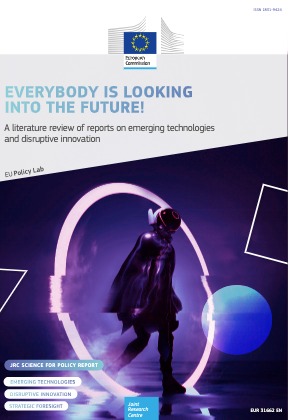
    Everybody is looking into the future!August 2023

    A Literature Review of Reports on Emerging Technologies and Disruptive Innovation

    Growing volatility, uncertainty, complexity and ambiguity, present leading challenges in policy-making nowadays. Anticipatory thinking and foresight are of utmost importance to help explore trends, risks, emerging issues, and their potential implications and opportunities in order to draw useful insights for strategic planning, policy-making and preparedness.


    This report is a part of the “Anticipation and monitoring of emerging technologies and disruptive innovation” (ANTICIPINNOV) project, a collaboration between the European Commission Joint Research Centre with the European Innovation Council (EIC).


    The findings include a set of 106 signals and trends on emerging technologies and disruptive innovations across several areas of application based on a review of key reports on technology and innovation trends and signals produced by public and private entities outside of the EU institutions. Its goal is to strengthen the EIC’s strategic intelligence capacity through the use and development of anticipatory approaches that will - among other goals – support innovation funding prioritisation. Other insights were extracted, namely those related with the scope of the EIC Programme Manager portfolios.

    Posted on: 28/10/2024