Loading...

    Mentions of

    sorted by publishing date

    Last Edited: 6 days ago

    Accelerating Transitions towards Regenerative EconomySeptember 2023

    S&T&I for 2050 case study: scenarios for science, technology and innovation in support of a regenerative economy

    This case study formed part of the Foresight on Demand project 'S&T&I for 2050: Science, Technology and Innovation for Ecosystem Performance – Accelerating Sustainability Transitions', carried out for the European Commission's Directorate-General for Research and Innovation. Conducted by Totti Könnölä (Insight Foresight Institute) with Carlo Sessa and Daniel Rodríguez Cassolà, it explored how science, technology and innovation can support the socio-economic transformation of production and consumption systems towards a regenerative economy that ensures prosperity and well-being for all on a healthy planet.

    Using the Three Horizons framework, the case study develops scenarios for different forms of regenerative economy, each coupled with one of the project's perspectives on ecosystem stewardship. Horizon 1, the eco-efficient market, limits environmental degradation through new eco-efficient technologies and is paired with protecting and restoring socio-ecological systems. Horizon 2, the circular economy, is presented as a possible pathway between the first and third horizons and is paired with co-shaping socio-ecological systems. Horizon 3, the symbiotic economy, converts today's economy into a radically different model and is paired with immersing in and caring within hybrid collectives.

    The study frames the regenerative economy as a possible next stage in the evolution of capitalism, in which economic vigour stems from human and societal vitality rooted in ecological health. In contrast to GDP-centred conventional economics, it treats economic and financial health as inseparable from human, societal and environmental health, and values diversity, integrity and fairness. Like the other case studies of the project, it concludes with implications for research and innovation policy in the context of the European Green Deal.

    Reference: Könnölä, T., Sessa, C., & Cassolà, D. (2023). Case study 4: Accelerating transitions to regenerative economy. In European Commission, Directorate-General for Research and Innovation, K. Kubeczko et al., S&T&I for 2050: Science, technology and innovation for ecosystem performance – Accelerating sustainability transitions. Publications Office of the European Union. https://doi.org/10.2777/100029 

    Posted on: 29/10/2026
    Last Edited: a year ago

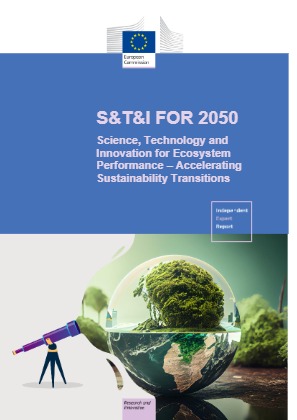
    Final Report: S&T&I 2050April 2023

    Science, technology and innovation for ecosystem performance: accelerating sustainability transitions

    This report presents the results of a the project S&T&I for 2050: science, technology and innovation for ecosystem performance – accelerating sustainability transitions. The project’s overarching goal was to identify and map future scientific and technological developments, which can radically improve ecosystem performance.

    The project was conducted along several phases:

    • Based on literature review, the project team developed three perspectives on future relations between humans and nature and humans’ role in the flourishing of planetary ecosystems. The three perspectives are: i) protecting and restoring ecosystems, ii) co-shaping socio-ecological systems, and iii) caring within hybrid collectives
    • A two-round Dynamic Argumentative Delphi (DAD) online survey explored the most dynamic scientific and technological developments. The survey engaged over 600 experts globally in enriching, assessing and prioritizing STI directions in terms of their potential to contribute to the capability of planetary ecosystems to flourish from now to 2050.
    • Drawing in on the three perspectives and the results of the DAD survey, six case studies on core sustainability issues explored the three perspectives. Reflections on implications for R&I policies in the context of the European Green Deal conclude each of the six case studies: i) Law for Nature; ii) Land Use Futures; iii) Soil to Soul; iv) Accelerating transitions to regenerative economy; v) Ecosystems and Micro-and Nano Cosmos; vi) Data as Representation

    Posted on: 12/12/2024

    Last Edited: a year ago

    S&T&I for 20501July 2021 - December 2022

    Science, technology and innovation for ecosystem performance : accelerating sustainability transitions

    Human performance has long been a dominant pursuit and driver of progress in science, technology and innovation (STI). As notions of performance are still guiding STI research, discussions on its nature are relevant and shape STI directions. Human needs and performance are inextricably linked to challenges related to the health of the planet. Considering that, a debate is warranted to shift the attention from human performance to a more inclusive performance of flourishing ecosystems.
    In this context, the vision of the project “S&T&I FOR 2050. Science, Technology and Innovation for Ecosystem Performance – Accelerating Sustainability Transitions” was driven by the desire for STI efforts to place ecosystem performance on par with human performance. This broadens the focus of STI to encompass multiple conceptualisations of human-nature relations and to contribute to sustainability transitions.

    The project’s overarching goal was to identify and map future scientific and technological developments, which can radically improve ecosystem performance. In doing so, it provided reflections on the 2nd strategic plan of Horizon Europe (HE), in its broad direction to support the Sustainable Development Goals.

    The study was conducted along several phases:

    • Based on literature review, the project team developed three perspectives on future relations between humans and nature and humans’ role in the flourishing of planetary ecosystems. The three perspectives are: i) protecting and restoring ecosystems, ii) co-shaping socio-ecological systems, and iii) caring within hybrid collectives
    • A two-round Dynamic Argumentative Delphi (DAD) online survey explored the most dynamic scientific and technological developments. The survey engaged over 600 experts globally in enriching, assessing and prioritizing STI directions in terms of their potential to contribute to the capability of planetary ecosystems to flourish from now to 2050.
    • Drawing in on the three perspectives and the results of the DAD survey, six case studies on core sustainability issues explored the three perspectives. Reflections on implications for R&I policies in the context of the European Green Deal conclude each of the six case studies: i) Law for Nature; ii) Land Use Futures; iii) Soil to Soul; iv) Accelerating transitions to regenerative economy; v) Ecosystems and Micro-and Nano Cosmos; vi) Data as Representation

    Posted on: 12/12/2024

    Last Edited: a year ago

    Foresight on Demand I1

    EC framework contract Foresight on Demand 2018-2022

    Established by the European Commission, Foresight-on-Demand is a mechanism to respond to the demand for quick inputs to policy-making by drawing on the best available foresight knowledge.

    FoD aims at offering the European Commission services with timely and effective support related to crisis situations, emerging risks, and policy challenges.

    Posted on: 08/11/2024