Last Edited: 24 days ago
Sidse Ansbjerg Bordal1
Posted on: 06/10/2026
sorted by publishing date
Last Edited: 2 months ago
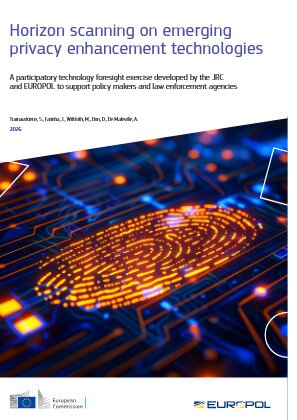
Privacy enhancing technologies (PETs) enable data sharing and collaboration in the digital space in a way that respects privacy, ensuring that users have confidence that their data is protected. However, PETs can also be used to hide traces of criminal activities, most of which today are carried out via, or have some link to, digital communications technology. For this reason, lawful access to electronic evidence has become one of the most critical issues for European law enforcement, as it seeks to ensure safety and security while balancing this with the fundamental right to privacy.
This report presents the results of a joint horizon scanning exercise carried out by the EU Policy Lab at the European Commission’s Joint Research Centre (JRC), and Europol, the EU law enforcement cooperation agency. It contributes to broader JRC efforts to support the European Commission’s political priority, the ‘New Era for European Defence and Security’, by anticipating future technological developments. The aim of the exercise was to assess emerging PETs that could help or, conversely, hinder the future work of European law enforcement. The report underscores the importance of several PETs that experts deem crucial for this purpose.
These technologies have the potential to be either leveraged by law enforcement to enhance their operations or be exploited by criminals, depending on how they are developed and used in the future. The report also examines related complex regulatory frameworks and contextual factors that influence the development and deployment of these technologies. In light of the development of new encryption methods and other related enabling technologies such as artificial intelligence, this report also discusses new ways for law enforcement agencies to securely exchange information and integrate these technologies in the future activities.
Posted on: 11/09/2026
Last Edited: 6 months ago
Mozambique is one of the youngest countries in the world, with more than 50% of the population under the age of 18. This youth bulge presents a unique demographic and economic opportunity but also places a significant strain on public services, particularly education. Facing challenges such as high unemployment, climate vulnerability, insecurity, and limited access to digital infrastructure, youth-led solutions are critical for building a “future-ready” country.
The European Union Delegation (EUD) established a Youth Sounding Board (YSB) in 2023 to get input on EU policies by young Mozambicans, as a part of the EU’s Youth Action Plan, and since then they have been consulting them regularly, including for the latest Annual Action Plan 2026.
In the context of the EU Global Gateway initiative and t he preparation for the EU's next long-term budget 2028-2034, the EU Delegation invited the YSB for a foresight exercises using the Youth4Foresight Toolkit to reflect on the long-term role of the youth and on the strategic priorities for energy, digital, and education in Mozambique. The exercise objectives were to strengthen the YSB members’ capacities and enhance their agency using foresight tools to critically engage with and influence policymaking processes, while providing insights for the upcoming EU programming in Mozambique.
The Three Horizons Workshop
An online workshop for 20 YSB members, facilitated by the young people themselves, took place on 5 December 2025. The online format allowed for participation from YSB members from all over the country and both the preparation and the workshop were held in Portuguese, based on the Portuguese version of the Youth4Foresight Toolkit.
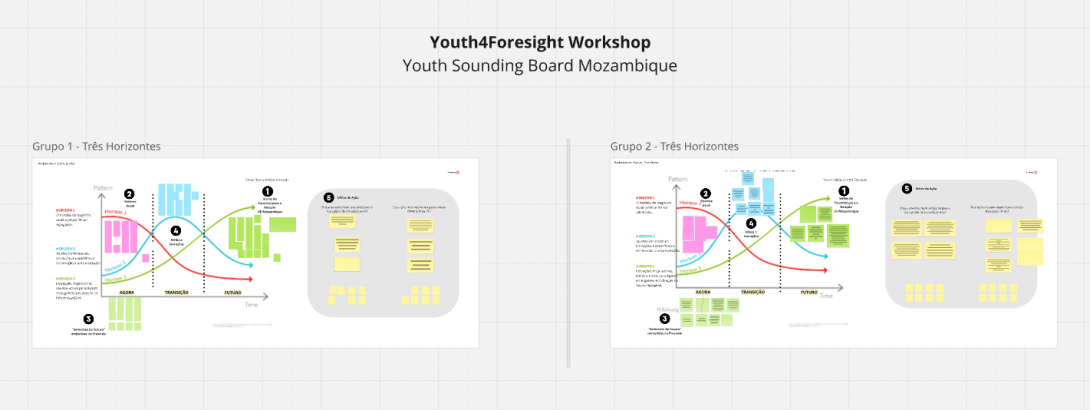
The Youth Sounding Board used the Three Horizons tool to struc ture their brainstorming in steps:
Horizon 3 (the desired future): participants imagined their inspirational future focusing on their aspired changes for the domains of energy, digital and education.
Horizon 1 (the current system): groups travelled back to the present to identify "business as usual" patterns that are no longer fit for purpose.
Seeds of the Future: participants identified existing pioneers and grassroots initiatives that are already starting to bring their future vision to life.
Horizon 2 (the transition): groups brainstormed innovations and collaborations needed to remove blockers and transition from the current system to the desired future.
Action board: finally, considering the three horizons that they have outlined, the groups defined action statements for the YSB and recommendations for the EU Delegation.
The Outcomes
Participants drafted a Declaration of Action and Commitments, outlining steps for current and future Youth Sounding Boards while providing recommendations for EU programming in energy, digital, and education sectors. Feedback was highly positive; members praised the tool's ability to foster structured creative thinking, with several planning to replicate the exercise in their local communities.
The Three Horizons tool successfully empowered youth by enhancing their futures thinking skills. The outcomes will now inform EU planning for Mozambique, allowing YSB members to actively architect their country's development.
Posted on: 26/03/2026
Last Edited: a year ago
Welcome to the second issue of Horizon Futures Watch, bringing you a fresh batch of articles revolving around the latest foresight developments in Horizon projects and beyond. Two new themes are treated in this issue: Tackling security concerns and the future of Science for Policy.
The ‘Tackling security concerns’ section goes beyond the scope of the Futures4Europe platform foresight project on the ‘interpenetration of criminal and lawful activities’ and explores new needs that arise for fighting crime and countering hybrid threats as a result of rapid technological developments.
The Science for Policy theme explores novel approaches taken to support the democratic process through evidence-based methods for policymaking.
We open this issue with an up-to-date selection of news on foresight projects and publications. The Foresight in the Field section presents the application of foresight in EUROPOL’s European Innovation Lab to support law enforcement agencies around the EU.
Posted on: 13/02/2025
Last Edited: a year ago
Millions of travellers cross the EU’s external borders every year and their numbers will likely increase even further. Thus, border checks will need to undergo significant transformations in the coming years, both to effectively safeguard the EU’s external borders and to improve the border crossing experience for travellers. Biometrics is one of the fields expected to significantly contribute to the attainment of these goals.
In light of the above, Frontex, the European Border and Coast Guard Agency delivered a Technology Foresight Research Study on Biometrics for the Future of Travel. The main objective of this research was the delivery of a study on the future of biometrics for its implementation in border control systems that may benefit the work of the European Border and Coast Guard (EBCG) community in a short (1-5 years), medium (5-10 years) and long term (10+ years) perspective. In particular, this research was to produce a research study that includes the prioritization and roadmapping of emerging relevant biometric technologies with the strongest potential to influence the strategic components of Integrated Border Management and the work of Border Guards themselves. The research study also produced comprehensive tailored technology foresight methodology and supporting tools, properly adapted to Frontex capabilities and organization. Furthermore, it delivered a technology taxonomy for biometrics and biometrics-enabled technological systems.
The obtained findings were to support Frontex in identifying specific research and innovation initiatives which could accelerate the integration of novel biometrics-enabled technological solutions for border checks. This study provides knowledge on how to maximize future benefits of biometrics technology in the border management environment while minimizing its risks and ensuring full compliance with the existing legal, ethical and technological constraints.
The research study consisted of five phases, which all produced their own set of insights intended to support the EBCG community in decision-making processes, compiled in the main report available here .
Posted on: 30/12/2024
Last Edited: a year ago
4CF The Futures Literacy Company is a consultancy entirely focused on strategic foresight and long-term strategies. For nearly two decades, 4CF has been on the mission to help its clients prepare for an uncertain tomorrow. The Company has executed hundreds of projects for private companies, public institutions and international entities, including the European Commission and its agencies (EUDA, ENISA), FAO, UNFCCC, UNESCO, UNEP and UNDP. 4CF is at the forefront of global innovation, and actively contributes to the development of cutting-edge foresight tools, including 4CF HalnyX (Delphi platform), 4CF Sprawlr, 4CF FLEx.
Posted on: 17/12/2024