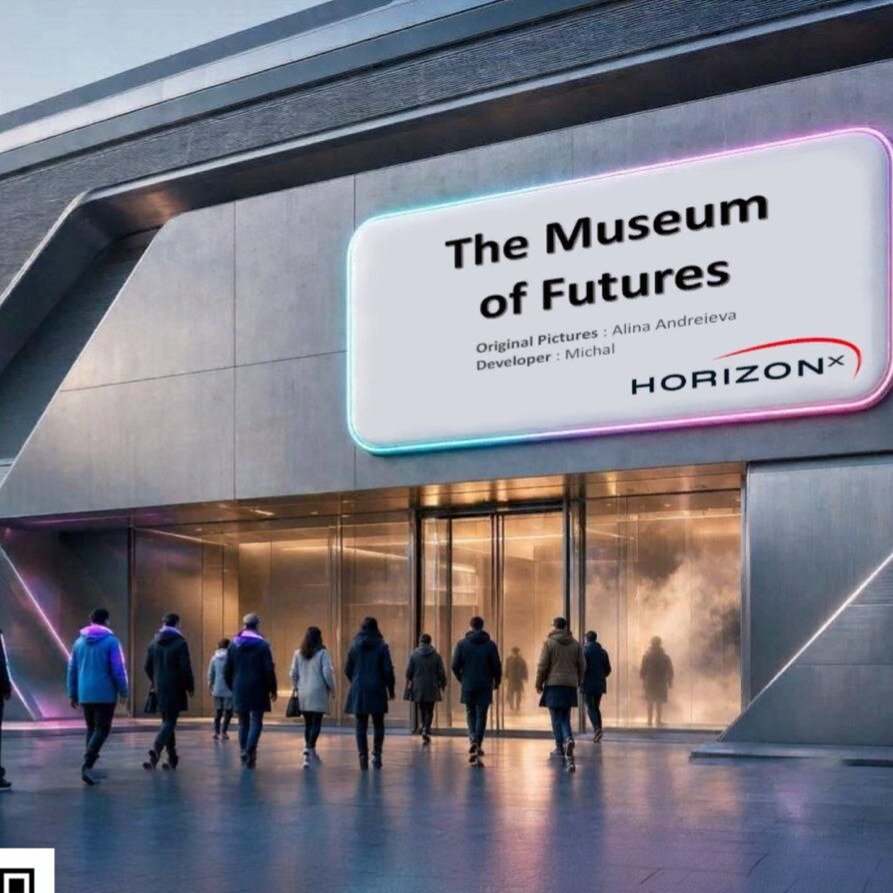
The Museum of Futures was created in August 2026 as a methodological tool by the HorizonX Institute team and partners: Alina Andreieva (International Business Manager and Senior Facilitator HorizonX), Robert Collins (Business Consultant and Educator), and Michal Collins (Software Developer). It was developed in response to a need we often face in foresight projects, both in training and in-house corporate projects: how to unlock imagination.
One of the biggest struggles in foresight is daring to imagine alternative futures. The reason is not that people lack imagination, but that we are full of biases and assumptions. Our brains have filters that protect us from being overloaded with information. As we cannot process everything, the brain selects what seems “relevant” to us. But what does it actually select? Familiar things, safe things, comfortable things, things we already know. Our comfort zone and stability help us survive, both mentally and physically. We cannot live in constant frustration and uncertainty, right? That’s how our brains work. And that’s how foresight does not work.
The Museum of Futures gently gives us permission to see more, with fewer filters (or at least to notice more than we usually do). Because the biggest problem for society is not necessarily the lack of information or the invisibility of signals. It is our tendency to ignore them. Why? Because once we notice them, we may have to change something. We need to take action, make new, uncomfortable and sometimes unconventional decisions. The Museum of Futures is like developing empathy towards change: we may like it or not, but we need to understand what is going on.
How does the Museum work?
Normally, in museums, we see artefacts from the past. Here, we see artefacts from the Futures. They are all different and may come from completely different possible futures. Some may even contradict each other. And they come without a detailed explanation of why they appeared or what exactly they were used for. Because there is no way to predict one exact future. The Museum is not about predictions. It is about provocations. There are 10 galleries: Work & Skills, Education, Economy & Finance, Climate, Technology, Security, Governance, Urban Futures, Health and Energy.
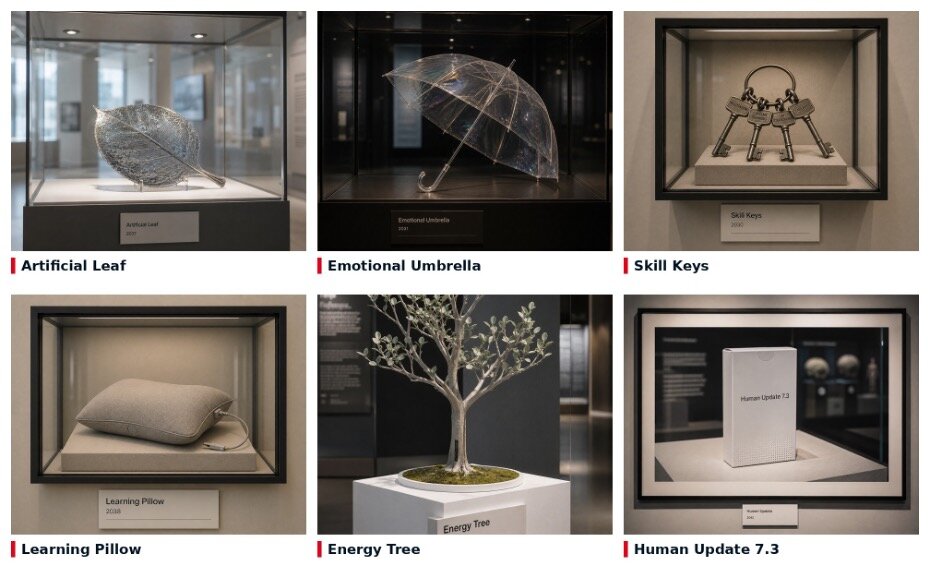
The artefacts are the result of combining STEEP analysis, signals of change, drivers and Futures Wheel thinking. The logic behind creating an exhibit looks like this: Signals → Drivers → Consequences → Future Need or Problem → Artefact. We start with signals and drivers, explore several layers of possible consequences using the Futures Wheel, and ask: What might people need in this future? What new problems could emerge? What could solve them? Or perhaps the problem was never solved. The resulting object, situation or experience becomes an exhibit.
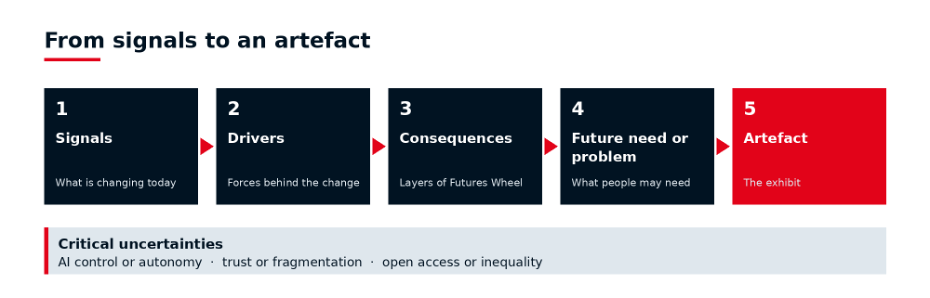
We also introduce critical uncertainties. For example, will AI remain under human control or become increasingly autonomous? Will societies move towards greater trust and cooperation or fragmentation? Will new technologies become widely accessible or deepen inequalities? Different developments of these uncertainties can lead to very different futures. That is why some objects in the Museum intentionally contradict each other.
Where can the Museum be used?
1. Understanding and analysing signals
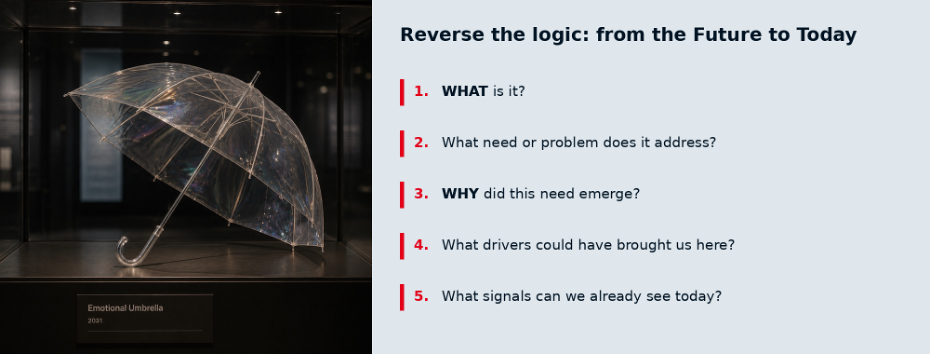
One way to use the Museum is to explain how to analyse signals of change. But we do it in reverse order. We start with an artefact from a possible future and travel backwards to today. Participants choose an exhibit and ask:
▪ WHAT is it?
▪ What NEED or PROBLEM does it address?
▪ WHY did this need emerge?
▪ What DRIVERS could have brought us here?
▪ What SIGNALS can we already see today?
This helps people understand the logic behind signal analysis in a more playful and engaging way. And what is particularly interesting is that we can already find signals today that could lead to many of the artefacts in the Museum.
2. Understanding how the Futures Wheel works
The Museum can also help explain and demonstrate the Futures Wheel methodology. Artefacts are not necessarily direct consequences of a trend or driver. They often represent indirect consequences: the second, third or even further layers of change. And this is exactly where we can discover hidden risks, unexpected future needs and new opportunities for innovation. Instead of simply explaining the methodology, we let people experience the logic behind it.
3. Creating scenarios
One of the biggest challenges in scenario development is imagining genuinely different Possible Futures. We often start with what seems plausible or probable because it feels more realistic and comfortable. But the Futures Cone reminds us that we should also explore a wider range of possible futures before narrowing our thinking to plausible, probable or preferable ones. The Museum can help open that door to imagination. It allows people to dare to think differently, challenge their assumptions and open their eyes to possibilities they might otherwise ignore. And once again, these possibilities are not necessarily pure fantasy. There are signals today that can help us explore the logic behind them.
The Museum as a Foresight Deliverable
We are also planning to develop this concept further by creating custom Museums of Scenarios for our clients. Because another challenge in foresight is not just creating scenarios, but making sure stakeholders remember them and actually act on them. Considering how the way we consume and remember information is changing, scenarios should be memorable, easy to understand and easy to revisit.
Can you imagine the CEO of a company opening a PowerPoint presentation or a 100-page report just to reread all the scenarios? Now, can you imagine the same CEO coming back to a Museum for 10 to 15 minutes, walking through the scenarios, reminding themselves what those futures could look like, and checking whether some signals are becoming more visible? Maybe it is already time to rethink the strategy. Maybe some new actions are needed.
What if every foresight project ended not only with a report, but also with its own Museum? A Museum that stakeholders can revisit, experience and use to keep alternative futures in mind. Not instead of rigorous foresight research, but as another way to make its results accessible, memorable and actionable.
To sum up
The Museum of Futures is a tool to help overcome biases at the beginning of a foresight project, particularly during the research and scanning stages. It helps us avoid being trapped by obvious trends and remain open to seeing more. It is a tool to understand the logic behind signal analysis and the Futures Wheel in a more playful way. It is a tool to create scenarios in a bolder, more imaginative way. It is a tool to remember. And we hope it can also help people develop greater empathy towards change and encourage them to take action.
Explore the Museum: https://museum.horizonx.eu/