Loading...

    Mentions of

    sorted by publishing date

    Last Edited: 6 days ago

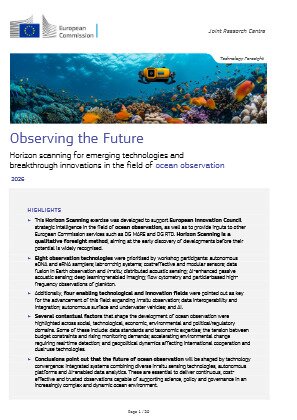
    Observing the future

    Horizon scanning for emerging technologies and breakthrough innovations in the field of ocean observation

    This technology foresight brief documents the process and findings of a horizon scanning exercise, part of a series under the FUTURINNOV.

    The workshop, held online on 12 November 2025, focused on the identification, evaluation, and prioritisation of emerging technologies and breakthrough innovations across all technology readiness levels (TRLs) in the field of ocean observation. Signals were collected through expert inputs, literature review, and text and data mining of patents, scientific publications, and EU-funded research and innovation projects.

    These signals were subsequently assessed by a multidisciplinary group of experts, leading to the prioritisation of eight key observation technologies: autonomous eDNA and eRNA samplers; lab-on-chip systems; cost-effective and modular sensors; data fusion between Earth observation and in-situ measurements; distributed acoustic sensing; AI-enhanced passive acoustic sensing; deep learning-enabled imaging; and flow cytometry and particle-based high-frequency observations of plankton.

    In addition, four enabling technological and innovation fields were identified as critical for advancing ocean observation capabilities: expanding in-situ observation infrastructures; data interoperability and integration; autonomous surface and underwater vehicles; and artificial intelligence. The brief also highlights a range of contextual factors shaping the development and uptake of ocean observation technologies across social, technological, economic, environmental, and political and regulatory dimensions. These include challenges related to data standards and taxonomic expertise, tensions between budget constraints and increasing monitoring demands, the need for real-time detection in the face of accelerating environmental change, and geopolitical dynamics influencing international cooperation and the governance of dual-use technologies. 

    Posted on: 05/03/2026

    Last Edited: 6 months ago

    Healing the FutureJuly 2025

    Horizon scanning for emerging technologies and breakthrough innovations in the field of cell and gene therapies

    This brief documents the process and findings of a horizon scanning exercise, in the context of FUTURINNOV (FUTURe-oriented detection and assessment of emerging technologies and break-through INNOVation) a collaboration between the European Innovation Council (EIC) and the Joint Research Centre (JRC), aiming to support the EIC's strategic intelligence through foresight and other anticipatory methodologies.

    The workshop, held online on 15 May 2025, had as its primary goal the evaluation and prioritisation of trends and signals related to emerging technologies and breakthrough innovation, across all technology readiness levels (TRLs), within cell and gene therapies.

    Signals for the workshop were gathered from experts, literature review, and text/data mining of patents, publications, and EU-funded projects. These signals were then scrutinised for their significance to the field's future by a diverse group of sector experts, which led to the identification of seven key topics: in vivo gene therapy; microphysiological pre-clinical models; stem cells in multiple applications; new tools for advanced tissue delivery; in silico & AI; conversion of tumour cells; and emerging genome and epigenome-based therapies.

    Participants also highlighted various contextual factors that could influence the development, adoption, and uptake of emerging technologies within this field, including in domains such as: competitiveness and geopolitics; talent and expertise; cross-border and cross-sector collaboration; funding, economic and market conditions; regulatory, safety and ethical challenges; health and RDI ecosystems; and infrastructure and manufacturing.

    Posted on: 24/09/2025

    Last Edited: a year ago

    Mobilising the future

    Horizon scanning for emerging technologies and breakthrough innovations in the field of mobility

    This report documents the process and findings of a horizon scanning exercise, part of a series under the FUTURINNOV (FUTURe-oriented detection and assessment of emerging technologies and breakthrough INNOVation) project, a collaboration between the European Innovation Council (EIC) and the Joint Research Centre (JRC), aiming to bolster the EIC's strategic intelligence through foresight and anticipatory methodologies.
    The workshop, held on 16 October 2024, had as its primary goal the evaluation and prioritisation of trends and signals on emerging technologies and breakthrough innovation, across all tech7-nology readiness levels (TRLs), within the broad Mobility domain, broken-down into four key areas: transport systems, networks and multimodality; automotive and roads; rail/freight and logistics and aviation and airports.
    Signals for the workshop were gathered from experts, literature review, and text/data mining of patents, publications, and EU-funded projects. These signals were then scrutinised for their significance to the field's future by a diverse group of sector experts which led to the identification of 22 different key topics across the key areas above. These signals can be seen as hotspots of innovation that deserve the EIC’s attention for possible future support.
    Participants also highlighted various factors that could influence the development, adoption, and promotion of these emerging technologies, which are presented in the report as drivers, enablers and barriers, and analysed specifically in each of the 4 key areas.

    Posted on: 17/03/2025

    Last Edited: a year ago

    IMAGING THE FUTURE

    Horizon scanning for emerging technologies and breakthrough innovations in the field of medical imaging and AI

    This report documents the process and findings of a horizon scanning exercise, part of a series under
    the FUTURINNOV (FUTURe-oriented detection and assessment of emerging technologies and break-
    through INNOVation) project, a collaboration between the European Innovation Council (EIC) and the
    Joint Research Centre (JRC), aiming to bolster the EIC's strategic intelligence through foresight and
    anticipatory methodologies.


    The workshop, held on 17 September 2024, had as its primary goal the evaluation and prioritisation
    of trends and signals on emerging technologies and breakthrough innovation, across all technology
    readiness levels (TRLs), within the EIC's Medical Imaging and AI portfolio.
    Signals for the workshop were gathered from experts, literature review, and text/data mining of pa-
    tents, publications, and EU-funded projects. These signals were then scrutinised for their significance
    to the field's future by a diverse group of sector experts which led to the identification of eight key
    topics: generative AI for healthcare; digital twins; multimodal data analysis; explainable AI in medical
    imaging; application of AI to specific diseases/conditions; XR - augmented and virtual realities; tensor-
    valued diffusion encoding, and AI-generated synthetic data for training AI. Furthermore, the workshop
    identified additional wild cards with high novelty and disruptive potential such as: blockchain, edge
    computing and differential privacy for secure, AI-driven medical imaging and collaborative healthcare
    optimisation and quantum medical imaging.


    Participants also highlighted various factors that could influence the development, adoption, and pro-
    motion of these emerging technologies, which can be grouped under the following categories: Tech-
    nological advancements and cross-sector applications; data infrastructure, AI models, and regulatory
    frameworks; workforce, education and societal factors; clinical efficiency and patient outcomes; trust,
    ethics, and AI adoption; financial pressures and industry investment in AI healthcare.

    Posted on: 13/01/2025

    Last Edited: a year ago

    Technology Foresight for Public Funding of InnovationAugust 2023

    Methods and Best Practices

    In times of growing uncertainties and complexities, anticipatory thinking is essential for policymakers.
    Technology foresight explores the longer-term futures of Science, Technology and Innovation. It can be used
    as a tool to create effective policy responses, including in technology and innovation policies, and to shape
    technological change.


    In this report we present six anticipatory and technology foresight methods that can contribute to anticipatory
    intelligence in terms of public funding of innovation: the Delphi survey, genius forecasting, technology roadmapping, large language models used in foresight, horizon scanning and scenario planning.


    Each chapter provides a brief overview of the method with case studies and recommendations.
    The insights from this report show that only by combining different anticipatory viewpoints and approaches
    to spotting, understanding and shaping emergent technologies, can public funders such as the European
    Innovation Council improve their proactive approaches to supporting ground-breaking technologies. In this
    way, they will help innovation ecosystems to develop.

    Posted on: 28/10/2024

    Last Edited: a year ago

    Scanning Deep Tech HorizonsAugust 2023

    Participatory Collection and Assessment of Signals and Trends

    The Joint Research Centre (JRC) and the European Innovation Council (EIC) conducted a series of Horizon Scanning exercises across six EIC programme managers’ (PM) portfolios as part of an ongoing collaborative effort to strengthen EIC strategic intelligence capacity through the use and development of anticipatory approaches. The fields covered include: Space Systems & Technologies; Quantum Technologies; Agriculture & Food; Solar Fuels & Chemicals; Responsible Electronics and Architecture, Engineering & Construction.


    The main findings of this Horizon Scanning – the identification and analysis of ‘signals’ from nascent research, technologies, or trends on the periphery of the mainstream – show opportunities for investment in emerging technologies and breakthrough innovations that can advance EU competitiveness while also serving to support the EU’s long-term policy and societal visions.
    Other insights were taken from this exercise, namely the identification of drivers, enablers and barriers to technology development and adoption, that could be the starting ground of further foresight exercises and policy initiatives.


    The report highlights three main themes – sustainability, energy, and scalability, which are overarching across signals, drivers, enablers and barriers. And concludes with a series of recommendations to streamline Horizon Scanning activities in the specific context and needs of the EIC.

    Posted on: 28/10/2024

    Last Edited: a year ago

    Everybody is looking into the future!August 2023

    A Literature Review of Reports on Emerging Technologies and Disruptive Innovation

    Growing volatility, uncertainty, complexity and ambiguity, present leading challenges in policy-making nowadays. Anticipatory thinking and foresight are of utmost importance to help explore trends, risks, emerging issues, and their potential implications and opportunities in order to draw useful insights for strategic planning, policy-making and preparedness.


    This report is a part of the “Anticipation and monitoring of emerging technologies and disruptive innovation” (ANTICIPINNOV) project, a collaboration between the European Commission Joint Research Centre with the European Innovation Council (EIC).


    The findings include a set of 106 signals and trends on emerging technologies and disruptive innovations across several areas of application based on a review of key reports on technology and innovation trends and signals produced by public and private entities outside of the EU institutions. Its goal is to strengthen the EIC’s strategic intelligence capacity through the use and development of anticipatory approaches that will - among other goals – support innovation funding prioritisation. Other insights were extracted, namely those related with the scope of the EIC Programme Manager portfolios.

    Posted on: 28/10/2024