Loading...

    sorted by publishing date

    Last Edited: 2 months ago

    THE DEMOGRAPHIC TURN09 December - 09 December 2025

    ACTIONS NEEDED FOR RESEARCH, INNOVATION, AND POLICY IN EUROPE?

    Curious about how Europe’s demographic trends may transform the R&I landscape?


    On 10 December 2025, DG Research & Innovation hosted a hybrid event at the DG RTD Library in Brussels to present the Foresight-on-Demand (FOD) study: “The Demographic Turn: Actions Needed for Research, Innovation and Policy in Europe?”


    FOD team members guided the audience through:

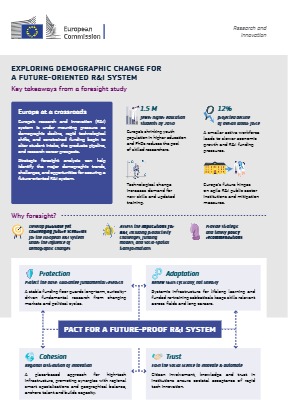
    • Background data showing a shrinking youth population, a declining workforce, and growing fiscal pressures on R&I funding.
    • A six-step Foresight Process combining horizon scanning, scenario-building, and windtunneling to anticipate future challenges.
    • Four Scenarios illustrating different pathways for Europe’s R&I system.
    • Strategic actions to protect fundamental research, foster lifelong learning, strengthen regional innovation, and build societal trust in technology.


    👏 A big thank you to the panelists and speakers:

    • Erik Canton (Deputy Head of Unit – Common R&I Strategy and Foresight Service, DG Research & Innovation)
    • Nicola Francesco Dotti (Chief Economist Unit – Common R&I Strategy and Foresight Service, DG Research & Innovation)
    • Brikena Xhomaqi (The Lifelong Learning Platform)
    • Alex Petropoulos (Centre for Future Generations)
    • Thomas Estermann (European University Association)
    • Maciej Krysztofowicz (EU policy Lab, Joint Research Centres)
    • Viola Peter (FOD team, Technopolis Group)
    • Michal Nadziak (FOD team, 4CF)
    • Katarzyna Figiel (FOD team, 4CF)

    And to all participants for an engaging exchange on how to build a more adaptive and resilient EU R&I system.


    Missed the event? Explore the below documentation !


    Posted on: 27/11/2025

    Last Edited: 9 months ago

    Being Human in 2035March 2025

    Experts predict significant change in the ways humans think, feel, act and relate to one another in the Age of AI

    Nearly 300 of the experts in this early 2025 study responded to a series of three quantitative questions, and nearly 200 wrote predictive essays in how the evolution of artificial intelligence (AI) systems and humans might affect essential qualities of being human in the next decade. Many are concerned that the deepening adoption of AI systems over the next decade will negatively alter how humans think, feel, act and relate to one another. They predicted whether change will be mostly for the better or for the worse in 12 categories:

    • Capacity and willingness to think deeply about complex concepts
    • Social and emotional intelligence
    • Confidence in our own native abilities
    • Trust in widely shared values and cultural norms
    • Mental well-being
    • Empathy and application of moral judgment
    • Individual agency, the ability to act independently in the world
    • Sense of self-identity, meaning and purpose in life
    • Native metacognition, the ability to think analytically about thinking
    • Native curiosity and capacity to learn
    • Native decision-making and problem-solving abilities
    • Native innovative thinking and creativity

    Source: Imagining the Digital Future Center 

    Posted on: 05/05/2025

    Last Edited: 10 months ago

    Strategic Foresight Toolkit for Resilient Public PolicyDecember 2024

    A Comprehensive Foresight Methodology to Support Sustainable and Future-Ready Public Policy

    By exploring 25 evidence-based potential disruptions across environmental, technological, economic, social, and geopolitical domains, the Strategic Foresight Toolkit for Resilient Public Policy helps anticipate challenges and opportunities that could reshape the policy landscape between 2030 and 2050. These disruptions are not predictions, but hypothetical future developments identified through extensive research, expert consultations, and workshops. The Strategic Foresight Toolkit features a five-step foresight process, guiding users to challenge assumptions, create scenarios, stress-test strategies, and develop actionable plans. It includes facilitation guides and case studies to support effective implementation. Each disruption is accompanied by insights on emerging trends, potential future impacts, and both immediate and long-term policy options to ensure resilience and preparedness. Designed for policymakers, public administrators, and foresight practitioners, this publication is designed to promote holistic, strategic and evidence-informed decision-making. It aims to support countries and organisations in using strategic foresight to design and prepare robust and adaptable public policies for a range of possible futures. With its practical methodology and forward-looking approach, the Strategic Foresight Toolkit is a vital resource for building sustainable, resilient, and effective public policies.

    Source: OECD - Publications 

    Posted on: 15/04/2025

    Post Image

    Last Edited: 10 months ago

    What will Research and Teaching look like in 2050? Take the survey !

    This seems far away but you will be shaping the path to the future!

    Have you ever wondered how you will (still) be conducting research or teaching in 2050? 

    The Foresight on Demand consortium (FOD2) invites you to participate in a survey in context to “Demographic change: implications and opportunities for Europe’s R&I system by 2050”.


    Your input will help identify weak signals, early trends, and unexpected ideas that could shape research careers, higher education, and innovation systems in Europe by 2050.


    Whether you are noticing shifts in work culture, research or teaching models, funding landscapes, please take 10-15 minutes and share your thoughts ! The survey is open until April 18.

    Posted on: 25/03/2025

    Last Edited: a year ago

    Strenthening foresight and the role of future generations in Finnish lawmakingOctober 2022

    POLICY BRIEF 2022:33

    This is the short English-language Policy Brief from the research project Foresight and Future Generations in Law-Making (FORGE). FORGE examined issues of future-regarding lawmaking in an interdisciplinary manner, combining expertise on futures studies, political science, and jurisprudence. The aim of the study was to analyse the status of future generations and their rights in current legislative processes, and to map and compare practices for foresight and consideration of future generations in different political contexts, nationally and internationally. The purpose of the project was to increase understanding on i) how future generations can be better taken into account in policymaking; ii) how foresight can be better utilised in lawmaking. 

    The FORGE-project was unique – there had not previously been a study with a similar scope in Finland and comparable international examples are, to the best knowledge of the authors, extremely rare. FORGE supported the preparation of the second part
    of the Government Report on the Future. The project was funded by the Government’s analysis, assessment and research activities (VN TEAS) and was conducted during 1/2022–11/2022 by researchers of the University of Turku, Åbo Akademi University and Tampere University.

    Findings:

    From an international comparison, Finland already has an advanced national foresight system and can be regarded as a pioneer in futureregarding policymaking. However, there is still room for improvement in terms of using foresight and considering future generations as a part of lawmaking. Such improvement could be achieved by developing and upgrading the existing institutions and practices and by making more incremental changes in practices, modes of interaction, and attitudes. For example, foresight should be conducted more as a continuous activity, and future generations’ interests and rights should be considered more systematically in legislative processes, while acknowledging the plurality of future interests.

    Development proposals:

    Full lenght-report available in Finnish

    In addition to the 12-page Policy Brief summarising the FORGE projects' finding in English, The Prime Minister's Office has published the full 203-page report in Finnish. This can be found here below.

    Posted on: 08/01/2025

    Post Image

    Last Edited: a year ago

    Socioeconomic and Socio-Political Scenarios Shaping the European Hydrogen Economy of 2040

    What could a European energy system that includes hydrogen look like in 2040 in the context of different global, political, economic and social constellations in and around the continent?

    Posted on: 25/11/2024