Loading...

    sorted by publishing date

    Last Edited: 3 months ago

    Radical Technology Inquirer1

    RTI

    The Parliament of Finland’s Committee for the Future has developed the Radical Technology Inquirer (RTI) methodology since 2012 to anticipate how technological transformation will reshape society over the next 20 years. The methodological development has been made through a series of commissioned projects, the most recent one ending in May 2026. The method is tailored to foresee how technological development will change the core functions of our society: what we eat, how we move, how we stay connected, how we work, how we acquire information, how we learn, how we make decisions, how we maintain our health, and how we entertain ourselves.

    Report and other materials: https://www.eduskunta.fi/en/members-and-parliamentary-bodies/committees/committee-for-the-future/radical-technology-inquirer-rti

    Link to RTI-GPT interface for interactive access to the project results: https://chatgpt.com/g/g-69f61028643c819194e7765805384657-radical-technology-inquirer-gpt-eng 

    The RTI methodology is built around identifying 100 emerging radical technologies and anticipating their potential societal impacts on a 20-year timeframe. RTI was originally created in 2013 and reported in "100 Opportunities for Finland and the world: radical Technology Inquirer (RTI) for anticipation/evaluation of technological breakthroughs" (TuVJ 11/2014). This was followed by report "Technological change 2013–2016: preliminary investigation of the development of radical technologies after the 2013 review (TuVJ 2/2016)".

    Second full report with improved methodology and updated results was published in 2018 under the name "Societal transformation 2018–2037: 100 anticipated radical technologies, 20 regimes, case Finland" (TuVJ 10/2018). The second full report was followed by a number of RTI application reports: ​Development of Genetic Engineering in Different Areas of Application 2018-2020 (TuVJ 3/2020), Towards a better future: technological opportunities and threats to the promotion of sustainable development (TuVJ 1/2021) and, in Finnish only, a report assessing the role of technologies in the Codiv-19 pandemic and the impact of the pandemic on the development of technology (TuVJ 4/2020).

    A peer-review RTI methodology paper "Radical Technology Inquirer: a methodology for holistic, transparent and participatory technology foresight" came out in European Journal of Futures Research 10, 18 (2022). https://doi.org/10.1186/s40309-022-00206-6.

    In 2024, a pilot project was launched to test generative AI as part of RTI methodology, especially in societal impact assessment. The pilot tested impact assessment only in the case of one radical technology, humanoid robots. The results are reported in Humanoid robots from now to 2040’s – AI assisted societal impact analysis using radical technology inquirer methodology (TuVJ 1/2025).

    During the pilot project 2024-2025, generative AI had developed in a way that enabled its use (in deep research mode) also in systematic technology scanning according to RTI principles. The latest project in the RTI project series (carried out in 2025-2026) utilised generative AI in most steps of the RTI method in order to produce an updated assessment of the societal impacts of 100 most radical technologies. The results are reported in Societal transformations 2026 – 2045: 100 anticipated radical technologies, 20 regimes. The first AI-assisted Radical Technology Inquiry (TuVJ 2/2025). The report includes a 90-page summary and over 2000 pages of appendices, where the actual results can be found. The extensive report is readable for a human, but primarily intended to be read through AI queries. Therefore it is also published as zipped data package with a readme.file to help the reader to create ones own GPT interface to the results. This data package is on the project pages, together with a link to one ready-made RTI-GPT enabling the user to test whether it is useful to interactively access and discuss with the RTI results.

    Posted on: 14/08/2026

    Last Edited: a year ago

    Janna Jokela1

    Rebellions are built on hope.

    Posted on: 04/07/2025

    Last Edited: a year ago

    Anne Arvonen1

    Posted on: 12/05/2025

    Last Edited: a year ago

    Black Swans - Futures Studies Students Association1

    Black Swans Futures Studies Students Association is the official student association for Futures Studies students and alumni of the Turku School of Economics and Finland Futures Research Center, University of Turku.

    Established in Spring 2015, our association is dedicated to uniting students from diverse backgrounds in the field of futures studies, advocating for their interests, and fostering connections within the academic community and beyond. We actively engage in scientific, educational, and cultural activities, including meetings, discussions, presentations, and excursions to enhance our members' academic and social experience.

    Membership is open to all degree, postgraduate, and exchange students of futures studies at the University of Turku. 

    Posted on: 06/04/2025

    Last Edited: a year ago

    Tolga Karayel1

    Doctoral Researcher - Project Researcher at Finland Futures Research Centre, TSE - University of Turku

    Posted on: 04/04/2025

    Last Edited: a year ago

    Futures Distillery1

    The University of Turku’s Futures Knowledge Distillery is a research group that serves organisations whose goals are to develop their foresight skills and the ability to prepare for changes in the operating environment. Our service is based on the Finland Futures Research Centre’s 30 years of experience in future, combined with the expertise of eight faculties of scientific research at the University of Turku.

    On this basis, we offer practical solutions for consciously making futures. Foresight can be seen as the most effective way to prepare for uncertainty, identify opportunities and create desirable futures.  

    Posted on: 08/01/2025

    Last Edited: a year ago

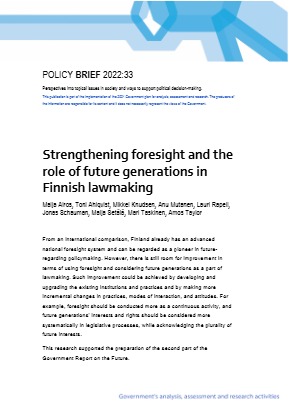
    Strenthening foresight and the role of future generations in Finnish lawmakingOctober 2022

    POLICY BRIEF 2022:33

    This is the short English-language Policy Brief from the research project Foresight and Future Generations in Law-Making (FORGE). FORGE examined issues of future-regarding lawmaking in an interdisciplinary manner, combining expertise on futures studies, political science, and jurisprudence. The aim of the study was to analyse the status of future generations and their rights in current legislative processes, and to map and compare practices for foresight and consideration of future generations in different political contexts, nationally and internationally. The purpose of the project was to increase understanding on i) how future generations can be better taken into account in policymaking; ii) how foresight can be better utilised in lawmaking. 

    The FORGE-project was unique – there had not previously been a study with a similar scope in Finland and comparable international examples are, to the best knowledge of the authors, extremely rare. FORGE supported the preparation of the second part
    of the Government Report on the Future. The project was funded by the Government’s analysis, assessment and research activities (VN TEAS) and was conducted during 1/2022–11/2022 by researchers of the University of Turku, Åbo Akademi University and Tampere University.

    Findings:

    From an international comparison, Finland already has an advanced national foresight system and can be regarded as a pioneer in futureregarding policymaking. However, there is still room for improvement in terms of using foresight and considering future generations as a part of lawmaking. Such improvement could be achieved by developing and upgrading the existing institutions and practices and by making more incremental changes in practices, modes of interaction, and attitudes. For example, foresight should be conducted more as a continuous activity, and future generations’ interests and rights should be considered more systematically in legislative processes, while acknowledging the plurality of future interests.

    Development proposals:

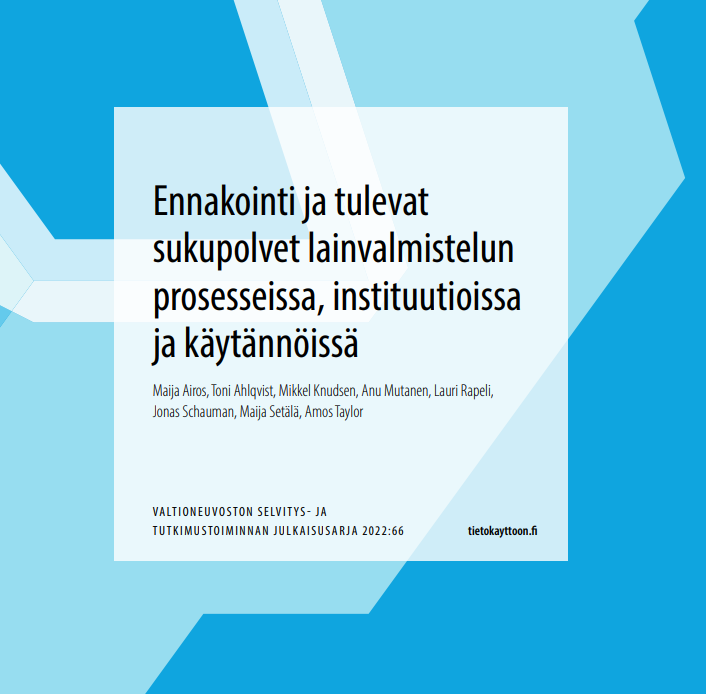
    Full lenght-report available in Finnish

    In addition to the 12-page Policy Brief summarising the FORGE projects' finding in English, The Prime Minister's Office has published the full 203-page report in Finnish. This can be found here below.

    Posted on: 08/01/2025

    Last Edited: a year ago

    FORGE1December 2021 - October 2022

    Foresight and Future Generations in Finnish Lawmaking

    The research project Foresight and Future Generations in Law-Making (FORGE) examined issues of future-regarding lawmaking in an interdisciplinary manner, combining expertise on futures studies, political science, and jurisprudence. The aim of the study was to analyse the status of future generations and their rights in current legislative processes, and to map and compare practices for foresight and consideration of future generations in different political contexts, nationally and internationally. The purpose of the project was to increase understanding on i) how future generations can be better taken into account in policymaking; ii) how foresight can be better utilised in lawmaking. FORGE’s conceptual and analytical structure is pictured in the figure 1.

    The FORGE-project is unique – there has not previously been a study with a similar scope in Finland and comparable international examples are, to the best knowledge of the authors, extremely rare. FORGE supported the preparation of the second part of the Government Report on the Future. The project was funded by the Government’s analysis, assessment and research activities (VN TEAS) and was conducted during 1/2022–11/2022 by researchers of the University of Turku, Åbo Akademi University and Tampere University.

    Posted on: 08/01/2025

    Last Edited: a year ago

    Nicolas Balcom Raleigh1

    Everything exists in complexity. Transformation is continuous. Novelty happens. (Profile photo credit: Erich Goldmann)

    Posted on: 07/01/2025

    Last Edited: a year ago

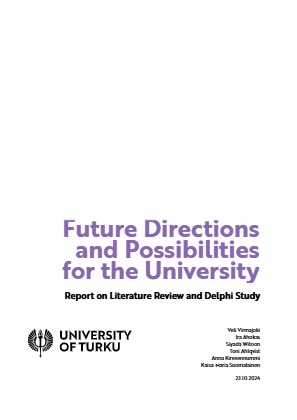
    Future Directions and Possibilities for the UniversitySeptember 2024

    Report on Literature Review and Delphi Study

    What lies ahead for universities? A new futures research study from the University of Turku maps multiple pathways and tensions that could transform how universities teach, research, and serve society.

    Introduction
    Researchers of the University of Turku have published a comprehensive report "Future directions and possibilities for the university: Report on literature review and Delphi study" (Virmajoki et al. 2024) about the possible future trajectories of the university of Turku. The report, which is uploaded here and also available on utupub.fi, is part of a larger project - Strategic Foresight and Futures Thinking Initiative.   

    The report, conducted by the Strategic Planning Unit of the University of Turku together with Finland Futures Research Centre (FFRC), contains the results of the analysis of the operating environment of universities. Operating environment here refers to the broader context of trends, challenges, and conditions - both nationally and globally - that affect how universities function and perform their core activities in teaching and research. While the report has as its scope the University of Turku, its findings and especially the approach are more broadly relevant, particularly in Europe.

    Analysis of Operating Environment as Research
    The analysis of the operating environment was primarily based on a literature review and a subsequent Delphi survey. We reviewed over 200 scientific texts relevant to the subject. It quickly became evident how multifaceted and unique universities are. Scenarios—a common tool in foresight—would not be sufficient on their own to understand the possible futures of universities. Therefore, we first categorised universities into 10 different dimensions, such as societal purpose, international orientation, and educational organization, and identified different directions for development for each dimension. This allowed us to create a multidimensional description of possible development paths for universities, yielding in total 30 different paths and their combinations. The reality is somewhere between the idealized end-points.

    In addition to helping understand various possible futures, the analysis where several dimensions and their paths are explained also provides a tool for the university units to examine their own position in relation to these possible developments. University units can differ significantly from one another, and no analytical tool that accounts for these differences can be sufficient. Our report offers such a tool by enabling discussion – with agreements and disagreements – of different development trajectories from the perspectives of diverse traditions and practices that can be found within any university.

    Possibilities and Desirability – The Delphi Study
    It was not only important to understand the possible futures universities may face. Equally crucial at the University of Turku was to understand what university members – researchers, students, administration, and other staff – think about these futures. To achieve such understanding, we conducted a Delphi study to ask what university members consider probable and desirable when it comes to the future. The statements were designed to provoke thoughts and bring out views that might not emerge in more traditional discussions. In addition to the probability and desirability assessments, we gathered valuable insights from the open comment sections, which often reveal perspectives that might be overlooked in the literature review.

    Some Key Results
    While the most interesting results cannot all be included in this text, some should be highlighted to provide a sense of the nature of the study.

    First, universities are continuously balancing societal impact, economic goals, and fundamental research. The demands from the side of the wider society often pull in different directions. The Delphi study showed that working towards a societal mission is seen as desirable, but market orientation is expected to be more likely. A common thought and worry seems to be that universities are likely to shift towards more commercial interests, despite the tension this creates with their social responsibilities not measurable in economic terms.

    Second, global research collaboration and local relevance create a significant tension. Universities aim to be part of global networks, while also expected to contribute to their local communities. The Delphi study revealed varying opinions on this balance. Some see global engagement as essential, while others stress the importance of local ties. Whether a university can succeed in both areas or must focus on one is a central question. The geopolitical tensions and the regional clusters this might create adds another path that might make the question between local and global even more difficult and multidimensional.

    Third, in teaching, the main tension seems to lie between scalable, mass-oriented education and more personalised, tailored teaching. Scalable teaching allows universities to reach more students, but the Delphi study showed that personalized methods are considered more desirable. Yet, the study also indicated that standardised models are, according to the members of the university, more likely to prevail due to the scarcity of resources. Technology and its development will be an integral part of both scalable and personalised teaching paths (and everything in between) but different technological solutions might be associated with different paths.

    Significance for the University Sector
    The project and the report highlight the value of combining an analysis of the university operating environment and a more detailed study of the views of the university community. On the one hand, an analysis of the environment and the paths therein provides a tool to navigate the prospects and risks. On the other hand, the analysis of the members’ perspective helps the university understand where we stand now and what are the paths that the members recognise. Together, these two provide a robust view on the strategic status and importance of different possible trajectories for universities’ operating environment.

    The research has broad applicability across universities worldwide. Through its dimensions and models, any higher education institution can map out and discuss likely trajectories, desired directions, and concerning paths ahead - regardless of their unique features. By combining extensive research literature with a Delphi study, the report opens a window into the possible futures of universities – or rather a map that can be used to navigate the long-term issues that these long-standing institutions face.

    References
    Virmajoki, V., Ahokas, I., Witoon, S., Ahlqvist, T., Kirveennummi, A., & Suomalainen, K.-M. (2024). Future directions and possibilities for the university: Report on literature review and Delphi study. A Report by University of Turku Strategic Planning Unit in collaboration with the Finland Futures Research Centre (FFRC). ISBN 978-952-249-617-1.

    Posted on: 13/12/2024

    Last Edited: a month ago

    Finland Futures Research Centre1

    Finland Futures Research Centre (FFRC) is one of the largest academic institutions in the world for foresight and futures studies with a history dating back to 1992. FFRC provides both graduate and doctoral degrees in futures studies. In 2024, the institute celebrated the completion of its 100th M.Sc. in Futures Studies! 

    FFRC is part of the Turku School of Economics at the University of Turku. 

    FFRC also provides standing services to the Committee for the Future at the Parliament of Finland and takes part in numerous national and European research projects and foresight projects. For example, FFRC is a partner in the European consortium Foresight on Demand II with a foresight framework contract with DG Research and Innovation.

    Finland Futures Research Centre (FFRC) works with a transdisciplinary approach in an international environment. The cornerstones of our activities are on developing academic futures studies, critical interdisciplinary research, high quality education, strategic and business foresight and insightfully produced futures knowledge.

    Learn more about our activities:
    Research at Finland Futures Research Centre
    Studying at the Finland Futures Research Centre
    Collaboration
    News from the Finland Futures Research Centre 

    Each year, the Finland Futures Research Centre organises its annual conference, an invaluable opportunity for meeting, exchanging and debating current topics related in futures studies and foresight. With approximately 200–350 individual participants attending from all over the world, international researchers, organisational delegates, business people and students convene to the annual conferences in the spirit of futures-oriented information, research, analysis and collaboration. 

    2025: Futures of Technologies – Mutual Shaping of Socio-Technical Transformations , 10–12 June 2025, Turku, Finland

    2026: Sustainability, Temporality, and Futures, 9-10 June 2026, Turku, Finland 

    Posted on: 04/11/2024