Loading...

    Mentions of

    sorted by publishing date

    Last Edited: a day ago

    From Vision to ActionApril 2026

    Climate-Driven Developments Influencing Future OSH and Their Implications for Stakeholders, EU-OSHA policy brief

    This policy brief, the third of three from EU-OSHA's fourth foresight cycle on climate change and occupational safety and health (OSH), sets out a shared vision for 2050 of a safe, healthy and sustainable working environment in Europe. The vision was synthesised by the research team from the desirable elements of the four scenarios presented in the second brief, then discussed and refined with stakeholders in a workshop, whose contributions were analysed to derive implications for different stakeholder groups.
    The vision is of a world of work that is climate-resilient, inclusive and safe for all, in which OSH is integrated into climate action, technological innovation and economic planning. Its key elements are a just transition, coordinated action between OSH and climate strategies, safety by design in green technologies and practices, ongoing monitoring and evaluation of emerging risks, adaptive, pragmatic and inclusive regulation, a focus on affected groups, and human-centred innovation. The brief also identifies the tensions and trade-offs on the way, including short-term crises that divert attention from long-term goals, financial pressures on businesses, resistance to behavioural change, global emissions and supply chains beyond Europe's reach, technologies deployed faster than safety frameworks can adapt, and the need for transparency and public engagement to keep policies legitimate.
    Implications are outlined for governments and policymakers, employers and their representatives, workers and their representatives, intermediary bodies such as social partners and civil society organisations, and researchers and innovators. They range from aligning OSH and climate policies across departments and levels of governance, embedding OSH in corporate sustainability strategies and engaging workers in early-warning systems, to sector-specific roadmaps for safe and equitable green transitions and interdisciplinary research on new risks. The brief concludes that climate change is a profound social and economic disruptor, and that the green transition is much more likely to succeed with safe, healthy and supported workers.
    Reference
    Maistrello, G., Sykes, K., Xu, L., Adams, A., Silfversten, E., & Könnölä, T. (2026). From vision to action: Climate-driven developments influencing future occupational safety and health and their implications for stakeholders [Policy brief]. European Agency for Safety and Health at Work. https://osha.europa.eu/en/publications/vision-action-climate-driven-developments-influencing-future-occupational-safety-and-health-and-their-implications-stakeholders

    Posted on: 02/11/2026
    Last Edited: a day ago

    Climate-Driven Scenarios for Future Occupational Safety and Health in Europe 2050April 2026

    EU-OSHA policy brief

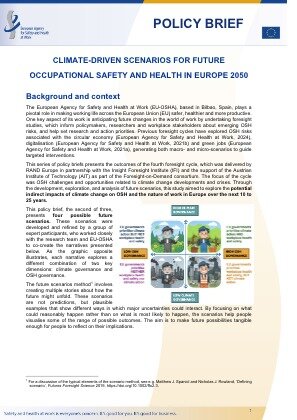
    This policy brief, the second of three from EU-OSHA's fourth foresight cycle on climate change and occupational safety and health (OSH), presents four scenarios for Europe in 2050. Developed and refined with expert participants in workshops, the scenarios are not predictions but plausible narratives that make possible futures tangible enough for policymakers and workplace stakeholders to reflect on their implications. Each combines a different level of two key dimensions, climate governance and OSH governance.
    In Just transition Europe (high climate and high OSH governance), a rapid green transition is matched by proactive, joined-up OSH management, though old risks such as asbestos in retrofitting and outdoor work in extreme heat remain, especially for small firms. In OSH havens Europe (low climate, high OSH governance), Europe adapts through automation and AI, and a skilled minority enjoys excellent protection while most people live on a universal basic income, informal work grows and OSH standards are neglected in global supply chains. In Climate race Europe (high climate, low OSH governance), belated and rushed climate action after the crises of the 2040s exposes workers to untested green materials, poorly implemented technologies and informal work, while mass migration northwards drives down wages and working conditions. In Grassroots hope Europe (low climate and low OSH governance), geopolitical instability and war leave both climate and OSH neglected, yet cooperatives and community initiatives that value workers' well-being begin to emerge.
    Each scenario highlights a group of vulnerable workers, from older people and informal workers to migrants and disabled workers. Read together, the scenarios show that climate action and worker protection need to advance hand in hand, and they provide the basis for the shared vision for 2050 developed in the third brief.
    Reference
    Maistrello, G., Sykes, K., Xu, L., Adams, A., Silfversten, E., & Könnölä, T. (2026). Climate-driven scenarios for future occupational safety and health in Europe 2050 [Policy brief]. European Agency for Safety and Health at Work. https://osha.europa.eu/en/publications/climate-driven-scenarios-future-occupational-safety-and-health-europe-2050

    Posted on: 02/11/2026

    Last Edited: a day ago

    Climate-Driven Trends Influencing Future Occupational Safety and HealthApril 2026

    EU-OSHA policy brief 1

    This policy brief comes from EU-OSHA's fourth foresight cycle on climate change and occupational safety and health (OSH). It outlines the key factors and trends influenced by climate change that in turn shape OSH and the world of work in Europe over the next 10 to 25 years. It draws on an evidence review and on expert input gathered through an online survey and a stakeholder workshop, with participants from academia, research institutions, trade unions, employers' organisations and industry.
    Seven interacting factors are examined: adaptation and mitigation strategies, automation and technology use, the circular economy, economic instability, climate-driven migration, new materials, and social and wealth disparities. Mitigation measures such as clean technologies and renewable energy can expose workers to novel materials, changed work processes and new skill needs, while adaptation measures may increase outdoor work and exposure to extreme weather or biological hazards. AI and digital tools can strengthen early warning and safety monitoring, but rushed deployment can outpace regulation. Economic losses from extreme weather may lead organisations to deprioritise prevention, migration can bring language barriers and informal work, and nanomaterials and biological agents carry risks that are not yet well understood, even though new materials can also improve protective equipment.
    The brief concludes that the impacts of climate change on OSH are intensifying but remain uncertain, and that adaptation and mitigation, while crucial, can have unforeseen consequences for worker safety. It calls on stakeholders across sectors to plan in a coordinated and proactive way, anticipating these interactions and protecting vulnerable workers, including those outside formal employment.
    Reference
    Maistrello, G., Sykes, K., Xu, L., Adams, A., Silfversten, E., & Könnölä, T. (2026). Climate-driven trends influencing future occupational safety and health [Policy brief]. European Agency for Safety and Health at Work. https://osha.europa.eu/en/publications/climate-driven-trends-influencing-future-occupational-safety-and-health 

    Posted on: 02/11/2026

    Last Edited: 2 days ago

    Foresight Study on the OSH Implications of Future Climate Change-Related Developments and CrisesApril 2026

    EU-OSHA final report of the fourth foresight cycle

    This report, commissioned by the European Agency for Safety and Health at Work (EU-OSHA), explores the indirect and cascading impacts of climate change on occupational safety and health (OSH) and on the future of work in Europe over the next 10 to 25 years. It is the final report of EU-OSHA's fourth foresight cycle, delivered by RAND Europe in partnership with the Insight Foresight Institute and with the support of the Austrian Institute of Technology.
    The study combined a scoping literature review and a PESTL analysis of climate-driven factors, a stakeholder survey and expert workshops. Four scenarios for 2050 were built on two dimensions, climate governance and OSH governance: Just transition Europe, OSH havens Europe, Climate race Europe and Grassroots hope Europe. They illustrate the pathways through which climate change and climate action may reshape labour markets, job roles and workplace risks, for instance through migration and informal work, the retrofitting of infrastructure, extreme heat or the rapid deployment of new technologies and materials.
    Several cross-cutting themes emerge. Climate action is necessary but not without risk, since labour-market transitions that are not managed proactively can leave older, low-skilled and other vulnerable workers behind. A healthy and safe workforce is a precondition for the green transition, and climate policy that neglects OSH undermines the very resilience it seeks to build. Technology, including AI and digital systems, brings both new hazards and new means of prevention. The report sets out the target elements of a shared vision for 2050, the tensions and trade-offs on the way, and the implications for policymakers, employers and workers' representatives, intermediary organisations, workers and researchers, underlining the need for coordinated, inclusive and adaptive strategies.
    Reference
    Maistrello, G., Sykes, K., Xu, L., Adams, A., Silfversten, E., & Könnölä, T. (2026). Foresight study on the occupational safety and health implications of future climate change-related developments and crises. European Agency for Safety and Health at Work. https://osha.europa.eu/en/publications/foresight-study-climate-change-implications-osh 

    Posted on: 02/11/2026

    Last Edited: 2 days ago

    EU-OSHA foresight on climate change and OSH1February 2025 - April 2026

    EU-OSHA foresight on climate change and OSH

    The European Agency for Safety and Health at Work (EU-OSHA) commissioned its fourth foresight cycle to explore the indirect and cascading impacts of climate change on occupational safety and health (OSH) and on the nature of work in Europe over the next 10 to 25 years. Earlier cycles had addressed green jobs, digitalisation and the circular economy. The study was delivered by RAND Europe in partnership with the Insight Foresight Institute and with the support of the Austrian Institute of Technology, as part of the Foresight on Demand consortium.
    The study combined a scoping literature review and a PESTL analysis of climate-driven factors (March–April 2025), an expert survey (April–May 2025) and two workshops in three sessions between June and September 2025. Four scenarios were built on two dimensions, climate governance and OSH governance: Just transition Europe, OSH havens Europe, Climate race Europe and Grassroots hope Europe. Participants then discussed a shared vision for 2050, its tensions and trade-offs, and the steps that policymakers, employers and workers' representatives, intermediary organisations, workers and researchers could take to realise it.
    The results were published by EU-OSHA in May 2026 as a final report, a summary and a series of three policy briefs on climate-driven trends, scenarios for 2050, and the vision and its implications for stakeholders.
    Final report
    Maistrello, G., Sykes, K., Xu, L., Adams, A., Silfversten, E., & Könnölä, T. (2026). Foresight study on the occupational safety and health implications of future climate change-related developments and crises. European Agency for Safety and Health at Work. https://osha.europa.eu/en/publications/foresight-study-climate-change-implications-osh
    All outputs: https://osha.europa.eu/themes/climate-change/future-climate-change-related-developments-and-crises 

    Posted on: 02/11/2026

    Last Edited: 9 months ago

    Synthetic Drugs 20501December 2024 - November 2025

    Increasing EU resilience to future developments in the availability and use of synthetic drugs by 2050

    The European Union Drugs Agency’s (EUDA) project “Synthetic Drugs 2050” addressed the growing uncertainty surrounding the future availability, spread, and use of synthetic drugs in Europe up to 2050. Synthetic drugs represent a rapidly evolving and systemic challenge for Europe, affecting public health, security, social cohesion, productivity, and overall wellbeing. Accelerated technological change, globalised supply chains, digitalisation, and increasingly blurred boundaries between legal, illegal, controlled, and uncontrolled substances further amplify the complexity of this issue.


    The project applied a participatory strategic foresight approach to explore possible futures of synthetic drugs in Europe, moving beyond short-term monitoring and reactive policy responses. By systematically analysing global and regional drivers of change, emerging trends, weak signals, and deep uncertainties, the project built a shared understanding of how synthetic drugs markets, uses, and impacts may evolve in the medium- and long-term.

    Through horizon scanning, trend analysis, scenario building, and sense-making activities, Synthetic Drugs 2050 supports EU-level and national stakeholders in anticipating risks, identifying opportunities, and strengthening policy resilience. The project explicitly linked foresight insights to strategic reflection, policy options, and research priorities, while embedding capacity-building components to enhance futures literacy and long-term preparedness within the EU drug policy ecosystem.

    Objectives

    The Synthetic Drugs 2050 project encompassed:

    • A comprehensive, methodologically robust foresight study on the future availability and use of synthetic drugs in Europe up to 2050, exploring systemic drivers, uncertainties, and disruptive developments across social, technological, economic, environmental, political, legal, and ethical dimensions.
    • Development of multiple plausible future scenarios describing how synthetic drugs diffusion in Europe could evolve by 2050, challenging prevailing assumptions and highlighting non-obvious risks and opportunities.
    • Mapping of first-, second-, and third-order implications of synthetic drugs diffusion across Europe, identifying cause–effect pathways, time-bound consequences, and cross-sectoral impacts on health, public safety, governance, and society.
    • Support for strategic preparedness and policy resilience by co-developing policy responses, strategic options, and research and innovation priorities at EU and national levels.
    • Further development of strengthened foresight capacity and futures literacy within EUDA and its stakeholder community through learning-by-doing, participatory engagement, and the development of reusable foresight tools and frameworks.

    Outputs

    • Horizon scanning and trend analysis reports
    • A set of four future scenarios for synthetic drugs in Europe by 2050
    • A mapped system of time-bound implications and cause–effect pathways
    • Policy responses and strategic recommendations
    • A foresight manual and horizon scanning framework for future use

    Find more information here: https://www.euda.europa.eu/index_en

    Posted on: 18/02/2026

    Last Edited: a year ago

    Tackling societal challenges and guiding the future of research and innovation in Norway1

    What was the challenge?

    The Research Council of Norway (RCN) identified five strategic areas in pursuit of ground-breaking research, radical innovation and sustainable development. RCN required a robust evidence base to help develop long-term, priority missions to help solve one or more societal challenges, as well as underpinning structural measures of the research environment in Norway. The five strategic areas include: Oceans; Green transition; Health and welfare; Cohesion and globalisation; and Technology and digitalisation.

    How did we approach it?

    We adopted a mixed method, participatory approach involving a variety of research tools such as trend analyses, literature reviews, stakeholder interviews, focus groups, crowdsourcing ideas from experts, a survey of the public, future scenario analyses and workshops.

    The core foresight work allowed us to examine what might happen in the next ten years in the different strategic areas and wider R&I system in Norway. Scenarios of future states were used as the basis for workshop discussions to stress test potential missions and structural measures that the RCN could consider developing and implementing in the future.

    What was the outcome or impact of the work?

    Extensive findings from this research were published in a series of nine reports. The research was cited as evidence in the RCN’s input to the 2022 revision of the Long-Term Plan for Research and Higher Education 2019–2028, which specifies the Norwegian government’s ambitions, key objectives and priority areas for research and higher education.

    The study also helped inform the RCN’s internal decision making, strategies and organisational activities. In addition, a summary of the findings and proposals was presented to the relevant Norwegian minister.

    Project webpage: https://www.rand.org/randeurope/research/projects/2021/future-research-innovation-norway.html 

    Research outputs:

    • Summary report: https://www.rand.org/content/dam/rand/pubs/research_reports/RRA900/RRA966-1/RAND_RRA966-1.pdf 
    • Addressing future societal challenges in Norway: Detailed methodology report: https://www.rand.org/content/dam/rand/pubs/research_reports/RRA900/RRA966-1/RAND_RRA966-2.pdf
    • A summary of potential cross-cutting missions to address future societal challenges in Norway: https://www.rand.org/content/dam/rand/pubs/research_reports/RRA900/RRA966-1/RAND_RRA966-3.pdf

      Structural measures to develop a resilient research and innovation environment in Norway: https://www.rand.org/content/dam/rand/pubs/research_reports/RRA900/RRA966-1/RAND_RRA966-4.pdf

      Health and welfare: An analysis of trends, future directions and potential missions to address societal challenges in Norway: https://www.rand.org/content/dam/rand/pubs/research_reports/RRA900/RRA966-1/RAND_RRA966-5.pdf

      Oceans: An analysis of trends, future directions and potential missions to address societal challenges in Norway: https://www.rand.org/content/dam/rand/pubs/research_reports/RRA900/RRA966-1/RAND_RRA966-6.pdf

      Technology and digitalisation: An analysis of trends, future directions and potential missions to address societal challenges in Norway: https://www.rand.org/content/dam/rand/pubs/research_reports/RRA900/RRA966-1/RAND_RRA966-7.pdf

      Cohesion and globalisation: An analysis of trends, future directions and potential missions to address societal challenges in Norway: https://www.rand.org/content/dam/rand/pubs/research_reports/RRA900/RRA966-1/RAND_RRA966-8.pdf

      Green transition: An analysis of trends, future directions and potential missions to address societal challenges in Norway: https://www.rand.org/content/dam/rand/pubs/research_reports/RRA900/RRA966-1/RAND_RRA966-9.pdf

    Posted on: 18/06/2025