Loading...

    Mentions of

    sorted by publishing date

    Post Image

    Last Edited: a year ago

    Presenting the EU Policy Lab's 'Foresight menu'

    Our new guide to using foresight in policymaking

    Foresight, it seems to be on everyone’s lips these days. But what is it exactly? And more importantly, how can policymakers use it in their daily work? These are the kinds of questions we at the EU Policy Lab (a unit of the European Commission's Joint Research Centre) often receive from people who are interested in foresight but are not exactly sure what it is and what it can do for them. 

    Where to start
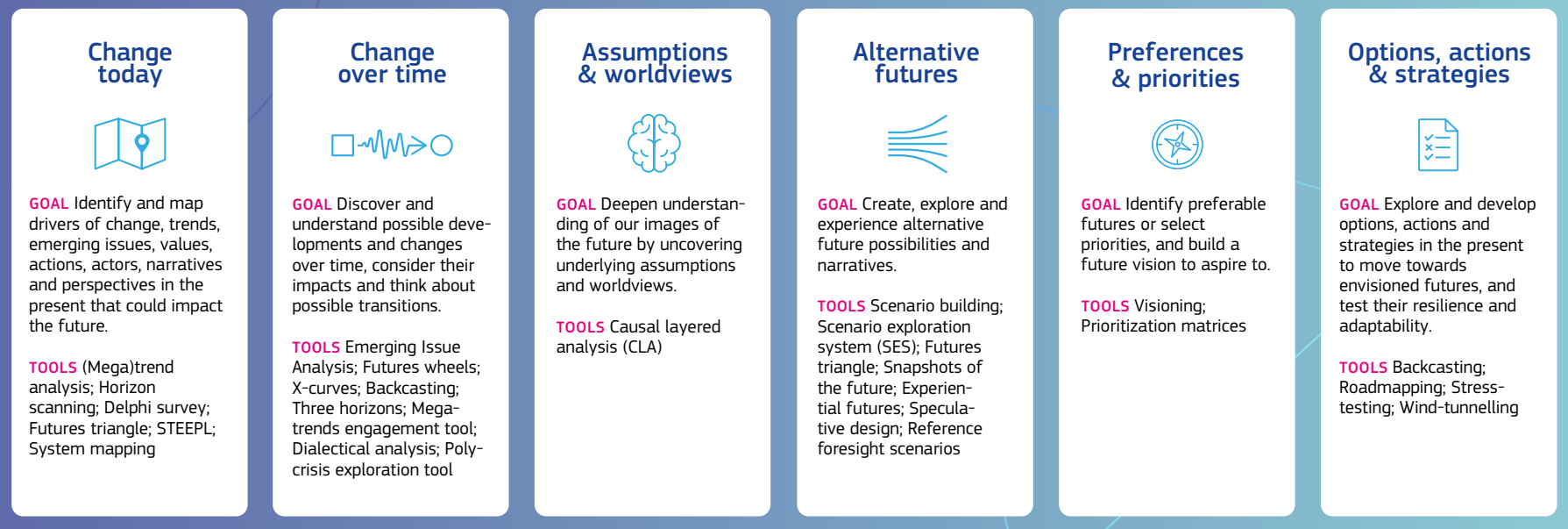
    To help them out, we have developed a ‘foresight menu’, for policymakers to understand and leverage foresight for more effective strategy building and decision-making. The menu describes various reasons why you would use foresight and guides the reader towards some of the tools/processes they can use. It will help policymakers clarify their starting point, their goals, and help them make the right choice about which foresight activities and processes are best suited to them.

    How does it work?
    Foresight - the discipline of exploring, anticipating, and shaping the future in a participatory way – can provide insights for future-oriented decision-making in many different sectors and for many different actors, not only policymakers. It seeks to navigate uncertainty and explore possible and preferable futures, not with the purpose of predicting the future, but with the intent to generate a wide variety of views on the future and understand emerging change and future possibilities.

    To help anyone starting off with foresight, we first outlined the types of goals for which foresight can be used along with their corresponding foresight tools. These goals range from mapping drivers of change, understanding possible developments and changes over time to creating and exploring alternative or preferred futures and developing actions to get closer to those futures. All these foresight 'pillars' represent different steps that can be individual activities or can be part of a comprehensive foresight process.  

    Posted on: 12/03/2025

    Post Image

    Last Edited: a year ago

    Help shape Europe’s future!

    Help shape Europe’s future! 🛡️ 

    To build the smart policies of tomorrow, we are counting on your insights for the 2025 Strategic Foresight Report. Together we can build a strong and resilient Europe that is fit for future challenges.
    This goes beyond security - it’s about democracy, well-being, the economy, climate, competitiveness, sustainability, fairness between generations, and more.
    We need your expertise now! The call for evidence is open for feedback on the citizens engagement platform until March 19th. 

    👉 2025 Strategic Foresight Report 

    Posted on: 12/03/2025
    Post Image

    Last Edited: a year ago

    Emerging risks and opportunities for EU internal security stemming from new technologies

    A technology foresight exercise to support EU policy development and Law Enforcement Agencies in the fields of Resilience of Critical Entities and Fighting Crime and Terr...

    This report explores the transformative potential of Key Enabling Technologies in addressing
    emerging security challenges within the European Union. By conducting foresight analysis, the report
    evaluates technologies such as artificial intelligence, advanced sensing, blockchain, and drones,
    highlighting their ability to enhance law enforcement and critical infrastructure resilience, and fighting
    crime and terrorism, while exposing vulnerabilities, such as misuse by criminal actors or regulatory
    gaps.
    The findings emphasise the need for proactive EU policies to both support technology transformation
    and mitigate risks, including strategic investments in secure innovation, legal harmonisation, and
    addressing societal resilience. This report aligns with the Commission’s 2024–2029 priorities,
    supporting a prosperous, secure, and resilient Europe through actionable insights into emerging
    security challenges. The recommendations aim to foster effective public-private collaborations,
    ensure regulatory coherence across Member States, and promote technological solutions that balance
    security needs with ethical and societal values, reinforcing the EU’s position as a leader in sustainable,
    innovation-driven policy-making in internal security. 

    Posted on: 11/03/2025

    Last Edited: a year ago

    Stress-testing of Policy Options Using Foresight ScenariosMarch 2024

    A Pilot Case

    Posted on: 13/11/2024

    Last Edited: a year ago

    Reference Foresight ScenariosMay 2023

    Scenarios on the Global Standing of the EU in 2040

    This report summarizes the results of a foresight process that started at the end of 2020 with the goal to develop reference foresight scenarios. Foresight scenarios are a tool to improve strategy development and decision making in a context of turbulence, uncertainty, novelty, and ambiguity. Recent events, such as the COVID pandemic or the Russian invasion of Ukraine, made clear that being prepared for the unknown and unexpected becomes increasingly important. The reference scenarios presented in this report aim to help decision makers to increase the preparedness of their organisations under increasingly unpredictable circumstances.

    Posted on: 13/11/2024

    Last Edited: a year ago

    Suppressing Indoor Pathogen TransmissionMarch 2024

    A Technology Foresight Study

    Airborne transmission is considered one of the most common ways of transmitting respiratory viruses. The reach of airborne pathogens and persistence of aerosolized particles suspended in the air are a significant concern for the spread of pandemic and seasonal respiratory diseases. This is particularly relevant in indoor spaces where most respiratory infections occur. Controlling the transmission of airborne pathogens is therefore a cornerstone of public health efforts to manage and prevent the spread of infectious diseases, ensuring safety and health for individuals and communities. Technologies that allow such control are essential to address the challenge.


    This report is the output of a comprehensive study which evaluates the potential of the current technology landscape for suppressing indoor airborne pathogen transmission. The analysis outlines two main technology groups: those for detecting airborne pathogens and those for decontaminating air and surfaces. It identifies several key technologies in each group, and assesses their maturity, impact, and potential priority for funding. It outlines the drivers, enablers, and barriers for the development and adoption of these technologies, providing insights into factors that may influence their future implementation. It also explores forward-looking perspectives with scenarios for future health crises and offers recommendations for policy and research to address the challenges and leverage the opportunities in the field of indoor air quality.

    Posted on: 13/11/2024

    Last Edited: a year ago

    Eyes on the FutureOctober 2024

    Signals from Recent Reports on Emerging Technologies and Breakthrough Innovations to Support European Innovation Council Strategic Intelligence - Volume 2

    This report, part of the FUTURINNOV project—a collaboration between the European Commission’s Joint Research Centre and the European Innovation Council and SMEs Executive Agency—provides the second literature review of third-party reports, in a continuous workstream that surfaces periodically cross-sector emerging technologies and breakthrough innovations.
    It summarises findings in a final selection of 30 signals and trends through an iterative methodology focused on their potential impact and novelty.
    These findings are categorised and analysed across the 10 critical technology areas defined by the European Commission, as well as through other frameworks such as the Strategic Technologies for Europe Platform and the EIC’s portfolios and specific taxonomy.
    The report concludes with a cross-cutting analysis and offers recommendations to support the EIC’s strategic intelligence, particularly in prioritising innovation funding.
    Additionally, it aims to raise awareness among EU policymakers about technological developments that may not yet be widely known.

    Posted on: 13/11/2024

    Last Edited: a year ago

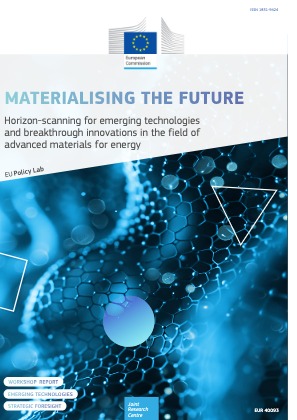
    Materialising the FutureOctober 2024

    Horizon Scanning for Emerging Technologies and Breakthrough Innovations in the Field of Advance Materials for Energy

    This report documents the process and findings of a horizon scanning exercise, part of a series under the FUTURINNOV (FUTURe-oriented detection and assessment of emerging technologies and breakthrough INNOVation) project, a collaboration between the European Innovation Council (EIC) and the Joint Research Centre (JRC), aiming to bolster the EIC's strategic intelligence through foresight and anticipatory methodologies.
    The workshop, held on 13 May 2024, had as its primary goal the evaluation and prioritisation of trends and signals on emerging technologies and breakthrough innovation, across all technolo-gy readiness levels (TRLs), within the EIC's Advanced Materials portfolio and with a particular fo-cus on their use in the Energy sector.


    Signals for the workshop were gathered from experts, literature review, and text/data mining of patents, publications, and EU-funded projects. These signals were then scrutinised for their sig-nificance to the field's future by a diverse group of sector experts which led to the identification of nine key topics: accelerated material design/synthesis; biomaterials as part of the circular economy; advanced materials allowing new applications; closed loop battery recycling; innova-tions in catalysis; organic batteries for sustainable energy storage; design to performance bat-teries; design to cost batteries; and electrochemical water treatment. Furthermore, the workshop identified additional wild cards with high novelty and disruptive potential such as: circularity of materials (safe and sustainable by design); membranes / separators; process optimisation; 3D printing of electrode materials for energy and environmental engineering applications; and use of AI for the study of materials.
    Participants also highlighted various factors that could influence the development, adoption, and promotion of these emerging technologies, which can be grouped under the following categories: governance and compliance frameworks; funding; collaboration and knowledge exchange; sustainable and efficient development; infrastructure and technological advancement and limita-tions; industry and market dynamics and constraints; innovation and risk management; supply chain and raw materials; and talent development.

    Posted on: 13/11/2024

    Last Edited: a year ago

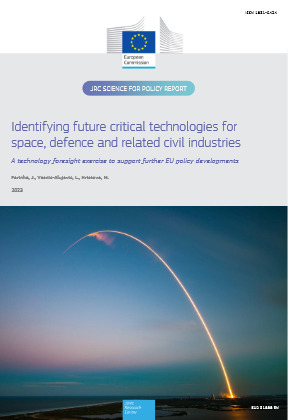
    Identifying Future Critical Technologies for Space, Defence and Related Civil IndustriesDecember 2022

    A Technology Foresight Exercise to Support Further EU Policy Developments

    This publication is a Science for Policy report by the Joint Research Center (JRC), the European Commissions's science and knowledge service.

    It aims to provide evidence-based scientific support to the European policymaking process. The contents of this publication do not necessarily reflect the position or opinion of the European Commission. Neither the European Commission nor any person acting on behalf of the Commission is responsible for the use that might be made of this publication. This report is based on research of the JRC. It does neither include any information or data collected in the context of the EU Observatory of Critical Technologies, nor does it prejudge the future work of the Observatory. For information on the methodology and quality underlying the data used in this publication for which the source is neither Eurostat nor other Commission services, users should contact the referenced source. The designations employed and the presentation of material on the maps do not imply the expression of any opinion whatsoever on the part of the European Union concerning the legal status of any country, territory, city or area or of its authorities, or concerning the delimitation of its frontiers or boundaries. 

    Posted on: 10/11/2024

    Last Edited: a year ago

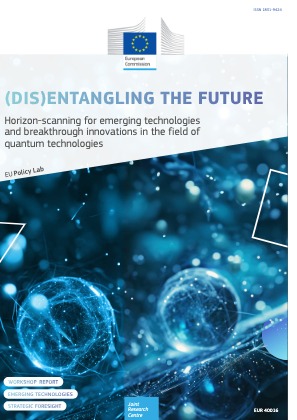
    (DIS)ENTANGLING THE FUTUREAugust 2024

    Horizon-scanning for Emerging Technologies and Breakthrough Innovations in the Field of Quantum Technologies

    This report documents the process and findings of a horizon scanning exercise, part of a series under the FUTURINNOV (FUTURe-oriented detection and assessment of emerging technologies and breakthrough INNOVation) project, a collaboration between the European Innovation Council (EIC) and the Joint Research Centre (JRC), aiming to bolster the EIC's strategic intelligence through foresight and anticipatory methodologies.


    The workshop, held on 24 April 2024, had as its primary goal the evaluation and prioritisation of trends and signals on emerging technologies and breakthrough innovation, across all technology readiness levels (TRLs) and within the EIC's Quantum technologies portfolio.


    Signals for the workshop were gathered from experts, literature review, and text/data mining of patents, publications, and EU-funded projects. These signals were then scrutinised for their significance to the field's future by a diverse group of sector experts which led to the identification of nine key topics: quantum sensing; quantum algorithms for lattice-based computational fluid dynamics models; materials for quantum; Artificial Intelligence for quantum; error correction; solid-state scalability; quantum for Artificial Intelligence; quantum as a service – metacloud; and quantum computers. Furthermore, the workshop identified additional wild cards with high novel-ty and disruptive potential such as quantum sensing AI on edge and molecular spin qubits.
    Participants also highlighted various factors that could influence the development, adoption, and promotion of these emerging technologies, which can be grouped under the following categories: technical advancements; investment and infrastructure support; cross-sector collaboration; regulatory navigation; talent acquisition; market maturity; and application utility.

    Posted on: 08/11/2024

    Last Edited: a year ago

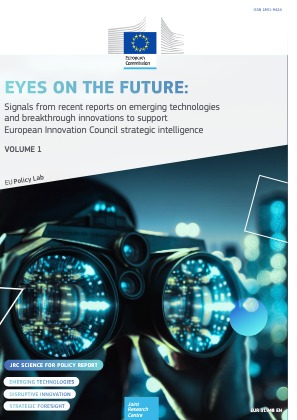
    Eyes on the FutureMay 2024

    Eyes on the Future - Signals from recent reports on emerging technologies and breakthrough innovations to support European Innovation Council strategic intelligence - Volume 1

    This report provides a literature review of publications authored by numerous external organisations. It summarises 34 signals and trends of emerging technologies and breakthrough innovations across the 11 primary categories of a taxonomy defined by the European Innovation Council (EIC). The authors investigate not only what is deemed most novel in multiple application domains but what is worth the attention of European Union (EU) policy audiences involved with priority-setting and decision-making.


    This work that has led to this literature review (1) reviews and evaluates 186 reports and articles on emerging technologies, (2) captures 489 signals, of which 86 have been short-listed and 34 selected for this report, (3) creates an internal database of signals which is used to digest and analyse the evolution of signals and novel technologies (4) connects signals with EIC portfolios and other European Commission (EC) initiatives such as policies surrounding critical technologies and Strategic Technologies for Europe Platform (STEP) investments that, together with the primary and secondary levels of the EIC taxonomy, provide multiple types of analysis and insights (5) draws conclusions that aim to support the EIC’s funding prioritisation and additionally, provide reflections on EIC portfolio setting.


    By using the best publicly-available data to produce a harmonised internal database, along with an appropriate filtering and selection methodology, the authors aim to provide a support platform for future-oriented technology analysis of relevance for other EU policy-making initiatives.

    Posted on: 08/11/2024

    Last Edited: a year ago

    Digital TransitionJune 2023

    Long-Term Implications of the Digital Transition for Farmers and Rural Communities

    Successfully managing the green and digital transitions is a crucial factor that could increase the resilience and strategic autonomy of the EU and shape its future. Yet digitalisation of agriculture and rural areas raises vital questions about winners and losers, costs, benefits, and long term implications.


    This foresight exercise explores the interplay between digital transition, policies and the resilience of the agricultural sector and rural areas, against the backdrop of potential disruptive and transformative changes. The report presents the outcomes of this exploration, proposing building blocks for an effective EU digital transition strategy for agriculture and rural areas supported by a hands-on policymaker’s toolkit

    The blog post reveals the goals and steps of the foresight process and explains how visioning can support transitions. 

    Posted on: 28/10/2024

    Last Edited: a year ago

    Technology Foresight for Public Funding of InnovationAugust 2023

    Methods and Best Practices

    In times of growing uncertainties and complexities, anticipatory thinking is essential for policymakers.
    Technology foresight explores the longer-term futures of Science, Technology and Innovation. It can be used
    as a tool to create effective policy responses, including in technology and innovation policies, and to shape
    technological change.


    In this report we present six anticipatory and technology foresight methods that can contribute to anticipatory
    intelligence in terms of public funding of innovation: the Delphi survey, genius forecasting, technology roadmapping, large language models used in foresight, horizon scanning and scenario planning.


    Each chapter provides a brief overview of the method with case studies and recommendations.
    The insights from this report show that only by combining different anticipatory viewpoints and approaches
    to spotting, understanding and shaping emergent technologies, can public funders such as the European
    Innovation Council improve their proactive approaches to supporting ground-breaking technologies. In this
    way, they will help innovation ecosystems to develop.

    Posted on: 28/10/2024

    Last Edited: a year ago

    Scanning Deep Tech HorizonsAugust 2023

    Participatory Collection and Assessment of Signals and Trends

    The Joint Research Centre (JRC) and the European Innovation Council (EIC) conducted a series of Horizon Scanning exercises across six EIC programme managers’ (PM) portfolios as part of an ongoing collaborative effort to strengthen EIC strategic intelligence capacity through the use and development of anticipatory approaches. The fields covered include: Space Systems & Technologies; Quantum Technologies; Agriculture & Food; Solar Fuels & Chemicals; Responsible Electronics and Architecture, Engineering & Construction.


    The main findings of this Horizon Scanning – the identification and analysis of ‘signals’ from nascent research, technologies, or trends on the periphery of the mainstream – show opportunities for investment in emerging technologies and breakthrough innovations that can advance EU competitiveness while also serving to support the EU’s long-term policy and societal visions.
    Other insights were taken from this exercise, namely the identification of drivers, enablers and barriers to technology development and adoption, that could be the starting ground of further foresight exercises and policy initiatives.


    The report highlights three main themes – sustainability, energy, and scalability, which are overarching across signals, drivers, enablers and barriers. And concludes with a series of recommendations to streamline Horizon Scanning activities in the specific context and needs of the EIC.

    Posted on: 28/10/2024

    Last Edited: a year ago

    Everybody is looking into the future!August 2023

    A Literature Review of Reports on Emerging Technologies and Disruptive Innovation

    Growing volatility, uncertainty, complexity and ambiguity, present leading challenges in policy-making nowadays. Anticipatory thinking and foresight are of utmost importance to help explore trends, risks, emerging issues, and their potential implications and opportunities in order to draw useful insights for strategic planning, policy-making and preparedness.


    This report is a part of the “Anticipation and monitoring of emerging technologies and disruptive innovation” (ANTICIPINNOV) project, a collaboration between the European Commission Joint Research Centre with the European Innovation Council (EIC).


    The findings include a set of 106 signals and trends on emerging technologies and disruptive innovations across several areas of application based on a review of key reports on technology and innovation trends and signals produced by public and private entities outside of the EU institutions. Its goal is to strengthen the EIC’s strategic intelligence capacity through the use and development of anticipatory approaches that will - among other goals – support innovation funding prioritisation. Other insights were extracted, namely those related with the scope of the EIC Programme Manager portfolios.

    Posted on: 28/10/2024

    Post Image

    Last Edited: a year ago

    The future of Europe: futures imagined by Greek citizens

    A portrait of how EU citizens imagine their futures - analysing stories collected through the #OurFutures project.

    What will Europe look like in 2040? How will we travel, how will our society be organised, how will our schools function and what kind of jobs will people have? These are just some of the questions we have been asking Europeans to reflect on as part of the #OurFutures project launched by the EU Policy Lab. Through it, we collect EU citizens' images through a narrative inquiry method.

    We recently did this in Greece, in close collaboration with foresight experts in the Greek government by reaching out to Greek citizens to gain insights into how people in this part of Europe would like the future to look like.

    We have spoken to Epaminondas Christophilopoulos (UNESCO chair on Futures research at the Foundation for Research and Technology) and Vivian Efthimiopoulou (communication expert), focusing on some of their findings which demonstrate the value of citizen-generated future images for developing people-centric policies at both national and EU level.

    Posted on: 24/10/2024

    Last Edited: a year ago

    Suppressing indoor pathogen transmission

    A Technology Foresight study

    Airborne transmission is considered one of the most common ways of transmitting respiratory viruses. The reach of airborne pathogens and persistence of aerosolized particles suspended in the air are a significant concern for the spread of pandemic and seasonal respiratory diseases. This is particularly relevant in indoor spaces where most respiratory infections occur. 

    Controlling the transmission of airborne pathogens is therefore a cornerstone of public health efforts to manage and prevent the spread of infectious diseases, ensuring safety and health for individuals and communities. Technologies that allow such control are essential to address the challenge. This report is the output of a comprehensive study which evaluates the potential of the current technology landscape for suppressing indoor airborne pathogen transmission. 

    The analysis outlines two main technology groups: those for detecting airborne pathogens and those for decontaminating air and surfaces. It identifies several key technologies in each group, and assesses their maturity, impact, and potential priority for funding. It outlines the drivers, enablers, and barriers for the development and adoption of these technologies, providing insights into factors that may influence their future implementation. It also explores forward-looking perspectives with scenarios for future health crises and offers recommendations for policy and research to address the challenges and leverage the opportunities in the field of indoor air quality. 

    The study was conducted during 2024 by European Commission Joint Research Centre (JRC) and Health Emergency Preparedness and Response Authority (HERA).

    Posted on: 22/10/2024

    Post Image

    Last Edited: a year ago

    The future of Europe: what do you imagine it will look like?

    A portrait of how EU citizens imagine their futures; analysis of stories collected by #OurFutures

    We invited people across the EU to share their imagined futures. For this collection we, the European Commission’s Competence Centre on Foresight, used a narrative inquiry method. Instead of asking opinions about the future, we asked participants to share a story about their desirable future, followed by a few questions about that story, in order to more fully comprehend their thinking. In this process we were guided by Voices That Count.

    In this article, we’ll take a look at the first 591 stories of people that participated so far, mostly from Greece and Slovenia, followed by Germany, Spain and Italy. Approximately half of them are students, and the other half mainly consists of employed people. 


    Posted on: 18/10/2024