Loading...

    Mentions of

    sorted by publishing date

    Post Image

    Last Edited: 18 days ago

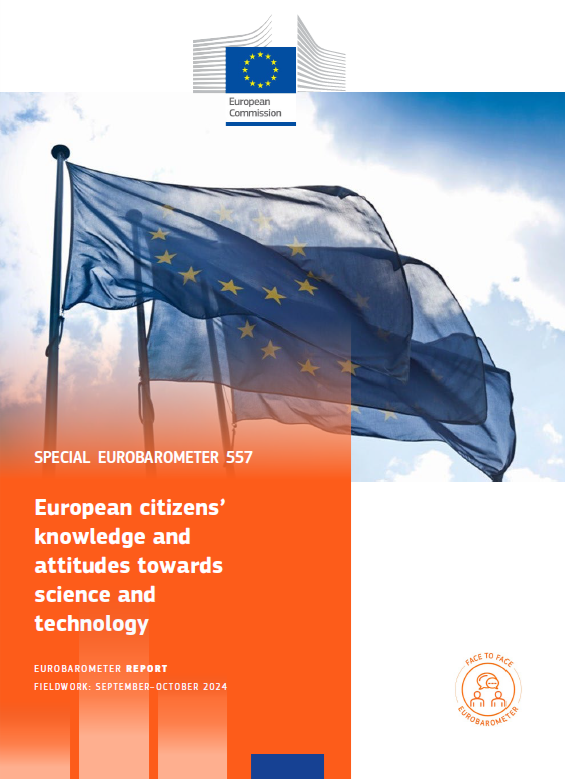
    European citizens’ knowledge and attitudes towards science and technology

    SPECIAL EUROBAROMETER 557

    This Special Eurobarometer report provides an insight into perceptions of science and technology.

    The survey covers the following topics: 🔵 knowledge about science and technology, 🔵 views on the impacts of science and technology, 🔵 views on the governance of science and technology, 🔵attitudes towards scientists, 🔵 citizens’ engagement in science and technology, 🔵diversity, inclusiveness, and social responsibility, and 🔵views on the use of AI for scientific research.

    The full report is avaliable here. Summary, country factsheets, infographics are available here

    Key findings

    📌Overall influence of science and technology on society
    83% of citizens think that the overall influence of science and technology is positive. 67% equally agree that science and technology make our lives easier, healthier and more comfortable. The majority of respondents in the EU agree that science makes our ways of life change too fast (63%) and that the applications of science and technology can threaten human rights (56%).

    📌Views about science and technology
    Respondents are most likely to think that renewable energies (87%), information and communication technology (79%) and vaccines and combatting infectious diseases (77%) will have a positive effect on our way of life in the next 20 years.

    📌Trust and equity in science
    Results show that 77% of respondents agree that science and technology should consider the needs of all groups of people when developing new solutions and products, while another 72% think that the government should take responsibility to ensure that new technologies benefit everyone.

    📌Attitudes towards scientists
    Respondents mostly agree that scientists should intervene in political debate to ensure that decisions take into account scientific evidence (68%), with fewer agreeing with the opposite statement that scientists should not intervene in this way (42%). Half of respondents (50%) agree that we can no longer trust scientists to tell the truth about controversial scientific and technological issues because they depend more and more on money from industry.

    📌Sharing results of scientific research
    When it comes to sharing scientific results and engaging with the public, 80% agree with the statement that results of publicly funded research should be made available online free of charge.

    📌Artificial intelligence
    This survey included a focus on the use of artificial intelligence (AI) for scientific research, revealing mixed views among citizens in this regard. 38% say they trust scientific research and discoveries created with the help of AI, while a quarter (25%) distrust this type of research.

    ***

    The survey was carried out in the 27 EU Member States and eight non-EU countries between 12 September and 10 October 2024. A total of 34,207 respondents from different social and demographic groups were interviewed in their mother tongue. This survey was commissioned by the European Commission, Directorate General for Research and Innovation (DG RTD)

    Posted on: 02/09/2026
    Last Edited: 10 months ago

    Identifying STI developments contributing to the capability of planetary ecosystems to flourishApril 2022

    Results of a Delphi survey

    This report showcases the results of the two-round Dynamic Argumentative Delphi survey carried out within the project “S&T&I for 2050. Science, Technology and Innovation for Ecosystem Performance – Accelerating Sustainability Transitions”. The overarching ambition of this project is the “identification and mapping of future scientific and technological developments that can radically improve ecosystem performance”. The main outcome is to provide “reflections towards the 2nd Strategic Plan of Horizon Europe (HE), in its broad direction to support the Sustainable Development Goals.”

    To this end, quantitative and qualitative methods were employed, among which this report refers to:  

    • Patent and bibliometric analysis for selecting the most dynamic Science, Technology and Innovation (STI) domains; 
    • Horizon scanning through web mining and human evaluation for identifying key STI directions and specific examples of technological/scientific breakthroughs within these directions; 
    • Dynamic Argumentative Delphi engaging relevant experts from around the world in an argument-based exploration regarding the contribution of STI to the capability of ecosystems to flourish from now to 2050. 

    Posted on: 04/03/2025

    Last Edited: 10 months ago

    Expectations and assumptions for the future in the Work Programme 2021-2022 of Horizon EuropeJanuary 2023

    Foresight on Demand (FoD)

    This report presents the results of a study on “Expectations and assumptions for the future in the Work Programme 2021-2022 of Horizon Europe”. The study scanned the HE Work Programme 2021-2022 for assumptions and expectations about the future and conducted a Delphi survey of experts on the likely time of realization of those expectations and assumptions. The analysis revealed three over-lapping but distinct types of challenges associated with assumptions and expectations that should be recognised in future workprogrammes: policy chal-lenges, diversification challenges and reflexivity challenges.

    Posted on: 30/01/2025

    Last Edited: 10 months ago

    ERA Industrial Technologies Roadmap on Human-Centric Research and InnovationApril 2024

    for the manufacturing sector

    Human centricity is one of the three pillars of Industry 5.0.

    This Roadmap shows how industrial innovation ecosystem stakeholders can take a leading role in achieving human-centric outcomes in technology development and adoption, such as improving workers’ safety and wellbeing, upskilling or learning.

    There are significant opportunities to capture the transformative potential of ground-breaking technologies like artificial intelligence and virtual worlds through more human-centric and user-driven design approaches. 

    The Roadmap recommends that policy makers support integrating human-centricity considerations in education and training, R&I funding and in company training and innovation strategies.

    Posted on: 30/01/2025

    Last Edited: 10 months ago

    ERA Industrial technology roadmap for low-carbon technologies in energy-intensive industriesFebruary 2022

    The energy crisis resulting from Russia’s invasion of Ukraine only underlines the urgency for the EU to reduce its dependency on fossil fuel, in order to reach climate neutrality by 2050, which is at the core of the European Green Deal. Decarbonising the industry, responsible for 17% of greenhouse gas emissions in the EU, is therefore key.

    This first industrial technology roadmap under the new European research area (ERA) provides an evidence base on the state of play of low-carbon technologies in energy-intensive industries in the EU and available support instruments, and points to possible research and innovation action in view of accelerating development and uptake of these technologies. These possible ways forward build on contributions from industry, other research and innovation stakeholders, Member States, and relevant European partnerships.

    This roadmap will feed into the transition pathway for the energy-intensive industries ecosystem under the EU industrial strategy and supports the work to accelerate the green and digital transitions under the ERA policy agenda.

    Posted on: 30/01/2025

    Last Edited: 10 months ago

    ERA Industrial technology roadmapNovember 2022

    for circular technologies and business models technologies and business models: in the textile, construction and energy-intensive industries

    This second industrial technology roadmap, under the European Research Area, sets out 92 circular technologies in the textile,
    construction and energy-intensive industries, which address all stages of a material and product lifecycle. It indicates the means to develop and adopt these technologies, which can help reduce the impact of these industries on climate and the environment. It finds a leading position of EU companies in circular technologies, but also looks at the substantial research &
    innovation investment needs at EU and national levels and necessary framework conditions to put in place. It builds on
    contributions from industry, other R&I stakeholders, Member States, and relevant European partnerships.

    Posted on: 29/01/2025

    Last Edited: 10 months ago

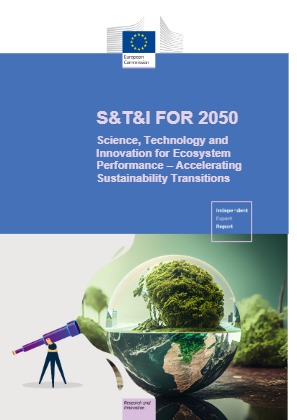
    Final Report: S&T&I 2050April 2023

    Science, technology and innovation for ecosystem performance: accelerating sustainability transitions

    This report presents the results of a the project S&T&I for 2050: science, technology and innovation for ecosystem performance – accelerating sustainability transitions. The project’s overarching goal was to identify and map future scientific and technological developments, which can radically improve ecosystem performance.

    The project was conducted along several phases:

    • Based on literature review, the project team developed three perspectives on future relations between humans and nature and humans’ role in the flourishing of planetary ecosystems. The three perspectives are: i) protecting and restoring ecosystems, ii) co-shaping socio-ecological systems, and iii) caring within hybrid collectives
    • A two-round Dynamic Argumentative Delphi (DAD) online survey explored the most dynamic scientific and technological developments. The survey engaged over 600 experts globally in enriching, assessing and prioritizing STI directions in terms of their potential to contribute to the capability of planetary ecosystems to flourish from now to 2050.
    • Drawing in on the three perspectives and the results of the DAD survey, six case studies on core sustainability issues explored the three perspectives. Reflections on implications for R&I policies in the context of the European Green Deal conclude each of the six case studies: i) Law for Nature; ii) Land Use Futures; iii) Soil to Soul; iv) Accelerating transitions to regenerative economy; v) Ecosystems and Micro-and Nano Cosmos; vi) Data as Representation

    Posted on: 12/12/2024

    Last Edited: 10 months ago

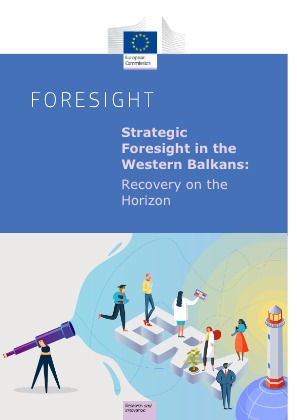
    Strategic Foresight in the Western BalkansSeptember 2021

    Recovery on the Horizon

    The report outlines three scenarios of possible futures for Research and Innovation (R&I) policies in the Western Balkans in 2035. Using a Strategic Foresight approach, the report supports policy makers in creating an enabling environment for R&I policies to thrive and in deciding on priorities for strategic investments for the future. 

    The scenarios in the report are based on an extensive co-creation process with more than 700 R&I experts from the Western Balkans, representing academia, civil society, the private sector, international organisations, and central and sub-national governments. To provide inspiration for the implementation of future-proof R&I policies, the report also includes initial roadmaps. 

    These are designed to inspire decision-makers by setting targets and the actions needed to develop their R&I systems for the benefit of all citizens in the Western Balkans. The project was launched in July 2020 and the final study was presented at the EU-WB Ministerial Meeting in October 2021.

    Posted on: 04/12/2024

    Last Edited: 10 months ago

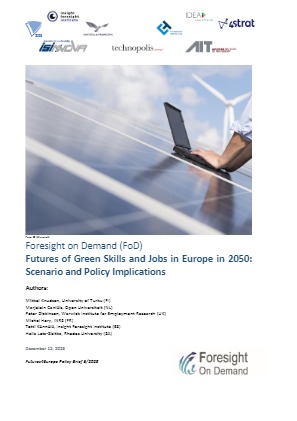
    Futures of Green Skills and Jobs in EuropeNovember 2023

    Scenario and Policy Implications

    Climate change and environmental degradation are an existential threat to the European Union and to the world. As a response, among other things, the European Green Deal aims to make Europe climate-neutral by 2050, boost the economy through green technology, create sustainable industry and transport, and cut pollution. The transition towards greener and more sustainable economies is a game changer in the EU labour market alongside digitalisation and automation. Skill needs will change with impacts far beyond the key occupations driving them, affecting all economic sectors.

    Europe needs to promote and support green employment, address the skilling and reskilling of workers, and anticipate changes in workplaces of the future. In order to get a better grasp on potential future outcomes, and better anticipate their potential policy implications, a foresight Deep Dive has been carried out. The Deep Dive uses a broad conceptualization of skills that encompasses the full palette from scientific and engineering skills to vocational and crafts-like skills. All are needed in the green labour market, although the scenario-led focus here for the most part is on skills of vocational professions. This policy brief presents the main findings.

    A set of four different scenarios for the futures of green skills and jobs in Europe in 2050 were crafted:

    • Scenario A: Green technology-intensive Europe: Struggling to fill all the green jobs
    • Scenario B: Apocalypse Soon: Fighting skills mismatches in a degraded environment
    • Scenario C: Feeling the pain: A workforce left behind in a non-green world
    • Scenario D: Green leapfrogging: Old, mismatched Europe surrounded by new green giants

    Posted on: 30/10/2024

    Last Edited: 10 months ago

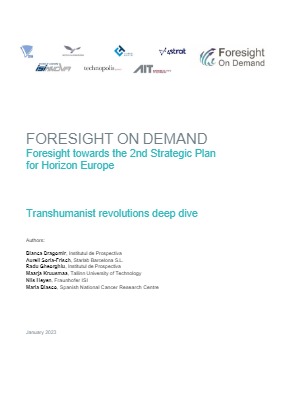
    Deep Dive: Transhumanist RevolutionsDecember 2022

    The twelve scenarios in this deep dive are informed by transhumanism, portraying futures in which the human condition – our bodies, functions, and lives – and the features of societies are fundamentally transformed by technology. Even though scenarios are built along the lines of particular scientific and/or technological advancements, the discussion spreads over sociotechnical ensembles and the re-conceptualization of the relationship between technology and society by 2040.

    The work leading to this report started with a horizon scanning exercise to identify a series of technological innovations and scientific breakthroughs that may be considered key factors towards re-engineering human nature. In parallel, the authors explored diverse narratives regarding the human condition and significance in the world, dreams and fears embodied in the so-called collective imaginary, echoing through myths and fantasies to literature, cinematography and the wider culture. At the intersection of these explorations, twelve topics were selected and further expanded into scenarios. They are not intended to cover the full spectrum of themes regarding human enhancement, but present a relevant ‘sample’ of potential future trajectories.

    We propose these narratives as exploratory scenarios, describing futures where both positive and negative consequences are palpable. They are not normative, outlininga vision of the future deemed desirable. We invite readers to regard them as devices for imagining the future and debating the future. They aim to nurture a reflection on the dynamics of change, future opportunities and potential threats, and in doing so they contribute to future preparedness.

    Three types of scenarios were developed:

    • The first type describe futures where scientific and technological advancements enhance embodied experiences: Sensory augmentation: extending human senses beyond the natural limits and adding sensorial modalities which are not native to humans. Sensory and brain stimulation, psychedelic microdosing: inducing altered states of consciousness, for healing purposes or for fostering new perspectives on being human. Molecular therapies for delaying aging; and new artificial reproductive technologies allowing people to be fertile until much older age.
    • The second type explore futures where human capabilities are extended by embodying non-biological means: a significant share of elderly people using exoskeletons for prolonging active life, for maintaining their mobility or as a form of assisted living; brain-computer interfaces leveraged in semi-automatized work environments, to improve learning outcomes, and to control smart devices; Brain to brain communication supporting cognitive and emotion sharing, leading to the creation of ‘hive minds’ covering multiple aspects of life.
    • The third type focus on the simulation and replication of the human body and mind: Digital body twins allowing alert signals for disease prevention and the simulation of the short- and long-term effects of a person’s behavior on their health and body; Digital twins of the brain allowing testing hypotheses in cognitive science, in mental health studies, responses to different types of treatments; Digital immersive worlds – gaming/ fantasy worlds or ‘mirror worlds’ that are replicating real-life environments – hosting interactions among people and automated entities; Digital replicas of the deceased changing the socio-political understanding of grief; and Artificial agents with complex underlying computational procedures (including e.g. self-reflection, development of value system, affective computing) and sophisticated interfaces calling for new theoretical frameworks of consciousness.


      ***
      The twelve scenarios presented in this deep dive are part of the Foresight towards the 2nd Strategic Plan of Horizon Europe project, which was conducted by Foresight on Demand Consortium on behalf of the European Commission’s Directorate-General for Research and Innovation (DG RTD).

    Posted on: 28/10/2024