Loading...

    sorted by publishing date

    Last Edited: 2 months ago

    Foresight as a Key Social Infrastructure for EuropeDecember 2025

    A Manifesto of the Research&Innovation Foresight Community

    Preamble
    Across Europe, the use of foresight for Research and Innovation (R&I) policy is growing, but unevenly. In many places, it still sits at the margins of policymaking, and its full potential—to inspire broader societal change—is not yet realised.

    The European R&I foresight community, made up of practitioners, policymakers, researchers, and future-oriented thinkers, is
    becoming stronger and more connected. The Eye of Europe project, supported by the European Commission, helps this
    community grow through the online hub futures4europe.eu, as well as workshops, conferences and shared learning spaces.

    This manifesto stems from a “foresight on foresight” workshop held in Mamaia, Romania (18–19 September 2025), coordinated by UEFISCDI and the Austrian Institute of Technology. 30 foresight practitioners and R&I policy experts from across Europe gathered to imagine how foresight could better support R&I policy and practice. Furthermore, these contents have also been discussed and enriched during Eye of Europe’s final mutual learning event held in Chișinău, Moldova (23–24 October 2025).

    This manifesto recognises the growing importance of foresight—not only within European R&I systems but also at the interface between R&I and society—repositioning the field as a driver of inspiration and renewal in shaping Europe’s futures.

    Foresight as a Key Social Infrastructure for Europe
    Vision 2030 in a nutshell

    Research and Innovation (R&I) foresight is a shared space of imagination and inquiry, enabling Europe to live creatively with emergence and diversity. Beyond agenda-setting, it cultivates futures literacy across science, policy, and society — expanding our capacity to sense, interpret, and engage with novelty.

    Embracing the open and interdependent nature of the world, foresight complements evidence with creativity and plural ways of knowing. It guides Europe’s research and innovation ecosystems to act with openness, responsibility, and imagination — co-creating sustainable and just futures as a shared public good.

    🔵 EXTENDED ROLE OF R&I FORESIGHT
    In 2030 R&I foresight enables boundary spanning, connecting sectoral policies, disciplines, and perspectives. Its value lies not only in generating agendas or scenarios, but in reshaping worldviews, reframing challenges, cultivating agency, enabling collective reflection, and inspiring transformative action

    🔵 OPEN AND INCLUSIVE SPACES
    In 2030 foresight thrives on openness, diversity, and empathy. It creates spaces where people engage not only as experts or institutional actors, but as whole humans— bringing values, worldviews, emotions, and lived experiences into the co-creation of futures.
    Trust grows from transparency, fairness, and shared ownership of both processes and outcomes. While AI expands access to knowledge, human judgment, engagement creativity, and responsibility remain essential.

    🔵 FUTURES LITERACY AS A FOUNDATIONAL CAPACITY
    Futures literacy becomes both a foundation and a legacy of R&I foresight. It strengthens the collective ability to recognise assumptions, navigate uncertainty, and act with intention amid complexity.
    Foresight processes evolve into open spaces for learning and experimentation, cultivating anticipatory competence among experts, policymakers, and citizens. Through its practices and communication, R&I foresight contributes to a societal diffusion of futures thinking, enhancing collective intelligence and agency.

    🔵 A MATURE COMMUNITY OF PRACTICE
    Foresight gains professional depth through dedicated academic programmes and practitioner networks. A wide variety of organisations embed foresight cultures that encourage reflection, experimentation, and communication. Shared infrastructures such as futures4europe.eu evolve into open, dynamic platforms for collaboration, knowledge exchange, and innovation in foresight.

    Download the document at the top of the page to read the full version.

    Posted on: 21/01/2026
    Last Edited: 4 months ago

    THE DEMOGRAPHIC TURN09 December - 09 December 2025

    ACTIONS NEEDED FOR RESEARCH, INNOVATION, AND POLICY IN EUROPE?

    Curious about how Europe’s demographic trends may transform the R&I landscape? 

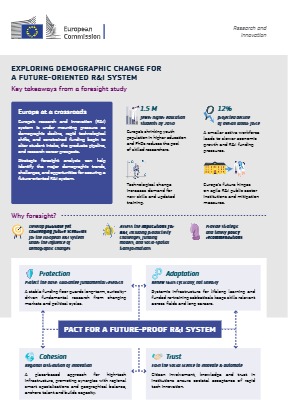
    On 10 December 2025, DG Research & Innovation hosted a hybrid event at the DG RTD Library in Brussels to present the Foresight-on-Demand (FOD) study: “The Demographic Turn: Actions Needed for Research, Innovation and Policy in Europe?”

    FOD team members guided the audience through: 

    • Background data showing a shrinking youth population, a declining workforce, and growing fiscal pressures on R&I funding. 
    • A six-step Foresight Process combining horizon scanning, scenario-building, and windtunneling to anticipate future challenges. 
    • Four Scenarios illustrating different pathways for Europe’s R&I system. 
    • Strategic actions to protect fundamental research, foster lifelong learning, strengthen regional innovation, and build societal trust in technology.

    👏 A big thank you to the panelists and speakers:

    • Erik Canton (Deputy Head of Unit – Common R&I Strategy and Foresight Service, DG Research & Innovation)
    • Nicola Francesco Dotti (Chief Economist Unit – Common R&I Strategy and Foresight Service, DG Research & Innovation)
    • Brikena Xhomaqi (The Lifelong Learning Platform)
    • Alex Petropoulos (Centre for Future Generations)
    • Thomas Estermann (European University Association)
    • Maciej Krysztofowicz (EU policy Lab, Joint Research Centres)
    • Viola Peter (FOD team, Technopolis Group)
    • Michal Nadziak (FOD team, 4CF)
    • Katarzyna Figiel (FOD team, 4CF) 

    And to all participants for an engaging exchange on how to build a more adaptive and resilient EU R&I system. 

    In case you missed the event, you can find all the materials below.


    Posted on: 27/11/2025

    Last Edited: 8 months ago

    Futures of R&I Foresight18 September - 19 September 2025

    Vision building workshop

    𝗙𝘂𝘁𝘂𝗿𝗲𝘀 𝗼𝗳 𝗥&𝗜 𝗙𝗼𝗿𝗲𝘀𝗶𝗴𝗵𝘁 𝘄𝗼𝗿𝗸𝘀𝗵𝗼𝗽 unfolded on September 18-19th on Romania’s seaside coast — two breezy summer days that provided the perfect setting for a rich exploration of “foresight about foresight.”

    Co-hosted by Executive Agency for Higher Education, Research, Development and Innovation Funding - UEFISCDI and AIT Austrian Institute of Technology, and part of the 𝗘𝘆𝗲 𝗼𝗳 𝗘𝘂𝗿𝗼𝗽𝗲 𝗽𝗿𝗼𝗷𝗲𝗰𝘁 (a Coordination and Support Action funded by the European Commission), the event brought together the community of practice working to 𝘀𝘁𝗿𝗲𝗻𝗴𝘁𝗵𝗲𝗻 𝗥𝗲𝘀𝗲𝗮𝗿𝗰𝗵 & 𝗜𝗻𝗻𝗼𝘃𝗮𝘁𝗶𝗼𝗻 (𝗥&𝗜) 𝗳𝗼𝗿𝗲𝘀𝗶𝗴𝗵𝘁 𝗶𝗻 𝗘𝘂𝗿𝗼𝗽𝗲.

    Our shared ambition was to imagine a vision that is grounded in reality and lived experience, yet bold enough to inspire the next decade of foresight’s contribution to R&I.

    Discussions flowed through several stages:
    🌍 reflecting on today’s foresight landscape, particularly within R&I in Europe
    🔎 identifying likely drivers of change for R&I in society by 2040
    🧭 probing the forces that could reshape foresight itself by 2040 and finally,
    🚀 envisioning the role and capabilities foresight will need to support R&I in 2040.

    A vision document capturing the outcomes of the workshop will be shared in due course, once the many insights, contributions, and reflections have been carefully woven together. 

    Posted on: 17/08/2025

    Last Edited: 10 months ago

    Future Topics for European Research AreaMay 2025

    Eye of Europe Policy Brief No. 1

    This policy brief provides insights into the thematic areas addressed in the first five Eye of Europe workshops. It also informs about the upcoming workshops and the futures4europe platform, the online home of the European foresight community, where visitors can explore a rich collection of foresight projects, showcase their work, and discover foresight-related upcoming events.

    Posted on: 17/06/2025

    Last Edited: a year ago

    Futures4Europe Conference | Book of AbstractsApril 2025

    For the Futures4Europe conference held on May 15 and 16, 2025 in Vienna on behalf of the Horizon Europe funded project Eye of Europe

    With over a dozen thematic tracks and hundreds of participants from more than 30 countries, the 2025 Futures4Europe conference in Vienna is the largest convergence of the European foresight community to date. Notably, it marks a transition from fragmented project-based foresight to a more integrated and sustained foresight infrastructure within the EU’s research and innovation systems. The conference is also a living lab for the kind of futures we want to see: inclusive, reflexive, care-centered, and critically engaged, and thus reflecting the efforts of the Eye of Europe project.

    Our gratitude extends to all who contributed to this conference— authors, reviewers, and conveners—for their intellectual generosity and for pushing the boundaries of what foresight can be. The diversity of themes, methods, and perspectives presented here is a testament to a foresight community that is not only growing, but maturing— anchored in practice, but not afraid to question its own foundations.

    As you read through these abstracts, we invite you not just to absorb insights, but to engage with them—challenge them, expand them, remix them. Because the future of Europe will be co-created not by prediction, but by participation, imagination, and shared responsibility.

    Let this book be an invitation to that ongoing process.

    Posted on: 09/05/2025

    Post Image

    Last Edited: a year ago

    Co-Creating Futures of Democracy in Europe

    YouthDecide 2040 is looking for participants to join our regional workshops

    📣 YouthDecide 2040 is looking for participants to join our regional workshops and co-create the future of European democracy!

    Be part of a one-and-a-half-day immersive workshop where diverse voices come together to imagine and shape resilient, thriving European democracies.

    🗣️💬 Through creative, participatory foresight activities, we will explore different visions of democracy in 2040—your perspective matters!

    🧭 The wider, the better
    Are you a European resident over 18? This call is for you!
    We're fostering intergenerational discussions on the future of European democracy, centring youth voices (18-34).

    🔓 The call for applications will remain open through May 2025. 

    Posted on: 10/04/2025

    Post Image

    Last Edited: a year ago

    Interview with Susanne Giesecke, Senior Researcher at the Austrian Institute of Technology

    Futures4Europe interviewed Susanne Giesecke, a member of the Eye of Europe Project consortium of the Austrian Institute of Technology. Susanne is a political scientist by...

    Posted on: 27/03/2025

    Last Edited: a year ago

    Democracy – a long-term project?

    Results from the EOE Pilot Worksho´p

    Reviewing the Event: The workshop gave a chance to take a structured look into the past of liberal democracies, into present research on some cornerstones of democracies today such as institutions, participation and the media, and into the future via reviewing four selected science fiction novels that deal with future democratic developments.


    Senior scientist at “Our World in Data” Bastian Herre gave an alarming as well as reconciling view into deterioration of liberal democracies worldwide as well as in Europe. Yet, he pointed out that most of our present democracies are built on solid institutions and that they are most likely to be resilient against internal and external attacks.


    Michel Debruyne of Beweging.net introduced results from comparative country research from the INVOLVE-democracy project. Among the factors stablizing liberal democracies long-term are the quality of trust in public institutions and policies as well as making participation possible for all citizens. However, when looking at public policies and social benefits, the picture is more ambiguous: while public health expenditure is considered a stabilizing factors, high expenditure in pensions might result in distrust. More definite in destabilizing democracy in a country are corruption and low quality of public transport.


    The RECLAIM project is researching the significance of expression of information disorder and democratic stability. The protection of the public sphere is identified as a cornerstone of democracy. Of similar importance are public service social media as well as a better regulation of social media companies. In his presentation Maximilian Conrad, University of Iceland, also pointed out the significance of the education factor, not only for children but also for adults, including science education and media literacy. Destabilizing factors are among other disruptive technologies, fragmented public spheres and distrust in traditional journalism and science.


    In the MeDeMAP presentation by Maren Beaufort, Austrian Academy of Sciences, focused on the role of (social) media and stated that traditional information media and pluralism, thinking long-term and endorsing a culture of diversity are crucial of maintaining democratic values. Investigative journalism plays a special role as it uncovers corrupt activities and disguised the foes of democracy. What we cannot expect is a consensus in social media bubbles. Definitely destabilizing liberal democracies is the exclusion of citizens from discourses; and also the suppression of media as well as the lack of self-criticism within journalism. Still open are questions such as: How to prevent democracies die at the hands of elected leaders—who subvert the very process that brought them to power.


    An outlook into diverse futures of democratic values was presented in the “Literary Quartet” where four passionate readers of science fiction literature gave their interpretation of four different novels dedicated to the longevity of democratic life in the future. What we can learn from novel like Infomocracy (2016), The Lost Cause (2023), The Left Hand of Darkness (1969), and The Ministry for the Future (2020)? The discussion extracted visions of pluralist and diverse societies where humans can change their identity, experiment with new forms of governance in local communities, where central governments are resolved and where people find ways to cope with climate change by supporting each other.

    Posted on: 25/03/2025

    Last Edited: a year ago

    RE-ENGINEERING HUMAN NATURE26 April - 26 April 2025

    Future Dialogue on Brain Interaction


    How does direct interaction with the brain work? The brain consists of a multitude of small nerve cells, so-called neurons. These neurons trigger a firework of electrical impulses with every subtle perception or thought. Even if these impulses are very weak, they can be measured with the help of sensitive sensors or even imitated by electrodes. These devices can be summarized under the term neurotechnologies. Will this make humans part of the machine?

    Neurotechnologies are devices that can directly access, observe, analyze, modify or stimulate the human nervous system. These technologies promise significant improvements for people with diseases such as Parkinson's and Alzheimer's as well as mental illnesses or in stroke rehabilitation. However, in addition to medical applications, there are also visions of enhancing human abilities, expanding consciousness and even merging mind and machine. 


    The prospect of enhancing human capabilities beyond natural limits raises critical questions. The long-term effects are unknown and the dangers arising from potentially discriminatory or abusive use of these technologies are great. Questions arise about the ownership of neural data, the potential for surveillance, commercial manipulation or political influence, as well as equality, inclusion and access, and even the very definition of what it means to be human. The topic underlines the need for a broad-based social discourse.

    In the future dialog Re-Engineering Human Nature, these and other critical points will be discussed with an interested audience and invited experts on two panels. The first panel will deal with human rights, ethics and the safety of neurotechnologies. Afterwards, film screenings will provide impulses for the second panel on the topic of myths and visions of neurotechnologies. With experts from various disciplines, we offer a comprehensive insight into this ambivalent technology and discuss new opportunities, potential challenges and the role of art in this socially relevant field of technology. The event is a collaboration between the Austrian Institute of Technology (AIT), the Ars Electronica NeuroExperience Lab, the Federal Ministry for European and International Affairs (BMEIA) and the University of Art and Design Linz.

    Posted on: 17/03/2025

    Last Edited: a year ago

    ERA Industrial Technologies Roadmap on Human-Centric Research and InnovationApril 2024

    for the manufacturing sector

    Human centricity is one of the three pillars of Industry 5.0.

    This Roadmap shows how industrial innovation ecosystem stakeholders can take a leading role in achieving human-centric outcomes in technology development and adoption, such as improving workers’ safety and wellbeing, upskilling or learning.

    There are significant opportunities to capture the transformative potential of ground-breaking technologies like artificial intelligence and virtual worlds through more human-centric and user-driven design approaches. 

    The Roadmap recommends that policy makers support integrating human-centricity considerations in education and training, R&I funding and in company training and innovation strategies.

    Posted on: 30/01/2025

    Last Edited: a year ago

    ERA Industrial technology roadmapNovember 2022

    for circular technologies and business models technologies and business models: in the textile, construction and energy-intensive industries

    This second industrial technology roadmap, under the European Research Area, sets out 92 circular technologies in the textile,
    construction and energy-intensive industries, which address all stages of a material and product lifecycle. It indicates the means to develop and adopt these technologies, which can help reduce the impact of these industries on climate and the environment. It finds a leading position of EU companies in circular technologies, but also looks at the substantial research &
    innovation investment needs at EU and national levels and necessary framework conditions to put in place. It builds on
    contributions from industry, other R&I stakeholders, Member States, and relevant European partnerships.

    Posted on: 29/01/2025

    Last Edited: a year ago

    Impact of the COVID-19 pandemic on European Consumer Behaviour - Foresight Study - Final ReportJune 2022

    This foresight study's purpose was to anticipate future challenges for consumer policy in the context of the twin transition and the short- and long-termed impacts of the COVID-19 pandemic on consumer behaviour, consumption patterns and markets in Europe with a time horizon of 2025 to 2030. In order to find answers to the complex questions of uncertain future developments the foresight team combined several approaches of foresight for anticipatory governance. This includes a systematic horizon scanning of existing reports for weak signals of change in all fields of society such as societal developments, technology, economy, environment, policy and values. The literature and data based information collection was combined with explorative exercises like a scenario development, a visioning process and a gap analysis to develop new ideas for policy options. The engagement of stakeholders and experts on consumer policy was crucial throughout the whole process, in particular for the analysis of influencing factors, alternative scenarios and suggestions for policy actions. 

    With its anticipatory and exploratory nature, the study was a pilot project for the implementation of comprehensive strategic foresight in DG JUST. Accordingly, the project was also used to build capacity for foresight in dealing with future uncertainty. Representatives of several departments of the DG actively participated in the workshops in all four steps of the process and thus got to know and tested the methods of foresight. These include participatory and qualitative foresight methods such as horizon scanning and scoping for identifying key future trends, scenario and vision development for exploring different possible futures and identifying challenges, and roadmapping approaches for developing options for action. Another important
    element of the study was the intensive involvement of stakeholders in all steps of the process, especially in the development and discussion of future scenarios and in the development of new policy ideas.

    The DG can use the various results of the Foresight process for the further future-proof implementation of the New Consumer Agenda. The trends examined for the scenarios can be reviewed at regular intervals with regard to new developments and impacts on consumption and consumer protection. The scenarios provide an overview of possible futures of consumption in Europe after the COVID-19 pandemic and serve for exploring the scope of possible developments. The visions for consumer protection and empowerment, especially of vulnerable groups and consumers with special needs, summarise stakeholders' expectations for consumer policy in the next 10 years. The action fields prioritised together with stakeholders for consumer policy in and after the pandemic and the ideas for policy actions can now be used by the EC to set its own priorities and develop ideas into concrete actions. The EC may not want to take up all the ideas presented here, but the suggestions can provide guidance on which issues are of high importance from a stakeholder perspective in the COVID-19 crisis.

    Posted on: 29/01/2025

    Last Edited: a year ago

    Democracy – a long term project?27 February - 27 February 2025

    Eye of Europe Pilot Workshop

    Event takeaways:

    The workshop offered a structured journey—reflecting on the past of liberal democracies, examining current research on key pillars like institutions, participation, and media, and exploring possible futures through the lens of four science fiction novels that imagine future democratic developments

    • Senior scientist at “Our World in Data”, Bastian Herre gave an alarming as well as reconciling view into the deterioration of liberal democracies worldwide as well as in Europe. Yet, he pointed out that most of our present democracies are built on solid institutions and they are most likely to be resilient against internal and external attacks.
    • Michel Debruyne of Beweging.net introduced results from comparative country research from the INVOLVE Democracy project. Among the factors stablizing liberal democracies long-term are the quality of trust in public institutions and policies as well as making participation possible for all citizens. However, when looking at public policies and social benefits, the picture is more ambiguous: while public health expenditure is considered a stabilizing factor, high expenditure in pensions might result in distrust. More definite in destabilizing democracy in a country are corruption and low quality of public transport.
    • The RECLAIM project is researching the significance of expression of information disorder and democratic stability. The protection of the public sphere is identified as a cornerstone of democracy. Of similar importance are public service social media as well as a better regulation of social media companies. In his presentation Maximilian Conrad, University of Iceland, also pointed out the significance of the education factor, not only for children but also for adults, including science education and media literacy. Destabilizing factors are, among others, disruptive technologies, fragmented public spheres and distrust in traditional journalism and science.
    • In the MeDeMAP presentation, Maren Beaufort, Austrian Academy of Sciences focused on the role of (social) media and stated that traditional information media and pluralism, thinking long-term and endorsing a culture of diversity are crucial in maintaining democratic values. Investigative journalism plays a special role as it uncovers corrupt activities and disguised the foes of democracy. What we cannot expect is a consensus in social media bubbles. Definitely destabilizing liberal democracies is the exclusion of citizens from discourses; and also the suppression of media as well as the lack of self-criticism within journalism. Still open are questions such as: How to prevent democracies dying at the hands of elected leaders—who subvert the very process that brought them to power.
    • An outlook into diverse futures of democratic values was presented in the “Literary Quartet”, where four passionate readers of science fiction literature gave their interpretation of four different novels dedicated to the longevity of democratic life in the future. What we can learn from novel like Infomocracy (2016), The Lost Cause (2023), The Left Hand of Darkness (1969), and The Ministry for the Future (2020)? The discussion extracted visions of pluralist and diverse societies where humans can change their identity, experiment with new forms of governance in local communities, where central governments are resolved and where people find ways to cope with climate change by supporting each other.

    This workshop is part of a series of “Eye of Europe” pilot activities taking place during 2025, aimed at exploring various futures and their implications for R&I policy.

    The workshop was open to a wide audience - experts and non-experts - interested in questions of future democracies.

    Posted on: 21/01/2025

    Last Edited: a year ago

    Mission Area: Climate-Neutral and Smart CitiesJuly 2021

    Foresight on Demand Brief in Support of the Horizon Europe Mission Board

    The EU introduced missions as a new instrument in Horizon Europe. Mission Boards were appointed to elaborate visions for the future in five Areas: Adaptation to Climate Change, Including Societal Transformation; Cancer; Healthy Oceans, Seas, and Coastal and Inland Waters; Climate-Neutral and Smart Cities; Soil Health and Food. Starting in autumn 2019, five Foresight on Demand projects supported them with foresight expertise and methodology.

    This report provides the work in support of the Mission Board on Climate-Neutral and Smart Cities. Starting with a systemic analysis, the project identified urban challenges in existing forward-looking studies in order to determine the thematic scope together with the Mission Board. It collected data about consolidated external and internal drivers, trends and practices as well as weak signals, potential disruptive events or incremental changes with a potentially substantial positive impact on cities.

    Posted on: 20/01/2025

    Last Edited: a year ago

    Foresight on the scientific, technological and societal conditions for the end of the COVID crisis

    COVID-19 has led to a global public health crisis and changed the course of lives for billions with ensuing social and economic damage. A foresight study was commissioned by the European Commission DG RTD in June 2020 that used Dynamic Argumentative Delphi method to explore experts’ views on what Europe may look like in 2023, in the domains relating to medicine, public health, and socio-economic conditions. Using expert responses to the survey, the points of consensus and the areas of divergence (uncertainties) were analysed, and five plausible 'exit scenarios' were developed. The report draws conclusions for EU R&I policy, but together with its data annex, it can support strategic discussions across many different policy fields.

    Link to the report: http://doi.org/10.2777/293413

    Posted on: 17/01/2025

    Last Edited: a year ago

    After the new normal: Scenarios for Europe in the post Covid-19 worldNovember 2021

    The Covid-19 pandemic has shattered our sense of ‘normal’, and amplified uncertainties and issues at the core of what the future may hold. The project ‘After the new normal: Scenarios for Europe in the post Covid-19 world’ examined possible futures of 2040 for the EU emerging from the crisis of the pandemic, as possible contexts for EU R&I. The five scenarios described in this report chart different possible post-Covid-19 evolution paths, creating new perspectives on key EU R&I policy issues.

    Control over technological development

    Across all scenarios, the ability of the European Union to exert control over future technological development - through regulation, standardisation, and the enforcement of policy - entails wide ranging socio-economic implications for the broader society.

    The EU share of global R&D is shrinking, and there is an unavoidable, growing EU dependence on technologies developed and produced elsewhere in the world, most notably in the US or China. There is also an ever-increasing influence of private firms on technological development, including large multinationals, which remain largely outside public control as regards potential societal consequences of the deployment of those technologies. The challenges these trends may pose to the ability of the EU to exercise control over technological development will depend on the speed of the recovery from the Covid-19 crisis and on the character of the relationships that will be built during the recovery effort.

    Resilience, adaptability and preparedness for future crises

    Resilience, adaptability and preparedness require an anticipatory R&I policy including ways of identifying, monitoring and addressing threats and developing new emergency response capacities that involve science in systemic roles: as a generator of advice, as a capacity for quick analysis, monitoring of the challenge and evaluating the efficacy of responses, as well as a generator of new responses and tools against the crisis. Preparedness should include:

    1. ‘Wind-tunnelling’ new plans, policies, and institutions through worst-case scenarios for alternative crises.
    2. Exploring regularly new modes of assessing threats and trialing emergency responses, which offer the possibility to explore hidden opportunities.
    3. Engaging research with all branches of government to share findings about threats and opportunities, and to foster more integrated and coordinated responses.

    The key role of education

    The Covid-19 crisis precipitates the introduction of a new wave of educational technologies, opening up new possibilities and engendering new challenges and risks. This could be heralding new opportunities for improving the relations
    between science and education, and therefore strengthening the contributions of science to society, as well as new challenges of fracturing value and belief systems, populism and fake news. The availability of public funds for education and the role that private companies will play in new educational developments will be critical. EU R&I policy can contribute to improving the links between science, technology and education by supporting local experimentation in education in a framework that could help diffuse good practices across the EU.

    EU level financing for R&I

    After nearly 50 years of Framework Programme, EU direct funding for R&I projects has become part of the institutional backbone of the EU. The scenarios remind us that this is not given and that the EU budget is subject to political negotiations despite its importance for the maintenance of R&I capacity in different Member States. There is a continuous need for ensuring that the EU gets value for money out of its investments in R&I including the recognition of the benefit that Member States and EU policies across the board gain from the EU Framework Programme.

    Regional disparities in R&I performance

    The persistence of regional disparities in R&I performance has been a problem for the EU for a long time, and one that the EU has yet to resolve. The scenarios remind us that such disparities can develop into deep divide across the economy and politics of the European Union. Furthermore, the scenarios demonstrate how some modes of recovery can be better suited for enabling the more equitable generation of economic and social value from R&I, particularly in those regions facing greater present day challenges. Emphasis in social innovation, social entrepreneurship and frugal innovation in the EU instruments may make important contributions to overcoming regional disparities.

    Defining future priorities in R&I policy

    R&I policy priority-setting processes and the extent to which R&I priorities are driven by concerns with the past, current and future challenges vary across Member States of the EU. This affects the definiton of joint priorities as well as the diversity and vibrancy of the EU innovation ecosystem. Scenarios that explored conditions of challenging polarisation between different national interests and between public and private interests, highlight the importance of public engagement and especially of engagement with new actors, such as social-purpose companies, in the definition of future priorities of EU R&I policy as well as in the governance and implementation of the R&I effort.

    Other emerging issues of relevance to EU R&I policy

    Additional emerging issues that may deserve particular attention in the coming years include:

    • Several scenarios suggest that there will be both a greater need and stronger willingness for Member States to collaborate closely on matters of R&I policy.
    • The widening of the range of actors as well as of policies that matter for R&I, linked to the growing policy attention to system change will become an important challenge for coordination of efforts and policy coherence.
    • With their strong emphasis on competitiveness and growth objectives, the established rationales underpinning EU R&I policy are increasingly out of synch with the needs of societal and world challenges.
    • As the landscape of European knowledge systems continues to evolve, R&I policy must realise its influential role in shaping broader change and adopt socio-economic disparities and environmental concerns as guiding principles.

    All scenarios suggest the need for stepping up collective capability and willingness to actively engage in open and collaborative R&I relationships, both within Europe and with the world beyond Europe. This is obvious in relation to some of the global challenges Europe is aiming to address, but also with regard to emerging technologies where international alliances are decisive for establishing common standards and regulation. In order to ensure a relevant global role of Europe in the world, it is essential to build upon a strong, stable and coherent home base in R&I.

    This report is also available on Zenodo.  

    Posted on: 07/01/2025

    Last Edited: a year ago

    Final Report: S&T&I 2050April 2023

    Science, technology and innovation for ecosystem performance: accelerating sustainability transitions

    This report presents the results of a the project S&T&I for 2050: science, technology and innovation for ecosystem performance – accelerating sustainability transitions. The project’s overarching goal was to identify and map future scientific and technological developments, which can radically improve ecosystem performance.

    The project was conducted along several phases:

    • Based on literature review, the project team developed three perspectives on future relations between humans and nature and humans’ role in the flourishing of planetary ecosystems. The three perspectives are: i) protecting and restoring ecosystems, ii) co-shaping socio-ecological systems, and iii) caring within hybrid collectives
    • A two-round Dynamic Argumentative Delphi (DAD) online survey explored the most dynamic scientific and technological developments. The survey engaged over 600 experts globally in enriching, assessing and prioritizing STI directions in terms of their potential to contribute to the capability of planetary ecosystems to flourish from now to 2050.
    • Drawing in on the three perspectives and the results of the DAD survey, six case studies on core sustainability issues explored the three perspectives. Reflections on implications for R&I policies in the context of the European Green Deal conclude each of the six case studies: i) Law for Nature; ii) Land Use Futures; iii) Soil to Soul; iv) Accelerating transitions to regenerative economy; v) Ecosystems and Micro-and Nano Cosmos; vi) Data as Representation

    Posted on: 12/12/2024

    Last Edited: a year ago

    Foresight on Demand: “Foresight towards the 2nd Strategic Plan for Horizon Europe”July 2023

    This is the final report from a foresight study that aimed at supporting the development of the Strategic Plan of Horizon Europe (2025-2027). The study lasted for 18 months and involved a wide range of activities that this report aims at presenting.

    These activities aimed at providing early-stage strategic intelligence and sense-making contributions – issues, trends, perspectives, ideas - that could contribute novel elements to the more structured processes of strategic planning that were to follow. The work followed two important directions that were recommended by EFFLA (2012)1 as core elements of bringing foresight into EU R&I policy: knowledge-based review and broad engagement.

    Knowledge based review was conducted with the help of the 40 experts who constituted the team that worked on the project. All these experts have contributed as authors to the authorship of the different chapters of this report. About 300 additional experts contributed to the project through its numerous workshops that helped shape the scenarios and ideas about their policy implications, and through membership in the on-line platform of the project at www.futures4europe.eu, which reached 307 people. Last, we acknowledge the 943 experts who responded to our final consultation survey on the implications of our foresight for the directions of EU R&I policy.

    The foresight process
    The foresight process in support of the 2nd Strategic Plan comprised a wide spectrum of activities:
    • As a reference point for the exploratory work, the explicit and implicit impact assumptions of the 1st Strategic Plan were identified and visualised with the help of a qualitative system analysis and modelling tool for causal loop analysis.
    • An exploratory analysis of forward-looking sources (e.g. foresight reports, web-based horizon scanning) was conducted to identify relevant trends and signals of unexpected developments. These were discussed in online workshops and on www.futures4europe.eu.
    • An outlook on emerging developments in the global and European context of EU R&I policy was developed drawing on a major online workshop in autumn 2021 with some 60 participants, experts and policy makers, who worked with multi-level context scenarios and specific context narratives about emerging disruptions.
    • On that basis and in close consultation with the European Commission involving another major workshop in February 2022 which brought together 80 participants, Expert Teams were set up to develop disruptive scenarios in five areas of major interest. Each team ran several internal workshops but also involved further experts and Commission staff in their work, both through the online platform and through a final policy-oriented workshop. The foresight work within the areas of interest resulted in five deep dives on the following topics:
    > Climate change, Research, and Innovation: Radical Options from Social Change to Geoengineering
    > Hydrogen Economy – A radical alternative
    > The EU in a Volatile New World - The challenge of global leadership
    > Global Commons
    > Transhumanist Revolutions
    • Further areas of interest identified since were explored through review papers aiming to capture major trends, developments and scenario sketches in relation to further disruptive developments
    > Social Confrontations
    > Artificial General Intelligence: Issues and Opportunities
    > The Interpenetration of Criminal and Lawful Economic Activities
    > The Future of Health
    • A third major workshop took place in October 2022 bringing together all the thematic strands of work and addressing possible R&I policy implications from this work. Participation in this workshop reached 250 individuals over 2 days.
    • Building on the workshop, the online Dynamic Argumentative Delphi survey Research4Futures collect suggestions from further experts and citizens about the implications of this foresight work for the priorities of EU R&I policy.

    This foresight study has been the most widely engaging foresight exercise yet aiming to support EU R&I policy. Through this broad engagement, the study did not only develop intelligence for the 2nd Strategic Plan of Horizon Europe but also contributed to the development of an EU R&I foresight community, one that is an asset for future R&I policies across Europe. 

    Posted on: 30/11/2024

    Post Image

    Last Edited: a year ago

    Exploring Future Dimensions and Elements of Contextual Developments Relevant for EU R&I Policies

    The online workshop on October 18–19, 2021, was the first in a series of interactive encounters involving foresight experts and practitioners from both EU services and the Member States. It focussed on exploring future dimensions and elements of contextual developments that may have important repercussions for EU R&I policies in general, and the 2nd Strategic Plan of Horizon Europe in particular. An overarching goal of the workshop, as well as the series of interactive meetings, was to provide initial impetus for a broad and in-depth discussion on the big picture and framework conditions for EU R&I policymaking.

    Posted on: 25/11/2024

    Post Image

    Last Edited: a year ago

    S&T&I for 2050 Perspectives on Ecosystem Performance

    “S&T&I for 2050” aims at broadening the focus of STI to encompass multiple conceptualisations of human-nature relations. To do this, a framework was constructed around the concept of ecosystem performance as driver of STI, instead of human performance. This places the attention on the flourishing of ecosystems that is deeply connected to human needs and wellbeing.

    Posted on: 25/11/2024

    Post Image

    Last Edited: a year ago

    The EU in a Volatile New World

    Challenge of Global Leadership

    The Russian invasion of Ukraine has turned the post-cold war world order upside down, and we are witnessing new global power constellations, block-building, and uncertainties that affect not only issues of military, deterrence, and defense but also the global economy, prosperity, and the social situation of the people. In the midst of this turmoil, the EU is confronted with finding a proper position and redefining its policies, its foreign, as well as internal relations. There is a chance for a proactive new neighborhood policy. Will the EU seize the momentum?  

    Posted on: 25/11/2024

    Post Image

    Last Edited: a year ago

    With Big Tech comes Big (Ethical) Responsibility

    In a world pervaded by the rapid entrance and development of new technologies, the pace at which ethical concerns are addressed is not always in sync. TechEthos, a Horizon 2020 project, wants to facilitate “ethics-by-design” in order to push forward ethical and societal values into the design and development of new and emerging technologies at the very beginning of the process.

    Posted on: 25/11/2024

    Last Edited: a year ago

    Futures of Science for Policy in EuropeAugust 2023

    Scenarios and Policy Implications

    In this brief, we explore practices and processes by which information should be exchanged between knowledge actors and policy-makers with the intention to produce scientifically informed policies in Europe. We can see an increasing prominence of science in many public debates and the increasing willingness of governments to mobilize scientific and other advice mechanisms in the context of public debate.

    The aim of science for policy is to produce actionable science, however, the level of control over those producing the knowledge and their responsibility for the consequences of the action is a matter of important societal dispute. Debates and interactions in the political and public space encompass interest-driven channels of communication, including scientific advice but also lay knowledge.

    Therefore, science for policy needs to integrate knowledge from different sources and this requires building connections and relationships between actors from different scientific disciplines and across public administrations, affecting both the nature of science and the nature of policy-making. Science for policy may face adjustments in its modes of operation and its formats of interaction, which – at times – may well be at odds with the dominant empirical-analytical perception of science.

    We make a deep dive into developments which are currently underway in the realm of research and innovation policy, and which can take us to different futures, including events largely unpredictable and decisions bound by constraints of diverse nature. We identify possible policy implications based on five scenarios of the future (in 2030), which highlight different types of science for policy ecosystems:

    • Scenario A on societal-challenge-driven and mission-oriented research and policy provides the context for advice mechanisms to policy. Such a context can be amenable for scientific advice but it also entails risks for science.
    • Scenario B on participatory science and policy support ‘under construction’ opens up the discussion on broadening the sources of evidence; why and how to include new types of actors beyond the ‘usual suspects’ (well-connected experts). This has implications for how to promote science and develop the policy support system. 
    • Scenario C on data enthusiasm and AI overtaking scientific policy advice illustrates the role of data, AI and international governance challenges and it alarms about over-reliance on multinational data providers, which may lead to a loss of transparency, autonomy and (normative) reflection in scientific advice. We should ask whether technology can be neutral, and whether scientific advice can be normative. 
    • Scenario D on open science and policy support points out that open science is not the same as open scientific advice whereby experts can speak frankly. Useful scientific advice has characteristics of a protected space where also unpopular (but well-founded) opinions can be voiced. 
    • Scenario E on policy-based evidence-making in incumbent-driven industrial policy increases weight on advice mechanisms and embedding data, evidence, and experimentation within government agencies, and government research and regulatory organisations. 

    Posted on: 18/11/2024

    Last Edited: a year ago

    Stories from 2050September 2021

    Radical, inspiring and thought-provoking narratives around challenges and opportunities of our futures

    Stories and narratives are a powerful tool of Futures Literacy and Futures Thinking. In recent years, they have been fighting for attention next to scenarios and trend research within the Foresight discipline, and there is a good reason for it. Adding up to 21 stories, the narratives in this booklet deal with the planetary emergency, the existential threat of climate change and the biodiversity crisis, which are driving the European Green Deal. They were built on ideas by people from all around the world. Some were experts in the field, some purely engaged citizens with a story to tell. Stories from 2050 range from plausible sci-fi stories of the future to fictional fairy tales that provoke abstract thinking. Some stories are hopeful; others are concerning. They are going to stimulate your thinking by providing different perspectives and layers of understanding.

    Posted on: 12/11/2024

    Last Edited: a year ago

    Futures of Innovation and Intellectual Property Regulation in 2040December 2023

    Scenarios and policy implications

    Innovation is changing in several dimensions. First, the initially closed innovation processes are complemented by various forms of open innovation. Second, consequently, innovation is not only performed by companies, but other actors, like users or non-governmental organisations get involved. Third, the dominance of product innovation based on hardware components is not only complemented but also partly substituted by digital components including software. Finally, the initially envisaged impact of innovation on firms and countries; economic success has been significantly widened in its contribution to sustainable development. Consequently, the existing IP regime is challenged by both its processes and its products, the Intellectual Property Rights (IPR).

    We explore how these changes in several dimensions of innovation might influence the IP regimes, its processes, and products, including their implementation and impacts in the future.

    Posted on: 12/11/2024

    Last Edited: a year ago

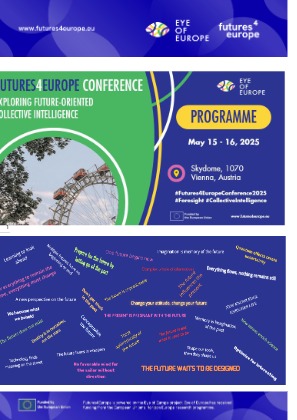
    Futures4Europe Conference 202515 May - 16 May 2025

    Exploring Future-Oriented Collective Intelligence

    The concept of Future-Oriented Collective Intelligence (FOCI) offers a transformative approach to making sense of and addressing future challenges that are complex and interconnected. 

    The topic was at the centre of the Futures4Europe Conference that took place on 15-16 May 2025 in Vienna, Austria, at the Skydome in Vienna’s thrilling 7th district.   

    We are deeply grateful to all 140 participants from 32 countries who joined us for these two days of exploration, dialogue, and inspiration. To gain an overview of the diverse themes, methods, and perspectives presented, you may consult the book of abstracts.

    We also invite you to revisit the highlights of the conference through our photo gallery and short wrap-up video

    Feel free to share them with your networks! We look forward to meeting again in 2026.

    The Conference is organised by AIT Austrian Institute of Technology, as part of the Eye of Europe project, which envisions a more cohesive and influential R&I foresight community that contributes significantly, as collective intelligence, to shaping and guiding policy decisions. The project has received funding from the EU’s Horizon Europe Research Programme under Grant Agreement n°101131738. 

    #Futures4EuropeConference2025 #Foresight #CollectiveIntelligence

    Posted on: 05/11/2024

    Last Edited: a year ago

    Deep Dive: The emergence of global commons: A new opportunity for science, business, and governanceOctober 2022

    The concept of the global commons refers to resource domains that fall outside national jurisdiction, to which all have access, including high seas, airspace, outer space, and cyberspace. Given the growing significance of these domains and related resources for states and other global and local players across a range of purposes, defining the concept of the global commons has become more complex. The Global Commons Alliance network of concerned organisations refers to two definitions of the concept.


    The first is based on geopolitics, where the global commons are areas whose potential economic resources lie beyond national jurisdiction: the atmosphere, the high seas, Antarctica, and outer space. The second definition has its roots more in economics and how shared resources can be overused by some at the expense of others, regardless of national jurisdiction. The strategic access and use of resource domains for military/commercial purposes put pressure on their status. Recent geopolitical developments highlight the need for exploring appropriate forms of global governance or stewardship to ensure responsible (sustainable) management to benefit present and future generations.

    This deep dive aims to address the following questions:

    • What constitutes a global commons? How do global commons differ? How is the concept of global commons likely to evolve up to 2040? Adapting a taxonomy of global commons for the emerging geopolitical, environmental, and economic context.
    • What are the main emerging disruptors of global commons up to 2040? What could change and upset established global commons regimes? How can laws be introduced and implemented in emerging global commons? The emphasis is on geopolitics and how legal frameworks can survive technological change. How can innovation reinforce the commons?
    • How is the economics of common property evolving (from Hardin's very influential work to the massive critique of Hardin by Elinor Ostrom)? linking to major policy debates such as privatisation. Can Ostrom’s approach be scaled up to the level of states? and extended to the common property of the atmosphere or oceans? What would be necessary for such a large-scale negotiation process?
    • How can we govern the commons as a different type of ownership? The emergence of global commons-orientation in innovation? In particular mission-oriented innovation. Exploring the rights and personality of ecosystems and other entities as right holders. Ecological services as transversal.
    • How can we make the global commons work? - the need for cooperative behaviour if global commons and sustainability are to be achieved. Multilateralism 2.0. and emerging role of science diplomacy up to 2040. Ukraine war as an epochal war: the dangers of the war (state of permanent cold war) for acting seriously on the global commons. Potential split with China and new hegemonies in Africa (e.g Belt and Road debt).


      The aim is to identify cross impacts of the global commons areas and key drivers.

    Posted on: 28/10/2024