Loading...

    Mentions of

    sorted by publishing date

    Last Edited: 9 days ago

    ESPAS Horizon Scanning Issue 11

    Aiming to build on existing early warning mechanisms across the EU institutions, agencies and bodies, the ESPAS horizon scanning project has a two-fold goal. On the one hand, to establish a rolling process to produce reports that engage colleagues across the ESPAS institutions and bodies in a continuous, longer-term, cross-cutting reflection around emerging and potential future trends. On the other hand, to create an EU community of practitioners and experts (‘future scanners’) able to identify and inform about emerging signals of change.


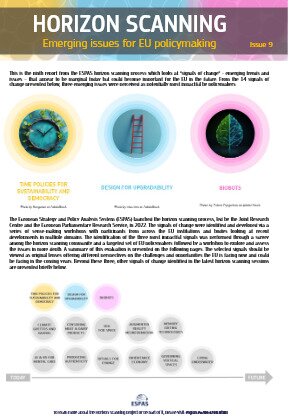
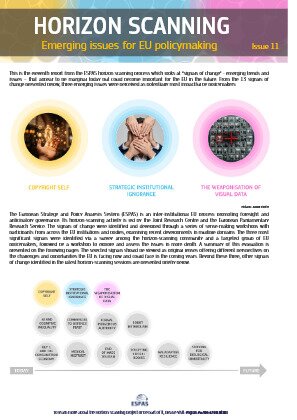
    This is the 11th report from the ES PAS horizon scanning process which looks at “signals of change” - emerging trends and
    issues – that appear to be marginal today but could become important for the EU in the future. From the 13 signals of
    change presented below, three emerging issues were perceived as potentially most impactful by policymakers: Copyright self, Strategic institutional ignorance and Weponisation of visual data.

    Posted on: 23/09/2026

    Last Edited: 15 days ago

    Shaping the Futures through Intergenerational Fairness21 September - 21 September 2026

    Online Dialogue

    "Shaping the Futures through Intergenerational Fairness” is an online dialogue organised by the EU Policy Lab at the Joint Research Centre (European Commission) in partnership with the Center of Foresight and Artificial intelligence at the Islamic World Educational, Scientific and Cultural Organization (ICESCO) Center for Foresight and Artificial Intelligence.

    The dialogue seeks to connect ongoing international efforts related to the UN Pact for the Future and its Declaration on Future Generations with regional and cross-institutional approaches aimed at integrating foresight, long-term responsibility, and intergenerational equity into public policy.

    This online dialogue is conceived as an exchange of ideas across cultural contexts on intergenerational fairness, drawing on the European Commission’s Strategy on Intergenerational Fairness and ICESCO’s foresight-driven agenda for anticipatory and inclusive governance across its Member States.  

    Join
    The online event will be accessible via this link: https://us06web.zoom.us/j/89849664062?pwd=MMOX9TzO6TeJCUFa1SWYakQbB0mtI3.1

    Looking forward to seeing you online and continuing the dialogue to support the Pact for the Future and intergenerational fairness globally.

    Read more about our work on intergenerational fairness 

    Programm


    13.30-13.50 Setting the Scene
    Why intergenerational fairness matters now, Salim M. AlMalik, Director General (ICESCO)

    Why this conversation matters globally, Jolita Butkeviciene, Director Innovation in Science & Policymaking (JRC, EC)

    The role of academia and intergenerational leadership in shaping long-term futures, Dr Ghadeeer Kayal, Associate Vice President for Academic Affairs (PMU)

    13.50-15.00 Plenary I: The State of Intergenerational Fairness
    UN Declaration on Future Generations - Themba Kalua, Director Pact for the Future Implementation at the Executive Office of the Secretary General (UN)

    EU Strategy on Intergenerational Fairness - Erica Bol, Foresight Policy Analyst at the EU Policy Lab (Joint Research Centre, EC)

    ICESCO’s foresight vision - Kais Hammam, Head of Center for Foresight and Artificial Intelligence (ICESCO)

    15.00-16.15 Plenary II: Open Dialogue: What can we explore together
    Thomas Hemmelgarn, Head of EU Policy Lab (EC)

    Cat Tully, Managing Director (School of International Futures)

    Kais Hammami, Head of Centre for Foresight & AI (ICESCO)

    Nouzha Chekrouni, Senior Fellow (Policy Center for the New South)

    Including online engagement

    Moderated by: Clare Stark, Head of Foresight (UNESCO)

    16.15-16.45 Thinking beyond our time: a cultural reflection on intergenerational fairness
    Thinking in Generations: Expanding the Horizon of Human Responsibility
    by Michael Münker, Founder (Milliongenerations Foundation)

    A Reflection on Time, Responsibility and Generations by Souleymane Bachir Diagne, Professor Emeritus of French and Philosophy (Columbia University)

    16.45-17.00 Looking ahead

    Posted on: 16/09/2026

    Last Edited: 21 days ago

    Horizon scanning on emerging privacy enhancement technologies

    Privacy enhancing technologies (PETs) enable data sharing and collaboration in the digital space in a way that respects privacy, ensuring that users have confidence that their data is protected. However, PETs can also be used to hide traces of criminal activities, most of which today are carried out via, or have some link to, digital communications technology. For this reason, lawful access to electronic evidence has become one of the most critical issues for European law enforcement, as it seeks to ensure safety and security while balancing this with the fundamental right to privacy.


    This report presents the results of a joint horizon scanning exercise carried out by the EU Policy Lab at the European Commission’s Joint Research Centre (JRC), and Europol, the EU law enforcement cooperation agency. It contributes to broader JRC efforts to support the European Commission’s political priority, the ‘New Era for European Defence and Security’, by anticipating future technological developments. The aim of the exercise was to assess emerging PETs that could help or, conversely, hinder the future work of European law enforcement. The report underscores the importance of several PETs that experts deem crucial for this purpose.


    These technologies have the potential to be either leveraged by law enforcement to enhance their operations or be exploited by criminals, depending on how they are developed and used in the future. The report also examines related complex regulatory frameworks and contextual factors that influence the development and deployment of these technologies. In light of the development of new encryption methods and other related enabling technologies such as artificial intelligence, this report also discusses new ways for law enforcement agencies to securely exchange information and integrate these technologies in the future activities.

    Posted on: 11/09/2026

    Last Edited: 24 days ago

    Explore the futures: Futures Wheel workshop

    - A step-by step guide

    The Futures Wheel is a participatory method to explore possible future direct implications and knock-on effects of a chosen change factor. This booklet presents a basic structure for a Futures Wheel workshop, which can be further tailored to specific needs. 

    The Futures Wheel exploration starts with imagine a future where a selected change factor has become a reality. The next step is to describe potential direct implications of this development, followed by knock-on effects resulting from the direct implications. The workshop ends with identifying, for example, emerging themes, risks, opportunities, or other aspects for further reflection or analysis.

    Explore the Futures Wheel workshop and download materials for your workshop here. 

    Posted on: 08/09/2026

    Last Edited: 4 months ago

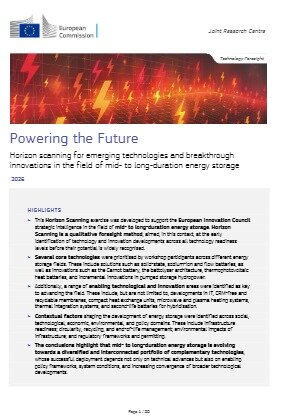
    Powering the FutureMay 2026

    Horizon scanning for emerging technologies and breakthrough innovations in the field of mid- to long-duration energy storage

    This technology foresight report presents the process and findings of a Horizon Scanning exercise conducted in the context of FUTURINNOV (FUTURe-oriented detection and assessment of emerging technologies and breakthrough INNOVation), a collaboration between the European Innovation Council (EIC) and the Joint Research Centre (JRC). The exercise aims to support EIC strategic intelligence through foresight and other anticipatory methodologies.


    The workshop, held online on 4 February 2026, focused on the identification, evaluation, and prioritisation of emerging technologies and breakthrough innovations across all technology readiness levels (TRLs) in the field of mid- to long-duration energy storage. Signals were collected through expert inputs, desk research, and text and data mining of patents, scientific publications, and EU-funded research and innovation projects.


    These signals were subsequently assessed by a multidisciplinary group of experts, leading to the prioritisation of a diverse set of energy storage technologies. These include electrochemical solutions such as solid-state, sodium-ion, and flow batteries; thermal systems such as Carnot and thermophotovoltaic heat batteries; and mechanical and hybrid approaches including pumped storage hydropower and battolyser architectures. In addition, several enabling technological and innovation areas were identified as critical to advancing the field, including developments in digital technologies, CRM-free and recyclable materials, advanced heat exchange and heating systems, and second-life batteries for hybridisation.


    The report also highlights a range of contextual factors shaping the development and deployment of energy storage technologies across social, technological, economic, environmental, and policy domains. These include infrastructure readiness, circularity and end-of-life management, environmental impacts, and regulatory and permitting frameworks. The findings point to an increasingly diversified and interconnected portfolio of energy storage solutions, where convergence and hybridisation across technologies are becoming central.


    The outcomes of this exercise can inform future EIC Challenges and other European Commission funding calls, contribute to EIC and EC strategic intelligence, and support broader EU policy initiatives related to energy systems, decarbonisation, and industrial competitiveness.

    Posted on: 10/06/2026

    Last Edited: 5 months ago

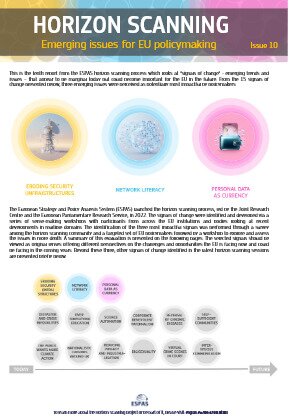
    ESPAS Horizon Scanning Issue 10February 2026

    Aiming to build on existing early warning mechanisms across the EU institutions, agencies and bodies, the ESPAS horizon scanning project has a two-fold goal. On the one hand, to establish a rolling process to produce reports that engage colleagues across the ESPAS institutions and bodies in a continuous, longer-term, cross-cutting reflection around emerging and potential future trends. On the other hand, to create an EU community of practitioners and experts (‘future scanners’) able to identify and inform about emerging signals of change.

    This is the tenth report from the ES PAS horizon scanning process which looks at “signals of change” - emerging trends and
    issues – that appear to be marginal today but could become important for the EU in the future. From the 15 signals of
    change presented below, three emerging issues were perceived as potentially most impactful by policymakers:Eroding security (infra)structures, Network literacy, Personal data as currency.

    Posted on: 12/03/2026

    Last Edited: 7 months ago

    ESPAS Horizon Scanning Issue 9

    Posted on: 12/03/2026

    Last Edited: 7 months ago

    Observing the future

    Horizon scanning for emerging technologies and breakthrough innovations in the field of ocean observation

    This technology foresight brief documents the process and findings of a horizon scanning exercise, part of a series under the FUTURINNOV.

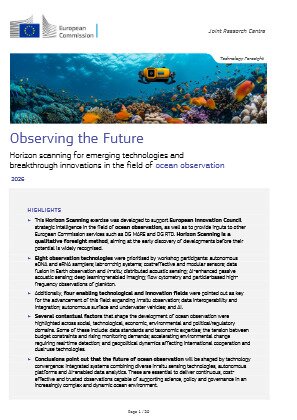
    The workshop, held online on 12 November 2025, focused on the identification, evaluation, and prioritisation of emerging technologies and breakthrough innovations across all technology readiness levels (TRLs) in the field of ocean observation. Signals were collected through expert inputs, literature review, and text and data mining of patents, scientific publications, and EU-funded research and innovation projects.

    These signals were subsequently assessed by a multidisciplinary group of experts, leading to the prioritisation of eight key observation technologies: autonomous eDNA and eRNA samplers; lab-on-chip systems; cost-effective and modular sensors; data fusion between Earth observation and in-situ measurements; distributed acoustic sensing; AI-enhanced passive acoustic sensing; deep learning-enabled imaging; and flow cytometry and particle-based high-frequency observations of plankton.

    In addition, four enabling technological and innovation fields were identified as critical for advancing ocean observation capabilities: expanding in-situ observation infrastructures; data interoperability and integration; autonomous surface and underwater vehicles; and artificial intelligence. The brief also highlights a range of contextual factors shaping the development and uptake of ocean observation technologies across social, technological, economic, environmental, and political and regulatory dimensions. These include challenges related to data standards and taxonomic expertise, tensions between budget constraints and increasing monitoring demands, the need for real-time detection in the face of accelerating environmental change, and geopolitical dynamics influencing international cooperation and the governance of dual-use technologies. 

    Posted on: 05/03/2026

    Last Edited: 8 months ago

    Nordic Foresight Network: From Planning to Action

    In the beginning of last year, we invited Nordic Foresight Professionals come together. We wanted to find people interested in the creation of the Nordic Foresight Network, hear their thoughts and then start the formal creation.

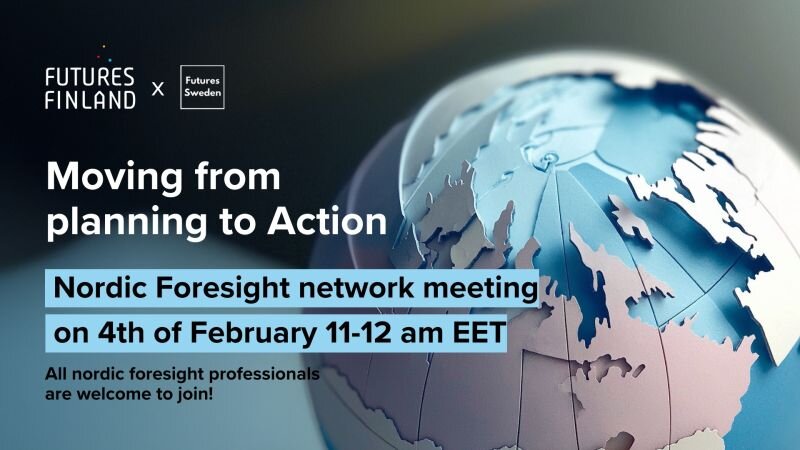
    Now it is time to take the next steps from planning to action in an online event on February 4th from 11:00 to 12:00 EET.

    We will share updates on:

    where we are now

    what we have done this year with the core team and those who have wanted to contribute

    what we see as next steps taking the network forward

    Register here by Tuesday 2nd of February and be part of shaping a collaborative future for foresight across the Nordics.

    If you have any questions about the event or the Nordic Foresight Network, please do not hesitate to contact us at info@futuresfinland.com.

    Posted on: 21/01/2026

    Last Edited: 9 months ago

    Taftie Academy Training “Foresight”02 December - 03 December 2025

    Finland Futures Research Centre (FFRC) provided a two-day foresight training for TAFTIE Agencies held in Brussels, Belgium on December 3rd and 4th 2025. 

    The objective of the training, influenced by a 2024 Eye of Europe pilot training session, was to give a solid, yet concise understanding on the field of futures studies and foresight, core foresight methods, and practical insight on applying foresight with particular emphasis its application in the fields of research and innovation. The training consisted of lectures and exercises that give first-hand experience on applying foresight ideas.

    The Taftie Academy foresight training session was attended by 30 participants from innovation agencies from 13 different European countries. 

    In addition to the training by FFRC, Maija Knutti (EU Policy Lab) and Joao Fabinha (Joint Research Centre) provided insights to the foresight and technology foresight work at the European Commission.

    The event was hosted by Brussels office of the National Centre for Research and Development (Poland). See the organization's wrap-up of the event (in Polish): LinkedIn .

    Posted on: 11/12/2025

    Last Edited: 10 months ago

    Embodying the future

    Horizon scanning for emerging technologies and breakthrough innovations in the field of human-like AI systems

    This technology foresight brief documents the process and findings of a horizon scanning exercise, in the context of FUTURINNOV (FUTURe-oriented detection and assessment of emerging technologies and break-through INNOVation) a collaboration between the European Innovation Council (EIC) and the Joint Research Centre (JRC), aiming to support the EIC's strategic intelligence through foresight and other anticipatory methodologies.
    The workshop, held online on 19 June 2025, had as its primary goal the evaluation and prioritisation of trends and signals related to emerging technologies and breakthrough innovations across all technology readiness levels (TRLs) within human-like AI systems. Signals for the workshop were gathered from experts, literature review, and text/data mining of patents, publications, and EU-funded projects.
    These signals were then scrutinised for their significance to the field's future by a diverse group of sector experts, which led to the identification of twelve key topics: enhancing human-AI collaboration; trustworthy and explainable AI; neurosymbolic AI; general-purpose neuro-symbolic methods; personalised medicine; embodied intelligence; emotion-aware AI; multi-agent frameworks; human-AI collective cognition; brain-inspired AI; addressing AI’s energy demand; and next generation LLMs.
    Several contextual factors that shape the development and uptake of AI are highlighted across social, technological, economical, environmental and political and regulatory domains, including: AI literacy; inter-disciplinary and inclusive development of models; benchmarking practices; and sustainability.
    The outcomes of this exercise may be used to inform future funding topics for EIC Challenges and other EC calls. They can also provide input for EIC and EC reports, as well as supporting other EU policy initiatives.

    Posted on: 24/09/2025

    Last Edited: 10 months ago

    Healing the FutureJuly 2025

    Horizon scanning for emerging technologies and breakthrough innovations in the field of cell and gene therapies

    This brief documents the process and findings of a horizon scanning exercise, in the context of FUTURINNOV (FUTURe-oriented detection and assessment of emerging technologies and break-through INNOVation) a collaboration between the European Innovation Council (EIC) and the Joint Research Centre (JRC), aiming to support the EIC's strategic intelligence through foresight and other anticipatory methodologies.

    The workshop, held online on 15 May 2025, had as its primary goal the evaluation and prioritisation of trends and signals related to emerging technologies and breakthrough innovation, across all technology readiness levels (TRLs), within cell and gene therapies.

    Signals for the workshop were gathered from experts, literature review, and text/data mining of patents, publications, and EU-funded projects. These signals were then scrutinised for their significance to the field's future by a diverse group of sector experts, which led to the identification of seven key topics: in vivo gene therapy; microphysiological pre-clinical models; stem cells in multiple applications; new tools for advanced tissue delivery; in silico & AI; conversion of tumour cells; and emerging genome and epigenome-based therapies.

    Participants also highlighted various contextual factors that could influence the development, adoption, and uptake of emerging technologies within this field, including in domains such as: competitiveness and geopolitics; talent and expertise; cross-border and cross-sector collaboration; funding, economic and market conditions; regulatory, safety and ethical challenges; health and RDI ecosystems; and infrastructure and manufacturing.

    Posted on: 24/09/2025

    Last Edited: 10 months ago

    Signal CardsJune 2025

    Signal Cards from ESPAS Horizon Scanning

    The Signals Cards present emerging issues identified through the ESPAS Horizon Scanning activity. Apart from using them to inform the regular Horizon Scanning newsletters, they work well as conversation starters in (foresight) workshops to get people into the right headspace to think about and interact with the future. The Signal Cards are a fun and interactive tool ideal for workshops to expand thinking, foster imagination and explore different potential futures. 

    How to use the cards

    Instructions provided with the cards contain four different short exercises that can be used at the beginning of a workshop to broaden the thinking, spark imagination and encourage looking forward.

    You can start your workshop with a quick exercise to

    📌 find relevant signals of change for your topic

    📌 challenge the common perspective

    📌 explore different aspects of novelty or

    📌 think about the culminating effects various signals might have together.

    If you have more time, you can dive deeper into the signals and explore their potential impacts for example in the beginning of a (foresight) project. Participants can envision a world where some of the signals become reality and brainstorm what might be the consequences. This can help to pinpoint areas for further analysis. You can find detailed instructions for all these exercises in the Signal Cards file. Or feel free to create your own activities with the Signals Cards!

    Download the Signal Cards, follow the enclosed detailed instructions and see how they can transform your next workshop.

    Print the chosen cards (ideally on thick paper, 2 pages per A4 sheet to get A5 sized cards) or paste them as pictures to a digital platform for online workshops.

    Read more from the blog.

    Posted on: 23/09/2025

    Last Edited: 10 months ago

    ESPAS Horizon Scanning Issue 8June 2025

    This is the eighth report from the ESPAS horizon scanning process which looks at “signals of change” – emerging trends and
    issues – that may appear marginal today but could become important for the EU in the future.

    Read all the Issues here.  

    Posted on: 23/09/2025

    Post Image

    Last Edited: a year ago

    Supporting the institutionalisation of future-oriented policymaking

    A new initiative to support EU Member States in embedding long-term, anticipatory thinking into decision-making at every level—national, regional, and local. 

    Future-Oriented Policymaking is an ongoing joint project by the European Commission Directorate-General for Structural Reform Support (DG REFORM) and the EU Policy Lab of the Joint Research Centre. The project supports foresight capacity building in EU Member States and integrating future-oriented thinking into decision-making.

    The project supports foresight capacity building in EU Member States and integrating future-oriented thinking into decision-making.

    Get involved!
    The success of the project depends on the active participation of policymakers, practitioners, and citizens. Whether you are an experienced foresight practitioner or entirely new to the concept, we welcome your insights.

    Share ideas, take our survey*: Help us understand your needs and shape the final deliverables. What has worked well in your context? What challenges have you faced? How can we make foresight more relevant to your needs? > Survey

    Join our beta testing group**: Be among the first to try out our new toolkit and training materials. Your feedback will help us refine and improve these resources for everyone (fill in the survey and click join beta testing group at the end).

    * Preferably before 12 September 2025 to make full use of your ideas.

    * *Places for beta testing are limited, and we are committed to working with a diverse range of partners. If you are interested, please fill in the survey by 5/09/2025 . We will confirm participation after that date. Institutionalising future-oriented policymaking is a collective journey, which requires commitment, curiosity, and courage: from leaders, civil servants, and citizens alike. Let’s work together to make foresight a cornerstone of European policymaking. 

    Stay tuned for updates and don’t hesitate to reach out if you’d like to contribute to this exciting initiative.

    > Future-oriented Policymaking 

    Posted on: 29/08/2025

    Last Edited: 10 months ago

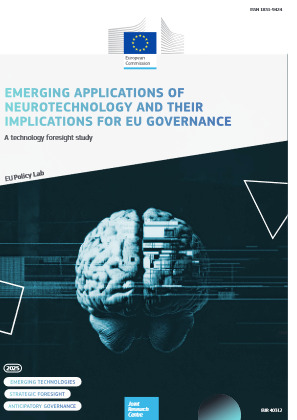
    Emerging applications of neurotechnology and their implications for EU governance

    A technology foresight study

    This report sums up recent developments in neurotechnology, that is, technology that can read and modify activity from the central nervous system. Some devices record information from the brain, and others deliver stimulation to the brain (and some do both).
    These technologies are rapidly advancing and are likely to have a profound impact on various aspects of society. In the near future, neurotechnology is set to revolutionise the way we approach a range of policy areas, from healthcare, education, employment, law enforcement and security, to more obvious areas such as technology, digital and research.
    The report analyses advances in the technologies for monitoring and stimulating the brain, some of which are incorporated into neurotechnology devices. It acts as a horizon-scan of new and emerging uses of these technologies, and takes these as inputs to pose a range of questions for the consideration of policymakers.

    Read more from the blogpost by the author.

    Posted on: 28/05/2025

    Last Edited: 10 months ago

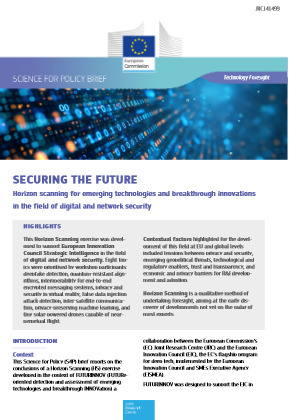
    Securing the Future

    Horizon scanning for emerging technologies and breakthrough innovations in the field of digital and network security

    This science for policy brief documents the process and findings of a horizon scanning exercise, part of a series under the FUTURINNOV (FUTURe-oriented detection and assessment of emerging technologies and break-through INNOVation) project, a collaboration between the European Innovation Council (EIC) and the Joint Research Centre (JRC), aiming to bolster the EIC's strategic intelligence through foresight and anticipatory methodologies.
    The workshop, held on 13 November 2024, had as its primary goal the evaluation and prioritisation of trends and signals on emerging technologies and breakthrough innovation, across all technology readiness levels (TRLs), within the digital and network security domain. Signals for the workshop were gathered from experts, literature review, and text/data mining of patents, publications, and EU-funded projects.
    These signals were then scrutinised for their significance to the field's future by a diverse group of sector experts which led to the identification of eight key topics: deepfake detection, quantum-resistant algorithms, interoperability for end-to-end encrypted messaging systems, privacy and security in virtual reality, false data injection attack detection, inter-satellite communication, privacy-preserving machine learning, and tiny solar-powered drones capable of near-perpetual flight.
    Participants also highlighted various factors that could influence the development, adoption, and promotion of these emerging technologies including: tensions between privacy and security, emerging geopolitical threats, technological and regulatory enablers, trust and transparency, and the economic barriers that shape technological development and adoption.

    Posted on: 16/04/2025

    Last Edited: 10 months ago

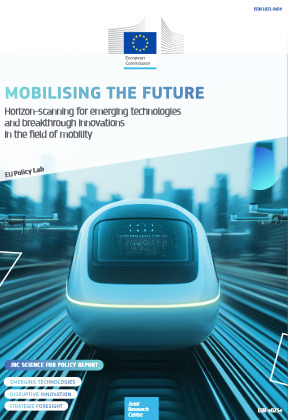
    Mobilising the future

    Horizon scanning for emerging technologies and breakthrough innovations in the field of mobility

    This report documents the process and findings of a horizon scanning exercise, part of a series under the FUTURINNOV (FUTURe-oriented detection and assessment of emerging technologies and breakthrough INNOVation) project, a collaboration between the European Innovation Council (EIC) and the Joint Research Centre (JRC), aiming to bolster the EIC's strategic intelligence through foresight and anticipatory methodologies.
    The workshop, held on 16 October 2024, had as its primary goal the evaluation and prioritisation of trends and signals on emerging technologies and breakthrough innovation, across all tech7-nology readiness levels (TRLs), within the broad Mobility domain, broken-down into four key areas: transport systems, networks and multimodality; automotive and roads; rail/freight and logistics and aviation and airports.
    Signals for the workshop were gathered from experts, literature review, and text/data mining of patents, publications, and EU-funded projects. These signals were then scrutinised for their significance to the field's future by a diverse group of sector experts which led to the identification of 22 different key topics across the key areas above. These signals can be seen as hotspots of innovation that deserve the EIC’s attention for possible future support.
    Participants also highlighted various factors that could influence the development, adoption, and promotion of these emerging technologies, which are presented in the report as drivers, enablers and barriers, and analysed specifically in each of the 4 key areas.

    Posted on: 17/03/2025

    Post Image

    Last Edited: 2 years ago

    Help shape Europe’s future!

    Help shape Europe’s future! 🛡️ 

    To build the smart policies of tomorrow, we are counting on your insights for the 2025 Strategic Foresight Report. Together we can build a strong and resilient Europe that is fit for future challenges.
    This goes beyond security - it’s about democracy, well-being, the economy, climate, competitiveness, sustainability, fairness between generations, and more.
    We need your expertise now! The call for evidence is open for feedback on the citizens engagement platform until March 19th. 

    👉 2025 Strategic Foresight Report 

    Posted on: 12/03/2025

    Post Image

    Last Edited: 2 years ago

    Co-Create the Strategy on Intergenerational Fairness with us!

    Join us in the conversation & design the Strategy with us.

    💫 Got thoughts on Intergenerational Fairness? 💫

    We’re in the process of shaping the EU Intergenerational Fairness Strategy, and we love YOUR input. Our Citizens' Engagement Platform is live and ready to hear from anyone who’s passionate about this critical issue.

    Your voice matters—let’s make sure it’s heard! 💥
    Join the conversation today: https://citizens.ec.europa.eu/intergenerational-fairness_en

    Want to learn more about this project, the background and process, check out this blogpost  

    Posted on: 07/03/2025

    Last Edited: 10 months ago

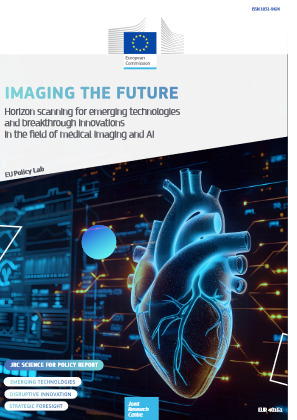
    IMAGING THE FUTURE

    Horizon scanning for emerging technologies and breakthrough innovations in the field of medical imaging and AI

    This report documents the process and findings of a horizon scanning exercise, part of a series under
    the FUTURINNOV (FUTURe-oriented detection and assessment of emerging technologies and break-
    through INNOVation) project, a collaboration between the European Innovation Council (EIC) and the
    Joint Research Centre (JRC), aiming to bolster the EIC's strategic intelligence through foresight and
    anticipatory methodologies.


    The workshop, held on 17 September 2024, had as its primary goal the evaluation and prioritisation
    of trends and signals on emerging technologies and breakthrough innovation, across all technology
    readiness levels (TRLs), within the EIC's Medical Imaging and AI portfolio.
    Signals for the workshop were gathered from experts, literature review, and text/data mining of pa-
    tents, publications, and EU-funded projects. These signals were then scrutinised for their significance
    to the field's future by a diverse group of sector experts which led to the identification of eight key
    topics: generative AI for healthcare; digital twins; multimodal data analysis; explainable AI in medical
    imaging; application of AI to specific diseases/conditions; XR - augmented and virtual realities; tensor-
    valued diffusion encoding, and AI-generated synthetic data for training AI. Furthermore, the workshop
    identified additional wild cards with high novelty and disruptive potential such as: blockchain, edge
    computing and differential privacy for secure, AI-driven medical imaging and collaborative healthcare
    optimisation and quantum medical imaging.


    Participants also highlighted various factors that could influence the development, adoption, and pro-
    motion of these emerging technologies, which can be grouped under the following categories: Tech-
    nological advancements and cross-sector applications; data infrastructure, AI models, and regulatory
    frameworks; workforce, education and societal factors; clinical efficiency and patient outcomes; trust,
    ethics, and AI adoption; financial pressures and industry investment in AI healthcare.

    Posted on: 13/01/2025

    Last Edited: 10 months ago

    Nordic Foresight Network Kick-off Event06 February - 06 February 2025

    Earlier this fall, we invited foresight professionals to participate in the Nordic foresight survey. We wanted to find people interested in the creation of the Nordic Foresight Network, hear their thoughts and then start the formal creation. We received many replies. Thank you. Now it is time to present the results and take the next steps toward building collaboration.


    Wecome to online event via MS Teams on February 6th from 10:30am to 12:00 EET where we will also get to discuss the formal creation: desired outcomes, ways of working etc.

    Register here before February 3th and be part of shaping a collaborative future for foresight across the Nordics.

    Feel free also to share the invitation with other foresight professionals.

    You can read more about the Nordic foresight initiative here.

    Looking forward to meet you!

    Futures Finland and Futures Sweden

    Posted on: 01/12/2024

    Post Image

    Last Edited: 2 years ago

    Join the Nordic Foresight Network Initiative

    This is a call for professionals working in foresight in the Nordic countries to join the discussion and to contribute and influence the development and formation of the Nordic Foresight Network.

    Posted on: 25/11/2024

    Last Edited: 10 months ago

    Digital TransitionJune 2023

    Long-Term Implications of the Digital Transition for Farmers and Rural Communities

    Successfully managing the green and digital transitions is a crucial factor that could increase the resilience and strategic autonomy of the EU and shape its future. Yet digitalisation of agriculture and rural areas raises vital questions about winners and losers, costs, benefits, and long term implications.


    This foresight exercise explores the interplay between digital transition, policies and the resilience of the agricultural sector and rural areas, against the backdrop of potential disruptive and transformative changes. The report presents the outcomes of this exploration, proposing building blocks for an effective EU digital transition strategy for agriculture and rural areas supported by a hands-on policymaker’s toolkit

    The blog post reveals the goals and steps of the foresight process and explains how visioning can support transitions. 

    Posted on: 28/10/2024

    Post Image

    Last Edited: 2 years ago

    The future of Europe: what do you imagine it will look like?

    A portrait of how EU citizens imagine their futures; analysis of stories collected by #OurFutures

    We invited people across the EU to share their imagined futures. For this collection we, the European Commission’s Competence Centre on Foresight, used a narrative inquiry method. Instead of asking opinions about the future, we asked participants to share a story about their desirable future, followed by a few questions about that story, in order to more fully comprehend their thinking. In this process we were guided by Voices That Count.

    In this article, we’ll take a look at the first 591 stories of people that participated so far, mostly from Greece and Slovenia, followed by Germany, Spain and Italy. Approximately half of them are students, and the other half mainly consists of employed people. 


    Posted on: 18/10/2024